
Turn AI Power Users Into Developers
Grow the skills, platforms, and IT capabilities power users need to deliver safely, sustainably, and with IT’s confidence.
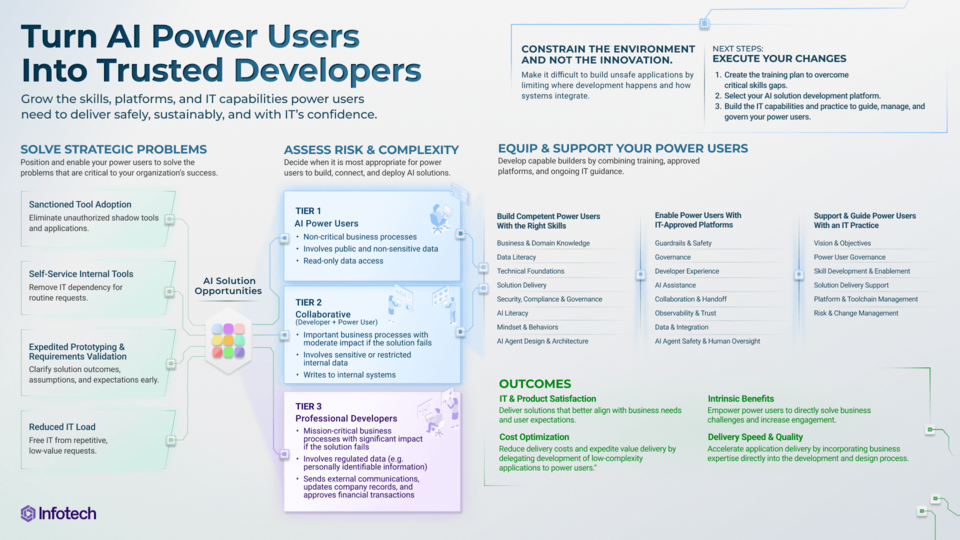
The explosion of low-code/no-code and AI-assisted platforms has made it possible for power users to design, automate, and deploy production-grade solutions that previously required developers. IT’s instinct is to slow this down due to risk and security concerns. But this gatekeeping actually drives shadow IT, ungoverned data access, and applications with no IT visibility. Follow our step-by-step research to define a well-governed environment where power users can build freely without IT needing to approve every output.
Enabling power users requires more than simply giving them a tool. It involves building the foundations and support necessary for their success. Power users need clearly defined boundaries around where development can happen, what data can be accessed, and how systems integrate. When the environment is well-governed and power users are well-equipped, innovation does not need to be restricted, it just needs a place to run.
1. Power users who succeed are not trying to replace IT.
They are trying to get things done with IT. Power users do not need a gatekeeper deciding whether their idea is worth delivering. They need a platform with clear and reasonable boundaries, the right tools, and enough structure and guidance to build confidently in collaboration with IT.
2. Strong business analysis is a requirement rather than an option.
Business analysis equips power users with the critical systems-thinking behaviors to move beyond building ‘what’s technically possible and best for me’ to ‘what is valuable for the team, department, and organization.’
3. A Center for Enablement (C4E) gives power users the support they need.
A Center of Excellence (CoE) reinforces the controls that restrict developer empowerment and innovation, but a Center for Enablement (C4E) removes that friction. The C4E provides power users with a productive environment to operate freely, while retaining a centralized operating model to ensure all tools, technologies, tactics, and governance are consistently managed.
Use this step-by-step research to drive secure innovation by safely enabling and supporting power users.
This framework is a key part of Info-Tech’s broader applications practice strategy. It equips applications and IT leaders with a detailed roadmap to build the necessary foundations and support for power users’ success. Use our actionable methodology and practical tools to:
- Evaluate the fit of your power users. Prioritize the skills they need to deliver solutions safely, sustainably, and in line with IT standards and confidence.
- Curate a list of IT-sanctioned platforms. Indicate the critical requirements a platform must have for power users to create solutions at scale in your production environment.
- Design your AI power user practice. Equip IT with the right capabilities to develop your power users’ skills, operate the platforms they use, and expand the sophistication of their solutions.
- Write your AI power user concept of operations. Tailor your enablement approach to solve the problems your stakeholders care most about.
About Info-Tech
Info-Tech Research Group is the world’s fastest-growing information technology research and advisory company, proudly serving over 30,000 IT professionals.
We produce unbiased and highly relevant research to help CIOs and IT leaders make strategic, timely, and well-informed decisions. We partner closely with IT teams to provide everything they need, from actionable tools to analyst guidance, ensuring they deliver measurable results for their organizations.
What Is a Blueprint?
A blueprint is designed to be a roadmap, containing a methodology and the tools and templates you need to solve your IT problems.
Each blueprint can be accompanied by a Guided Implementation that provides you access to our world-class analysts to help you get through the project.
Turn AI Power Users into Developers Storyboard
AI Power User Skills Assessment Tool
AI Platform Requirements Assessment Tool
AI Power User IT Practice Capability Assessment Tool
AI Power User Concept of Operations Template
Talk to an Analyst
Our analyst calls are focused on helping our members use the research we produce, and our experts will guide you to successful project completion.
Book an Analyst Call on This Topic
You can start as early as tomorrow morning. Our analysts will explain the process during your first call.
Get Advice From a Subject Matter Expert
Each call will focus on explaining the material and helping you to plan your project, interpret and analyze the results of each project step, and set the direction for your next project step.
Unlock Sample ResearchContributors
- Kam Panchal, Head Enterprise Architect, Farm Mutual Re
- Steven Martinez, Enterprise Architecture Manager, Iowa Department of Management
- Kier von Konigslow, Lead A.I. Engineer and Quantum & A.I. Researcher, GoodLabs Studio
- Two external anonymous contributors
