
Transform Your Data Center Strategy With a Business-Driven Approach
Transforming data centers for business resilience and growth
The role of the data center is evolving. Traditional ownership models are reaching their limits. Rising operational costs, aging facilities, and increasing compliance pressures are making physical data centers unsustainable. At the same time, organizations are rushing to cloud, edge, and colocation — often without a cohesive strategy. Use this research to align IT strategy with business needs, design for resilience, and create a scalable ecosystem that adapts as fast as your organization does.
When it comes to data centers, the competitive edge is no longer in owning infrastructure but in strategically placing workloads. Each workload has unique requirements for performance, security, latency, and compliance. The future of the data center is hybrid, flexible, and designed around organizational value – not square footage.
1. Data center ownership is out, agility is in.
Owning physical data center infrastructure is no longer a competitive advantage for most organizations. The real value lies in how infrastructure drives agility, resilience, and cost optimization. Rethink physical ownership in favor of flexible models such as colocation, cloud, or hybrid.
2. Put workloads where they belong.
A modern data center strategy starts with the workload. Each workload type has unique requirements for latency, compliance, performance, and cost, so placement must be intentional and data driven.
3. Design for automation and flexibility.
Next-generation data centers must be automated, modular, and able to adapt to shifting workloads, power constraints, and sustainability demands. AI and orchestration tools are critical for enabling “lights-out” operations and reducing reliance on manual intervention.
Use this guide to shape your future-ready infrastructure.
This research provides a structured framework to evaluate workloads, compare infrastructure options, and plan execution with security, sustainability, and cost control in mind. Explore how to:
- Place agility over ownership: Infrastructure should deliver adaptability, not long-term capital drag.
- Make workload-driven decisions: Place workloads intentionally – on-premises, in the cloud, or at the edge – based on business priorities.
- Prioritize automation & flexibility: Build for resilience with modular, automated, and AI-assisted operations.
- Gain a hybrid advantage: Balance cloud, colocation, and on-prem to optimize cost, control, and performance.
- Consider sustainability and compliance: Design with ESG and regulatory requirements as first-class priorities.
Transform Your Data Center Strategy With a Business-Driven Approach
Transforming data centers for business resilience and growth
EXECUTIVE BRIEF
Analyst perspective
Rethinking the role of data centers

The role of the data center is evolving from a static, capital-intensive facility to a dynamic enabler of business agility and digital transformation. Infrastructure is no longer just about uptime – it’s about adaptability, efficiency, and alignment with broader business objectives.
Today’s IT leaders must ask whether continued ownership of physical infrastructure truly serves the organization or if alternatives like colocation, modular builds, and edge computing offer more flexibility, resilience, and cost control. The rise of hybrid models reflects a broader realization: There is no one-size-fits-all answer
The shift toward hybrid models reflects a broader need: infrastructure must be flexible, resilient, and optimized for performance and cost.
In summary:
- “One-size-fits-all” is obsolete – hybrid and modular approaches are rising.
- Energy, environmental, and cost factors are redefining what’s sustainable.
- AI, automation, and zero trust are the new default design principles.
- Success lies in aligning infrastructure with business outcomes – not just IT uptime.
John Donovan
Principal Research Director, I&O Practice
Info-Tech Research Group
Executive summary
Your Challenge
Most organizations are facing pressure to modernize aging infrastructure, reduce costs, and support new workloads without a clear plan for how or where their data center fits in.
- Data centers are costly, aging, and often underused.
- Cloud-first strategies are misaligned with legacy workloads.
- Business stakeholders demand agility and availability.
- Power, space, and staffing are harder to scale internally.
Common Obstacles
There is often unclear ownership of the data center strategy across IT, Facilities, and leadership. This can lead to:
- Lack of visibility into what workloads should move and where.
- Power and cooling limitations in existing facilities
- Risk aversion around migrating core or regulated workloads
- No structured process infrastructure footprint for rationalizing
Info-Tech’s Approach
Reframe your data center strategy as a business-driven workload placement decision, not just an infrastructure exercise.
- Focus on key decision areas that impact cost, control, and performance.
- Apply a structured framework to guide infrastructure choices.
- Align workload placement with strategic, technical, and operational priorities.
This approach ensures infrastructure decisions directly support business goals, maximizing value, agility, and long-term sustainability.
Info-Tech Insight
The objective is not to simply exit data centers but to establish a future-ready infrastructure strategy that balances cost, performance, and risk. Success requires aligning workload placement with business value – across cloud, colocation, and on-prem – while embedding security, compliance, and sustainability from the outset.
Market trends and statistics
Key statistics highlighting the need for a data center strategy
Major increase in cloud and hybrid strategies.
73%
73% of enterprises have adopted a hybrid cloud strategy, up to 2025.
(Auvik, 2024)
Power and energy consumption has significantly increased.
44%
44% of data center operators identified costs as a top concern.
(Uptime Institute, 2024)
Decisions on where to place workloads lack strategic direction.
55%
55% of workloads are off-premises.
(Uptime Institute, 2024)
Workload-Driven Decisions Matter
Rethinking data center strategy
Large enterprises are steadily divesting from infrastructure ownership, reinforcing the need for strategic workload placement.
60%
In 2018, nearly 60% of data center capacity was owned by enterprises. By 2024, that figure dropped to just 37% as hyperscalers and co-lo providers expanded their share.
Source: Data Centre Dynamics, 2024
76%
76.4% of organizations rank security as the top factor influencing workload placement decisions in hybrid cloud environments.
Source: Zones, 2021
- Enterprise-owned data centers are shrinking at scale, reflecting a broader shift away from traditional infrastructure.
- Cloud-only is rarely optimal. Hybrid strategies mixing on-prem, co-lo, and cloud have emerged as the strategic norm for most enterprises.
Info-Tech Insight
The data is clear: Enterprise ownership of data centers is shrinking, hybrid strategies are the norm, and energy costs are climbing fast. Organizations need to rethink their infrastructure through the lens of workload fit, operational efficiency, and long-term sustainability – not legacy ownership.
A modern data center is no longer a fixed location – it’s an evolving ecosystem of cloud, colocation, on-prem, and edge computing tailored to business needs.
- Exit strategies should be based on business value, not just cost-cutting.
- Cloud is not always the answer – organizations must balance on-prem, colocation, and cloud workloads strategically.
- Security, compliance, and sustainability must be built into the strategy from the start.
Info-Tech Insight
The goal is not just to exit data centers but to create a future-proof infrastructure strategy that aligns with business growth.
Manage your data centers
Organizations are struggling with legacy data center infrastructure, rising costs, and shifting IT models. The traditional approach of owning and managing a data center is becoming unsustainable for many due to:
- Rising operational expenses (power, cooling, real estate).
- The growing shift to cloud, edge, and colocation models without a clear strategy.
- Security, compliance, and disaster recovery risks of aging facilities.
- The need for more flexible and scalable IT infrastructure.
35%
Data center power consumption has increased by 35% in the last five years, making energy efficiency a critical concern.
(Source: Uptime Institute, 2024)
Organizations are at a crossroads: should they maintain, modernize, or exit their data center? The right strategy enables agility, security, and cost-effectiveness.
Infrastructure, Services, and Utilities
Applications and Services
Business Apps, Collaboration AI/ML, Databases
Middleware and Virtualization
VMs, Containers, APIs, IAM
Compute Layer
Servers, HPC, Cloud Compute, Edge Nodes
Storage Layer
SAN, NAS, Object Storage, Backup & DR
Network Layer
SDN, Load Balancers, Firewalls, Cloud Connectivity
Security & Compliance
Zero Trust, SOC, Compliance Frameworks
Monitoring & Management
DCIM, AI-Driven Optimization, ITSM
Power & Cooling
UPS, Generators, Liquid Cooling, Renewable Energy
Physical Infrastructure
Data Center Building, Fire Suppression, Disaster Resilience
- Electricity – Grid power, renewable sources, UPS
- Water – Cooling systems, chillers, liquid cooling
- Fuel – Generators, backup power
- Connectivity – Fiber, 5G, cloud interconnects
Strategic Decision Framework and Workload Placement
Key Decision Areas
- Workload Types: AI, business apps, databases
- Performance vs. cost balance
- Security and compliance needs
- Resilience and disaster recovery strategies
Decision Framework
- Business Alignment: Revenue, cost savings, innovation
- Technology Fit: Performance, security, compliance
- Financial Impact: TCO, ROI, operational costs
- Future Scalability and Sustainability: AI-readiness, ESG goals
- Risk & Governance: Operational, regulatory, and security risks
Strategic Workload Placement
- On-Prem: Secure, mission-critical apps
- Colocation: Cost-optimized, partial control
- Cloud (Public/Private): Scalability and agility
- Hybrid IT: Balance of security & cloud benefits
- Edge Computing: Real-time processing needs
- HPC: AI, big data, specialized computing
Data center workload strategy framework
A structured approach to data center decisions
Key Decision Areas
What must be evaluated before placing a workload
- Business objectives and growth plans
- Security and compliance requirements
- Application performance and latency needs
- Resiliency and disaster recovery expectations
- Cost sensitivities (power, cooling, OpEx )
- Technology dependencies (e.g. data gravity, AI/ML processing)
Decision Framework
How decisions are made consistently and accurately
- Assess workload type: high performance, storage- intensive, etc.
- Score fit across deployment models: data center, cloud, colocation, edge
- Use weighted criteria: cost, performance, security, control, latency
- Evaluate constraints: geographic, regulatory, architectural
- Apply governance: decision logic embedded in IT strategy and policy
Strategic Workload Placement
What the outcome looks like – optimized placement
- Retain on-prem for tightly coupled systems, regulatory-heavy workloads, and mission-critical apps.
- Migrate to cloud for scalable, bursty, or SaaS-ready apps.
- Colocate to reduce facility cost while maintaining control.
- Deploy at the edge for low-latency or data-intensive near-user services.
- Enable high performance computing (HPC) for AI, big data, and specialized computing.
Executive summary
Info-Tech Insights
Reframe Data Center Ownership
Owning a data center is no longer a strategic differentiator for most enterprises. The true value lies in how infrastructure supports business agility, resilience, and cost optimization. Organizations should rethink physical ownership in favor of flexible delivery models like colocation, cloud, or hybrid environments that align with evolving business needs.
Align Workloads to Their Best-Fit Locations
Data center strategy should begin with the workload – not the facility. Each workload type has unique requirements for latency, compliance, performance, and cost, which means its placement must be deliberate and data-driven. Enterprises need a clear framework to assess and assign workloads to the right environment, whether that’s on-prem, cloud, edge, or a hybrid mix.
Design for Automation and Flexibility
Next-generation data center environments must be highly automated, modular, and capable of adapting to shifting workloads, power availability, and sustainability demands. AI and orchestration tools are essential for achieving “lights-out” operations and reducing human dependency in core infrastructure management. Flexibility is no longer optional – it’s a design requirement.
Data Center Strategy
From insight to execution: strategic moves for a future-ready data center
Case study
“Workload placement separates the winners from the losers in IT.”
IDC
INDUSTRY
Multiple
SOURCE
IDC Survey, 2024
Challenge
Enterprises were struggling to find the right deployment model for modern workloads (e.g. AI, Gen AI) due to conflicting demands – data privacy, performance, and cost. IDC found that 81% of organizations expected to repatriate workloads from public cloud to private/dedicated environments within 12 months.
Decision-makers needed guidelines to strategically evaluate workload placement rather than default to the public cloud or fully on‑prem.
Solution
IDC built a workload-driven placement framework based on workload type (AI, transactional, storage-heavy).
It conducted a structured evaluation of workload requirements (e.g. data security, performance, regulatory/legal, scalability) and placed workloads based on optimal fit.
- AI and sensitive data → private cloud/on‑prem
- Bursty or scalable apps → public cloud
- Long‑running analytics/storage → dedicated or colocated environments
Results
81% of organizations signaled movement toward private or dedicated infrastructure, reflecting the operational logic of the framework.
34% total infrastructure cost savings were observed in private cloud deployments vs. public cloud.
CIOs confirmed the strategy provided better alignment across performance, compliance, cost-efficiency, and resilience.
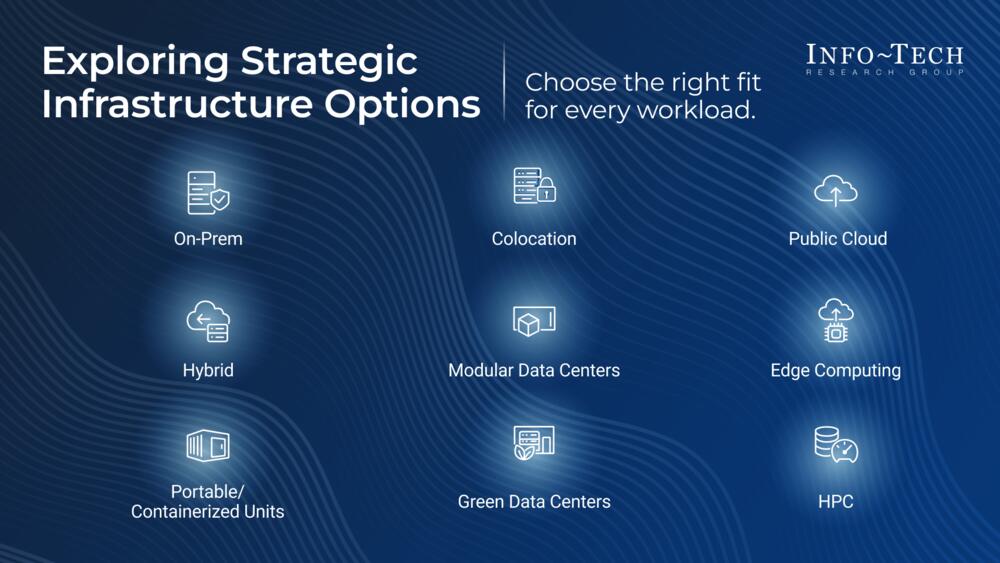
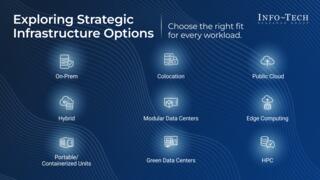
Exploring strategic infrastructure options
Choose the right fit for every workload.
On-Prem
Control everything – ideal for sensitive, tightly integrated workloads
Hybrid
Mix of on-prem and cloud- optimized placement based on workload needs
Portable/Containerized Units
Deployable anywhere – suitable for disaster response or field ops.
Colocation
Shared facility, dedicated hardware – good for cost-effective control
Modular Data Centers
Prefabricated, portable builds – scalable and fast to deploy
Green Data Centers
Sustainability-first – uses renewable energy and energy efficient design
Public Cloud
Elastic and scalable – best for bursty or fast-growing workloads
Edge Computing
Computes close to data source – minimizes latency for real-time workloads
HPC
Optimized for compute intensive workloads (AI, simulations, etc.)
Case study
“Right-sizing and optimizing infrastructure to cut $1 million in costs”
GE VERNOVA
INDUSTRY
Energy
SOURCE
AWS, 2023
Challenge
GE Vernova faced escalating infrastructure costs and operational inefficiencies due to a mix of underused cloud resources and legacy workloads that had been migrated without a clear placement strategy.
The lack of visibility into workload behavior led to overspending, suboptimal performance, and governance challenges in a complex hybrid environment.
Solution
GE undertook a structured workload assessment initiative using AWS tools like AWS Compute Optimizer and CloudWatch to analyze performance metrics, use patterns, and architectural fit.
It implemented a targeted workload placement strategy, reallocating certain workloads to better-suited environments, including right-sizing instances, retiring unnecessary resources, and keeping certain workloads on-prem for performance or regulatory reasons.
Results
- Over $1 million in annual cost savings
- Streamlined operations and better performance
- Enhanced visibility and governance across the organization’s hybrid environment
- Strong alignment between workload needs and platform capabilities
The new model allows GE Vernova to align IT operations with business objectives while maintaining flexibility for future growth and innovation.
Building a future-ready data center strategy
A structured, phased approach ensures your data center strategy aligns with business objectives, optimizes performance, and evolves toward future-ready infrastructure – balancing cost, compliance, and innovation at every stage.
-
Business and IT alignment
- Define growth objectives, regulatory needs, and workload dependencies.
- Assess cost and risk exposure of current infrastructure.
-
Future-State Infrastructure design
- Choose between hybrid, cloud-first, or colocation-first models
- Identify the best mix of on-prem, colocation, cloud, and edge.
-
Cost Optimization and Efficiency
- Optimize power and cooling (liquid cooling, free-air cooling).
- Improve networking and interconnectivity (SD-WAN, 400G Ethernet).
- Implement AI-driven automation and AIOps for operating efficiency.
-
Security and Compliance
- Implement zero trust security (microsegmentation, IAM).
- Ensure backup, disaster recovery, and business continuity.
- Improve physical security and regulatory compliance (GDPR, HIPAA, ISO27001).
-
Phased Execution Plan
- Short-term: Optimize existing infrastructure and reduce cost.
- Medium-term: Implement a hybrid or colocation strategy.
- Long-term: Transition to automation and AI-driven operations. Focus on continuous optimization of workload placement, dynamic scalability, and alignment with evolving business needs and goals.
Challenges and solutions
How to approach the challenges and their impact on a data center
Stage |
Description |
1. Problem Identification |
Rising costs, complexity, security risks, scalability concerns |
2. Analysis & Insights |
Data center inefficiencies, lack of clear cloud/co-lo strategy |
3. Strategic Considerations |
IT strategy aligned with business needs, hybrid options evaluated |
4. Implementation Approach |
Phased migration, automation, sustainability initiatives |
5. Outcome |
Cost-effective, secure, scalable, and resilient IT infrastructure |
Sample challenges
Current Challenge |
Impact |
Solution Approach |
Outcome |
Rising Power and Cooling Costs |
Increased OpEx and ESG concerns | Sustainability-driven colocation and AI-optimized energy management | Cost and carbon footprint reduction |
Security and Compliance Gaps |
High risk and potential legal exposure | Zero trust and encrypted cloud workloads | Secure, compliant infrastructure |
Limited Scalability |
Performance bottlenecks and business disruptions | Hybrid and modular data center solutions | Agile, future-ready IT operations |
IT Skills Shortage or Data Center Management Skills |
Operational inefficiencies and downtime risks | Managed services and AI automation | Streamlined operations and reduced human error |
Case study
Unlocking environmental sustainability and savings through data center transformation
Hitachi Vantara
INDUSTRY
Industrial Technology & Digital Infrastructure Services
SOURCE
Hitachi Vantara
Challenge
- Rising power and cooling costs: Hitachi Vantara faced escalating OpEx and an oversized, inefficient facility.
- Security and compliance needs: Mission-critical systems (e.g. Oracle ERP) required guaranteed control and uptime.
- Limited scalability in legacy DC: Aging racks and storage constrained growth and performance.
- IT skills and capacity bottlenecks: Manual operations and legacy tools increased the risk of downtime.
Solution
Hitachi Vantara consolidated 180 racks down to 74 by migrating to modern, high-density Hitachi VSP 5600 and DS 120/220 servers.
To reduce power demands, the organization optimized server room layout for airflow, replaced storage hardware, and upgraded networking.
It shifted noncritical workloads to the cloud but kept core ERP on-prem for data control and compliance.
It improved monitoring and automation to simplify operations and reduce manual intervention.
Results
- Reduced DC footprint by 59%, with power consumption halved and power usage effectiveness improved from 1.6 to 1.3.
- Achieved estimated 50% total cost savings, including OpEx and e-waste elimination.
- Enhanced security and reliability of core systems, supported by zero‑downtime deployment.
- Streamlined IT operations and boosted sustainability, laying the groundwork for future automation and ESG goals.
Execution planning and workload alignment
Turn strategy into infrastructure decisions that align with business goals.
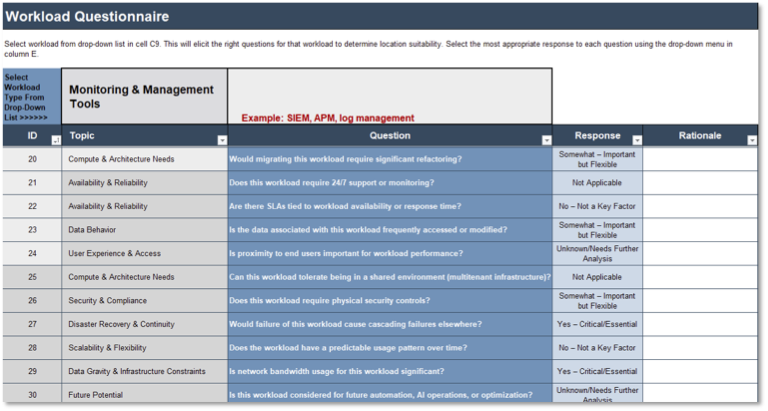
This phase shifts from strategy to execution – helping you translate planning into concrete decisions around infrastructure modernization. At the center of this is a guided workbook activity designed to assess your current environment, constraints, and goals. By answering targeted questions, you’ll receive recommendations on optimal workload placement – whether that’s on-prem, in the cloud, at the edge, or a hybrid mix. The goal is to align each workload with the infrastructure option that best balances performance, compliance, cost, and scalability.
Workload location assessment
Evaluate workload characteristics to align placement with business priorities and infrastructure capabilities.
This activity guides you through a series of questions designed to determine the optimal hosting environment for your workloads – whether that’s on-prem, hybrid, edge, or public cloud. Use the workbook to evaluate factors such as:
- Security and compliance requirements.
- Application performance and latency sensitivity.
- Data residency or sovereignty.
- Cost constraints (CapEx vs. OpEx).
- Scalability and automation needs.
Download the Data Center Strategy Workbook
Document your current reference architecture
Establish a clear baseline for your existing infrastructure before planning the next step.
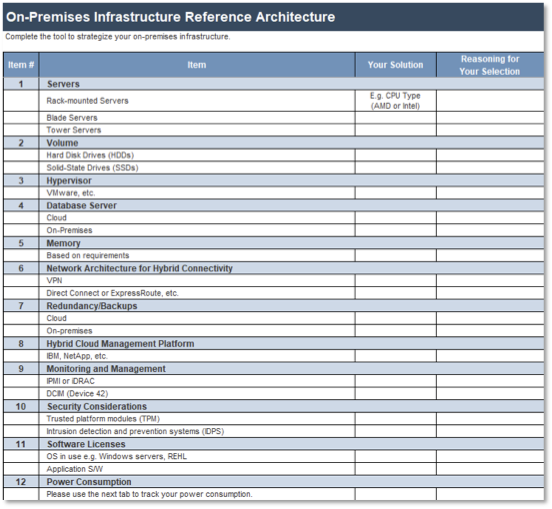
Before determining where your workloads belong, it’s critical to understand your current environment. Use this section of the workbook to capture key components of your data center reference architecture, including:
- Server types (rack, blade, tower).
- Storage options and hypervisor platforms.
- Database hosting models.
- Redundancy and backup strategies.
- Network connectivity and hybrid cloud readiness.
- Management platforms, software licenses, and power usage.
Download the Data Center Strategy Workbook
Costs to consider apart from hardware – power consumption and real estate
Power consumption costs are a significant portion of the total cost of ownership (TCO) of an on-prem data center. Energy costs, including electricity for servers, cooling systems, and other IT equipment, can take up a significant portion of your operating budget. By understanding and optimizing power consumption, organizations can control costs and use financial resources efficiently and responsibly.
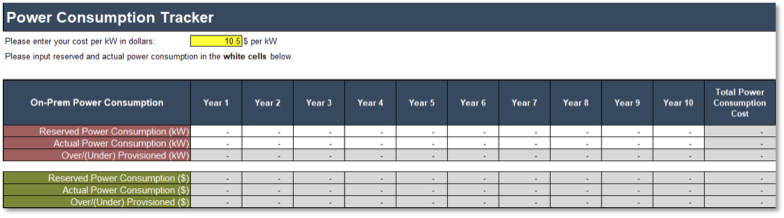
See Tab 5, Power Consumption Tracker, in the Data Center Strategy Workbook
About Info-Tech
Info-Tech Research Group is the world’s fastest-growing information technology research and advisory company, proudly serving over 30,000 IT professionals.
We produce unbiased and highly relevant research to help CIOs and IT leaders make strategic, timely, and well-informed decisions. We partner closely with IT teams to provide everything they need, from actionable tools to analyst guidance, ensuring they deliver measurable results for their organizations.
What Is a Blueprint?
A blueprint is designed to be a roadmap, containing a methodology and the tools and templates you need to solve your IT problems.
Each blueprint can be accompanied by a Guided Implementation that provides you access to our world-class analysts to help you get through the project.
Talk to an Analyst
Our analyst calls are focused on helping our members use the research we produce, and our experts will guide you to successful project completion.
Book an Analyst Call on This Topic
You can start as early as tomorrow morning. Our analysts will explain the process during your first call.
Get Advice From a Subject Matter Expert
Each call will focus on explaining the material and helping you to plan your project, interpret and analyze the results of each project step, and set the direction for your next project step.
Unlock Sample Research Consolidate Your Data Centers
 Repatriate Cloud Services
 Transform Your Data Center Strategy With a Business-Driven Approach
