
Integrate IT/OT Business Continuity Planning and Disaster Recovery
Minimize disruptions by breaking down IT/OT silos.
- Minimal collaboration exists between IT and OT teams when developing organizational business continuity management.
- OT business continuity planning lacks the same rigor and thoroughness as their IT counterparts.
- IT and OT dependencies are only discovered during a disruption, causing extended delays.
Our Advice
Critical Insight
Utilities must stop treating IT and OT business continuity as separate concerns – true resilience requires an integrated, shared-risk approach. IT and OT leaders must collaborate to develop, execute, and refine a BCM to support the continuity of the business when faced with the heighted risk of disruptions.
Impact and Result
- Minimize business disruptions by ensuring IT/OT business processes and technology have adequate continuity programs and resources.
- Future-proof convergence processes, amplify collaboration, and maximize the skillset between IT and OT teams
Member Testimonials
After each Info-Tech experience, we ask our members to quantify the real-time savings, monetary impact, and project improvements our research helped them achieve. See our top member experiences for this blueprint and what our clients have to say.
10.0/10
Overall Impact
$96,599
Average $ Saved
20
Average Days Saved
Client
Experience
Impact
$ Saved
Days Saved
The City of Daytona Beach
Guided Implementation
10/10
$96,599
20
Integrate IT/OT Business Continuity Planning and Disaster Recovery
Minimize disruptions by breaking down IT/OT silos
Analyst Perspective
Reduce disruptions by integrating IT&OT in your Business Continuity Management development

In the utility sector, the convergence of IT and OT is no longer optional – it’s imperative. As critical infrastructure becomes increasingly digitized and the target of external cyber threats, utility organizations must evolve their Business Continuity Management (BCM) to account for both enterprise systems (IT) and real-time operational technologies (OT) such as SCADA, AMI, and DERMS. Successful BCMs recognize that IT and OT not only share technological interdependencies but also valuable human and process-driven insights.
Rather than build parallel BCP structures for IT and OT, utilities can gain efficiency and resilience by integrating OT into the development of the enterprise BCM. Starting small – aligning recovery objectives for joint systems, for example – and scaling iteratively helps reduce organizational resistance and complexity. The key is to define clear boundaries, establish common ground, and identify cross-domain dependencies. This ensures that when a disruption occurs, both IT and OT teams can respond in a coordinated manner, preserving not only uptime but also public safety and regulatory compliance.
Technology and threats evolve rapidly; BCM must do the same. By treating IT/OT BCM as a living framework – governed, tested, and improved jointly – utility organizations can achieve not just recovery, but adaptive resilience and drive toward a converged IT/OT way-of-working.
Bevin Chau
Research Director
Utilities, Industry Practice
Info-Tech Research Group
Executive Summary
Your Challenge | Common Obstacles | Info-Tech’s Approach |
|---|---|---|
|
|
|
Info-Tech Insight
Utilities must stop treating IT and OT business continuity as separate concerns – true resilience requires an integrated, shared-risk approach. IT and OT leaders must collaborate to develop, execute, and refine a BCM to support the continuity of the business when faced with heighted risk of disruptions.
Your challenge
Organizations face greater impact from disruptions with a siloed IT and OT approach to BCM
Siloed Approach to BCM | Differing Domain Requirements | Unclear Delineation Between IT & OT |
|---|---|---|
|
|
|
Utility organizations are at a growing risk of disruptions (cyber attacks, extreme weather, aging infrastructure) and require a robust and comprehensive BCM with IT and OT coverage.
62%
Percentage of Computers Impacted from Ransomware: Utilities
Source: Sophos 2024
A study by Sophos shows a ransomware attack on an Energy, Oil and Gas, and Utility organization in 2024 impacted on average 62% the organization’s devices/computers, leading any other surveyed industry. An indication of the potential extent a disruption can pose within this industry.
A survey conducted by Claroty highlighting trends in cyber security threats between 2021 and 2023 indicates a 10% increase when it comes to ransomware attacks on IT and OT environments (Continuity Insights 2023).
Common Obstacles
Separate IT and OT BCM reduces overall response effectiveness
Separate Organizational Constructs | Unclear Roles and Responsibilities | Domain Institutional Knowledge | Absent Common Vision |
|---|---|---|---|
IT and OT organizations maybe arranged in a variety of ways – for example OT reporting into Operations and IT into Finance. Separate organizational constructs creates a barrier for collaboration due to competing priorities, resources, budget, etc. | IT and OT overlaps are generally known but are not documented and communicated well across the organization. Often this leads to a reactive approach to conflict resolution when IT and OT intersects and is evaluated on a case-by-case basis. | IT and OT have contrasting foundational operating environments; understanding the intricacies of the respective domains is a challenge. Additionally, OT technology tends to trail that of IT with obsolete OT equipment still operational and knowledge residing with few individuals. | As with organization constructs, priorities between IT and OT can vastly differ. Without a common, “guiding star” vision to align both teams, individuals will feel less empowered to collaborate, change will be impeded, and leadership accountability misplaced. |
Info-Tech’s Approach
Stop treating IT and OT business continuity as a separate concern
Ensure the Right People at the Table | Start on Common Ground | Drive a Collaborative Culture |
|---|---|---|
|
|
|
“Nearly half of the HMI’s identified associated with water and wastewater could be manipulated without any authentication required.”
Censys 2024
“Standardized security procedures help align IT, OT, and external partners to respond quickly to cyberattacks and avoid physical consequences that affect operations (for example, loss of plant operations and production).”
McKinsey & Company 2023
Info-Tech’s Approach
Focus BCM on the intersection of IT and OT
| 1. Level-set & Align | 2. Identify Dependencies | 3. Develop IT/OT BCM | 4. Sustain | |
|---|---|---|---|---|
Objective | Establish a common definition and boundaries of IT/OT applications for your organization by referencing industry best practices. | Highlight the applications where IT and OT involvement is required and identify the roles and responsibilities for both respective teams. | Based on the dependencies identified, initiate the development of the IT/OT BCM by leveraging Info-Tech’s BCM methodology. | Create a governance structure and associated processes to enable the sustainment of the BCM and other converging processes. |
Activities | IT/OT Stakeholder Mapping IT/OT Definition & Boundary Mapping | IT/OT Application Heatmap and Ownership IT/OT Business Processes Identification | IT Disaster Recovery Plan IT/OT Business Continuity Plan | IT/OT BCM Governance Structure Document Maintenance Processes |
Accelerators | 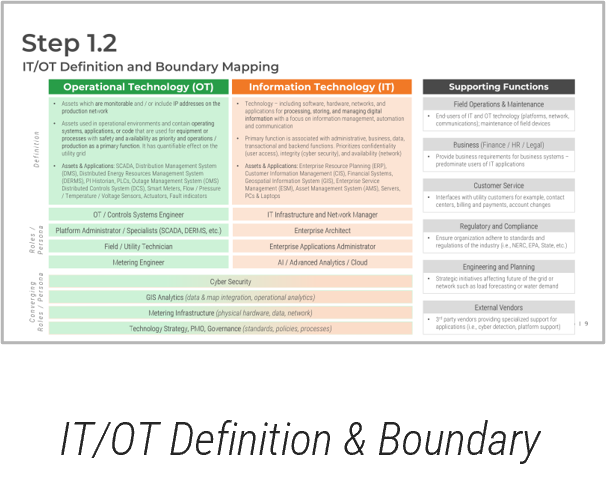 | 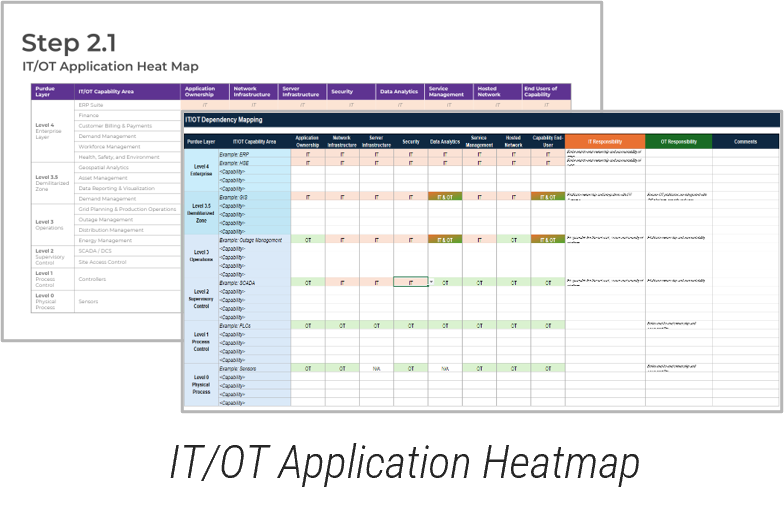 | 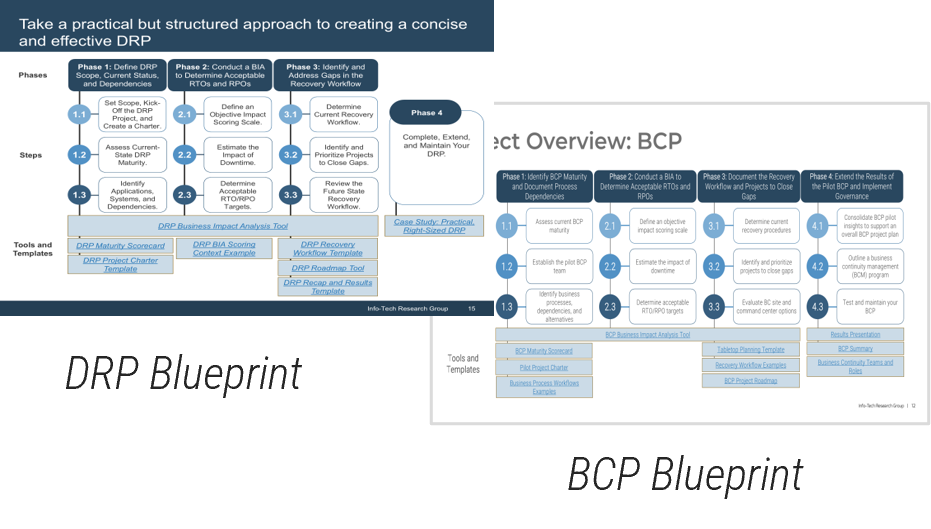 | 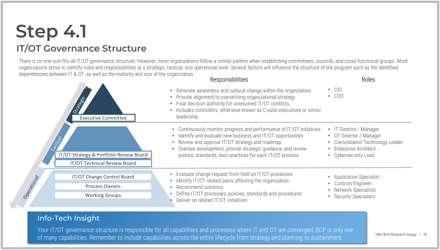 |
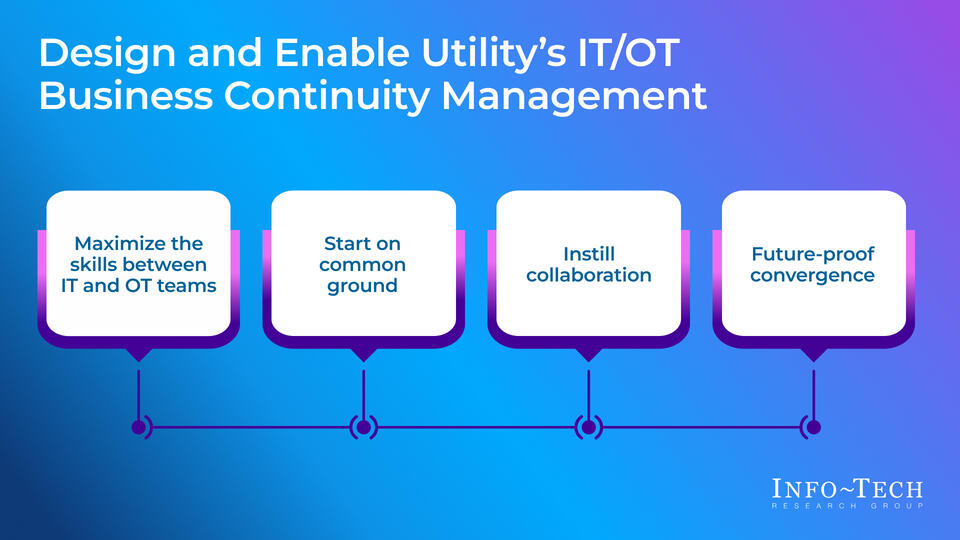
Design and Enable Utility’s IT/OT Business Continuity Management
Focus BCM at the intersection of IT and OT
Maximize the skills between IT and OT teams | Start on common ground | Instill collaboration | Future-proof convergence | |
Phase 1 | Phase 2 | Phase 3 | Phase 4 | |
Activities | 1.1 IT/OT Stakeholder Mapping 1.2 IT/OT Boundary Definition | 2.1 IT/OT Application Heat-Map & Ownership Assignment 2.2 IT/OT Business Processes Identification | 3.1 IT Disaster Recovery Plan 3.2 IT/OT Business Continuity Plan | 4.1 IT/OT Governance Structure 4.2 BCM Maintenance Processes |
Outcomes | Defined IT and OT application and capability boundaries across the organization. | Catalog of IT and OT capabilities and where convergence occurs with clear ownership. | Joint recovery and continuity plans accounting for IT/OT technology and processes. | Means to sustain and maintain converged BCM, with the potential to scale across other processes. |
Common Obstacles
Ambiguity in IT and OT Definition
Organizations have yet to align on the definition and boundaries of IT and OT, generating confusion across teams and individuals.
Organizational Constructs With Conflicting Priorities
IT and OT have separate reporting lines, priorities, resources, and budget, creating a barrier for the two teams to actively collaborate.
Your Challenge
Siloed Business Continuity Planning
Each business unit (beyond IT and OT) conducts business continuity planning in a silo, duplicating resources and effort, unaware the plans of other business units.
Drastic IT and OT Domain Requirements
Technical and functional requirements of both domains are drastically different and managed by two distinct and contrasting skillsets.
Impact
Reduced Downtime & Enhanced Readiness
Minimize business disruptions when real incidents occur by ensuring IT/OT business processes and tech have the adequate continuity programs and resources to execute.
Future-Proofed Convergence Processes
Build on the foundations from this exercise to expand across additional converged processes across the organization.
Use This Blueprint to Supplement Larger BCM Development
Three Components to an Enterprise Business Continuity Management System: an effective enterprise business continuity management system consists of three in-sync components working together to enable an enterprise business continuity function. This blueprint supports the initiation of 1) an IT disaster recovery plan by including OT technology and 2) a IT/OT BCP by identifying IT/OT business processes.
Start by Including OT in the IT Discovery Recovery Plan: OT Technology is increasingly being critically dependent on IT services, therefore by starting with IT DRP, dependent OT applications and infrastructure will be captured in the recovery plan. Additionally, outputted IT DRP will inform business units of IT & OT recovery constraints to support the development of their own BCP, especially workarounds while IT/OT systems are down.
Differentiate Between Disaster Recovery and Business Continuity: Disaster recovery focuses on returning applications and infrastructure back to normal operating conditions whereas BCP evokes workarounds to maintain business processes in the event of a disruption (e.g. cyber attack, network failure, natural disaster). This blueprint supports the identification of IT/OT applications and infrastructure and the IT/OT processes they support, hence supplements (does not replace) Info-Tech’s Create a Right-Sided Disaster Recovery Plan and Develop a Business Continuity Plan blueprints.
Overall Enterprise Business Continuity Management (BCM) | ||
|---|---|---|
IT Disaster Recovery Plan This blueprint supports the creation of the IT DRP by identifying IT/OT applications Download IT DRP Tool | BCP for Each Business Unit This blueprint supports the creation of a BCP for the IT/OT “business unit” by identifying dependent business processes Download Overall BCP Tool | Crisis Management Plan A plan to manage a wide range of crises, from health and safety incidents to business disruptions to reputational damage. Download Crisis Management Best Practices |
Insight Map
Leverage the existing skills and knowledge between IT & OT
IT and OT is not only being interconnected from a Technology point of view, but also from the lens of people and processes. Tools and practices deployed in OT space mimic those which have been successfully deployed in the IT space. Leverage existing skills, knowledge, and lessons learned where possible – don’t re-invent the wheel if there is no need to.
Start IT/OT Convergence Small, Then Scale
BCP is one of many converging processes. The foundations being built as part of this blueprint should enable your organization to scale convergence across other processes as well – i.e. BCP governance can become IT/OT governance.
Establish Common Ground, Identify Dependencies
Start with defining what IT and OT are at your organization and the boundaries, understanding they will be iterative as technology evolves. Dependencies will mature, evolving into normal ways of working.
Review, Iterate, and Improve – Together
Changes in technology in both IT and OT are dynamic. Keep both teams abreast on updates in their respective environment and continue to improve and iterate on the BCP. Include a review/change management process as part of the BCP governance.
Blueprint Deliverables
Each step of this blueprint is accompanied by supporting deliverables and exercises to help you accomplish your goals
Stakeholder Register Template
Assess the relevant stakeholders contributing to IT & OT at your organization and determine their level of involvement the development of the BCM
IT/OT Application Heatmap & Processes List
Map the IT/OT dependencies against the Purdue model across each technology level. The application heatmap will provide a high-level overview of the areas IT and OT are responsible for across each application
IT/OT Disaster Recovery & Business Continuity Plan RACI
Document your IT/OT DR and BCP roles and responsibilities during the execution of each process.
Key deliverable
Utilities Business Impact Assessment Tool
The design and implementation of the IT/OT Application Business Continuity Plan captures the key insights your work will generate, including:
- A set of converging applications requiring IT and OT to operate.
- A jointly conducted business assessment of IT/OT capabilities.
- Recovery procedures for critical IT/OT applications.
Blueprint Benefits
IT Benefits | Business Benefits |
|---|---|
|
|
Measure the value of the IT/OT BCM toolkit
This toolkit will accelerate your goal in developing an IT/OT integrated BCM and spark a journey toward IT/OT convergence
Info-Tech IT/OT BCM Toolkit Value
5-7 Weeks Effort of ~4 IT & OT FTE
The value of the toolkit comes from the initial design, but you will experience benefits over time as convergence expands across broader areas.
Phase | Deliverable | Without Blueprint | With Blueprint |
|---|---|---|---|
Phase 1: Level-Set & Align |
| 1 week
| 1 Day
|
Phase 2: Identify Dependencies |
| 1-2 weeks
| 1 Day
|
Phase 3: Develop IT DR and IT/OT BCP |
| 1-2 weeks
| 1 Day
|
Phase 4: Sustain |
| 1-2 weeks
| 1 Day
|
Organization
Nova Scotia Power, Nova Scotia, Canada
Industry:
Electricity
Sources:
Nova Scotia Energy Board (2025), CBC (2025), CityNews (2025), Halifax Examiner (2025)
“But customer information was not central to the plan’s concerns. In fact, the particular concern about the risk to customer data seemed like an after-thought, mentioned only once in the report as part of a list of concerns.”
– Halifax Examiner (2025)
Case Study
Breached at the Starting Line: Nova Scotia Power Attacked Before IT-OT Cyber Project Can Begin
Background | In March of 2025, Nova Scotia Power (NSP), submitted “IT-OT Cyber Security Control Implementation Phase 1” to the Utility and Review Board (UARB) for approval. In the plan, NSP acknowledges the increase in frequency and sophistication of cyber threats and also the importance in “securing NS Power’s OT environment responsible for controlling physical processes or operations.” NSP had all the correct intentions of protecting their OT environment; however, as the Halifax Examiner wrote “the focus was almost entirely on OT…but customer information was not central to the plan’s concern.” Following the submission of the plan to UARB, NSP was a victim of a ransomware attack where 280,000 customers’ information – including names, SINs, phone numbers, addresses, and banking information – has been compromised. NSP has declined to meet the financial demands of the perpetrators. |
|---|---|
Impact | The impacts of this breech are still unknown at the time of this publication: however, a few early indicators point to the following:
|
Lessons Learned |
|
Organization
CrowdStrike
Industry:
Various
Sources:
ISA
“In the wake of the recent global IT outage caused by a faulty CrowdStrike update, the importance of robust business continuity planning (BCP) and Disaster Recovery (DR) strategies in Operational Technology (OT) environments has never been more apparent.”
– ISA
Case Study
CrowdStrike Update: an IT Update Impacting OT Across Various Industries
Background | On July 19, 2024, a routine update from CrowdStrike disrupted organizations globally across various sectors, including utilities. Deemed as one of the largest IT outages in history, it cost Fortune 500 companies $500 billion dollars in direct losses. The impact of the IT outages was widespread and cascaded into the OT environments of many organizations. |
|---|---|
Impact | If an organization had CrowdStrike deployed, it would have been overseen by the IT organization. However, depending on the industry, this update on the IT domain created cascading effects on the OT domain. For example, rail systems faced signaling outages, and airlines such as Delta and United faced communication network disruptions, grounding flights worldwide. Luckily for utilities, impacts were isolated to the IT domain with reports of customer billing outages from City of Corpus Christi and unavailable outage information system from Avangrid. |
Lessons Learned |
|
Info-Tech offers various levels of support to best suit your needs
| DIY Toolkit | Guided Implementation | Workshop | Consulting |
|---|---|---|---|
| "Our team has already made this critical project a priority, and we have the time and capability, but some guidance along the way would be helpful." | "Our team knows that we need to fix a process, but we need assistance to determine where to focus. Some check-ins along the way would help keep us on track." | "We need to hit the ground running and get this project kicked off immediately. Our team has the ability to take this over once we get a framework and strategy in place." | "Our team does not have the time or the knowledge to take this project on. We need assistance through the entirety of this project." |
Diagnostics and consistent frameworks are used throughout all four options.
Guided Implementation
What does a typical GI on this topic look like?
| Phase 1: Align | Phase 2: Identify | Phase 3: Develop | Phase 4: Sustain |
|---|---|---|---|
Call #1: Call #2: Define IT/OT definition and boundaries. | Call #3: Call #4: | Call #5: Call #6: | Call #7: |
A Guided Implementation (GI) is a series of calls with an Info-Tech analyst to help implement our best practices in your organization.
A typical GI is 4 to 6 calls over the course of 6 months.
Workshop Overview
Contact your account representative for more information.
workshops@infotech.com 1-888-670-8889
| Day 1 | Day 2 | Day 3 | Day 4 | |
|---|---|---|---|---|
Level-Set & Align IT and OT Teams | Identify IT & OT Dependencies | Develop DRP and BCP for IT/OT Applications and Processes | IT/OT Governances | |
Activities | 1.1 Identify IT & OT stakeholders 1.2 Define IT/OT definition & boundaries | 2.1 Complete IT/OT application heatmap and assign ownership 2.2 Identify IT/OT business processes impacted by IT/OT technology 3.0 IT/OT business impact assessment alignment and development 3.1.1 Conduct business impact assessment for IT/OT applications | 3.1.2 Document recovery workflows and RACI for each converged application 3.2.1 Conduct business impact assessment for IT/OT processes 3.1.2 Document workarounds and RACI for each IT/OT process | 4.1.0 Define IT/OT governance structure and maintenance processes for BCM 4.2.0 Align back with broader organizational BCM strategy |
|
|
|
|
Phase 1
Identify IT/OT Stakeholders and Align on IT/OT Boundaries and Definitions
| Phase 1 | Phase 2 | Phase 3 | Phase 4 |
|---|---|---|---|
1.1: Identify IT/OT stakeholder mapping 1.2: Establish IT/OT boundaries and align on definition | 2.1 Complete IT/OT application boundary heatmap & ownership 2.2 Identify IT/OT business processes impacted by IT/OT technology | 3.0 Define aligned Business Impact Assessment (BIA) Tool 3.1.1 Conduct BIA for IT/OT applications 3.1.2 Document IT/OT recovery workflows and assign RACI 3.2.1 Conduct BIA for IT/OT business processes 3.2.2 Document IT/OT workarounds and assign RACI | 4.1 Define IT/OT governance structure 4.2 Establish IT/OT BCP maintenance routines |
Insights & Outcomes
Ensure your entire organization has a common understanding of the definition and boundaries of IT and OT and remove any confusion and ambiguity about ownership, roles, and responsibilities.
Participants:
- IT lead and domain owners/specialists
- OT lead and application owners
Bridge Cultural and Operational Silos
Joint Participation: Traditionally, IT and OT each have their distinct priorities, tools, and processes. Sticking to this conventional way of working will not further collaboration between the two teams. Clearly identify the participants who are critical of executing a joint IT/OT BCP but also individuals who play a key part in creating a collaborative culture where IT and OT teams are regularly working together.
Make Decisions Together: Identifying stakeholders upfront will support subsequent phases of the blueprint when ownership is assigned to applications and continuity workflows are drafted. This step allows you to clearly define escalation pathways, document RACIs, and develop cross-functional decision-making workflows.
About Info-Tech
Info-Tech Research Group is the world’s fastest-growing information technology research and advisory company, proudly serving over 30,000 IT professionals.
We produce unbiased and highly relevant research to help CIOs and IT leaders make strategic, timely, and well-informed decisions. We partner closely with IT teams to provide everything they need, from actionable tools to analyst guidance, ensuring they deliver measurable results for their organizations.
What Is a Blueprint?
A blueprint is designed to be a roadmap, containing a methodology and the tools and templates you need to solve your IT problems.
Each blueprint can be accompanied by a Guided Implementation that provides you access to our world-class analysts to help you get through the project.
Need Extra Help?
Speak With An Analyst
Get the help you need in this 4-phase advisory process. You'll receive multiple touchpoints with our researchers, all included in your membership.
Guided Implementation 1: Align
- Call 1: Scope requirements, objectives, and specific challenges.
- Call 2: Identify key IT/OT stakeholders as part of the BCP journey.
- Call 3: Define IT/OT definition and boundaries.
Guided Implementation 2: Identify
- Call 1: Highlight applications where convergence exists and assign IT and/or OT ownership.
- Call 2: Identify IT/OT processes impacted by IT/OT applications disruptions.
Guided Implementation 3: Develop
- Call 1: Complete BIA for converging applications/ capabilities.
- Call 2: Design recovery workflows and business continuity workarounds for identified applications and processes.
Guided Implementation 4: Sustain
- Call 1: Define IT/OT governance structure and committees.
Contributors
- Mark Thomas, Director of IT Operational Technology, Denver Water
- Roderick Cook, Information Security Officer, Modesto Irrigation District
- Chris Vasche, OT Analyst. Modesto Irrigation District
