
Identify and Select AI Use Cases to Pilot in the Education Sector
Go from idea to impact with a value-driven selection process.
- Get input from academic and administrative stakeholders on potential use cases.
- Align use cases to your educational mission and strategic objectives.
- Select the best use cases from among the many available options.
- Navigate education-specific compliance and accessibility requirements.
Our Advice
Critical Insight
- Educational institutions lack methodology or process to arrive at a shortlist specific to education.
- Institutions haven't established criteria necessary to select use cases that would add value to their educational mission.
- Organizations are unsure of their readiness to pilot AI technologies in educational contexts.
- Clarity is needed on how to use AI to create strategic advantage for the institution.
Impact and Result
- Give AI in your organization a purpose aligned to educational mission and strategic value.
- Develop an iterative, structured, and reusable process to identify, rationalize, and prioritize potential AI use cases using proven education examples.
- Distinguish between horizontal and vertical AI approaches for strategic advantage.
Member Testimonials
After each Info-Tech experience, we ask our members to quantify the real-time savings, monetary impact, and project improvements our research helped them achieve. See our top member experiences for this blueprint and what our clients have to say.
10.0/10
Overall Impact
Client
Experience
Impact
$ Saved
Days Saved
LHRIC - Lower Hudson Regional Information Center
Guided Implementation
10/10
N/A
N/A
Speaking with Mark Maby and learning about the services he can provide to my organization.
Identify and Select AI Use Cases to Pilot in the Education Sector
Go from idea to impact with a value-driven selection process.
Analyst Perspective
Differentiate your institution in a time of change.
There are multiple opportunities for educational institutions to leverage generative AI (Gen AI) across institutional operations, administrative processes, and classroom learning. However, success requires the strategic selection of pilot use cases that align with the educational mission while building sustainable competitive advantages.
Our analysis of implementations across K-12 districts and higher-education institutions reveals three critical success factors: strategic categorization of use cases by institutional value, understanding of the differences between horizontal and vertical AI approaches, and sector-specific implementation strategies that account for the distinct governance and operational characteristics of K-12 versus higher-education environments.
IT leaders in the education sector must move beyond generic AI adoption to focus on use cases that leverage their institution's unique knowledge, processes, and educational mission to create sustainable competitive advantages that cannot be easily replicated by other institutions.

Mark Maby
Principal Research Director for Education,
Industry Practice
Info-Tech Research Group
Executive Summary
Your Challenge
You have been asked to identify and select practical, valuable, and appropriately sized pilot use cases for AI on behalf of your educational institution. There are many ideas, and you must:
- Get input from academic and administrative stakeholders on potential use cases.
- Align potential use cases to your educational mission and strategic objectives.
- Select the best use cases from among the many available options.
Common Obstacles
However, you are facing the following obstacles:
- You do not have a methodology or process in place to arrive at a shortlist specific to education.
- You have not established the criteria necessary to select use cases that would add value to your educational mission.
- You are unsure of the readiness of your organization to pilot AI technologies.
- You lack clarity on how to use AI to the strategic advantage of your organization.
Info-Tech's Approach
Follow Info-Tech's methodology and fit-for-purpose tools, enhanced for education, to:
- Give AI in your organization a purpose aligned to educational mission and strategic value.
- Develop an iterative, structured, and reusable process to identify, rationalize, and prioritize potential AI use cases using proven education examples.
- Distinguish between horizontal and vertical AI approaches for strategic advantage.
Info-Tech Insight
Pick a use case that is the right size and ready to go, aligns to your organization's educational mission, creates a vertical AI competitive advantage, and
can be scaled rapidly if the pilot succeeds.
Scalable + Ready + Mission-Aligned + Vertical AI Advantage = Successful Education Sector Use Case
Your Challenge
This research is for organizations that want to:
- Collect and define use cases for AI from across the business.
- Evaluate proposed ideas based on alignment to business value and readiness to execute on them.
- Build a systematic approach for use case prioritization.
A systematic approach aligned to value and readiness will help you maximize the material benefits of AI by accelerating the process of deploying and embracing AI across your organization.
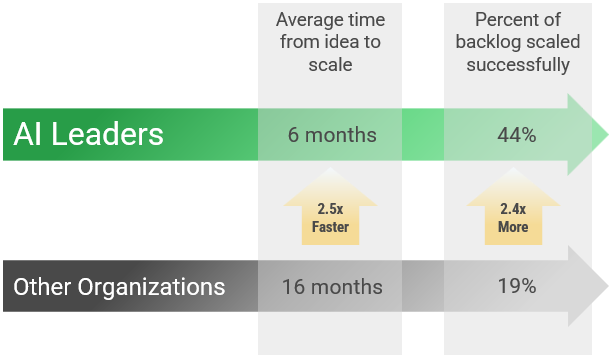
Leading AI organizations use a systematic approach to successfully scale more than twice as many AI
use cases
as average organizations.
Source: "Scaling AI Pays Off," BCG, 2023
Deploy these three tactics from leading organizations to accelerate AI adoption
1 |
2 |
3 |
|---|---|---|
|
Carefully consider value when choosing AI use cases based on corporate priorities. Consider creating a specialized team to structure and accelerate scaling. Ask yourself: Do we track the use cases in the pipeline against clear objectives and key results? |
Adopt a consistent execution model, with agile build and validation cycles for AI use cases. The development of minimum viable products (MVPs), which add features and users as they are scaled and incorporated into the operating model, begins with prototypes that gather early end-user input. Use cases and associated operating models are eventually implemented throughout the entire organization. Ask yourself: Do we have a systematic approach that prioritizes scaling of use cases based on value? |
Set up an enablement role to make sure that, as new AI applications are developed, they are accessible to the teams that require them across the organization. The enabling function may, in some cases, assign specialized teams to develop any lacking capabilities. Ask yourself: Do we have identified roles that can continue to identify missing features after deployment? |
Source: "Scaling AI Pays Off," BCG, 2023
Identify and Select AI Use Cases to Pilot in the Education Sector
Your Challenge
Educational institutions have great potential to leverage AI but also carry great risks related to student privacy, academic integrity, and effective pedagogy. How do you balance value and risk to deliver AI pilot projects that enhance your educational mission?
- Align to educational mission and clearly define the why. The purpose must support teaching, learning, and institutional effectiveness.
- Distinguish between horizontal and vertical AI to identify strategic competitive advantages versus commodity solutions.
- Involve cross-disciplinary stakeholders, including academic affairs, faculty, IT, and student services in decision-making.
- Evaluate readiness to pilot and scale within educational governance structures and compliance requirements.
- Keep pilots the right size and focus on making something work within institutional culture and constraints.
Info-Tech Insight
Pick a use case that is the right size and ready to go, aligns to your organization's educational mission, creates a vertical AI competitive advantage, and can be scaled rapidly if the pilot succeeds.
Scalable + Ready + Mission-Aligned + Vertical AI Advantage = Successful Education Sector Use Case
Explore three case studies as models to emulate
These three institutions tackled the challenge of generative AI and are frontrunners for its implementation and adoption in the education sector.
|
UC San Diego |
UCLA Anderson School of Management |
Lower Hudson Regional Information Center |
|---|---|---|
|
Optimized its internal infrastructure for generative AI and achieved an 8x cost advantage over Microsoft Copilot |
Achieved rapid deployment of generative AI through a fully managed third-party partnership |
Achieved comprehensive teacher adoption of AI, using a regional cohort model with its partner school districts |
Read the detailed case studies in this blueprint.
Ideate AI use cases using Info-Tech's AI Case Study Library for the Education Sector
Review proven AI use cases in the education sector.
This library provides the following information about the case study for each use case:
- Education Level (Higher Education or K-12)
- Use Case Name
- Category (Administrative, Classroom, and Knowledge)
- Sub-Category
- Description
- Institution Name
- Value Approach (horizontal AI or vertical AI)
- Technology Platform
- Trigger (both manual and automatic triggers)
- Data Sources (system data and others)
- Source (for more information about the case study)
Download Info-Tech's AI Case Study Library for the Education Sector.
The benefits of using this shortlisting tool include the following:
Education Sector Benefits
Track education-specific use cases across administrative, instructional, and student support functions.
Technology
Identify the technology used and determine whether it should be classified as commodified horizontal AI or
competitive AI with a strategic advantage.
Integration With the Shortlisting Tool
Integrate case study details into the tool, including the data sources that were used and the trigger that activates the use case.
Structure your selection process with Info-Tech's AI Pilot Project Shortlisting Tool
Streamline the evaluation and selection process.
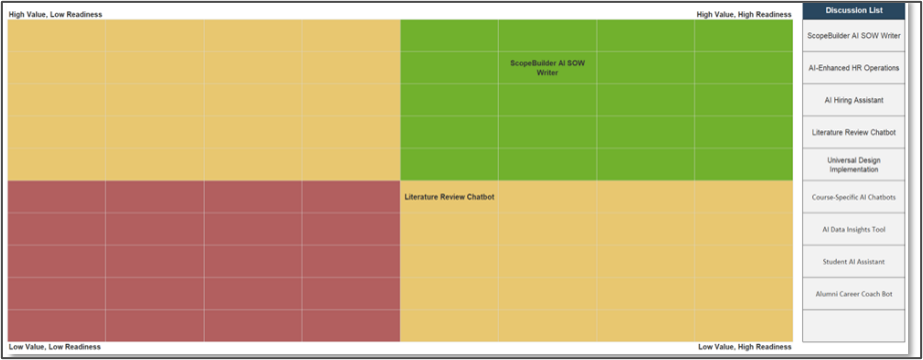
|
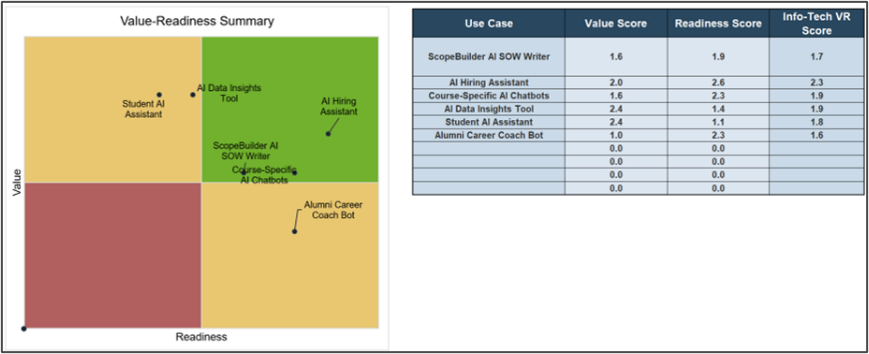
|
|
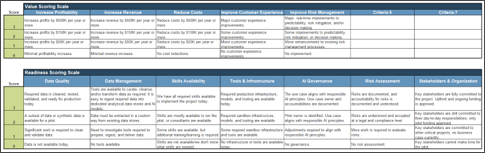
The Discussion List tab helps the working group sort use cases into different quadrants. |
The Summary tab provides the average value-readiness (VR) score and ranks the use cases accordingly. |
|
The Scoring Scales tab provides criteria to rank the use cases. |
Download Info-Tech's AI Pilot Project Shortlisting Tool for Education.
The benefits of using this shortlisting tool include the following:
Time Saved
Automate the initial screening process, saving significant time for the working group by quickly filtering out unsuitable use cases.
Scalability
Track and evaluate a large volume of potential use cases. Grow as needed with additional use cases identified from across your organization.
Objective Evaluation
Apply consistent evaluation criteria to all use cases, reducing bias and ensuring fair assessment aligned to organizational value and readiness.
Case Study: UC San Diego–TritonGPT Platform
Build institutional AI capability through internal development.
INDUSTRY: Education
SOURCE: Interview
Challenge
Balance AI innovation with cost control and institutional autonomy.
UC San Diego recognized the transformative potential of AI for higher education. However, the university felt that commercial solutions, such as Microsoft Copilot at $20 per user per month, would create unsustainable costs for its large community, while external platforms could affect data sovereignty and institutional control over AI development roadmaps. The university leveraged its existing NVIDIA GPU infrastructure.
The challenge involved building internal AI development capabilities while maintaining the university's commitment to open-source principles and cost-effective operations. Success would require assembling technical expertise, integrating with existing institutional systems, and creating AI applications that could serve both internal needs and potentially expand to external institutions, all while ensuring complete data sovereignty and long-term competitive differentiation..
Case Study: UC San Diego–TritonGPT Platform
Build institutional AI capability through internal development.
INDUSTRY: Education
SOURCE: Interview
Solution
- Core team structure: Five-person internal development team to manage operations and development of the entire platform
- Infrastructure approach: Leveraging of existing San Diego Supercomputer Center with NVIDIA H100 and L40S GPU clusters
- Technology stack: Meta's Llama models as primary AI foundation with custom vector database and application framework
- Development methodology: Proprietary platform built using open-source components rather than commercial AI platforms
- Strategic focus: "Vertical AI" strategy, pointing generative AI at UC San Diego–specific content (public and proprietary)
- Application development: Specialized AI assistants created for institutional functions rather than generic chatbots
- Partnership model: Limited hardware partnerships (Dell through Scripps Institute) while maintaining software independence
- Cost structure: Full pricing model based on five-year GPU depreciation plus electricity and facilities costs
- Governance process: Internal prioritization system for development efforts with CIO strategic leadership
- Knowledge integration: Deep integration with institutional policies, procedures, templates, and specialized compliance requirements
Case Study: UC San Diego–TritonGPT Platform
Build institutional AI capability through internal development.
INDUSTRY: Education
SOURCE: Interview
Results
The supercomputer advantage is overestimated:
"We do have some benefit there, but it's not as great as people think. Because if you run a good data center and you put in the right GPU chips, you can do this at your institution too."
– Vince Kellen, CIO UC San Diego
- Cost achievement: $2.50 per user per month versus $20 for Microsoft Copilot (8x cost advantage)
- Application portfolio: Six live task-specific AI agents covering diverse institutional functions
- External expansion: Platform that hosts five external universities, creating additional revenue streams
- Data sovereignty: Complete institutional control with no information leaving university boundaries
- Capability building: Internal team now capable of autonomous AI application development and platform expansion
Specific applications deployed:
- UC San Diego Assistant: Institution-specific guidance using campus policies and procedures
- Fund Manager Coach: Grant accounting compliance with complex institutional rules
- Job Description Helper: 1,000+ institutional templates for career-track descriptions
- Email Phishing Analyzer: Security threat assessment using institutional context
- Legal Contract Review: 75% time savings with automated redlining and editing
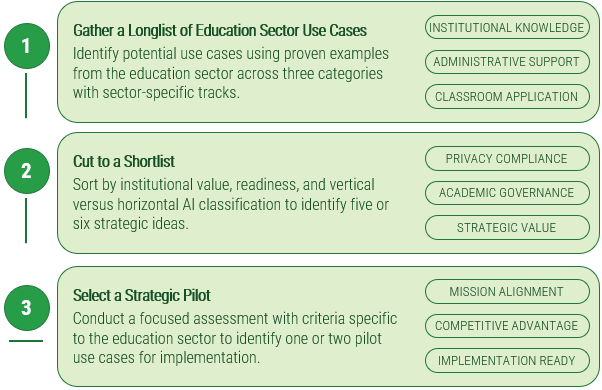
Info-Tech's methodology for selecting pilot AI use cases
|
Step 1: Develop a Longlist |
Step 2: Cut to a Shortlist |
Step 3: Select Your Pilot AI Use Case |
|
|---|---|---|---|
|
Steps |
|
|
|
|
Step Outcomes |
|
|
|
Guided Implementation
What does a typical GI on this topic look like?
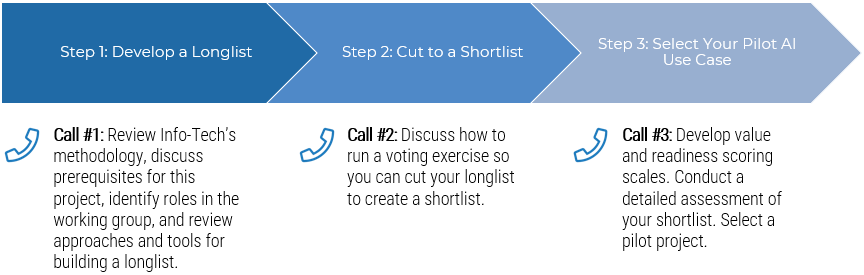
A Guided Implementation (GI) is a series of calls with an Info-Tech analyst to help implement our best practices in your organization.
AI Strategy Roadmap – Workshop Overview
Contact your account representative for more information.
workshops@infotech.com
1-888-670-8889
This blueprint details the education-specific content of Sessions 2 and 3.
|
Pre-Workshop |
Session 1 |
Session 2 |
Session 3 |
Session 4 |
Post-Workshop |
|
|
Activities |
Understand Business Strategy and AI Adoption |
Establish Scope of AI Strategy |
Assess Current AI Maturity and Identify |
Prioritize AI Use Cases |
Develop AI Roadmap |
Next Steps and |
|
|
|
|
|
|
|
|
Outcomes |
|
|
|
|
|
|
Insight Breakdown
Pick a use case that is the right size, aligns to your organization's goals, and can be scaled rapidly if the pilot succeeds.
Use Info-Tech's AI Pilot Project Shortlisting Tool for Education to evaluate value and readiness and to develop a shortlist of use cases.
Give your AI a purpose.
Your AI strategy and current exploration activities should closely align with your organization's mission and
strategic goals. The key question you should be asking is not "What can AI technologies do?" but rather "What can
AI technologies do for us?" You should also be asking, "How much would we benefit from AI if we were to invest in it?"
.Empower a working group.
Empower a cross-functional working group. Include representatives from Academic Affairs, Student Services, and IT, as well as a faculty champion. The right team matters. This team will brainstorm, collect, evaluate, and select
AI use cases from across your organization and will own the process from start to finish.
Define educational value and readiness before you brainstorm a longlist.
Clarify what value you expect to realize and what criteria will support readiness before you start to brainstorm use cases. Building a longlist aligned to value (e.g. learning outcomes, student success) and readiness will help you arrive at a better shortlist faster.
Converge everyone's longlists.
Long to short ... that's the long and short of it. Use a quick sorting exercise to cut from a longlist to a shortlist.
Evaluate the shortlist.
Use a systematic and structured process, including a detailed value-readiness analysis and SWOT exercise, to evaluate the expected risks and rewards of the use cases on your shortlist.
Use SMART success metrics to define your expected outcomes
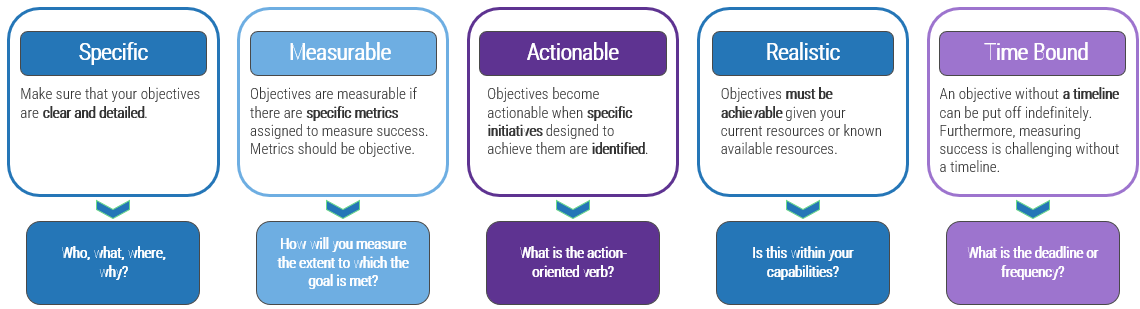
Examples:
|
Expected Outcome |
Project Metrics |
|---|---|
|
Increase throughput of use cases. |
|
|
Select valuable use cases. |
|
Step 1
Develop a Longlist
Activities
- Establish the core working group and the role of departmental champions.
- Understand artificial intelligence.
- Leverage Info-Tech's body of research to learn about opportunities of AI.
- Define value and readiness for your organization.
- Collect use cases.
- Use Tab 1, Idea Reservoir, in Info-Tech's AI Pilot Project Shortlisting Tool for Education to document a longlist of potential use cases.
This step involves the following participants:
- Core working group members, including IT, academic affairs, student services, faculty champions, and compliance officer
Outcomes of this step:
- Finalized longlist
- Identified working group and departmental champions
- Initial analysis of each use case on the list
- Educational value criteria defined and aligned with student success metric
Start with a working group
- Establishing the right core membership for your working group is a critical step to ensure the group's success.
- The working group is a team of faculty, administrative, and technical experts who can assess proposed projects in terms of business value and technical feasibility.
- Choose members who represent key educational functions – instruction, student services, administration, and compliance – to get a comprehensive perspective.
- Select champions who understand both their educational area and the potential AI applications.
- Give your working group a compelling name – a name that will have a positive connotation within your organization.
- Reach out to Info-Tech to advise your working group on the selection process outlined in this research.
Establish a working group
This methodology relies on having the right stakeholders in the room to identify AI goals, challenges, roles, structure, and more. It is absolutely critical to have effective representation from your business stakeholders to be able to drive business value.
Use the table below as a starting point to identify possible working group participants:
- Modify or add to roles in the list below.
- Identify who will take on each role in the list. Some individuals make take on more than one role, and some roles will be filled by multiple individuals.
|
Role |
Expectations |
|---|---|
|
Project sponsor |
|
|
Lead facilitator |
|
|
AI lead |
|
|
Technical subject matter experts (SMEs) |
|
|
Role |
Expectations |
|---|---|
|
Provost/ superintendent |
|
|
Faculty champions |
|
|
Student services director |
|
|
Compliance officer |
|
|
Student representative |
|
About Info-Tech
Info-Tech Research Group is the world’s fastest-growing information technology research and advisory company, proudly serving over 30,000 IT professionals.
We produce unbiased and highly relevant research to help CIOs and IT leaders make strategic, timely, and well-informed decisions. We partner closely with IT teams to provide everything they need, from actionable tools to analyst guidance, ensuring they deliver measurable results for their organizations.
What Is a Blueprint?
A blueprint is designed to be a roadmap, containing a methodology and the tools and templates you need to solve your IT problems.
Each blueprint can be accompanied by a Guided Implementation that provides you access to our world-class analysts to help you get through the project.
Need Extra Help?
Speak With An Analyst
Get the help you need in this 3-phase advisory process. You'll receive multiple touchpoints with our researchers, all included in your membership.
Guided Implementation 1: Develop a Longlist
- Call 1: Review Info-Tech’s methodology, discuss prerequisites for this project, identify roles in the working group, and review approaches and tools for building a longlist.
Guided Implementation 2: Cut to a Shortlist
- Call 1: Discuss how to run a voting exercise so you can cut your longlist to create a shortlist.
Guided Implementation 3: Select Your Pilot AI Use Case
- Call 1: Develop value and readiness scoring scales. Conduct a detailed assessment of your shortlist. Select a pilot project.
Contributors
- Leslie Accardo, Model Schools Coordinator, Lower Hudson Regional Information Center
- Mary Lynn Collins-Callanan, Manager of Instructional Technology Department, Lower Hudson Regional Information Center
- Madalyn Romano, Assistant Director - Strategic Planning, Lower Hudson Regional Information Center
- Howard Miller, Chief Information Officer, UCLA Anderson School of Management
- Vince Kellen, Chief Information Officer, UC San Diego
