
Empower Not-For-Profits With AI and ML
Explore AI use cases to transform your not-for-profit.
- Not-for-profits (NFPs) are key players in the social impact ecosystem. They have an opportunity to leverage AI and ML to address complex societal challenges across diverse mission areas.
- Many NFPs focus narrowly on individual projects, missing the broader potential of integrating AI and ML to optimize delivery and operational capabilities.
- The NFP sector encompasses activities such as fundraising, program delivery, volunteer management, advocacy and constituent engagement, all of which can be enhanced with AI-driven insights.
- Trends like digital transformation, equity, and sustainability are reshaping NFP operations, with AI and ML enabling smarter decision-making and more impactful service delivery.
- AI and ML tools are revolutionizing NFP by optimizing program delivery, streamlining operational workflows and automating repetitive tasks, allowing organizations to focus on their missions.
- Predictive analytics, natural language processing and other AI capabilities empower NFPs to measure impact, forecast needs, and personalize services for constituents and donors.
Our Advice
Critical Insight
Make NFP leadership aware of the potential benefits and risks of transforming core functions and essential services delivery with responsible AI solutions.
Impact and Result
The research can be used as a tool for NFPs to inform their AI and ML strategy. AI can have transformative impact as it can drive better fundraising success, operational efficiency, and improved decision-making to deliver tangible benefits across mission-critical areas and operations
Empower Not-For-Profits With AI and ML
Explore AI use cases to transform your not-for-profit.
Analyst perspective
AI is transforming technological change and driving efficiency and innovation across all industries, including not-for-profits. However, it requires careful consideration and management to use AI and machine learning to drive organizational efficiency and outcomes.
Adopting AI and machine learning (ML) can unlock significant potential for nonprofits, enabling them to optimize operations, enhance donor engagement, and maximize their impact. Benefits include automating time-consuming tasks such as data entry or donor segmentation, identifying trends in fundraising efforts, and improving resource allocation through predictive analytics. These technologies can also empower nonprofits to personalize outreach, ensuring messages resonate with specific audiences, and to better measure the impact of their programs with data-driven insights. However, to realize these benefits, nonprofits needs to start with clear objectives aligned with their mission, ensuring that AI solutions address their unique challenges rather than simply adopting trends.
Despite the advantages, nonprofits must navigate several challenges and considerations when implementing AI and ML. Limited budgets often mean investing in these technologies requires careful prioritization, balancing short-term costs against long-term benefits. Ethical considerations are paramount, especially when dealing with sensitive data about beneficiaries or donors. The risk of biased algorithms or unintended consequences can undermine trust and harm reputations if not addressed proactively. Moreover, nonprofits must assess their technical capabilities, considering whether to build in-house expertise or partner with external providers. A thoughtful approach, rooted in understanding the organization's needs, engaging stakeholders, and prioritizing transparency, can help nonprofits navigate these complexities effectively.

Eli Yufest
Principal Research Director
Info-Tech Research Group
Executive summary
|
Your Challenge |
Common Obstacles |
Info-Tech’s Approach |
|---|---|---|
|
AI is disrupting all industries and providing opportunities for organization-wide advantages. Understand this disruptive technology and its trends to develop a successful strategy for leveraging AI.
All NFP organizations should be planning to responsibly leverage and implement this innovative and exponential technology. |
NFP stakeholders and leaders must cut through the hype to optimize and leverage AI to address core functions and drive business outcomes focused on essential services delivery.
Without a proper strategy and responsible AI guiding principles, the risks to deploying AI technology could negatively impact service delivery and outcomes. |
Info-Tech’s human-centric, value-based approach is a guide for deploying AI applications and covers:
This playbook will provide the list of activities and deliverables required for the successful deployment of AI solutions in NFP organizations. |
Info-Tech Insight
Make not-for-profit leadership aware of the potential benefits and risks of transforming core functions and essential services delivery with responsible AI solutions.
Machine learning and Gen AI are innovations in AI
Artificial Intelligence
A field of computer science that focuses on building systems to imitate human behavior. Not all AI systems have learning behavior; many systems operate on preset rules, such as customer service chatbots.
Generative AI
A form of machine learning where, in response to prompts, the platform generates new outputs based on the data it has been trained on. Depending on its foundational model, a Gen AI platform will provide different modalities and use case applications.
- Audio – Creates sound outputs from text prompts.
- Visual – Creates image, video, or web design outputs from text prompts.
- Code – Creates code in various programming languages based on human
language prompts. - Text – Creates text-based outputs such as articles, blog posts, emails, and
information summaries.
Machine Learning (ML)
An approach to implementing AI where the AI system is instructed to search for patterns in a data set and then make predictions based on that set. In this way, the system “learns” to provide accurate content over time (think of Google’s search recommendations).
Info-Tech Insight
Many vendors have jumped on AI as the latest marketing buzzword. When vendors proclaim to offer AI functionality, pin down exactly how their AI works. The solution must be able to induce new outputs from inputted data via self-supervision – not trained to produce certain outputs based on certain inputs.
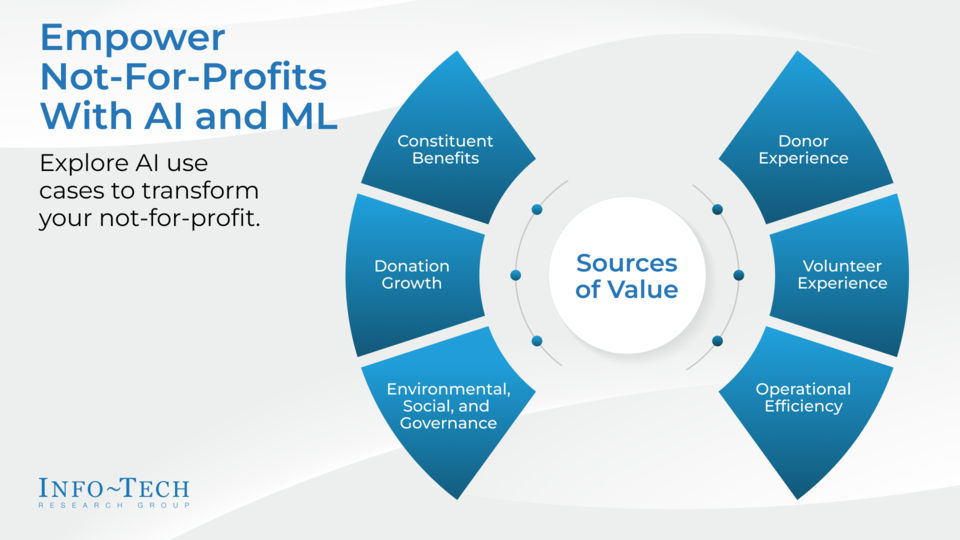
AI and ML can optimize volunteer, fundraising, donor, and constituent experience
Volunteer engagement: AI and ML can optimize volunteer engagement by analyzing volunteer preferences, skills, and availability to match them with suitable opportunities, ensuring higher satisfaction and retention. Additionally, these technologies can predict volunteer needs, automate communication, and personalize outreach, fostering stronger connection and streamlined coordination.
Fundraising: AI and ML can grow donations by analyzing donor behavior and preferences to create personalized fundraising campaigns that resonate with individual contributors. They can also identify patterns and trends to predict donor potential, enabling targeted outreach and maximizing lifetime donor value.
Donor experience: AI and ML can enhance donor experience by delivering personalized communication and tailored impact reports that align with each donor’s interests and contribution history. AI and ML can also provide real-time support through chatbots and predictive analytics to anticipate donor needs, fostering deeper engagement and trust.
Constituent needs: AI and ML can analyze data to provide personalized services, resources, and communication tailored to individual needs. They can also automate routine tasks and offer predictive insights, ensuring timely support and more seamless interaction with the organization.
The majority of NFPs are using AI in their day-to-day
The Charity Digital Skills Report 2024 found that over half of charities are using AI tools in day-to-day work or operations.
Percent of charities using AI tools
61%
Individual use cases have low levels of adoption in NFPs
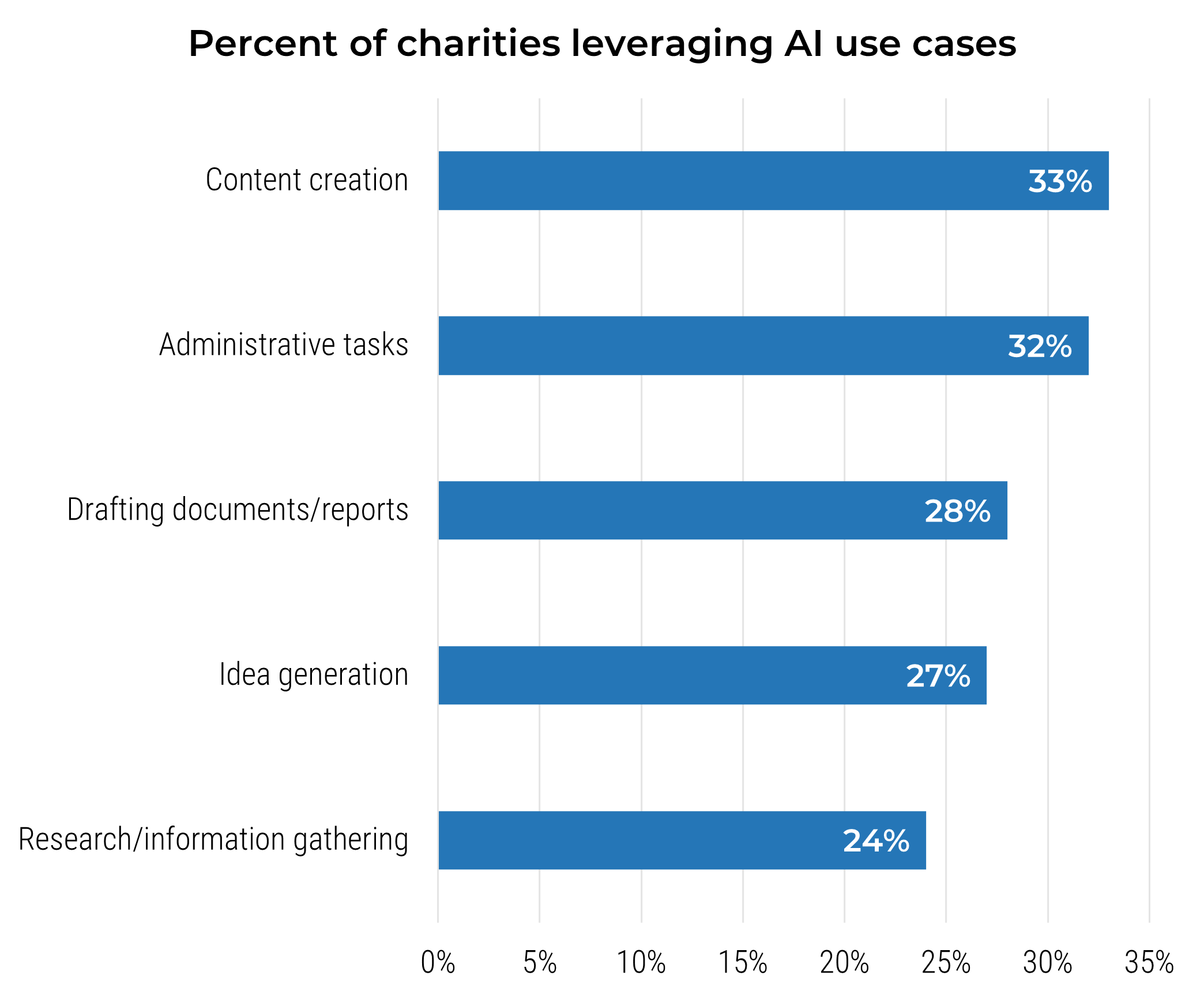
Source: Charity Digital Skills Report, 2024
Only 11% of charities are using AI across the entire organization.
57% of charities are looking for external training on AI.
Only 34% of respondents said that AI is a priority for their organization.
Info-Tech’s approach and team can help, irrespective of where you are in your digital journey
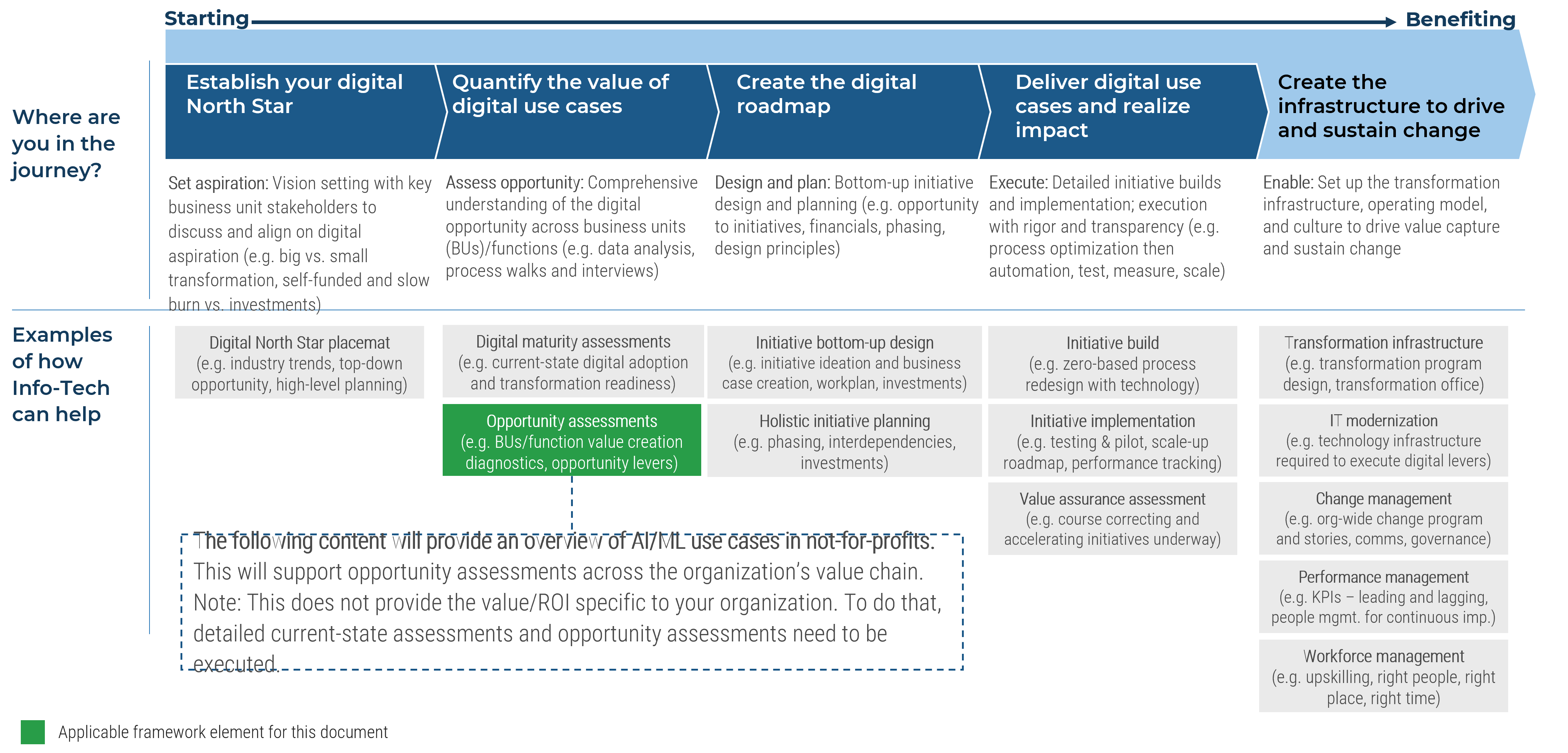
How to use this report
Use this map to determine where to use this research material.
This report is intended to act as both a standalone report on the AI opportunities within the not-for-profit industry while also serving as a research-based accelerated input to the Build Your AI Strategy Roadmap blueprint and associated activities. It uses research-based data for a sample not-for-profit, “Not-for-Profit Corp,” to demonstrate AI use case opportunities for use in a holistic AI strategy and roadmap.
All teams are unique, and some sample information may not be relevant to or represent your organization well due to your products, services, geographic area, etc. Customize as needed to create the most valuable AI strategy for your organization.
If using this report as a research-based accelerant input to the Build Your AI Strategy Roadmap blueprint, use it in phases 2 and 3 and activities 2.1 and 3.1 specifically:
| Phase 2 Identify AI Use Cases |
Phase 3 |
|---|---|
|
2.1 Map your candidate AI use cases |
3.1 Prioritize candidate AI use cases |
AI Strategy Roadmap Activities
Act. X.X When you see this box in this document, it represents the corresponding Build Your AI Strategy Roadmap blueprint activity.
Measure the value of this document
Document your objective
Highlight best-in-class use cases to spur the initiative-planning and ideation process.
Measure your success against that objective
There are multiple qualitative and quantitative, direct and indirect metrics by which you can measure the progress of your initiative pipeline’s development. Some examples are:
- Increased initiative pipeline value.
- Number of capabilities impacted by initiative pipeline.
- Enhanced understanding of the initiatives’ impact aligned to the organization’s capability map.
- Better understanding of which sources of value are being addressed or under-addressed in the organization’s initiative pipeline.
See Establish Your Transformation Infrastructure in the Digital Transformation Center for more details
AI in the NFP industry should produce measurable results
|
Outcomes |
Metrics |
Impacts |
Measures |
|---|---|---|---|
|
Increased Donor Retention |
|
|
|
|
Optimized Volunteer Engagement |
|
|
|
|
Reduced Operational Costs |
|
|
|
|
Enhanced Program Delivery and Constituent Benefits |
|
|
|
About Info-Tech
Info-Tech Research Group is the world’s fastest-growing information technology research and advisory company, proudly serving over 30,000 IT professionals.
We produce unbiased and highly relevant research to help CIOs and IT leaders make strategic, timely, and well-informed decisions. We partner closely with IT teams to provide everything they need, from actionable tools to analyst guidance, ensuring they deliver measurable results for their organizations.
What Is a Blueprint?
A blueprint is designed to be a roadmap, containing a methodology and the tools and templates you need to solve your IT problems.
Each blueprint can be accompanied by a Guided Implementation that provides you access to our world-class analysts to help you get through the project.
Talk to an Analyst
Our analyst calls are focused on helping our members use the research we produce, and our experts will guide you to successful project completion.
Book an Analyst Call on This Topic
You can start as early as tomorrow morning. Our analysts will explain the process during your first call.
Get Advice From a Subject Matter Expert
Each call will focus on explaining the material and helping you to plan your project, interpret and analyze the results of each project step, and set the direction for your next project step.
Unlock Sample ResearchContributors
- Craig Bradley, CIO, YMCA GTA
- Jim Ganotis, Director of Information Technology, Destination Cleveland
- Tom Catalini, AVP, Information Technology and Security, Museum of Science
- Nirmin Daredia, Head of Data, Museum of Science
