
Build Your Digital Sovereignty Execution Plan
Turn sovereignty priorities into an outcome-driven 90-day sprint.
Public sector technology leaders coming out of a sovereignty assessment need a proven, time-bound framework to convert priorities into owned actions inside a 90-day sprint. Sovereignty execution fails for structural reasons: Priorities are never operationalized, ownership is unclear, and delivery discipline breaks down without explicit decision gates and time-boxing.
Our Advice
Critical Insight
Sovereignty execution succeeds when the first 90 days are structured as a decision-gated sprint that forces ownership and produces visible progress. Most organizations stall not because they lack priorities, but because priorities are never translated into owned, time-boxed actions. A four-phase methodology – Scope, Filter, Structure, Assemble – combined with explicit go/no-go gates at Days 30, 60, and 90 eliminates the structural failure modes that cause sovereignty initiatives to dissipate before delivering results.
Impact and Result
Produce a complete, authorization-ready 90-day digital sovereignty execution plan with named owners, structured work items, decision gates, and all supporting governance artifacts. Avoid the 12-18 months of momentum loss and $50,000-$200,000 in stranded assessment investment that result from a failed first sprint. Eliminate the $500,000-$2,000,000 in consulting fees that would otherwise be required to produce equivalent execution capability. Build internal sprint execution capacity that persists beyond the 90-day period and enables subsequent phases without external support.
Build Your Digital Sovereignty Execution Plan
Analyst perspective
Strategic advancement of digital sovereignty will fail without a structured execution plan.
The critical strategic impetus to strengthen digital sovereignty keeps rising. With our Strengthen Your Organization's Digital Sovereigntyproduct, public sector technology leaders can assess and determine their unique top ten strategic sovereignty opportunity areas. This blueprint equips you to translate those priorities into a tangible 90-day execution plan, with critical supporting tools on governance, messaging, and more.
Without a clear operating model, defined ownership, and decision gates, sovereignty initiatives stall. Cross-functional coordination breaks down, ownership remains unclear, and momentum dissipates without visible progress.
Conventional approaches treat sovereignty as a compliance program, a transformation initiative, or a vendor-selection exercise. None produce operational outcomes within a fiscal quarter.
The answer is to impose execution discipline through a decision-gated 90-day sprint that turns priorities into owned, time-bound action.
This shifts sovereignty from a strategic exercise to a visible, accountable execution program within a single fiscal quarter.

Andy Best
Research Director, Public Sector
Info-Tech Research Group
Executive summary
Your Challenge
Public sector leaders often have clarity on sovereignty priorities but cannot turn them into execution:
- Priorities are defined but not operationalized: There is no clear path to a 90-day plan.
- Execution lacks credibility: Progress is hard to demonstrate within a fiscal quarter.
- Confidence is at risk: Reliance on consultants or unclear outcomes erodes trust.
Without a credible execution path, sovereignty priorities stall before delivering results.
Common Obstacles
Sovereignty execution fails for three structural reasons:
- Execution lacks structure: Priorities never translate into a bounded 90-day plan.
- Ownership is unclear: Silos persist and decisions stall.
- Delivery discipline breaks down: Timelines slip and activity replaces outcomes.
These failures are structural, not strategic, and require a different execution model.
Info-Tech's Approach
Impose execution discipline by structuring sovereignty work as a 90-day, decision-driven sprint:
- Force focus and feasibility: Select a small set of executable priorities and filter out what won't move in 90 days.
- Establish ownership and decisions: Assign accountable owners and define clear decision gates.
- Build a sequenced execution plan: Translate priorities into a week-by-week workplan with dependencies and governance.
This approach converts sovereignty priorities into visible, accountable progress within a single fiscal quarter.
Info-Tech Insight
Sovereignty execution succeeds when the first 90 days are structured as a decision-gated sprint that forces ownership and produces visible progress.
Your challenge
You've identified the priorities.
Now you need to execute.
Public sector technology leaders coming out of a sovereignty assessment need a proven, time-bound framework to convert priorities into action inside a 90-day sprint.
Action on digital sovereignty cannot wait.
01 It is a system-wide constraint
It affects every order of government – federal mandatory reporting, subnational jurisdictional variation, and local procurement leverage.
02 Execution failure carries real cost
A failed first sprint costs 12 to 18 months of momentum and strands $50,000 to $200,000 in assessment investment.(1)
03 Every quarter of delay compounds exposure
Geopolitical disruption – trade realignments, extraterritorial data demands – magnifies risk from supply chain shocks, regulatory surprises, and foreign policy shifts.
(1). Average IT consulting rate in the United States is $100 to $250 per hour (Clutch, 2026).
Common obstacles
Six obstacles stand between strategy and execution.
Each derails the transition from high-level sovereignty mandate to operational delivery, turning ambitious priorities into stalled initiatives.
01
Assessment-to-execution gap
Priorities are identified, but there is no methodology to act on them.
02
Cross-functional silos
IT, Legal, Procurement, and Security operate independently with no shared accountability.
03
Decision ambiguity
There are no named owners, no escalation paths, and no formal gates to force resolution.
04
Scope inflation
The 90-day sprint balloons into an 18-month transformation as stakeholders add requirements.
05
Budget cycle misalignment
Initiatives miss quarterly reporting windows and lose funding momentum.
06
Procurement complexity
New federal preference frameworks add mandatory criteria that interact with sovereignty decisions.
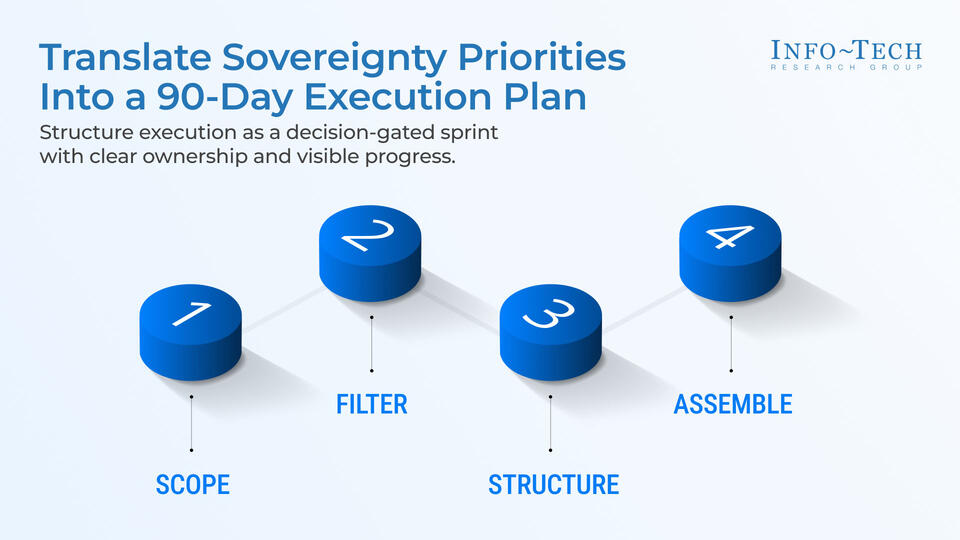
Translate sovereignty priorities into a 90-day execution plan
Structure execution as a decision-gated sprint with clear ownership and visible progress.
| 01 Scope Confirm priority pressure zones, select operational recommendations, and document scope rationale before any planning begins. |
02 Filter Apply the eligibility filter across five feasibility dimensions, classify by tier, and name accountable owners. |
03 Structure Break each recommendation into five execution elements, validate sprint readiness, map dependencies, and build the risk register. |
04 Assemble Build the 90-day workplan, draft the Working Group Charter, and stress-test for execution readiness. |
| Commit to Scope Agree on priorities and boundaries. |
Confirm Feasibility Validate what you can execute in 90 days. |
Define Execution Break work into sequenced, owned actions. |
Authorize Plan Approve the 90-day execution roadmap. |
From assessment to sovereignty strength: Build your 90-day sprint plan
AS A PUBLIC SECTOR LEADER
You've completed a sovereignty assessment and know your priority pressure zones. Now you need to translate those priorities into an execution plan.
Sovereignty is an opportunity to modernize, build resilience, and maximize organizational value. This execution path moves you from assessment to operational sovereignty strength in a single fiscal quarter.
KEY DELIVERABLE
90-Day Digital Sovereignty Execution Roadmap
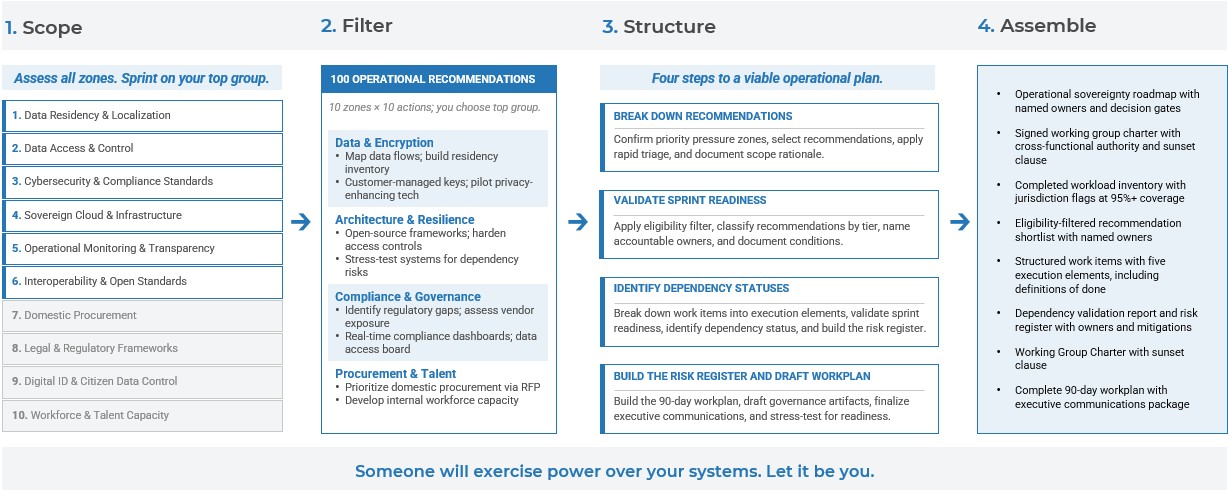
Info-Tech's methodology for building a 90-day digital sovereignty execution roadmap
|
Phase Steps |
1. Scope |
2. Filter |
3. Structure |
4. Assemble |
|---|---|---|---|---|
|
1.1 Confirm pressure zone priorities. |
2.1 Apply eligibility filter. |
3.1 Analyze recommendations into five execution elements. |
4.1 Assign work items to phases and weeks. |
|
|
Phase Outcomes |
|
|
|
|
Insight summary
The gap is execution, not assessment
Most organizations know their priorities. They stall without owners, decision gates, and time-boxing.
|
Scope creep can defeat progress |
Encryption key custody is the strongest CLOUD Act control |
Decision gates preserve trust |
|---|---|---|
|
A focused 90-day sprint beats a sprawling transformation. Five completed artifacts beat thirty unfinished ones. Use the eligibility filter to lock scope before commitment. |
The CLOUD Act cannot compel decryption if the provider doesn't hold the key.1 Customer-managed keys on domestic hardware security modules are the highest-impact control achievable in 90 days. |
Day 30, 60, and 90 gates force clean go/stop decisions. Stopping early is leadership; finishing nothing erodes trust. |
Sunset clauses prevent governance drift
Dissolve the working group at Day 90 unless explicitly reauthorized – avoid zombie committees and ensure clear accountability.
1. United States Congress, 2018
Blueprint benefits
|
IT Benefits |
Business Benefits |
|---|---|
|
Structured framework Workload inventory Reusable sprint methodology Reduced extraterritorial exposure |
$500K to $2M cost avoidance Quarterly progress reporting Scale/Stop/Sequence framework Sovereignty as catalyst |
Measure the value of this blueprint
|
SHORTENED TIME TO EXECUTION
|
COST AVOIDED
|
CAPABILITY BUILT
|
Track these KPIs to confirm sovereignty value materializes
01
% of data within sovereign jurisdictions
02
Active sovereignty policy violations
03
Vendor concentration risk score
04
Sovereignty gap index
05
Compliance audit pass rate and response time
Case Study: Estonia
Sovereignty through interoperability
INDUSTRY: National Government
SOURCE: e-Estonia, 2024; Emerging Europe, 2024; NIIS, 2024
Pressure Zone:
Interoperability and Open Standards
Operational Move:
Op Step 6: Establish Cross-Agency Data Exchange Framework Using Open Standards
In 1991, Estonia chose a decentralized model. Each ministry owns its own data systems, connected through a shared open-standards layer. The result: X-Road, launched in 2001, is the backbone of the world's most digitally sovereign state. No central data warehouse exists to be compromised, and each agency retains custody of its own data while exchanging it in encrypted, digitally signed transactions. Sovereignty is structural; it's built into the architecture, not bolted on as policy.
Results
- 100% digitalization of all government services (December 2024); second in UN
E-Government Development Index - 2.2 billion X-Road transactions per year across 52,000+ organizations; 1,345 working years saved annually
- No known major X-Road security breaches despite persistent foreign cyberattacks
- X-Road adopted in 20+ countries; NIIS Gaia-X alignment PoC launched 2024
- Data Embassy program: sovereign backup infrastructure hosted on legally Estonian territory in allied nations
Case Study: Australia
Sovereignty as compliance obligation
INDUSTRY: National Government
SOURCE: Australian Government, 2023, April 2025 & Dec. 2025; Protiviti, 2024
Pressure Zone:
Cybersecurity and Compliance Standards
Operational Move:
Embed Sovereignty Risks Into Enterprise Cyber Risk Registers
Rather than creating a parallel sovereignty structure, Australia extended its existing cybersecurity regulatory apparatus to carry the sovereignty mandate. The SOCI Act 2018, amended in 2021 and 2022, expanded from four sectors to eleven, requiring critical infrastructure operators to treat foreign ownership risk, supply chain compromise, and vendor dependency as mandatory risk register items. Layered on top are the Hosting Certification Framework, IRAP cloud assessments, and a 2023–2030 Cyber Security Strategy. A mandatory AI policy (v2.0, December 2025) extends the same logic to AI deployment. The gap: structural hyperscaler dependence persists, illustrating why compliance sets the floor but operational steps must operationalize the ceiling.
Results
- SOCI Act: 11 critical sectors (22 asset classes) carry mandatory sovereignty-aware risk management programs
- IRAP: AWS, Azure, Google Cloud, Oracle assessed against ISM controls at Protected level
- Hosting Certification Framework certifies cloud/data center providers against sovereignty criteria
- AI policy v2.0 (Dec 2025): mandatory impact assessments, transparency statements, and Australia Public Service–wide AI training
Phase 1
Phase 1: Scope
|
Phase 1 |
Phase 2 |
Phase 3 |
Phase 4 |
|---|---|---|---|
|
1.1 Confirm pressure zone priorities 1.2 Select operational recommendations 1.3 Apply rapid triage 1.4 Document scope rationale |
2.1 Apply eligibility filter 2.2 Classify recommendations by tier 2.3 Name accountable owners 2.4 Document conditions and mitigations |
3.1 Break down recommendations 3.2 Validate sprint readiness 3.3 Identify dependency statuses 3.4 Build the risk register |
4.1 Assign work items to phases and weeks 4.2 Draft governance artifacts and finalize plan 4.3 Finalize executive communications and stress-test the plan |
This phase will walk you through the following activities:
Confirm your sovereignty priorities and select the operational recommendations that will enter your plan. No planning begins until pressure zones are ranked, recommendations are shortlisted, and scope rationale is documented.
This phase involves the following participants:
CIO, IT Strategy Lead, CDO, Legal Counsel, Working Group Lead, Procurement Advisor, IT Operations Lead, Security Advisor, AI/Data Analytics Advisor, HR/People Operations
The CIO can say: "I understand which sovereignty priorities we are acting on and why these were selected over the alternatives."
Identify your digital sovereignty pressure zones
- Data Residency and Localization
- Data Access and Control
- Cybersecurity and Compliance Standards
- Sovereign Cloud and Infrastructure
- Operational Monitoring and Transparency
- Interoperability and Open Standards
- Domestic Procurement
- Legal and Regulatory Frameworks
- Digital ID and Citizen Data Control
- Workforce and Talent Capacity
Choose your starting point
OPTION ARecommended Use results from Strengthen Your Organization's Digital Sovereignty to confirm your top two to four pressure zones. |
OPTION BRapid self-selection
|
Convert sovereignty priorities into a 90-day execution plan
Five decisions turn inputs into an execution-ready workplan.
INPUT: Pressure zones identified → candidate sovereignty actions defined
| Commit to Scope FORCES FOCUS |
Confirm Feasibility FORCES REALISM |
Assign Accountability FORCES OWNERSHIP |
Define Execution FORCES CLARITY |
Authorize the Plan FORCES COMMITMENT |
|
DAYS 0–30 | STEPS 1–2 |
DAYS 30–60 | STEPS 3–4 |
60–90 | STEP 5 |
||
OUTCOME
Execution-ready 90-day sovereignty plan
EXECUTION SYSTEM | EXCEL TOOL
Scope → Filter → Structure → Assemble
Each stage enforces a decision before progression and captures deferred work for later phases.
WHAT THIS PREVENTS
Common failure modes a 90-day plan must avoid
- Scope creep
- Unowned initiatives
- Unrealistic plans
- Execution without alignment
WHY THIS WORKS
Each step is a gate, not a task. The tool supports decisions; it does not replace them.
1.1 Confirm pressure zone priorities
Effort: 4-6 hours
- Review applicable regulatory frameworks:
- M-25-21, Executive Office of the President
- Digital Ambition, Government of Canada
- Bill 82, National Assembly of Québec
- Define your sprint scope using one of the following paths:
- Option A: Use prior outputs (fastest). Review your Strengthen Your Organization's Digital Sovereigntyoutputs and confirm two to four priority pressure zones.
- Option B: Run a rapid self-assessment (no prior work required). Use the Build Your 90-Day Digital Sovereignty Workplan tool to assess your current state and identify top priority pressure zones.
- Identify candidate actions: In Tab 3, Recommendation Library, select up to ten recommendations per selected zone for eligibility screening in Step 1.2.
- Triage for feasibility: Flag obvious Tier 3 items (require legislation, multiyear funding, or missing capabilities) before fully filtering for eligibility in future steps.
- Narrow to viable candidates: Confirm five to eight candidate recommendations for deeper eligibility assessment in Step 1.2.
- Document scope rationale: State why these zones, why now, and what is explicitly excluded.
Download Build Your 90-Day Digital Sovereignty Workplan
|
Input |
Output |
|---|---|
|
|
|
Materials |
Participants |
|
|
About Info-Tech
Info-Tech Research Group is the world’s fastest-growing information technology research and advisory company, proudly serving over 30,000 IT professionals.
We produce unbiased and highly relevant research to help CIOs and IT leaders make strategic, timely, and well-informed decisions. We partner closely with IT teams to provide everything they need, from actionable tools to analyst guidance, ensuring they deliver measurable results for their organizations.
What Is a Blueprint?
A blueprint is designed to be a roadmap, containing a methodology and the tools and templates you need to solve your IT problems.
Each blueprint can be accompanied by a Guided Implementation that provides you access to our world-class analysts to help you get through the project.
Need Extra Help?
Speak With An Analyst
Get the help you need in this 4-phase advisory process. You'll receive multiple touchpoints with our researchers, all included in your membership.
Guided Implementation 1: Scope
- Call 1: Confirm pressure zones and scope.
Guided Implementation 2: Filter
- Call 1: Apply eligibility filter.
- Call 2: Name owners and confirm authority spans.
Guided Implementation 3: Structure
- Call 1: Validate dependencies and risks.
- Call 2: Break down work items and define five elements of each.
Guided Implementation 4: Assemble
- Call 1: Build the 90-day workplan; assign phases and weeks.
- Call 2: Draft Working Group Charter.
- Call 3: Prepare executive communications package.
- Call 4: Stress-test and finalize the complete plan.