
Build Cyber Resilience in Connected Retail
Make consistent security decisions across stores, platforms, and customer data.
- Store systems, IoT devices, cloud platforms, and customer applications operate as a single ecosystem
- Security controls are deployed by technology domain, not aligned to retail operations
- Compliance demands increase complexity without improving consistency
Our Advice
Critical Insight
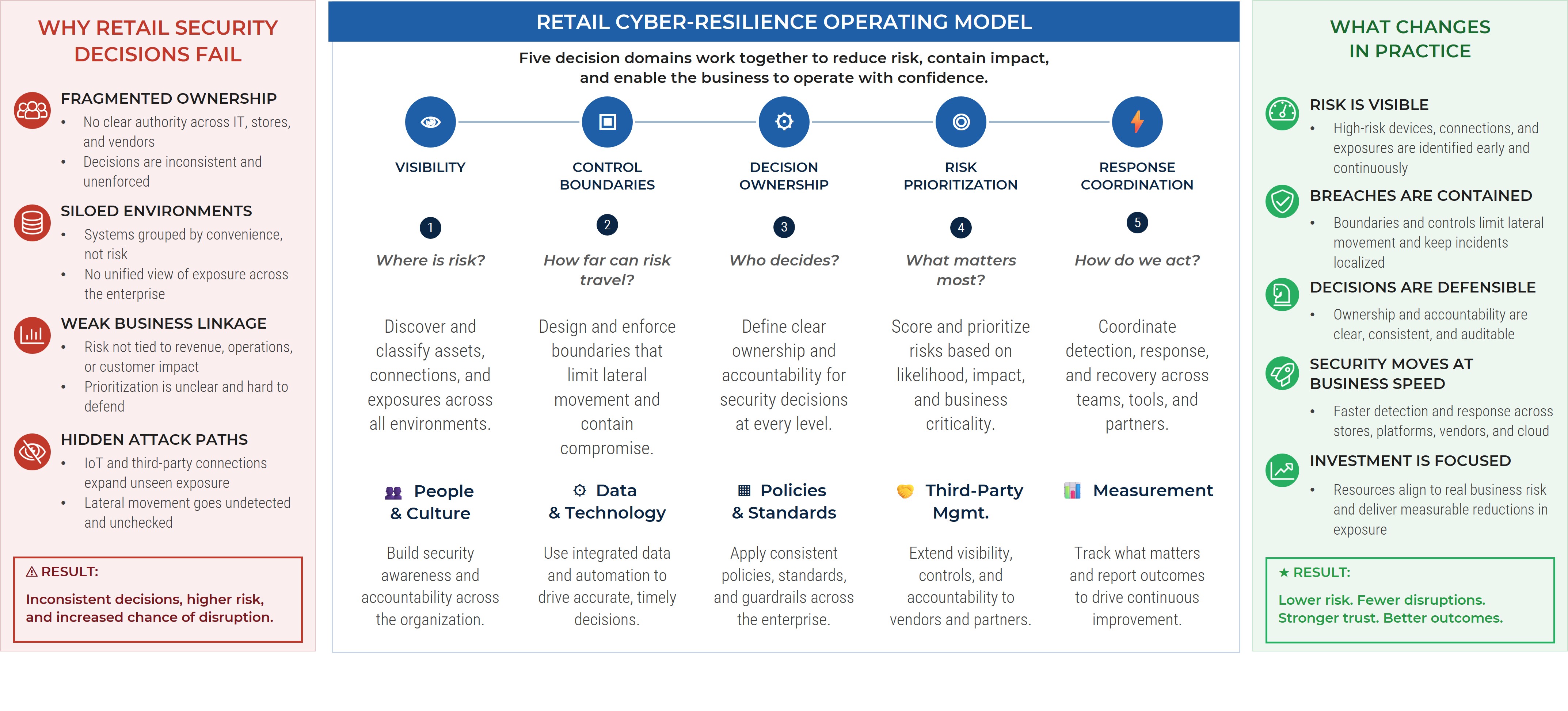
Cyber resilience in retail is not achieved by adding more controls, but by defining how security decisions are made, owned, and applied across the connected retail environment.
Impact and Result
- Establish clear decision boundaries across stores, platforms, and data
- Align security ownership across IT, operations, and vendors
- Apply selective rigor based on retail risk patterns and business impact
Build Cyber Resilience in Connected Retail
Make consistent security decisions across stores, platforms, and customer data.
Analyst perspective
Security failures stem from fragmented decisions, not missing controls

Retail cybersecurity is no longer defined by isolated systems or a clear network perimeter. Stores, cloud platforms, IoT devices, and customer-facing applications now operate as a single, interconnected environment, dramatically expanding the attack surface.
Most organizations have responded by adding tools and controls across these environments. However, these investments are fragmented, applied inconsistently across channels, and rarely aligned to how retail operations function.
As a result, security breakdowns are not primarily caused by missing controls, but by unclear decision boundaries, fragmented ownership, and inconsistent application of security across the retail environment.
Cybersecurity has shifted from a compliance and tooling challenge to an operating model challenge that directly affects resilience, business continuity, and customer trust.
Donnafay MacDonald
Research Director, Retail Industry
Info-Tech Research Group
Executive summary
Your Challenge |
Common Obstacles |
Info-Tech’s Approach |
|---|---|---|
Security is fragmented across the retail environment:
As a result, security is applied unevenly across channels, creating blind spots and inconsistent protection. |
Operating model gaps prevent consistent security decisions:
Security decisions are reactive, inconsistent, and difficult to defend. |
Define a cyber-resilience operating model for retail:
Consistent, defensible security decisions across the retail environment. |
Info-Tech Insight
Cyber resilience in retail is not achieved by adding more controls, but by defining how security decisions are made, owned, and applied across the connected retail environment.
Your challenge
Retail security decisions face structural constraints.
- Fragmented systems limit decision authority
Legacy POS systems, IoT devices, and cloud platforms were deployed by different teams at different times, leaving no single function with full visibility or control.
Decision constraint: No single owner can make end-to-end security decisions, creating gaps in accountability and inconsistent controls. - Compliance complexity creates conflicting requirements
PCI-DSS, GDPR, CCPA, and other mandates impose overlapping and sometimes contradictory expectations on how data is stored, processed, and protected.
Decision constraint: Security decisions must satisfy competing regulations at once, making it hard to standardize controls across shared systems. - Attack speed outpaces traditional governance
Modern attacks exploit identity, third-party access, and lateral movement with speed that legacy, perimeter-based defenses were not designed to handle.
Decision constraint: Response decisions must be made faster than traditional escalation allows, driving reliance on ad hoc decision-making.
Retail environments combine:
- High-value payment data
- Extensive third-party access
- Vendor-dependent digital commerce
The result is a broad, interconnected attack surface that amplifies risk propagation.
Your obstacles
Organizational design, not technology, prevents consistent security decisions
Retail CIOs understand the complexity but lack the organizational model to respond. The result: security decisions that are inconsistent, slow, and hard to defend at the executive level.
- Ownership is not structured for cross-channel decisions
Security responsibilities are split across IT, store operations, and third parties – with no clear model for how decisions are shared or enforced.
Decision impact: No single function can enforce decisions across the full retail environment. - Execution is not coordinated across the environment
Security capabilities are implemented independently across systems, teams, and vendors, with limited integration at the decision level.
Decision impact: Teams cannot apply consistent controls across channels, leading to fragmented execution. - Security is not framed in business terms
Security decisions are rarely tied to operational disruption, revenue impact, or customer risk.
Decision impact: CIOs cannot clearly prioritize or justify decisions, limiting executive alignment and investment confidence.
Core Failure
Retail organizations do not fail to understand cyber risk. They fail to structure how decisions about that risk are made, owned, and enforced.
Abandon perimeter-based security as the primary decision model
Retail environments no longer support perimeter-based assumptions about control and trust
Perimeter-based security assumes clear boundaries, controlled access points, and limited trust relationships. These conditions no longer exist in retail environments.
Driver |
Decision Implication |
Attackers use trusted access |
Identity and third-party access must be governed as primary control points. |
The edge is everywhere |
Security decisions cannot rely on a single network boundary. |
Attacks move at machine speed |
Decision-making must be faster and more distributed. |
Third-party exposure scales risk |
Vendor and ecosystem risk must be explicitly governed. |
Retail security cannot be structured around defending a boundary. It must be structured around how decisions are made across a distributed, interconnected environment.
Build cyber resilience in connected retail organizations
Make security decisions visible, consistent, and defensible.
Control how risk travels through the retail environment
Security decisions must determine how far compromise can spread
Once an attacker gains access, the impact is determined by how the environment is structured. In retail, the way systems, devices, and networks are grouped defines whether a breach remains contained or spreads across the enterprise.
Unstructured environments allow risk to propagate
When IT, IoT, and operational systems mix freely, a single compromised asset can expose critical systems.
Deliberate segmentation creates control boundaries
Grouping systems by purpose, risk, and communication need enables controlled interaction and reduces exposure.
Architecture reflects decision discipline
The way environments are structured determines whether risk is contained quickly or escalates into enterprise-wide disruption.
Cyber resilience in retail depends on defining where and how environments must be segmented, not simply deploying controls within them.
How Architecture Reflects Security Decisions |
||
|---|---|---|
Uncontrolled Environment |
Controlled Environment |
Decision Outcome |
Flat Network |
Segmented Architecture |
Reduced attack surface |
Devices grouped by convenience |
Devices grouped by purpose and risk |
Easier containment |
Broad internal trust |
Explicit traffic controls |
Limited lateral movement |
Easy attacker movement |
Isolated critical systems |
Stronger operational resilience |
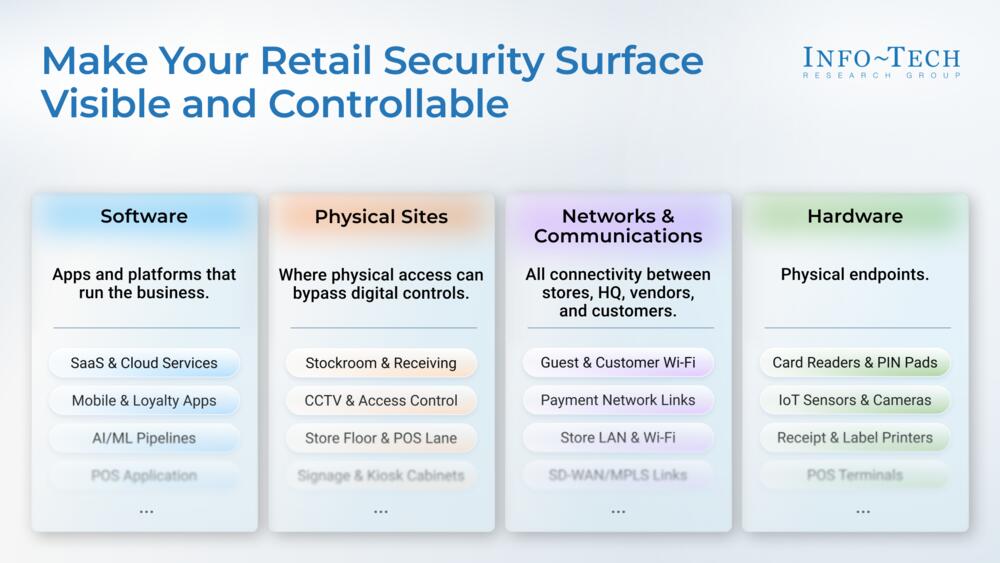
Hidden device risk creates attack paths security teams often cannot see
Retailers must uncover their blind spots
The retail attack surface is expanding faster than visibility Stores, supply chains, and digital channels keep adding connected devices, many of which sit outside traditional security controls.
Identifying both lets retailers focus where exposure is greatest – protecting payment systems, customer data, and store operations. |
High-risk devices are actively communicating with internal business systems, expanding the retail attack surface. 48.2% of IoT-to-IT connections come from high-risk devices. |
Critical-risk device connections pose the most danger as they combine severe technical weakness with high business importance. 4% of IoT-to-IT connections come from critical-risk devices |
Source: "Device Security Threat Report," Palo Alto Networks, 2025.
Make security risk prioritization decisions based on business impact
KEY INSIGHT
Retail security gets stronger when CIOs stop chasing every threat and instead focus controls on their own devices, traffic paths, and business‑critical operations.
1. Define what risk matters in your environment |
2. Determine where exposure exists |
3. Decide which risks justify action |
|---|---|---|
Replace intuition with a fact-based view of cyber exposure using recent risk data and simple device-level scoring. |
Combine technical risk and business impact to create a clearer basis for prioritization. |
Identify high-risk paths and define practical segmentation actions that reduce exposure quickly. |
1.1 Prepare security risk evaluation criteria Configure TRA identifiers, data classifications, risk tolerance, and severity scales. |
2.1 Assess vulnerabilities Identify and prioritize vulnerabilities across assessed system components. |
3.1 Assess likelihood and impact Score risks by likelihood and impact, then define responses. |
1.2 Evaluate relevant assets Identify and document asset inventory under assessment. |
2.2 Identify threats and develop risk scenarios Identify system threats and build concise, AI-assisted risk scenarios. |
3.2 Prioritize security risks Rank risks by severity to focus mitigation efforts. |
Outcome Establish a documented risk baseline by identifying assets and defining tolerances for assessment. |
Outcome Link threats and vulnerabilities to components using AI-assisted risk scenarios. |
Outcome Generate a risk-scored register with responses prioritized against risk tolerance. |
Info-Tech’s methodology to build cyber resilience in connected retail
1. Define What Risk Matters in Your Environment |
2. Determine Where Exposure Exists |
3. Decide Which Risks Justify Action |
|
|---|---|---|---|
Phase Steps |
1.1 Prepare security risk evaluation criteria |
2.1 Assess vulnerabilities |
3.1 Assess likelihood and impact |
Phase Outcomes |
Establish a documented risk baseline by identifying assets and defining tolerances for assessment. |
Link threats and vulnerabilities to components using AI-assisted risk scenarios. |
Generate a risk-scored register with responses prioritized against risk tolerance. |
Research deliverable
Each step of this research is accompanied by supporting deliverables to help you accomplish your goals:
Retail Security Threat Risk and Assessment Tool
Provides the structure to define your risk foundation, assess system vulnerabilities, identify and scenario-map threats, and score each risk by likelihood and impact.
This tools produces a prioritized risk register that enables security teams to confidently target the highest-severity risks and move into informed mitigation planning and control implementation.
Insight summary
Structure builds confidence
A structured, tool-supported threat and risk assessment (TRA) process replaces intuition with evidence, enabling retail security teams to defend prioritization decisions to executive stakeholders.
Baseline before acting
Anchoring your risk classification, tolerance, and matrix before assessment takes the guesswork out of where security improvement is needed in your retail environment.
Reduce blind spots
Rather than defending against security threats that feel most visible, listing your assets and mapping threats to them gives organizations the clarity needed to assess risk accurately.
Tolerance anchors scoring
Rather than treating every risk as equally urgent, scoring against your defined tolerance threshold separates the risks demanding immediate attention from those your organization can consciously accept, monitor, or fix.
Start narrow
Focusing on a defined in-store scope, such as POS devices, back-office systems, or inventory platforms, surfaces the most exposed retail assets first, before expanding the assessment further.
Build the practice
A structured TRA process built around consistent steps means retail teams spend less time reinventing the approach and more time acting on the risks that matter most.
Measure the value of the retail cyber resilience project
Info-Tech’s approach will accelerate your success. Estimates reflect advisory and workshop experiences.
With this research |
Without this research |
||
|---|---|---|---|
Phase 1: Define what risk matters in your environment |
1 to 5 people |
1 day |
1-2 weeks |
Phase 2: Determine where exposure exists |
1 to 5 people |
1 day |
1-2 weeks |
Phase 3: Decide which risks justify action |
1 to 5 people |
1 day |
1-2 weeks |
Time Saved: 6 weeks
Benefits are iterative
The value of the project comes from the initial program design, but you will experience benefits over time as well as you iterate the approach and evaluate additional risks more effectively.
Case study
Ready teams resolve threats faster
COMPANY: Anonymous – Gas Station
INDUSTRY: Retail Industry
SOURCE: Palo Alto Networks, 2023
A global gas station franchise with hundreds of locations running thousands of daily card transactions discovered a threat actor had physically modified in-store POS credit card readers to harvest customer payment data.
A staff member spotted a suspect physically attaching a Bluetooth-enabled credit card skimmer to a POS reader on surveillance footage they were actively reviewing. Managers immediately pulled the device and engaged Palo Alto Networks' Unit 42 to assess the full scope of the breach.
How the attack worked:
- The skimmer was fitted with a tamper-evident sticker taken from an authorized card reader to appear legitimate
- A single device can hold data from up to 3,000 cards
- The device used Bluetooth to collect, store, and transmit stolen card data.
Because staff identified and removed the device quickly, only a small number of customers were affected. The forensic investigation gave the retailer a focused, evidence-based response rather than a broad customer notification that would have caused reputational damage.
Results:
The forensic investigation identified precisely when the attack occurred and which cards were compromised.
With a precise scope confirmed, the retailer notified only the affected banks, who issued replacement cards and resolved the incident without triggering widespread customer alarm.
Understanding the attacker’s tactics gave the retailer the knowledge to identify what to monitor, what controls to strengthen, and how to respond faster if a similar threat occurs again.
Source: "Retailer Evaluates Impact of Credit Card Skimming Attack …", Palo Alto Networks, 2023.
About Info-Tech
Info-Tech Research Group is the world’s fastest-growing information technology research and advisory company, proudly serving over 30,000 IT professionals.
We produce unbiased and highly relevant research to help CIOs and IT leaders make strategic, timely, and well-informed decisions. We partner closely with IT teams to provide everything they need, from actionable tools to analyst guidance, ensuring they deliver measurable results for their organizations.
What Is a Blueprint?
A blueprint is designed to be a roadmap, containing a methodology and the tools and templates you need to solve your IT problems.
Each blueprint can be accompanied by a Guided Implementation that provides you access to our world-class analysts to help you get through the project.
Talk to an Analyst
Our analyst calls are focused on helping our members use the research we produce, and our experts will guide you to successful project completion.
Book an Analyst Call on This Topic
You can start as early as tomorrow morning. Our analysts will explain the process during your first call.
Get Advice From a Subject Matter Expert
Each call will focus on explaining the material and helping you to plan your project, interpret and analyze the results of each project step, and set the direction for your next project step.
Unlock Sample ResearchContributors
2 Anonymous contributors
