
Build a Resource Plan to Support Integrated IT and Biomedical Device Management
Secure your expanding digital estate.
- Rising device complexity and volume: Health IT leaders must now support 10 times more devices – including biomedical, IoT, and imaging systems – without standardized processes or resourcing models.
- Lack of staffing benchmarks for integrated device support: Hospitals are struggling to allocate the right mix of IT security, Biomed, and clinical informatics roles due to the absence of industry benchmarks for device management staffing.
- Operational inefficiencies from poor device integration: Disconnected systems and unclear accountability across IT and Biomed lead to clinician frustration, security gaps, and workflow delays that threaten patient safety.
Our Advice
Critical Insight
- No standard framework for tracking and securing devices: Many healthcare organizations rely on manual spreadsheets and point systems to manage device inventory making it difficult to ensure security across thousands of connected devices.
- Skills and coverage gaps in staffing models: As device ecosystems grow, healthcare leaders face gaps in 24/7 support coverage, cross-trained teams, and cybersecurity readiness especially in remote or high-risk areas.
- Unclear accountability between IT and biomed: Without clear roles, responsibilities, and shared governance, device management becomes fragmented, increasing risk and reducing organizational resilience.
The real risk in healthcare device management isn’t just the rise in connected devices, it’s the lack of a unified, data-driven resource plan to support them. As IT inherits responsibility for everything with an IP address, healthcare systems must proactively align staffing, governance, and support models across IT and Biomed to manage risk, scale operations, and protect care delivery.
Impact and Result
- Review the current trends and models for biomedical device management, resource planning, and regulatory requirements.
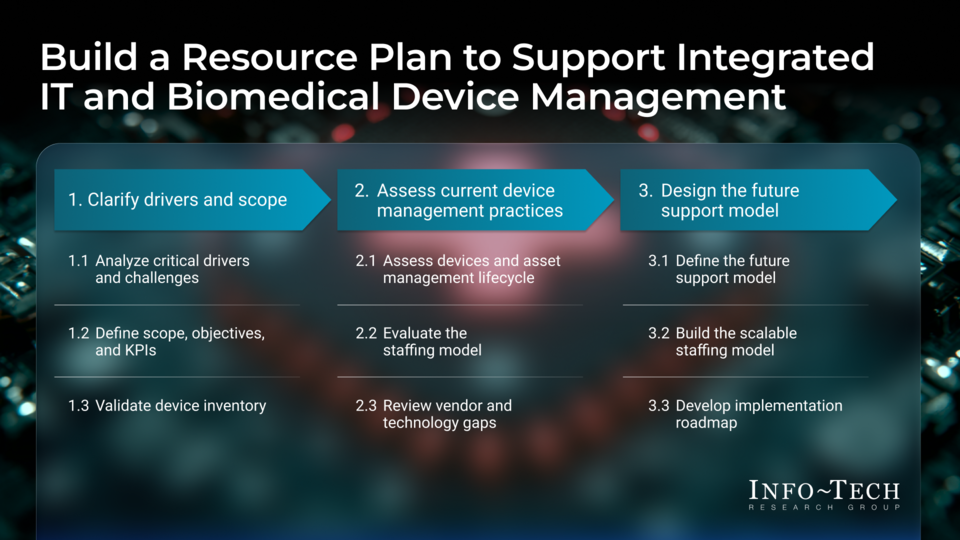
- Identify key organizational pain points through stakeholder interviews, define clear objectives and KPIs, and validate the biomedical and IT device inventory to establish an accurate baseline.
- Evaluate asset lifecycle processes, staffing capabilities, and vendor solution gaps to uncover inefficiencies and identify improvement opportunities through a gap analysis.
- Define a risk-based, integrated support model; build a scalable staffing and training plan; and develop a detailed implementation roadmap with milestones and communication strategies.
Build a Resource Plan to Support Integrated IT and Biomedical Device Management
Secure your expanding digital estate.
Analyst perspective
Align IT and Biomed to secure the expanding edge of care.

The future of healthcare hinges on a quiet transformation: the convergence of clinical technology management and digital infrastructure. As every infusion pump, monitor, and imaging device becomes a networked endpoint, the line between IT and biomedical device teams has blurred. Yet most hospitals still operate with fragmented ownership – leaving critical gaps in security, support coverage, and governance.
What’s needed isn’t just more staff – it’s a unified operating model that reflects the shared accountability required in modern care environments. Biomedical and IT teams must evolve from parallel functions to an integrated capability – jointly responsible for lifecycle management, cybersecurity, compliance, and clinical uptime.
This research challenges the traditional model and proposes a future-ready approach rooted in cross-functional alignment. It empowers leaders to scale their support models, address the device explosion, and harden the expanding edge of care – where technology and patient safety intersect.
Sharon Auma-Ebanyat
Research Director, Healthcare Industry
Info-Tech Research Group
Build a Resource Plan to Support Integrated IT and Biomedical Device Management
Secure your expanding digital estate.
EXECUTIVE BRIEF
Executive summary
Your Challenge
Rising device complexity and volume
Health IT leaders must now support 10 times more devices – including biomedical, IoT, and imaging systems – without standardized processes or resourcing models.
Lack of staffing benchmarks for integrated device support
Hospitals are struggling to allocate the right mix of IT security, biomed, and clinical informatics roles due to the absence of industry benchmarks for device management staffing.
Operational inefficiencies from poor device integration
Disconnected systems and unclear accountability across IT and Biomed lead to clinician frustration, security gaps, and workflow delays that threaten patient safety.
Common Obstacles
No standard framework for tracking and securing devices
Many healthcare organizations rely on manual spreadsheets and point systems to manage device inventory making it difficult to ensure security across thousands of connected devices.
Skills and coverage gaps in staffing models
As device ecosystems grow, healthcare leaders face gaps in 24/7 support coverage, cross-trained teams, and cybersecurity readiness especially in remote or high-risk areas.
Unclear accountability between IT and Biomed
Without clear roles, responsibilities, and shared governance, device management becomes fragmented, increasing risk and reducing organizational resilience.
Info-Tech’s Approach
Review the current trends and models for biomedical device management, resource planning, challenges, and regulatory requirements.
Identify key organizational pain points through stakeholder interviews, define clear objectives and KPIs, and validate the biomedical and IT device inventory to establish an accurate baseline.
Evaluate asset lifecycle processes, staffing capabilities, and vendor solution gaps to uncover inefficiencies and identify improvement opportunities through a gap analysis.
Define a risk-based, integrated support model; build a scalable staffing and training plan; and develop a detailed implementation roadmap with milestones and communication strategies.
Info-Tech Insight
The real risk in healthcare device management isn’t just the rise in connected devices; it’s the lack of a unified, data-driven resource plan to support them. As IT inherits responsibility for everything with an IP address, healthcare systems must proactively align staffing, governance, and support models across IT and Biomed to manage risk, scale operations, and protect care delivery.
Healthcare CIOs are overseeing more devices due to cyberthreats
With rising device complexity and volume health IT leaders must now support 10x more devices, including biomedical, IoT, and imaging systems, without standardized processes or resourcing models.
- Device growth is outpacing support structures: US hospitals now manage 10-15 network-connected devices per bed, creating a support burden that legacy IT/biomed support models aren’t designed to handle (The HIPAA Journal, 2024; Armis 2025).
- Siloed departments widen oversight gaps: Biomedical, imaging, and IT/OT teams manage devices independently, resulting in fragmented security and inconsistent device support practices.
- Hospitals lack benchmark staffing models for hybrid device support: No industry standard or guidance exists on how many biomedical equipment technicians, clinical engineers, cybersecurity engineers, or IT roles are needed per bed or per device, leading to wide variation in resource allocation making planning difficult.
- Ad hoc staffing models risk gaps in device security: Without defined staffing structures or cross-functional roles, hospitals rely on informal coordination between Biomed and IT, increasing the risk of accountability breakdowns.
- Device integration burdens staff under fragmented systems: In a US survey, 83% of nurses reported alarm fatigue, and 55% witnessed critical alarms go unchecked, highlighting operational strain from poorly integrated device systems (BMJ, 2023).
Healthcare CIOs face mounting barriers to secure device management
Lack of governance, staffing gaps, and unclear accountability hinder safe, scalable oversight of biomedical and IoT systems
No Standard Framework for Tracking & Securing Devices
- Many hospitals still lack a unified system to track IoT/medical devices. They still rely on ad hoc methods such as spreadsheets, leading to blind spots in what devices are online. Industry experts warn that siloed, piecemeal tracking creates risky blind spots in device visibility and security coverage.
Skills and Coverage Gaps in Staffing Models
- Healthcare organizations continue to struggle to recruit cybersecurity talent specific to device-level risk, undermining 24/7 support and cross-functional coverage for device management.
Unclear Accountability Between IT and Biomed
- The rise of network-connected medical devices has blurred the traditional boundaries between IT departments and clinical engineering (biomed) teams. Many hospitals are now grappling with confusion over who owns tasks like device cybersecurity, integration, and maintenance. Undermining workflow efficiency and exposing the organization to safety risks.
Barriers to secure device management
84%
Of US and UK hospital leaders identified asset tracking as a priority, yet a majority still rely on manual spreadsheets or basic point systems
Source: Zebra Technologies Vision Study, 2024
70%
of health systems are recruiting for medical device security roles, yet 80% report difficulty finding qualified candidates
Source: The Global Healthcare Cybersecurity Study, Claroty, 2023
51%
of health systems incorporate medical devices into their cybersecurity planning, reflecting a lack of shared IT–Biomed governance
Source: The HIPAA Journal, 2025
Healthcare talent gaps threaten device security and operations
Healthcare systems are facing critical staffing gaps in clinical engineering, biomedical equipment technicians (BMETs), cybersecurity, and health IT roles.
Clinical engineers
Over 55% of clinical engineers describe their workload as “heavy” or “excessive,” with 40% of clinical engineers aged 55 or older and nearing retirement, creating leadership and skills succession risks (GE Healthcare, 2024).
Biomedical equipment technicians (BMETs)
With ~7,300 annual openings for medical equipment repairers (BMETs), the US Bureau of Labor Statistics projects 18% job growth between 2023 and 2033, while there are only ~400 BMET graduates from BMET programs per year, indicating a major talent gap in healthcare (Business Insider, 2025).
Health IT staff
39% of hospital CIOs identify retaining and budgeting for qualified IT staff as their top operational challenge for 2025, highlighting widespread constraints in securing enough tech resources to support initiatives (Stoltenberg Consulting, 2025).
Cybersecurity professionals
14% of healthcare organizations have fully staffed cybersecurity teams, while 30% report being severely understaffed, creating critical gaps in medical device security and incident response readiness (Healthsectorcouncil, 2025).
Emerging regulations complicate the creation of an IT–Biomed strategy (US)
Regulation Name |
Summary of Key Requirements/Changes (2023–2025) |
Applicable Area |
Effective Date/Timeline |
FDA – Medical Device Cybersecurity Requirements (FD&C Act §524B & Guidance) |
|
Cybersecurity (devices) | Law effective March 29, 2023; FDA guidance finalized September 2023 with ongoing updates and enforcement refinement. |
HIPAA – Privacy & Security Rule Updates (Proposed 2024) |
|
"Privacy & Security (health data)" | Notice of Proposed Rulemaking published December 2024; final rule timeline pending (current Security Rule remains in effect). |
Emerging regulations complicate the creation of an IT–Biomed strategy (UK)
Regulation Name | Summary of Key Requirements/Changes (2023–2025) | Applicable Area | Effective Date/Timeline |
MHRA – Post-Market Surveillance Regulations (UK MDR 2002, as amended 2025) |
| Post-market Surveillance & Safety | Effective June 16, 2025 (applicable to devices placed on GB market from that date). Further UK regulatory updates (covering device approvals, UKCA marking, etc.) are expected in phases through 2025–2026, but the PMS requirements are already in force. |
NHS England – Data Security & Protection Toolkit (DSPT) |
| Cybersecurity & Data Privacy | Recurring annual requirement; e.g. 2023–24 Toolkit due by June 30, 2024 (Version 7.0 for 2024–25 due by June 30, 2025). |
Emerging regulations complicate the creation of an IT–Biomed strategy (Australia)
Regulation Name | Summary of Key Requirements/Changes (2023–2025) | Applicable Area | Effective Date/Timeline |
TGA – Medical Device Unique Device Identification (UDI) System |
| Device Identification & Traceability | UDI law effective 2024; Stages from 2025 (Class III/IIb by Jul 2025; others by 2026–27) |
About Info-Tech
Info-Tech Research Group is the world’s fastest-growing information technology research and advisory company, proudly serving over 30,000 IT professionals.
We produce unbiased and highly relevant research to help CIOs and IT leaders make strategic, timely, and well-informed decisions. We partner closely with IT teams to provide everything they need, from actionable tools to analyst guidance, ensuring they deliver measurable results for their organizations.
What Is a Blueprint?
A blueprint is designed to be a roadmap, containing a methodology and the tools and templates you need to solve your IT problems.
Each blueprint can be accompanied by a Guided Implementation that provides you access to our world-class analysts to help you get through the project.
Need Extra Help?
Speak With An Analyst
Get the help you need in this 3-phase advisory process. You'll receive multiple touchpoints with our researchers, all included in your membership.
Guided Implementation 1: Clarify drivers and scope
- Call 1: Scope objectives and identify key challenges.
- Call 2: Validate current inventory baseline.
Guided Implementation 2: Define business capabilities
- Call 1: Assess staffing and asset lifecycle practices.
- Call 2: Conduct capability and gap analysis.
- Call 3: Design future-state support model.
- Call 4: Build staffing and certification blueprint.
Guided Implementation 3: Identify assessment criteria and assess solutions
- Call 1: Develop roadmap and change plan.
- Call 2: Finalize implementation toolkit and next steps.
Contributors
- Anonymous, CIO, Hospital in South Africa
- Anonymous, CIO, Hospital on the West coast of the US
- Anonymous, CIO, Hospital on the East coast of the US
- Anonymous, CIO, Hospital in Midwest US
- Anonymous, CIO, Hospital in Midwest US
