
Build a Data Strategy for Professional Service Organizations
A pragmatic roadmap for B2B firms to drive client-centric outcomes.
- Fragmented systems and limited integration are limiting the opportunity for proactive decision-making. The knock-on effect of this shows up in resource underutilization, delivery issues, and cost control all severely impacting the bottom line.
- Overreliance on contractors due to poor forecasting puts further pressure on margins, while limited investment in internal upskilling continues to weaken talent readiness.
- Client expectations are shifting toward measurable ROI and faster delivery, especially considering the advances of Gen AI to accomplish portions of the PSO work product.
Our Advice
Critical Insight
- Shifting from technical planning to a business-aligned data strategy accelerates time to value by clarifying priorities, demonstrating ROI, and enabling executive buy-in.
- Without a focused, client-centric data strategy, PSO firms are flying blind while AI reshapes client expectations.
Impact and Result
- This research enables a streamlined process to achieve executive buy-in by purposefully linking data initiatives directly to revenue, internal metrics, and client impact.
- Additionally, it equips IT leadership with a clear outcome-focused narrative to prioritize investment and successfully drive transformation.
- Finally, it helps position the firm to meet shifting market conditions with measurable, data-driven service improvements.
Build a Data Strategy for Professional Service Organizations
A pragmatic roadmap for B2B firms to drive client-centric outcomes.
Analyst perspective
Data strategy gaps are now business sustainably risks.
Professional service organizations (PSOs) have long operated on deep individual expertise and partner autonomy, decentralized decision-making, and complex service delivery models. While this approach has historically driven success, it is now a source of structural friction as firms are under pressure to improve efficiency, protect margins, and remain competitive. Yet most PSOs lack the integrated data foundation required to respond, with fragmented systems, legacy technologies, and entrenched silos limiting firm agility.
While many PSOs have invested in analytics, most efforts remain isolated and tactical, disconnected from enterprise transformation. The convergence of margin pressure, client expectation shifts, and the rise of Gen AI reinforces the requirement for a cohesive, enterprise-level data management strategy.
This research provides PSOs with a data strategy framework to overcome structural and cultural barriers and position data as a firm asset. Traditional reporting approaches are insufficient to navigate the scale and speed of disruption facing the sector. A holistic data management strategy is now essential to achieve operational maturity, resilience, and sustainable growth.
As margin compression intensifies, talent models evolve, and Gen AI reshapes client expectations, the professional services industry is at an inflection point, making an enterprise-wide data strategy a business imperative, not a discretionary investment.

Kassim Dossa, MBA
Research Director, Industry Practice
Info-Tech Research Group
Executive summary
Your Challenge
Professional service organizations are at a critical juncture – where internal friction and external disruption necessitate transformation and simultaneously hinder it.
- Disjointed data systems don't allow for predictive decision-making across utilization, hurting profitability and reducing agility.
- Evolving workplace dynamics have uncovered gaps in planning and opportunities to build internal capacity.
- Client expectations are shifting toward faster delivery and demonstrable ROI, while discounting pressure and in-sourcing by leveraging AI threaten to displace PSOs on some basis.
Without a cohesive data strategy that links to talent while maintaining customer focus, PSOs risk experiencing further margin erosion.
Common Obstacles
These barriers are preventing professional service organizations from responding effectively to internal and market pressures:
- Real-time visibility gaps remain as current tools operate in silos, unable to integrate fragmented systems or provide company-wide insights across planning, delivery, and financials.
- Cultural resistance and capability gaps are adding further complexity the change management equation.
- A combination of weak Gen AI readiness and low data governance maturity are slowing the pace of transformation.
These barriers entrench operational inertia, making it challenging to drive transformation at scale and respond with agility to the changing landscape.
Info-Tech's Approach
- Focus on business outcomes: Shift the emphasis from technical data capabilities to how data initiatives can directly support and enable the achievement of critical business goals.
- Simplify communication for executive buy-in: Develop a clear strategy that resonates with the C-suite by aligning data initiatives with corporate objectives, making it easier to gain executive sponsorship and funding.
- Separate strategy from execution: Avoid conflating strategy with detailed operational plans; instead, focus on defining a clear direction and priorities first, allowing time for thorough assessments and implementation roadmaps to follow later.
Info-Tech Insight
Chaos in your data approach is already eroding margins and slowing transformation. Without a focused data strategy, you are flying blind while AI/ML reshapes client expectations. Align your data priorities now or risk falling even further behind.
Your challenge
Single-digit profitability marks an inflection point for the professional services industry, requiring urgent transformation.
- Fragmented data and gaps in system integration are hindering PSOs' ability to achieve proactive decision-making. These deficiencies are driving challenges across utilization, project delivery, and cost-management – ultimately eroding profitability.
- PSOs are struggling to adapt to evolving workplace dynamics. Many are unable to accurately forecast staffing needs, leading to an overreliance on contractors. At the same time, the industry is not prioritizing hiring for Gen AI capabilities or investing in upskilling teams, despite widespread expectations that AI will become central to their workflows in the near term.
- Client demands are evolving – morphing into requirements for measurable ROI within compressed timelines. This coincides with market tightening where new client acquisition is declining and discounting is on the rise. Compounding these challenges is the threat that clients may leverage AI to internally perform the work, disintermediating the PSO altogether.
Industry under threat
|
Key Performance Indicator (KPI) |
5-year avg. |
2024 |
|
Annual revenue per billable consultant (K) |
$204 |
$199 |
|
Percentage of annual revenue target achieved |
92.1% |
87.9% |
|
Percentage of annual margin target achieved |
89.3% |
86.9% |
|
Profit (EBITDA %) |
14.9% |
9.8% |
|
N=403, representing >150K team members |
Source: Service Performance Insight, 2025
Common obstacles
These barriers make the execution of a data management strategy challenge difficult to address for many organizations:
PSOs lack real-time visibility into their core business functions, generally due to fragmented data structures, siloed business units, and disparate, often homegrown, systems.
Lack of data governance maturity combined with inconsistent policies create compliance, trust, and risk issues that stall adoption.
Limited internal data science capacity – driven by a dearth of training initiatives, tooling costs, and hiring practice gaps.
Cultural resistance in an industry which is used to relying on history and intuition for decision-making, compounded by lack of trust in Gen AI security and outcomes.
52% |
52% of professional service organizations reported having no policies around Gen AI. Source: Reuters, 2025 |
27% |
Only 27% of organizations reported that their planning solutions were integrated with their core financial applications. Source: Service Performance Insight, 2025 |
Standardize core processes to unlock effective data strategy
|
% of Industry |
Maturity Level |
|
L5 5% |
Optimized "Collaborative": These organizations are highly disciplined and collaborative. Their focus is trained on continuous improvement and optimization via technology innovation. |
|
L4 15% |
Institutionalized "Portfolio Excellence": These organizations are focused on optimizing performance and delivering differentiated services. |
|
L3 25% |
Deployed "Project Excellence": Organizations at this stage have shifted away from heroics and firefighting by using standard business processes across core service performance pillars. |
|
L2 25% |
Piloted "Functional Excellence": They have repeatable core processes, but they're not enforced or widely documented. Best practices have emerged in specific functional areas or geographies. |
|
L1 30% |
Initiated "Heroic": Ad hoc processes coupled with a primary focus on client acquisition. Success is highly reliant on individual team member competence. |
Source: Service Performance Insight 2025, N=403, representing >150K team members
Improve Capabilities First
You are best positioned to successfully execute a data strategy if your organization is operating at Level 3 or above. If you're still at the heroic and functional excellence levels, your efforts are best spent standardizing your core business processes. This foundation is essential for enabling scalable data management and analytics.
Enhance efficiency and profitability through process maturity
Effective resource allocation, driven by process maturity (as shown on the previous slide), directly impacts your bottom line.
|
|
L1 Initiated |
L2 Piloted |
L3 Deployed |
L4 Institutionalized |
L5 Optimized |
|
Year-over-year change in PS revenue |
0.1% |
2.7% |
6.4% |
9.3% |
14.4% |
|
Employee billable utilization |
59.6% |
61.3% |
70.4% |
78% |
83.6% |
|
PROFIT (EBITDA %) |
2.7% |
5.7% |
9.1% |
11.8% |
20.8% |
Source: Service Performance Insight 2025
Realign your data priorities to address user expectation gaps
Your users already recognize the misalignment between IT priorities and business expectations.
Four key areas pertinent to developing a data strategy are:
- Data quality
- Analytics capabilities
- IT innovation leadership
- Quality of IT training for IT support services
Launch the CIO Business Vision Diagnostic
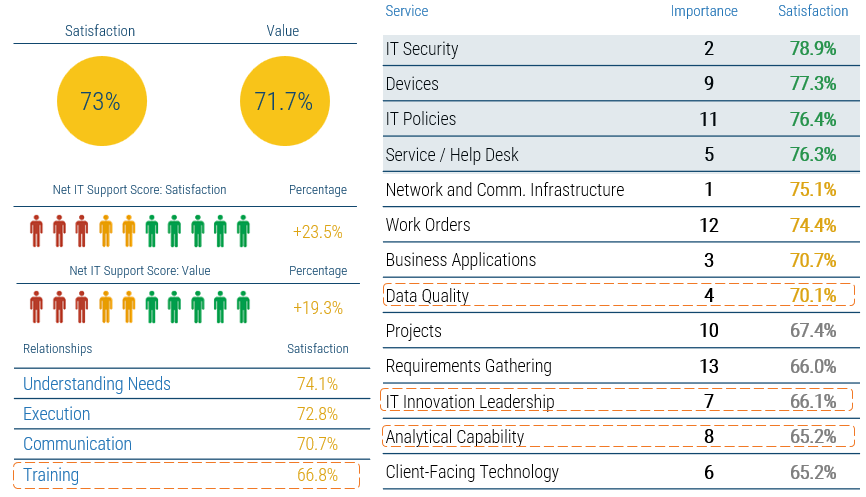
Source: Info-Tech's CIO Business Vision Diagnostic 2022-2025, N=48 Professional services organizations
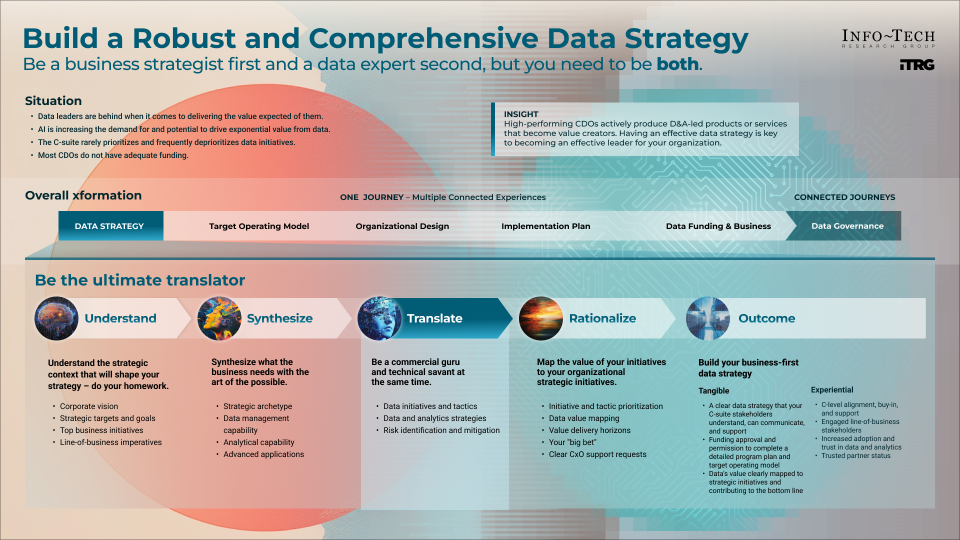
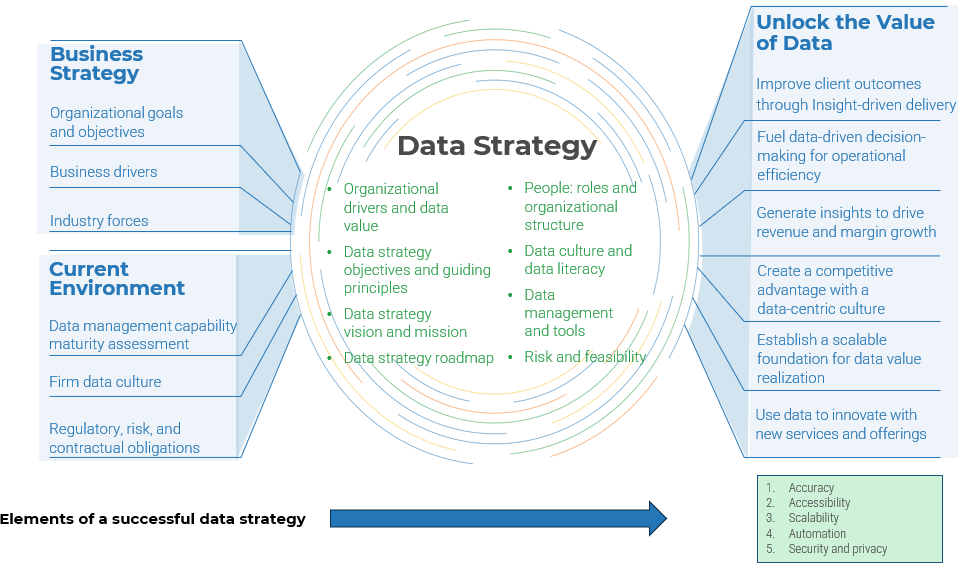
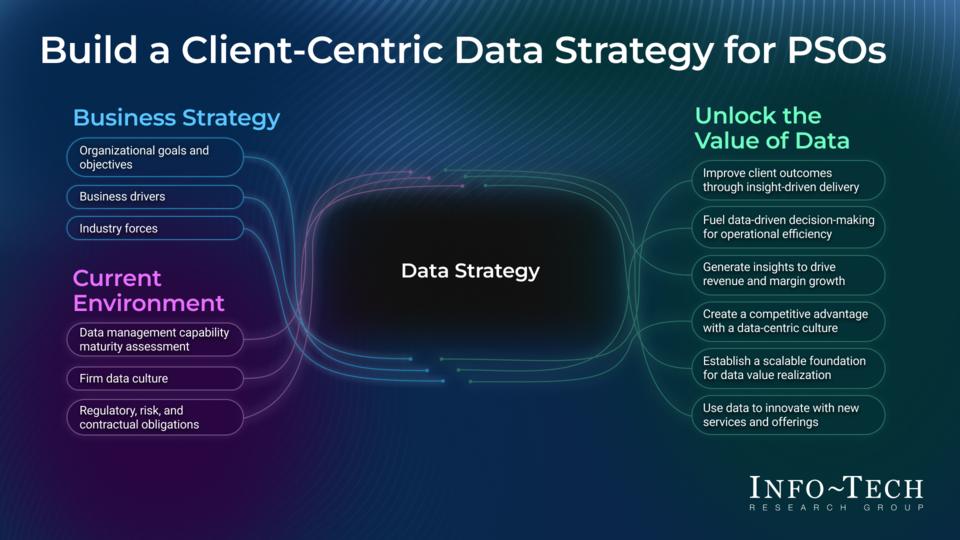
Build a client-centric data strategy for PSOs
About Info-Tech
Info-Tech Research Group is the world’s fastest-growing information technology research and advisory company, proudly serving over 30,000 IT professionals.
We produce unbiased and highly relevant research to help CIOs and IT leaders make strategic, timely, and well-informed decisions. We partner closely with IT teams to provide everything they need, from actionable tools to analyst guidance, ensuring they deliver measurable results for their organizations.
What Is a Blueprint?
A blueprint is designed to be a roadmap, containing a methodology and the tools and templates you need to solve your IT problems.
Each blueprint can be accompanied by a Guided Implementation that provides you access to our world-class analysts to help you get through the project.
Need Extra Help?
Speak With An Analyst
Get the help you need in this 5-phase advisory process. You'll receive multiple touchpoints with our researchers, all included in your membership.
Guided Implementation 1:
- Call 1: Scope requirements, objectives, and your specific challenges.
- Call 2: Establish business context for your strategy.
- Call 3: Establish vision, mission, and guiding principles
Guided Implementation 2:
- Call 1: Debrief line-of-business deep dive.
- Call 2: Identify risks and inhibitors to your data strategy.
Guided Implementation 3:
- Call 1: Define your data initiatives portfolio.
- Call 2: Define your data strategies and key tactics.
Guided Implementation 4:
- Call 1: Assess data initiative feasibility and prioritization.
- Call 2: Rationalize your initiatives portfolio and align strategic value.
- Call 3: Define your “big bet” and complete your strategy cards.
Guided Implementation 5:
- Call 1: Summarize results and plan next steps.
Contributors
- Harjinder Nohal, Senior Manager, Strategy and Center of Excellence, IT, BDO Canada LLP
- John Kemp, Executive Counselor, Global Services, Info-Tech Research Group
- Reiaz Somji, Executive Counselor, Global Services, Info-Tech Research Group
- Usman Lakhani, Principal Advisory Director, Info-Tech Research Group
- Areez Elavia, Senior Workshop Director, Info-Tech Research Group
- Andrea Malick , Principal Advisory Director, Info-Tech Research Group
- Igor Ikonnikov, Advisory Fellow, Info-Tech Research Group
- Steve Willis, Practice Lead – R&D, Info-Tech Research Group
