
Assess and Prioritize Agentic AI Use Cases in Professional Services Organizations
Assess agentic AI use cases with a triage model that connects fit, guardrails, and value.
- Determine when judgement-heavy workflows require agentic AI versus Gen AI, RPA, or redesign.
- Understand where autonomy can be allowed and where human accountability must remain in workflows.
- Confirm that use cases fit the firm’s economics, client expectations, and service model.
Our Advice
Critical Insight
- In professional services, agentic AI is primarily a workflow governance decision, not just a technology decision.
- The strongest use cases are grounded in real workflows, bounded by human review, and prioritized for business fit, delivery value, and firm readiness.
- Firms create value when they replace isolated assessments with a consistent triage model that links workflow fit, autonomy guardrails, and proven business value.
Impact and Result
- Teams gain a shared understanding of agentic AI concepts, vocabulary, and practical fit for professional services firms.
- The work produces a structured set of safe, agentic use cases mapped to business capabilities and evaluated through business impact and implementation feasibility.
- The final output is a scored, visually represented portfolio that supports confident, defensible prioritization and leadership decision-making.
Assess and Prioritize Agentic AI Use Cases in Professional Services Organizations
Assess agentic AI use cases with a triage model that connects fit, guardrails, and value.
Analyst perspective
Deploy agentic AI where firms can gain leverage without creating unmanaged risk.
In professional services, agentic AI is not primarily a technology decision. It is a workflow governance decision. Professional services organizations (PSOs) do not struggle because they lack ideas on where to apply AI. They struggle because they have not yet standardized how to judge fit, assign accountability, and distinguish where autonomy is appropriate versus where Gen AI, workflow automation, or process redesign is the better solution path.
In client-facing, judgment-heavy workflow contexts, the real issue is not whether an agent can do the work but whether the firm can safely contain the agent work without disrupting its business model. Successful firms that move fastest will be the ones that anchor their AI decisions in business capabilities, apply explicit safety and suitability gates, and prioritize only the opportunities that improve delivery, economics, and trust.
In this research, we assess agentic AI through a professional services lens, using real workflow patterns, case examples, and a structured evaluation model to uncover viable opportunities. Agentic AI in PSOs should be viewed as a controlled redesign of professional workflows at a system level, not as a generic productivity experiment using point solutions. The key decision is where autonomy can be safely allowed without weakening accountability, client trust, or commercial fit. However, culture and governance capacity will dictate whether the initiatives will scale.

Kassim Dossa
Research Director, Retail Industry
Info-Tech Research Group
Executive summary
Your Challenge
CIOs are being asked to evaluate agentic AI before the boundaries of fit, autonomy, or business value are fully settled.
- Determine when judgment-heavy workflows require agentic AI versus Gen AI, RPA, or simply redesign.
- Understand where autonomy can be allowed and where human accountability must remain in workflows.
- Confirm that use cases fit the firm's economics, client expectations, and service model.
As a result, use case triage is inconsistent and PSOs struggle to approve agentic AI initiatives with confidence.
Common Obstacles
Most PSOs are not blocked by a lack of use case ideas but by inconsistent evaluation conditions.
- Use cases are framed as technology-first experiments rather than workflow decisions.
- Autonomy and oversight thresholds are not well defined.
- ROI, ownership, and client/service-model constraints are surfaced too late.
Until firms standardize their approach, autonomy thresholds, and authority controls, they will struggle to shift agentic AI into professional delivery contexts.
Info-Tech's Approach
When CIOs align teams to define practical AI use cases, they reduce risk and avoid stalled adoption. Info‑Tech helps you align teams around practical agentic AI use cases by:
- Tying all potential use cases in the reference architecture to value streams and capabilities.
- Clarifying where agentic AI fits in professional service workflows by confirming use case safety and agentic suitability.
- Assessing and prioritizing remaining use cases across business impact and implementation feasibility dimensions.
Info-Tech Insight
Agentic AI creates value in PSOs only when firms replace isolated assessments with a consistent use case triage model that links workflow fit, autonomy guardrails, and proven business value.
Your challenge
Agentic AI evaluation is difficult because PSOs must classify the right workflow, set acceptable autonomy limits, and justify business fit in parallel.
- Firms lack clear criteria to distinguish when judgment-heavy workflows are a fit for autonomous reasoning rather than Gen AI or rules-based automation.
- Evaluations remain tool-first instead of pressure testing agents to see if they can operate across realistic PSO workflows that span disparate silos like document management systems, CRM, and billing functions.
- The level of acceptable autonomy varies widely across tasks, professions, and client context, making a standard approval approach difficult to implement.
- Defining authority and accountability for outcomes of agents that work across systems and silos.
- Commercial fit of use cases is difficult to confirm, as use of agents has implications on service mix, pricing logic, and client expectations in parallel.
Less than 10% of professionals would be comfortable allowing AI to make final decisions on complex matters. This reality will bound the acceptable level of autonomy for agentic use cases under consideration.
40% of professionals have been told to both use and not use AI on client work. This level of conflict heightens the risk of agentic AI being used in contravention of client instructions.
Common obstacles
These barriers hinder the ability of firms to assess and approve agentic AI use cases on a consistent basis.
- Teams continue to conflate agentic AI with Gen AI, leading to vague proposals that fail to define specific professional workflow boundaries.
- A lack of firm-wide standards regarding autonomy thresholds based on work product type creates inconsistent, practice-area-specific risk tolerances.
- Use cases are often supported using proxy ROI data focused on internal efficiency metrics rather than decision-grade evidence that supports business impact. This is further compounded by the fact that the blank-check funding era is ending.
- It's difficult to manage agentic use cases that are operationally successful but commercially disruptive.
- Siloed, function-based agent creation (i.e. for marketing or legal) leads to AI agent sprawl.
- Data and AI literacy gaps hinder agent effectiveness and scalability.
82% of professionals say their organizations do not measure AI ROI or are unsure if they do. Your agentic AI selection criterion must force alignment to a specific, measurable commercial outcome.
Source: Reuters, 2026
Expect agentic AI to move quickly from exploration to workflow integration
The adoption curve is steepening.
Agentic AI is defined as an AI-enabled system that can plan, decide, and act across multistep workflows using tools and feedback to progress work toward a defined goal.
| 15 | 53 | 77 |
|---|---|---|
% of organizations using agentic AI |
% of organizations planning or considering agentic AI |
% of professionals who expect agentic AI to be central to their workflows by 2030 |
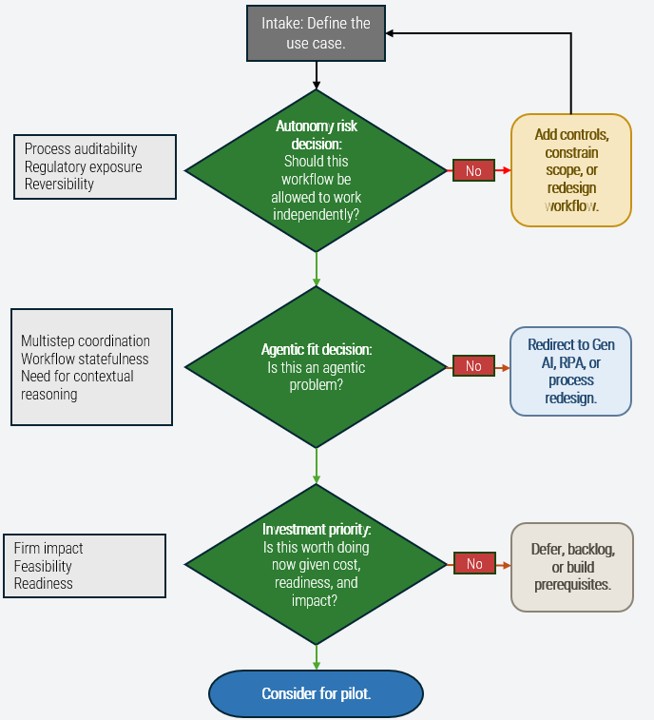
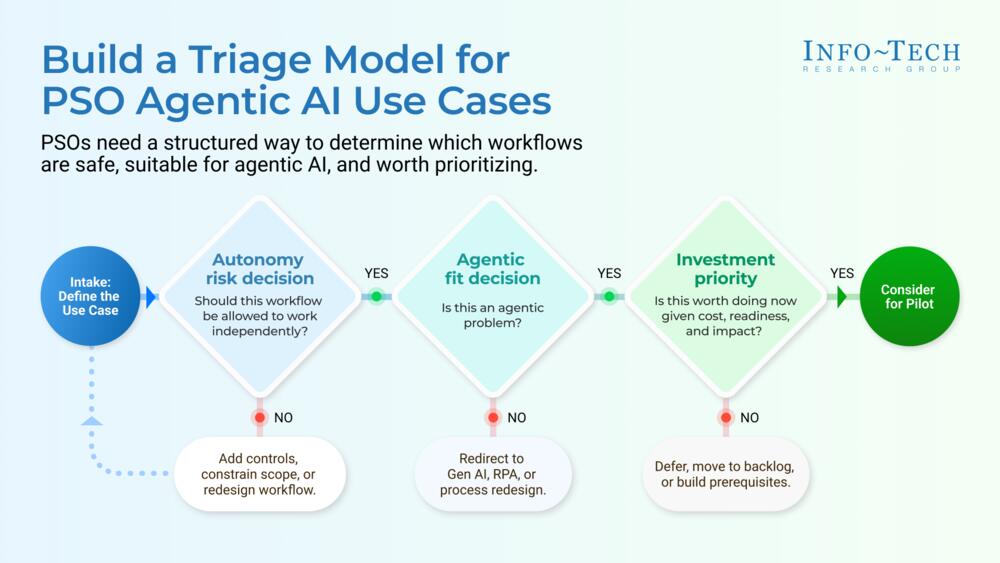
Build a triage model for PSO agentic AI use cases
Core Problem
PSOs need a structured way to determine which workflows are safe, suitable for agentic AI, and worth prioritizing.
Challenges |
Outcomes |
|---|---|
|
|
KEY INSIGHT
In PSOs, agentic AI is primarily a workflow governance decision. Firms create value when they apply explicit gates for safety, suitability, and prioritization before scaling use cases into delivery.
Info-Tech's methodology for determining where agentic AI fits in PSO firms
1. Define & Anchor the Context |
2. Identify & Assess |
3. Prioritize & Validate the Portfolio |
|
|---|---|---|---|
Phase Steps |
1.1 Align on fundamental agentic AI concepts |
2.1 Review the Tool Structure and Scoring Model |
3.1 Score use cases for prioritization |
Phase Outcomes |
A shared understanding of agentic AI concepts, capability patterns, and how they connect to your business context |
A structured set of agentic AI use cases anchored to clear capabilities evaluated against consensus-driven criterion |
A prioritized and validated use case portfolio with alignment on the highest-value opportunities to pursue |
Insight summary
Agentic AI in PSOs requires workflow discipline
The strongest use cases are grounded in real service workflows, bounded by review, and prioritized for business fit, delivery value, and firm readiness. However, it's also important to consider optimizing your current workflow designs for AI agent capabilities.
Map to real workflows
Use cases should be anchored in named value streams and business capabilities. This approach exposes where the workflow sits, who owns it, which systems and handoffs it touches, and how its value will be measured across delivery, growth, and operations.
Use agents to absorb coordination workload
Early agentic wins come from workflows that are cross-step, repetitive, and coordination-heavy, such as routing, retrieval, follow-up, exception handling, and documentation assembly. These use cases increase delivery leverage around professionals without automating judgment.
Gate autonomy by exposure
Client-facing outputs, regulatory exposure, reviewability, and workflow coupling should determine how much autonomy is allowed. In PSOs, acceptable autonomy varies by task, profession, and client context.
Measure value beyond productivity
Measure impact on delivery leverage, quality, trust, margin, and client outcomes, not just internal productivity signals.
Pressure test commercial fit
Confirm use case implications early for pricing, service mix, client expectations, and the broader firm business model before expanding scope.
Research deliverable
Each step of this research is accompanied by supporting deliverables to help you accomplish your goals:
Agentic AI Use Case Tool for Professional Services Organizations
This tool provides the structure to identify agentic AI use cases, score each one across business value and feasibility, and build a prioritized portfolio, enabling teams to confidently select the highest-impact opportunities ready to move into the Build Your Agentic AI Prototype phase.
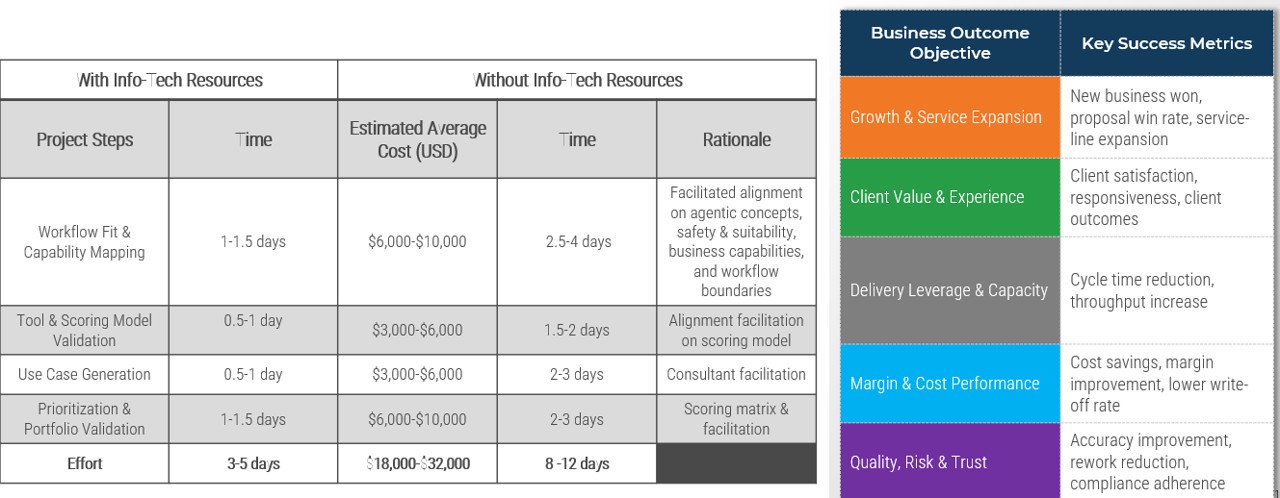
Measure the value of this research
Leverage this research's approach to ensure your agentic AI use cases align with and support your key business drivers and accelerate time to value.
Staffing case study
Agentic AI candidate screening
INDUSTRY: Staffing & Recruiting
SOURCE: Adecco Group Website
Challenge
Adecco faced mounting pressure to manage a high-volume, time-sensitive recruiting workflow as candidate expectations increasingly demanded faster, more responsive engagement. At the same time, the organization needed to protect service quality and candidate experience, a challenge that required freeing recruiters from administrative burden without removing human judgment.
Solution
Adecco deployed an AI prescreening workflow that interviews candidates by SMS or email, records responses in Salesforce, summarizes the interactions, and routes completed cases back to recruiters. Recruiters review transcripts and decide who advances in the hiring process.
Results
Using this new workflow, Adecco helped 28 companies fill vacancies, contacted thousands of candidates, and achieved a 4.6/5 candidate satisfaction rating. It also reported that 57% of candidate conversations occurred outside standard working hours. In later scale disclosures, Adecco said the workflow delivered 15% time savings, significantly reduced time to fill, increased fill rates, and lowered cost to serve.
Law firm case study
INDUSTRY: Legal
SOURCE: A&O Shearman Website
Challenge
Major law firm A&O Shearman faced multihour, deadline-sensitive workflows in areas such as antitrust filings, fund formation, cybersecurity, and loan reviews. All of these high-value areas required deep legal expertise and multistep processes. These workflows were taking 5-10+ hours of senior lawyer time per matter.
Solution
Working in partnership with Harvey AI, A&O built a series of agents, embedding the firm's own lawyer's expertise. Each of the agents were configured for a specific, high-complexity practice domain. For all agent outputs, human review was part of the workflow. Additionally, A&O uses these tools internally and also sells them commercially to clients and peer firms, sharing software revenue with Harvey AI.
Results
A&O's Harvey-based agents are already reducing the time spent on deadline-sensitive legal workflows from hours to minutes. The initial rollout covers high-value work in antitrust, cybersecurity, fund formation, and loan review, and the firm has gone beyond internal use by selling these solutions to their clients and other law firms.
Workshop overview
Day 1 |
Day 2 |
Day 3 |
Day 4 |
Day 5 |
|
Activities |
Define |
Anchor |
Generate |
Score |
Validate |
1.1 Align on fundamental agentic AI concepts.
|
1.2 Anchor on business capabilities.
|
2.1 Confirm the use case scoring model.
|
3.1 Score use cases.
|
3.2 Review portfolio.
|
|
Deliverables |
|
|
|
|
|
Phase 1
Define & Anchor the Context
| Phase 1 | Phase 2 |
Phase 3 |
|---|---|---|
1.1 Align on fundamental agentic AI concepts 1.2 Anchor AI capability to business context |
2.1 Review the tool structure and scoring model 2.2 Identify candidate use cases across value stream domains |
3.1 Score use cases for prioritization 3.2 Review and validate use case portfolio |
This phase will walk you through the following activities:
- Review your organization's business goals, key initiatives, and capability maps to anchor AI planning in real, firm-level priorities.
- Explore the purpose and structure of AI use cases to build a common understanding of how they support core processes and systems.
This phase involves the following participants:
- AI initiative lead
- CIO
- Other IT/practice leadership
- Senior business leader and managers accountable for AI initiatives
1.1 Align on fundamental agentic AI concepts
1-2 hours
- Gather the AI strategy creation team and introduce the concept of agentic AI, systems that are goal driven, tool using, and adaptive, distinguishing them from simple automation and AI assistance.
- Walk through the four agentic AI capability patterns that repeatedly deliver value across industries.
- Discuss how real-world agents combine multiple patterns in their workflow and establish a shared vocabulary your team will use going forward.
Input |
Output |
|---|---|
|
|
Materials |
Participants |
|
|
Position agentic AI on the automation spectrum
From rules to agents
Concept |
Profile |
Description |
Typical Autonomy Range |
Coordination Pattern |
Typical Use/ Example |
|---|---|---|---|---|---|
Traditional Automation |
Rule-Based Operator |
Executes predefined, rule-based tasks with no learning or reasoning. |
None |
None |
RPA, workflow triggers, autoapprovals |
AI Agent |
Specialist |
A single intelligent unit that can perceive, reason, and act to produce a response. May use memory and tools but operates within defined boundaries. |
Assistive to guided |
Minimal (single agent) |
AI assistant, chatbots, recommendation agent |
Multi-Agent System (MAS) |
Team of Specialists |
An MAS is a network of cooperating AI agents that each do their part when told to (e.g. one checks weather, one looks at prices, one manages reservations). |
Guided to conditional |
Coordinated (multi-agent) |
Supply chain agents, logistics optimization, multibot workflows |
Agentic AI |
Self-Managing Assistant |
A self-directed, evolving autonomous system that can reason, plan, and act using multiple AI agents. It manages its own feedback loops and tool usage and is internally orchestrated. |
Conditional to autonomous |
Dynamic self-managed |
Adaptive workflows, continuous optimization, self-improving enterprise AI |
Agentic systems exist on a progression of autonomy
How much authority should your agent have?
1Assistive(Human Initiated) |
2Guided(Bounded Automation) |
3Conditional(Acts Within Thresholds) |
4Autonomous(Acts Without Real-Time Review) |
|---|---|---|---|
The human starts the task, the agent analyzes or drafts, and the human decides and acts. Best for early use cases and low trust environments. |
The agent performs defined steps within fixed rules, workflow boundaries, or approvals. The human still governs important handoffs. |
The agent can act automatically when conditions are normal and preapproved thresholds are met, but it must escalate exceptions. |
The agent plans and executes without waiting for human review in the live loop, though it still operates with guardrails, monitoring, and auditability. |
Ensure agentic AI use cases meet the safety benchmark before prioritizing value
Before evaluating business impact or feasibility, organizations must first determine whether a use case is structurally appropriate for agentic AI within a professional services context. This step ensures that operational realities, safety constraints, and system dependencies are accounted for before any further evaluation occurs.
Professional Accountability Boundary |
Regulatory and Compliance Exposure |
External Reliance and Representation Risk |
Workflow Coupling and Cascade Risk |
Human Reviewabilty |
Reversibility and Containment |
|---|---|---|---|---|---|
Does this influence professional advice, judgment, or conclusions? Can a qualified professional confidently sign off on the output? |
Is the workflow subject to audit requirements, regulatory filings, or professional standards? |
Will a client, regulator, or third party act on this output or assume it reflects professional judgment? Does the output represent your firm's position on a particular matter or influence external decisions? |
Does the output feed into other deliverables or regulatory filings? Can errors spread across engagements, financial outputs, or compliance artifacts? |
Is the review process practical and reliable under time pressure? Is there enough visible evidence, traceability, and rationale for a reviewer to meaningfully challenge or validate the output? |
Can decisions be easily reversed or corrected without downstream impact? Is there a clear mechanism to contain failures before they spread? |
High accountability exposure requires constrained autonomy or a rejection of the use case. |
High regulatory exposure limits full autonomy and requires auditability. |
High levels of reliance require explicit review controls and should constrain autonomy. |
High interdependency increases need for coordination controls and supervision. Alternatively, the scope can be constrained or decomposed. |
Low reviewability leads to a defer or reject flag on the use case. |
Low reversibility requires restricted autonomy or a rejection of the use case. |
Not every workflow requires agentic AI
While agents offer powerful automation opportunities, they are not a universal solution.
After confirming the use case is structurally appropriate, assess whether introducing autonomy into a judgment-driven workflow is warranted or whether a workflow redesign, Gen AI, or traditional automation is the better approach.
Multistep Coordination
Does the workflow require orchestration across roles, systems, or client interactions?
Statefulness
Does the workflow require persistent context across interactions, files, or client history (vs. a single task or prompt)?
Dynamic Decisions
Does the workflow involve professional judgment, ambiguity, or context-driven decisions (vs. fixed rules)?
Actionability
Does the workflow require the system to take actions across tools or processes (vs. just generate outputs)?
Repeatable Triggers
Is the workflow economically meaningful and frequent/structured enough to initiate reliably?
About Info-Tech
Info-Tech Research Group is the world’s fastest-growing information technology research and advisory company, proudly serving over 30,000 IT professionals.
We produce unbiased and highly relevant research to help CIOs and IT leaders make strategic, timely, and well-informed decisions. We partner closely with IT teams to provide everything they need, from actionable tools to analyst guidance, ensuring they deliver measurable results for their organizations.
What Is a Blueprint?
A blueprint is designed to be a roadmap, containing a methodology and the tools and templates you need to solve your IT problems.
Each blueprint can be accompanied by a Guided Implementation that provides you access to our world-class analysts to help you get through the project.
Need Extra Help?
Speak With An Analyst
Get the help you need in this 3-phase advisory process. You'll receive multiple touchpoints with our researchers, all included in your membership.
Guided Implementation 1: Define & Anchor the Context
- Call 1: Review the firm capability map/value streams.
- Call 2: Identify domains and workflows where agentic AI may create value.
Guided Implementation 2: Identify & Assess Use Cases
- Call 1: Review and finalize tool criterion and scoring model.
- Call 2: Ideate a list of use cases aligned to agentic AI patterns.
- Call 3: Evaluate use cases against safety criteria.
- Call 4: Evaluate remaining criteria against agentic fit criteria.
Guided Implementation 3: Prioritize & Validate the Portfolio
- Call 1: Complete tool with remaining use cases and refine scoring.
- Call 2: Summarize results and plan next steps.
Contributors
- Kevin Yengling, Director – IT & Security, Rehmann
- Alan Segal, Chief Digital & Technology Officer, AMS
- Andrea Voth, Associate Director, Business Application Solutions, Rehmann
- Austin Greca, Manager – Data, Automation & Intelligence, Rehmann
- Kyle Ireland, Head of AI Transformation, Axiom Law
