
AI-Assisted Sales Automation Solutions
Buyers Guide and Market Trends
The pressure for organizations to get sales automation right has never been higher. Externally, organizations face a saturated sales automation AI marketplace and rising customer expectations. Internally, competing stakeholder opinions often stall progress and increase the risk of poor investments in sales automation tools. Use this buyers guide to cut through the noise of both sets of pressures and focus on solutions that help your sales team spend more time selling to the right people.
Prospective customers now expect personalized engagement across every channel – yet too often receive generic, templated outreach. To meet these rising expectations and avoid losing promising leads, organizations need to leverage AI-assisted tools to connect with warm leads where they are and when they are most receptive.
1. Don’t get lost in the sea of AI-assisted sales automation solution options.
The sales automation landscape is complex and saturated with tools that promise quick wins and flashy features. But without considering how these solutions fit into existing workflows, organizations risk adding complexity instead of value. To get the most out of your AI-assisted sales automation solution, pinpoint the stage of the selling funnel that needs attention, align your team there, and let real use cases guide your decisions.
2. Stay agile in an evolving AI marketplace.
The sales automation market is shifting fast. Vendors are consolidating, and unique features are quickly becoming standard. Before investing in new tools, take stock of your existing stack – you may already have what you need. If gaps remain, opt for short-term contracts to stay flexible as the market continues to evolve.
3. Evaluate solution maturity to ensure the right fit.
Not all AI-assisted platforms are created equal. Some lean heavily on automation, while others keep humans firmly in the loop. Assess each solution against your organization’s risk tolerance, need for personalization, and efficiency goals. The best fit is the one that balances automation with oversight in a way that builds trust and delivers value.
Use this step-by-step guide to make the right decisions on sales automation.
This buyers guide helps you cut through the noise of a crowded sales automation AI marketplace by grouping vendors into four distinct categories based on the sales funnel. Learn from real-world case studies and explore the strengths and weaknesses of ten leading vendors through practical SWOT analyses. Then, accelerate selection with our Rapid Application Selection Framework to ensure you choose the right solution with confidence.
Use our two-phase approach, along with practical tools such as a requirements workbook and demo script, to:
- Define the sales automation AI marketplace, explore important trends, and understand which AI tools are a good fit for your organization.
- Select an AI-assisted sales tool by building the business case, streamlining requirements elicitation, and constructing a requirements list and demo script.
AI-Assisted Sales Automation Solutions
Buyers Guide and Market Trends Report
Analyst perspective
Spend valuable time selling to the right people!
The pressure for organizations to get sales automation right is growing. Prospective B2B customers now expect personalized engagement across multiple channels, but they are often met with templated, impersonal outreach.
At the same time, organizations are navigating a complex and saturated sales automation AI marketplace. With a wide range of opinions and proposed solutions, it's easy to get swept up in the promise of new tools.
Before investing in additional applications, evaluate your existing technology stack. In many cases, the answer is not adding another tool but making better use of what you already have.
This buyers guide is designed to help you evaluate how to navigate the sales automation AI marketplace. When considering a new tool, prioritize alignment between sales leadership and operations. Focus on what matters most: spending more time selling to the right people. Begin by examining your current sales process to identify where friction exists and where AI-assisted sales automation can make the biggest impact for your organization.

Jennifer Aswald
Research Analyst, AI Marketplace
Info-Tech Research Group
Executive summary
| Your Challenge | Common Obstacles | Info-Tech's Approach |
|
The sales department directly impacts revenue and faces intense pressure to not just succeed but excel. A new tool must:
With so many solutions available, it's hard to know where to start or where to focus to gain the most value. |
When implementing an AI-assisted sales automation tool, organizations often face:
These challenges can stall decision-making or lead to replacing an existing tool with minimal benefit. |
Cut through the noise of existing sales tools, endless new options, and many stakeholder opinions by:
This focused strategy helps you avoid decision fatigue and unlock real value. |
Info-Tech Insight
Do not get lost in the sea of AI-assisted sales automation solution options. Pinpoint the stage of the selling funnel that needs attention, align your team there, and let real use cases guide your decisions.
Your challenge
- AI-assisted sales tools must connect seamlessly with CRMs, outreach platforms, and enrichment databases without duplicating functionality or disrupting workflows. Poor integration leads to data silos, manual workarounds, and reduced efficiency.
- AI innovation pressures organizations to innovate, especially in the sales department. AI tools are expected to deliver differentiation, but with so many solutions available, it's increasingly difficult to find one that truly sets a company apart.
- Sales reps are often skeptical of new tools, especially those powered by AI. Concerns about reliability, transparency, and disruption to established workflows can lead to resistance, making team-wide adoption a persistent hurdle.
42% of sales professionals use AI only a few times a year or not at all, often due to poor integration with existing workflows (ZoomInfo Blog, 2025).
Common obstacles
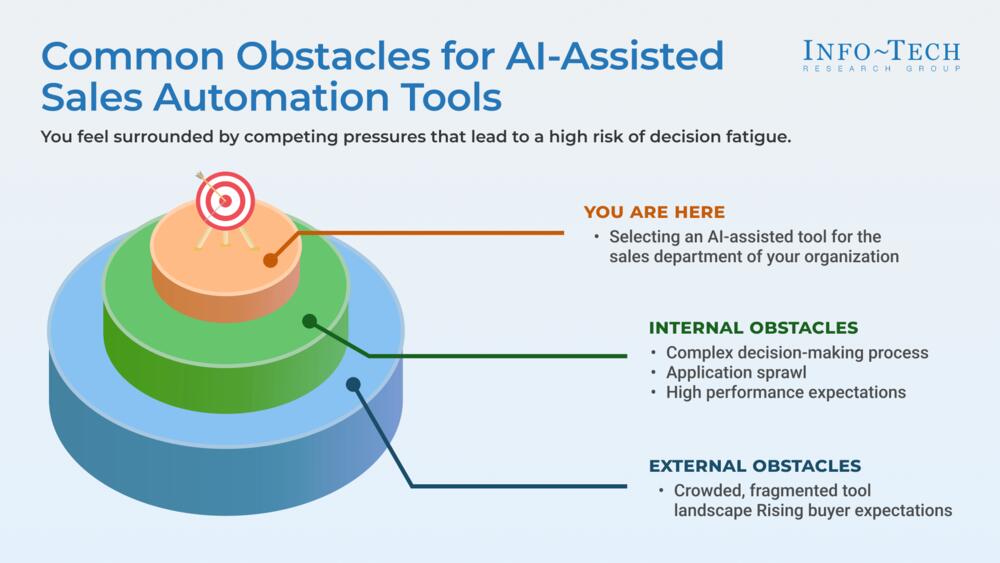
You feel surrounded by competing pressures that lead to a high risk of decision fatigue.
You Are Here
Selecting an AI-assisted tool for the sales department of your organization.
Internal Obstacles
- Complex decision-making process: In large enterprises, buying decisions often involve six or more people (Mixology Digital, 2025).
- Application sprawl: Only 34% of software is seen as both essential and effective (Info-Tech's CIO Business Vision).
- High performance expectations: Nearly two-thirds of executives feel increased pressure to prove ROI faster than before (Master B2B, 2024).
External Obstacles
- Crowded, fragmented tool landscape: The SaaS market is growing at nearly 18% annually, making it harder to identify the right solution (Forbes, 2024).
- Rising buyer expectations: 80% of B2B buyers expect a personalized, seamless, and intuitive B2C-like experience (Jobera, 2024).
Info-Tech's approach
Pinpoint where your sales funnel needs the most support to overcome surrounding challenges.
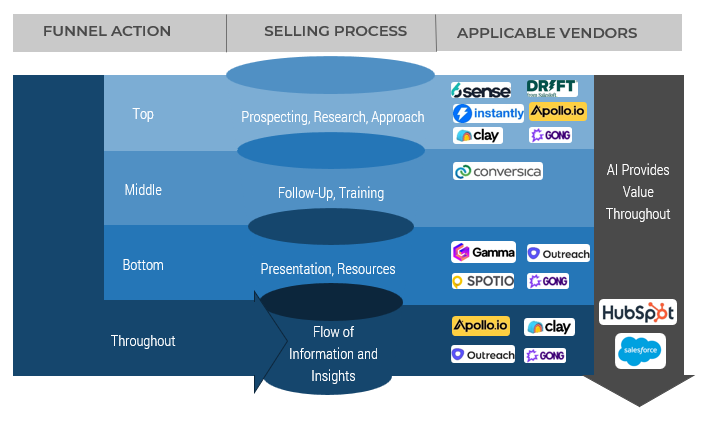
The Info-Tech difference:
- Avoid application sprawl by reviewing your current tools, especially your CRM, for features you already have or will soon gain. This helps you invest only in what truly supports your sales team.
- Meet rising buyer expectations by connecting with warm leads on their preferred channels at the right time.
- Cut through the fragmented landscape by avoiding the confusing conventional organization of these tools (by use cases). Instead apply our unique framework to pinpoint where in your sales funnel automation is most needed.
Info-Tech's methodology for selecting the right AI solution
| Phase Steps | 1. Contextualize the Vendor Landscape | 2. Select the Right AI Vendor |
|
|
|
| Phase Outcomes |
|
Create:
|
Info-Tech Insight
In a hurry? Save time by leveraging a lean RFP. A lean RFP is just that a very lean or light RFP that includes the constructs of an RFI while keeping the competitive advantages of negotiating an RFP.
Insight summary
Overarching insight
Do not get lost in the sea of AI-assisted sales automation solution options. Pinpoint the stage of the selling funnel that needs attention, align your team there, and let real use cases guide your decisions.
Phase 1 insight
With the rapid pace of consolidation in AI-assisted sales automation, today's standout tool could quickly become tomorrow's standard feature. To stay agile, consider opting for short-term contracts when selecting point solutions.
Phase 2 insight
Info-Tech's Requirements Workbook accelerates the procurement process by combining RFP-style operational and technical requirements with a focus on high-value use cases.
Tactical insight
Avoid application sprawl by reviewing your current tools, especially CRMs, for existing or upcoming features.
Tactical insight
One of the most effective ways to meet rising buyer expectations is by connecting with warm leads on their preferred channels at the right time
Buyers guide deliverables
Each step of this blueprint is accompanied by supporting deliverables to help you accomplish your goals:
This demo script will ensure vendors demonstrate the capabilities that matter most to your organization, aligned to your top use cases. It keeps demos focused, comparable, and relevant so you can evaluate solutions based on how well they meet real-world needs, not just polished presentations.
Key deliverable:
This workbook will help you clearly define what your organization needs from an AI-assisted sales automation solution based on real use cases, not just features. It streamlines vendor conversations and improves evaluation consistency.
This buyers guide makes it easier for both IT and business teams to make the right knowledge management decision
| IT Benefits | Business Benefits |
|---|---|
|
|
About Info-Tech
Info-Tech Research Group is the world’s fastest-growing information technology research and advisory company, proudly serving over 30,000 IT professionals.
We produce unbiased and highly relevant research to help CIOs and IT leaders make strategic, timely, and well-informed decisions. We partner closely with IT teams to provide everything they need, from actionable tools to analyst guidance, ensuring they deliver measurable results for their organizations.
What Is a Blueprint?
A blueprint is designed to be a roadmap, containing a methodology and the tools and templates you need to solve your IT problems.
Each blueprint can be accompanied by a Guided Implementation that provides you access to our world-class analysts to help you get through the project.
Need Extra Help?
Speak With An Analyst
Get the help you need in this 2-phase advisory process. You'll receive multiple touchpoints with our researchers, all included in your membership.
Guided Implementation 1: Contextualize the AI-Assisted Sales Automation Landscape
- Call 1: Discover what AI tools are right for your organization. Understand what AI-assisted sales automation software is and discover the “art of the possible.”
- Call 2: Identify right-sized vendors and build the business case to select an AI off-the-shelf SaaS provider.
Guided Implementation 2: Select an AI-Assisted Sales Tool
- Call 1: Define your key requirements.
- Call 2: Build procurement items, such as a requirements workbook and demo script.
- Call 3: Evaluate vendors and perform final due diligence.
Contributors
- Austin Wagar, Senior Research Analyst, Info-Tech Research Group
- Thomas Randall, Research Lead, Info-Tech Research Group
- Jess Jenkinson, Sales Enablement Project & Operations Lead, Info-Tech Research Group
- Terra Higginson, Principal Research Director, Info-Tech Research Group
- Shashi Bellamkonda, Principal Research Director, Info-Tech Research Group
- Ben Dickie, Advisory Practice Lead, Info-Tech research Group
- Benjamin Fletcher, Director, GTM Engineer, Info-Tech Research Group
- Seth Martin, Head of Growth at Nalpeiron
- 6sense (Anonymous Contributor)
