
Retail Banking Industry Business Reference Architecture
Capability maps, value streams, and strategy maps for retail banking organizations.
- Banking leadership requires a unified and validated view of retail banking business capabilities that help CIOs and bank leadership accelerate the strategy design process and that aligns initiatives, investments, and strategy.
- The business and IT often focus on a project, ignoring the holistic impact and value of an overarching value stream and business capability view.
Our Advice
Critical Insight
- Using an industry-specific business reference architecture is central, and has many benefits, to organizational priorities. It’s critical to understanding, modeling, and communicating the operating environment and the direction of the organization, but more significantly, to enabling measurable top-line organizational outcomes and the unlocking of direct value.
Impact and Result
- Demonstrate the value of IT’s role in supporting your banking organization’s capabilities while highlighting the importance of proper alignment between organizational and IT strategies.
- Apply reference architecture techniques such as strategy maps, value streams, and capability maps to design usable and accurate blueprints of your retail banking operations.
- Assess your initiatives and priorities to determine if you are investing in the right capabilities. Conduct capability assessments to identify opportunities and to prioritize projects.
Frequently Asked Questions
What is a business reference architecture for retail banking?
A business reference architecture for retail banking is a set of validated models including capability maps, value streams, and strategy maps that help CIOs and bank leadership accelerate the strategy design process. Info-Tech Research Group's Retail Banking Industry Business Reference Architecture provides a unified view of retail banking business capabilities that aligns initiatives, investments, and strategy with organizational priorities. The reference architecture helps organizations understand, model, and communicate their operating environment while enabling measurable top-line business outcomes and unlocking direct value.
Why do retail banks need an industry-specific business reference architecture?
Retail banks need an industry-specific business reference architecture because the banking industry is being driven by increasing levels of competition from new technologies and fintech competitors using digitally native products. Info-Tech Research Group emphasizes that using an industry-specific reference architecture is critical to understanding, modeling, and communicating the operating environment, but more significantly, to enabling measurable top-line organizational outcomes and unlocking direct value. The reference architecture serves as a powerful stakeholder alignment and communication tool as technology gets closer to customers and IT departments deal with more vendors, new delivery models, and growing complexity.
What are the core value streams in retail banking?
Info-Tech Research Group identifies five core value streams for retail banking organizations: Attract Customers, Supply Loans and Mortgages and Credit Cards, Provide Core Banking Services, Offer Card Services, and Grow Investments and Manage Wealth. These value streams connect business goals to value realization activities and enable organizations to create and capture value in the marketplace by engaging in interconnected activities. Value streams can extend beyond the organization into the supporting ecosystem, whereas business processes are contained within the organization.
How does Info-Tech define business capabilities in the context of retail banking?
According to Info-Tech Research Group's framework, a business capability defines what a business does to enable value creation, rather than how. Business capabilities represent stable business functions, are unique and independent of each other, and typically have a defined business outcome. A business capability map provides details that help the business architecture practitioner direct attention to a specific area of the business for further assessment. Info-Tech's retail banking business capability map organizes capabilities across the five value streams with defining, shared, and enabling capability levels.
What are the four phases of Info-Tech's reference architecture methodology?
Info-Tech Research Group's reference architecture methodology consists of four phases. Phase 1: Build Your Organization's Capability Map by defining the organization's value stream and validating the industry reference architecture. Phase 2: Use Business Capabilities to Define Strategic Focus by defining the organization's key capabilities and developing a prioritized strategy map. Phase 3: Assess Key Capabilities for Planning Priorities through a review of business processes, information, applications, and technology support of key capabilities. Phase 4: Adopt Capability-Based Strategy Planning through ongoing identification and roadmapping of capability gaps.
How do I build my organization's capability map for retail banking?
According to Info-Tech Research Group's methodology, building your organization's capability map involves two key steps. First, define the organization's value stream by identifying and assembling key stakeholders, determining how the organization creates value, and defining and validating value streams specific to your organization. Second, develop a business capability map by determining which business capabilities support value streams, accelerating the process with Info-Tech's industry reference architecture, validating the business capability map, establishing Level 2 capability decomposition priorities, and decomposing Level 2 capabilities. This phase produces defined and validated value streams, a validated Level 1 business capability map, and decomposed Level 2 capabilities.
What is the difference between value streams and business processes?
Info-Tech Research Group explains that value streams connect business goals to the organization's value realization activities and enable an organization to create and capture value in the marketplace by engaging in a set of interconnected activities. Value streams can extend beyond the organization into the supporting ecosystem, whereas business processes are contained within the organization and the organization has complete control over them. There are two types of value streams: core value streams that are mostly externally facing and deliver value to either an external or internal customer, and support value streams that are internally facing and provide foundational support for an organization to operate.
How does Info-Tech's framework interpret business value realization?
Info-Tech Research Group defines business value as the success criteria of an organization manifested through organizational goals and outcomes, interpreted from four perspectives. Profit generation refers to revenue generated from a business capability with a product enabled with modern technologies. Cost reduction involves cost reduction when performing business capabilities with products enabled with modern technologies. Service enablement represents productivity and efficiency gains of internal business operations from products and capabilities enhanced with modern technologies. Customer and market reach reflects the improved reach and insights of the business in existing or new markets.
Who should participate in the reference architecture process?
Info-Tech Research Group recommends involving Enterprise/Business Architects, Business Analysts, Business Unit Leads, the CIO, and Department Executive and Senior Managers in the reference architecture process. The exercise of identifying capabilities for an organization is very introspective and requires deep analysis, so it is important to ensure the right stakeholders participate. Info-Tech advises considering who the decision makers and key influencers are, who will impact the business capability work, who has a vested interest in the success or failure of the outcome, and who has the skills and competencies necessary to help you be successful.
What is a strategy map in the context of retail banking reference architecture?
According to Info-Tech Research Group's glossary of key concepts, an industry strategy map is a visualization of the alignment between the organization's strategic direction and its key capabilities. The strategy map is developed in Phase 2 of Info-Tech's methodology, where organizations use business capabilities to define strategic focus by defining the organization's key capabilities and developing a prioritized strategy map. This visualization helps banking organizations break down business goals into strategic and achievable initiatives focused on specific value streams and business capabilities.
What common obstacles do organizations face when developing business architecture?
Info-Tech Research Group identifies three common obstacles organizations face when developing business architecture. First, organizations don't know where or how to begin or how to engage the right people, model the business, and drive the value of business architecture. Second, the business and IT often speak in their own languages without a holistic and integrated view of mission, strategies, goals, processes, and projects. Third, business and IT often focus on a project, ignoring the holistic value of an overarching value stream and business capability view.
What tools and templates does Info-Tech provide for retail banking reference architecture?
Info-Tech Research Group provides a Retail Banking Industry Business Reference Architecture Template that serves as a place to collect all activity outputs and outcomes completed for use in next steps. The template includes tools for developing value streams, business capability maps at Level 1 and Level 2, strategy maps, and capability assessments. Info-Tech also provides a comprehensive guide that includes the methodology, framework, glossary of key concepts, and detailed steps for each of the four phases of the reference architecture process.
How does Info-Tech's Guided Implementation work for reference architecture projects?
Info-Tech Research Group's Guided Implementation for reference architecture is a series of calls with an Info-Tech analyst to help implement best practices in your organization, typically consisting of 6 to 9 calls over the course of 1 to 4 months. The guided implementation covers all four phases: Call 1 introduces the methodology, Calls 2-3 cover defining value streams and modeling Level 1 capability maps, Calls 4-5 focus on mapping value streams to capabilities and modeling Level 2 maps, Calls 6-7 involve creating strategy maps and introducing capability assessment frameworks, and Calls 8-9 review capability assessment maps and prioritize capability gaps with next steps planning.
What are capability assessments in retail banking reference architecture?
According to Info-Tech Research Group's glossary, capability assessments are heat-mapping efforts based on people, process, information, and technology that analyze the strength of each key capability. Capability assessments are conducted in Phase 3 of Info-Tech's methodology to assess key capabilities for planning priorities through a review of business processes, information assessment, and technology opportunity identification. The outcomes of this phase include identification of capability process enablement, capability data support, and capability application and technology support.
How long does it take to identify and assemble key stakeholders for reference architecture work?
Info-Tech Research Group estimates that identifying and assembling key stakeholders takes 1-3 hours. This activity involves using a list of who is accountable for key business areas and decisions, the organizational chart, and a list of who has decision-making authority to produce a list of key stakeholders and a prioritized list of decision-making support needs. Info-Tech advises avoiding a focus on organizational structure and hierarchy, as stakeholder groups often don't fit the traditional structure, and not ignoring subject-matter experts on either the business or IT side.
Retail Banking Industry Business Reference Architecture
Business Capability Maps, Value Streams, and Strategy Maps for the Retail Banking Industry
Analyst Perspective
In the age of disruption, IT must end misalignment and enable value realization.
An industry business reference architecture helps accelerate your strategy design process and enhances IT’s ability to align people, process, and technology with key business priorities.
The retail banking industry is being driven by increasing levels of competition. Often, the competition is being enabled by new technologies that are creating new product and service offerings. To remain competitive, modern banks need to transform many of their core products and services along with how they are delivered.
The end result is that technology is getting closer to the customers. Often specialized technologies are at the center of the industry’s changes. IT departments are dealing with more vendors, new delivery models, and growing complexity. The reference architecture is a powerful stakeholder alignment and communication tool.

|
David Tomljenovic, MBA LLM CIM
|
Executive Summary
Your Challenge
|
Common Obstacles
You don’t know where or how to begin or how to engage the right people, model the business, and drive the value of business architecture. The business and IT often speak in their own languages without a holistic and integrated view of mission, strategies, goals, processes, and projects. Business and IT often focus on a project, ignoring the holistic value of an overarching value stream and business capability view. |
Info-Tech’s Approach
|
Info-Tech Insight
Using an industry-specific reference architecture is central, and has many benefits, to organizational priorities. It’s critical not only to understanding, modeling, and communicating the operating environment and the direction of the organization but also, more significantly, to enabling measurable top-line organizational outcomes and the unlocking of direct value.
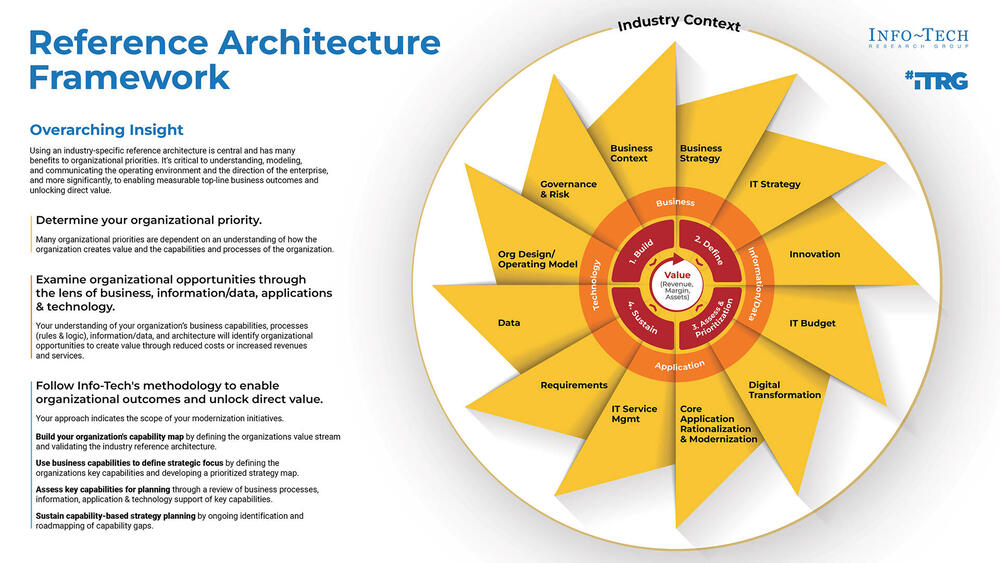
Reference Architecture Framework
Overarching Insight
Using an industry-specific reference architecture is central and has many benefits to organizational priorities. It's critical to understanding, modeling, and communicating the operating environment and the direction of the enterprise, and more significantly, to enabling measurable top-line business outcomes and the unlocking of direct value.
Determine your organizational priority.
Many organizational priorities are dependent on an understanding of how the organization creates value and the organization's capabilities and processes.
Examine organizational opportunities through the lens of business, information/data, applications & technology.
Your understanding of your organization's business capabilities, processes (rules & logic), information/data, and architecture will identify organizational opportunities to create value through reduced costs or increased revenues and services.
Follow Info-Tech's methodology to enable organizational outcomes and unlock direct value.
Your approach indicates the scope of your modernization initiatives.
Build your organization's capability map by defining the organization's value stream and validating the industry reference architecture.
Use business capabilities to define strategic focus by defining the organization's key capabilities and developing a prioritized strategy map.
Assess key capabilities for planning priorities through a review of business processes, information, applications, and technology support of key capabilities.
Sustain capability-based strategy planning through ongoing identification and roadmapping of capability gaps.
Industry Context

Industry Overview: Retail Banking

The Retail Banking industry is rapidly evolving. It is being influenced and reshaped by many factors. Customer bases are aging, and younger, tech-savvy customers are becoming more important to the business. Non-traditional competitors and fintech competitors are using highly mature, digitally native products and delivery channels to compete with incumbents.
As a result, Retail Banking is changing rapidly, as is the technology required to compete effectively. IT has become an integral part of survival and success, and IT needs to align with the business to assure it can support business needs.
Figure above: Value Chain for the Retail Banking
Business Value Realization
Business value defines the success criteria of an organization as manifested through organizational goals and outcomes, and it is interpreted from four perspectives:
- Profit generation: The revenue generated from a business capability with a product that is enabled with modern technologies.
- Cost reduction: The cost reduction when performing business capabilities with a product that is enabled with modern technologies.
- Service enablement: The productivity and efficiency gains of internal business operations from products and capabilities enhanced with modern technologies.
- Customer and market reach: The improved reach and insights of the business in existing or new markets.
Business Value Matrix

Value, goals, and outcomes cannot be achieved without business capabilities
Break down your business goals into strategic and achievable initiatives focused on specific value streams and business capabilities.

Retail Banking business capability map
Business capability map defined…
In business architecture, the primary view of an organization is known as a business capability map.
A business capability defines what a business does to enable value creation, rather than how. Business capabilities:
- Represent stable business functions.
- Are unique and independent of each other.
- Typically will have a defined business outcome.
A business capability map provides details that help the business architecture practitioner direct attention to a specific area of the business for further assessment.

Glossary of Key Concepts
A business reference architecture consists of a set of models to provide clarity and actionable insight and value. Typical techniques and terms used in developing these models are:
| Term/Concept | Definition |
| Industry Value Chain | A high-level analysis of how the industry creates value for the consumer as an overall end-to-end process. |
| Business Capability Map | The primary visual representation of the organization’s key capabilities. This model forms the basis of strategic planning discussions. |
| Industry Value Streams | The specific set of activities an industry player undertakes to create and capture value for and from the end consumer. |
| Strategic Objectives | A set of standard strategic objectives that most industry players will feature in their corporate plans. |
| Industry Strategy Map | A visualization of the alignment between the organization’s strategic direction and its key capabilities. |
| Capability Assessments | Based on people, process, information, and technology, a heat-mapping effort that analyzes the strength of each key capability. |
| Capability | An ability that an organization, person, or system possesses. Capabilities are typically expressed in general and high-level terms and typically require a combination of organization, people, processes, and technology to achieve. |
Tools and templates to compile and communicate your reference architecture work

|
Download the Retail Banking Industry Reference Architecture Template |
Info-Tech’s methodology for Reference Architecture
| 1. Build Your Organization’s Capability Map | 2. Use Business Capabilities to Define Strategic Focus | 3. Assess Key Capabilities for Planning Priorities | 4. Adopt Capability Based Strategy Planning | |
| Phase Steps |
1.1 Define the Organization’s Value Stream 1.2 Develop a Business Capability Map |
2.1 Define the Organizations Key Capabilities 2.2 Develop a Strategy Map |
3.1 Business Process Review 3.2 Information Assessment 3.3 Technology Opportunity Identification |
4.1 Consolidate and Prioritize Capability Gaps |
| Phase Outcomes |
|
|
|
|
Info-Tech offers various levels of support to best suit your needs
DIY Toolkit |
Guided Implementation |
Workshop |
Consulting |
| "Our team has already made this critical project a priority, and we have the time and capability, but some guidance along the way would be helpful." | "Our team knows that we need to fix a process, but we need assistance to determine where to focus. Some check-ins along the way would help keep us on track." | "We need to hit the ground running and get this project kicked off immediately. Our team has the ability to take this over once we get a framework and strategy in place." | "Our team does not have the time or the knowledge to take this project on. We need assistance through the entirety of this project." |
Diagnostics and consistent frameworks used throughout all four options
Guided Implementation
A Guided Implementation (GI) is a series of calls with an Info-Tech analyst to help implement our best practices in your organization.
A typical GI is between 6 to 9 calls over the course of 1 to 4 months.
What does a typical GI on this topic look like?
Phase 1 |
Phase 2 |
Phase 3 |
Phase 4 |
|
| Call #1: Introduce Info-Tech’s industry reference architecture methodology. | Call #2: Define and create value streams.
Call #3: Model Level 1 business capability maps. |
Call #4: Map value streams to business capabilities.
Call #5: Model Level 2 business capability maps. |
Call #6: Create a strategy map.
Call #7: Introduce Info-Tech's capability assessment framework. |
Call #8: Review capability assessment map(s).
Call #9: Discuss and review prioritization of key capability gaps and plan next steps. |
Phase 1
Build Your Organization’s Capability Map
| Phase 1 1.1 Define the Organization’s Value Stream 1.2 Develop a Business Capability Map | Phase 2 2.1 Define the Organization’s Key Capabilities 2.2 Develop a Strategy Map | Phase 3 3.1 Business Process Review 3.2 Information Assessment 3.3 Technology Opportunity Identification | Phase 4 4.1 Consolidate and Prioritize Capability Gaps |
This phase will walk you through the following activities:
- Identify and assemble key stakeholders
- Determine how the organization creates value
- Define and validate value streams
- Determine which business capabilities support value streams
- Accelerate the process with an industry reference architecture
- Validate the business capability map
- Establish Level 2 capability decomposition priorities
- Decompose Level 2 capabilities
This phase involves the following participants:
- Enterprise/Business Architect
- Business Analysts
- Business Unit Leads
- CIO
- Department Executive and Senior Managers
Step 1.1
Define the Organization’s Value Stream
Activities
- 1.1.1 Identify and assemble key stakeholders
- 1.1.2 Determine how the organization creates value
- 1.1.3 Define and validate value streams
This step involves the following participants:
- Enterprise/Business Architect
- Business Analysts
- Business Unit Leads
- CIO
- Department Executive and Senior Managers
Outcomes of this step
- Defined and validated value streams specific to your organization
1.1.1 Identify and assemble key stakeholders
1-3 hoursInput: List of who is accountable for key business areas and decisions, Organizational chart, List of who has decision-making authority
Output: A list of the key stakeholders, Prioritized list of decision-making support needs, Reference Architecture Template
Materials: Whiteboard/Flip Charts, Reference Architecture Template
Participants: Enterprise/Business Architect, Business Analysts, Business Unit Leads, CIO, Department Executive and Senior Managers
Build an accurate depiction of the business.
- It is important to make sure the right stakeholders participate in this exercise. The exercise of identifying capabilities for an organization is very introspective and requires deep analysis.
- Consider:
- Who are the decision makers and key influencers?
- Who will impact the business capability work? Who has a vested interest in the success or failure of the outcome?
- Who has the skills and competencies necessary to help you be successful?
- Avoid:
- Don’t focus on the organizational structure and hierarchy. Often stakeholder groups don’t fit the traditional structure.
- Don’t ignore subject-matter experts on either the business or IT side. You will need to consider both.
Download the Reference Architecture Template
Define the organization’s value streams
- Value streams connect business goals to the organization’s value realization activities. They enable an organization to create and capture value in the market place by engaging in a set of interconnected activities. Those activities are dependent on the specific industry segment an organization operates within. Value streams can extend beyond the organization into the supporting ecosystem, whereas business processes are contained within and the organization has complete control over them.
- There are two types of value streams: core value streams and support value streams. Core value streams are mostly externally facing: they deliver value to either an external or internal customer and they tie to the customer perspective of the strategy map. Support value streams are internally facing and provide the foundational support for an organization to operate.
- An effective method for ensuring all value streams have been considered is to understand that there can be different end-value receivers. Info-Tech recommends identifying and organizing the value streams with customers and partners as end-value receivers.

Value stream descriptions for Retail Banking
Value
|
Attract Customers | Supply Loans and Mortgages and Credit Cards | Provide Core Banking Services | Offer Card Services | Grow Investments and Manage Wealth |
|
|
|
|
|
Determine how the organization creates value
Begin the process by identifying and locating the business mission and vision statements.

What is Business Context?
“The business context encompasses an understanding of the factors impacting the business from various perspectives, including how decisions are made and what the business is ultimately trying to achieve. The business context is used by IT to identify key implications for the execution of its strategic initiatives.” (Source: Business Wire, 2018)
1.1.2 Determine how the organization creates value
1-3 hours
The first step of delivering value is defining how it will happen.
- Use the organization’s industry segment to start a discussion on how value is created for customers. Working back from the moment value is realized by the customer, consider the sequential steps required to deliver value in your industry segment.
- Consider:
- Who are your customers?
- What tasks are your customers looking to accomplish?
- How does your organization’s set of products and services help customers accomplish that?
- What are the benefits the organization delivers to customers?
- Don't boil the ocean. Focus on your industry segment and how you deliver value to your partners and customers specifically.
Download the Reference Architecture Template
About Info-Tech
Info-Tech Research Group is the world’s fastest-growing information technology research and advisory company, proudly serving over 30,000 IT professionals.
We produce unbiased and highly relevant research to help CIOs and IT leaders make strategic, timely, and well-informed decisions. We partner closely with IT teams to provide everything they need, from actionable tools to analyst guidance, ensuring they deliver measurable results for their organizations.
What Is a Blueprint?
A blueprint is designed to be a roadmap, containing a methodology and the tools and templates you need to solve your IT problems.
Each blueprint can be accompanied by a Guided Implementation that provides you access to our world-class analysts to help you get through the project.
Need Extra Help?
Speak With An Analyst
Get the help you need in this 4-phase advisory process. You'll receive multiple touchpoints with our researchers, all included in your membership.
Guided Implementation 1: Build your organization’s capability map
- Call 1: Introduce Info-Tech’s industry reference architecture methodology.
Guided Implementation 2: Use business capabilities to define strategic focus
- Call 1: Define and create value streams.
- Call 2: Model Level 1 business capability maps.
- Call 3: Map value streams to business capabilities.
- Call 4: Model Level 2 business capability maps.
Guided Implementation 3: Assess key capabilities for planning priorities
- Call 1: Create a strategy map.
- Call 2: Introduce Info-Tech's capability assessment framework.
Guided Implementation 4: Adopt capability-based strategy planning
- Call 1: Review capability assessment map(s).
- Call 2: Discuss and review prioritization of key capability gaps and plan next steps.