
Rebuild Your Talent Engine: Attract and Retain IT Talent in Insurance
A practical strategy guide for insurers to strengthen talent outcomes in the face of modernization and workforce attrition.
- Workforce risk is slowing modernization as digital skills in cloud, data, and cybersecurity remain scarce.
- Legacy system experts are retiring, creating capability and knowledge gaps.
- Insurance is viewed as less flexible and innovative than other industries.
- Attrition and slow hiring cycles are increasing dependency on external partners.
Our Advice
Critical Insight
- Insurers must align workforce experience with modernization goals to close talent gaps.
- A modern EVP built on flexibility, growth, purpose, and belonging bridges expectation gaps between digital and legacy talent.
- Embedding EVP into work design and communications improves retention and accelerates transformation.
Impact and Result
- Stronger retention and engagement in modernization-critical IT roles.
- Improved modernization readiness and reduced reliance on contractors.
- A measurable, repeatable EVP framework that links workforce strategy with modernization delivery.
Rebuild Your Talent Engine: Attract & Retain IT Talent in Insurance
A practical guide for IT leaders to improve recruitment, retention, and readiness in an evolving insurance landscape.
Analyst Perspective
A modern EVP can transform how insurers attract and retain technology talent.

Insurance modernization is being constrained as much by workforce challenges as legacy technology. Core-system experts are retiring, and digital skills in cloud, data, and security are difficult to attract. This creates capability gaps that slow delivery and increase reliance on costly external partners.
The core issue is a value proposition disconnect. Technologists want flexibility, growth, and meaningful work; legacy experts want recognition and clear pathways to contribute to the future. Without meeting these needs, insurers continue to face talent churn and long hiring cycles in roles critical to transformation.
A modern employee value proposition, built around flexibility, growth, purpose, and belonging, directly addresses these pressures. When embedded into work design and communications, it improves retention, strengthens internal mobility, and positions insurers as competitive employers for IT talent. Modernization succeeds when the employee experience evolves at the same pace as the technology.
Vidhi Trivedi
Senior Research Analyst
Industry Team, Insurance
Info-Tech Research Group
Rebuild Your Talent Engine: Attract & Retain IT Talent in Insurance
A practical guide for IT leaders to improve recruitment, retention, and readiness in an evolving insurance landscape.
EXECUTIVE BRIEF
Executive Summary
Your Challenge |
Common Obstacles |
Info-Tech’s Approach |
|---|---|---|
Insurance modernization depends on digital talent with strong skills in cloud, data, AI, and cybersecurity. Yet many carriers are struggling to build and retain these capabilities at scale, making workforce gaps a critical barrier to transformation. As experienced legacy experts retire, valuable institutional knowledge is being lost. At the same time, digital professionals often pursue roles in industries that offer faster growth, flexible work, and more visible innovation. This creates a growing capability gap. This slows modernization, increases risk, and raises costs as projects face delays and technical debt grows. |
Insurers struggle to keep and attract IT talent due to:
These gaps make insurers less attractive to talent and increase turnover. |
Winning the talent race requires transforming the employee value proposition (EVP) for technology and IT roles. A modern EVP built on the pillars of flexibility, growth, purpose, and belonging bridges the gap between what talent expects and what insurers offer today. Info-Tech's solution helps insurers strengthen these pillars through improved work design, capability development, recognition of legacy experts, and clearer employer identity. When the employee experience evolves alongside the IT roadmap, modernization moves faster and with less risk. |
Info-Tech Insight
Insurers need a modern EVP strategy to close talent gaps and power transformation. Aligning workforce experience with modernization goals strengthens retention, attracts top digital talent, and builds a resilient, high-performing technology organization.
Your challenge
Modernization cannot succeed if the workforce is not ready to support the future of insurance.
- Transformation outcomes depend on attracting and retaining critical digital roles. Cloud engineers, data architects, and cybersecurity specialists are needed to support target system states, improve integration, and enable automation. When these roles remain vacant or experience high churn, modernization programs stall and transformation costs increase.
- Legacy platform expertise is leaving faster than insurers can replace it. Core administration systems support mission-critical functions and compliance requirements. As retirement accelerates, insurers risk losing operational knowledge that cannot be easily externalized or automated without structured transition strategies.
- Insurance is not yet viewed as a career destination for technologists. While the industry delivers societal value and career stability, it is often overshadowed by sectors offering greater innovation exposure, flexible work models, and competitive equity-based compensation. Without a differentiated workforce experience, insurers struggle to attract builders capable of driving modernization forward.
Common obstacles
Current employee experiences are misaligned to what IT talent values and what modernization demands.
- Rigid work policies limit access to broader and more diverse talent pools. Digital professionals expect hybrid models, modern delivery environments, and autonomy in how work gets done. Inflexibility signals outdated culture and reduces both hiring success and retention in digital roles.
- Growth pathways are not clearly tied to modernization needs. Talent will prioritize environments where skills are continuously developed and rewarded. Without structured learning paths linked to future-state architectures and skills, employees experience stagnation and leave for employers offering faster advancement.
- Legacy expertise is undervalued during transformation. When modernization focuses solely on new capabilities, long-tenured staff feel disconnected from future roles and exit early. This knowledge drain introduces operational risk and slows transformation execution.
- Employer brand does not communicate technological purpose or impact. The industry protects people and businesses during critical moments, yet this purpose is not fully leveraged to motivate technology candidates. Without a compelling narrative, insurers struggle to differentiate from tech competitors that appear more innovative.
Info-Tech’s approach
Using a structured methodology that aligns the workforce experience with modernization goals will accelerate your transformation success.
- Diagnose talent pressures that create modernization risk. Assess where transformation is being slowed by skills shortages, legacy knowledge loss, or elevated turnover. Identify the roles that pose the highest operational and delivery risk if left unaddressed.
- Define a modern EVP tailored to technology roles. Use employee and market insights to articulate what talent values most, linking flexibility, growth, purpose, and belonging to clear modernization outcomes. Align the EVP with what digital and legacy experts need to be successful.
- Activate workforce changes that support modernization delivery. Introduce improvements in work design, internal mobility, recognition, and capability development. Ensure legacy platform experts are included in transformation plans through structured transition opportunities and mentorship.
- Plan and govern transformation readiness. Create a workforce modernization roadmap with milestones tied to technology delivery. Integrate talent metrics into transformation governance so decisions about timing, capacity, and sourcing are informed by workforce realities.
Blueprint deliverables
Each step of this blueprint is accompanied by supporting deliverables to help you accomplish your goals:
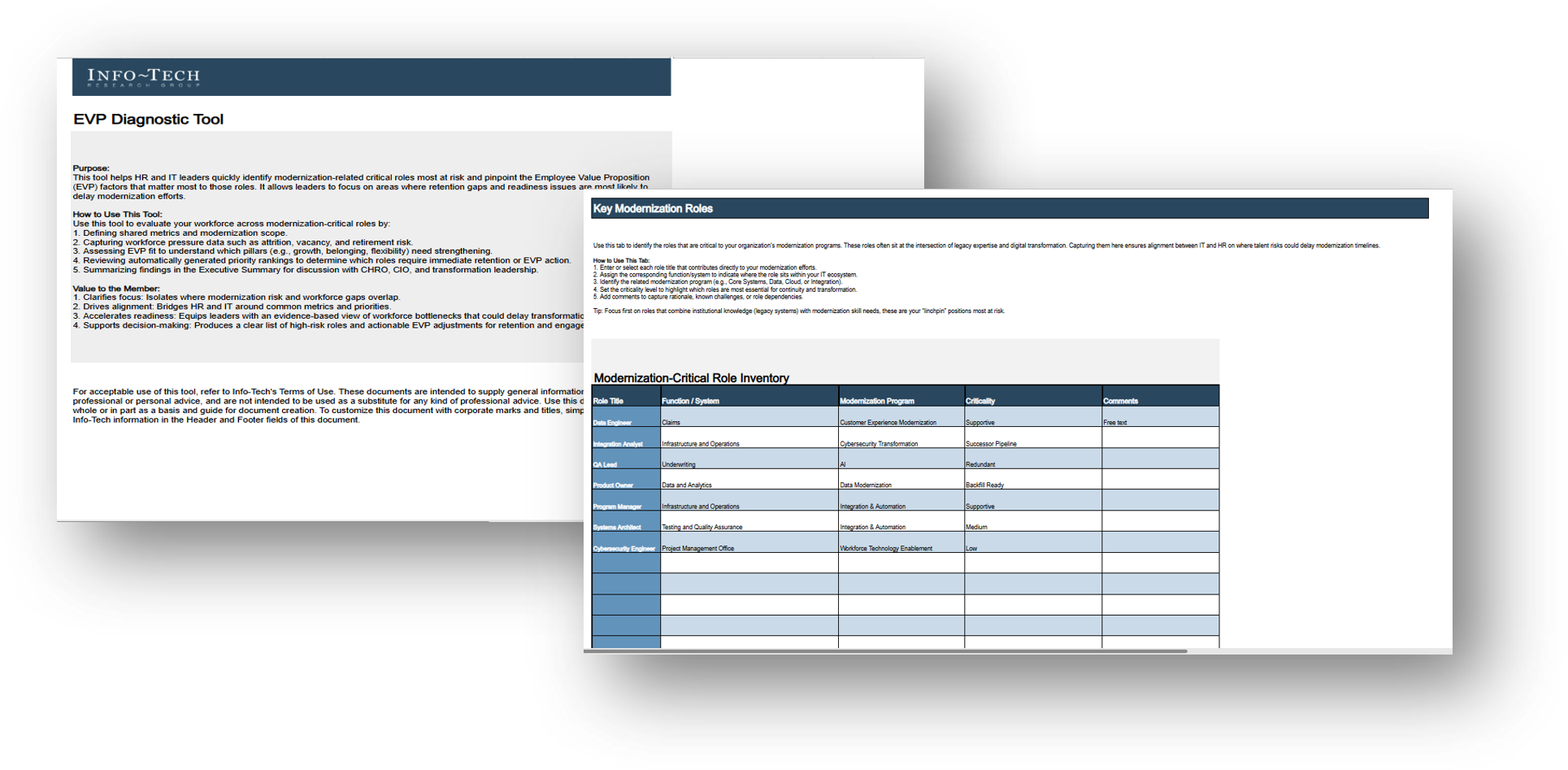
EVP Diagnostic Tool
Identifies at-risk modernization roles and the EVP factors needed to strengthen retention and readiness.
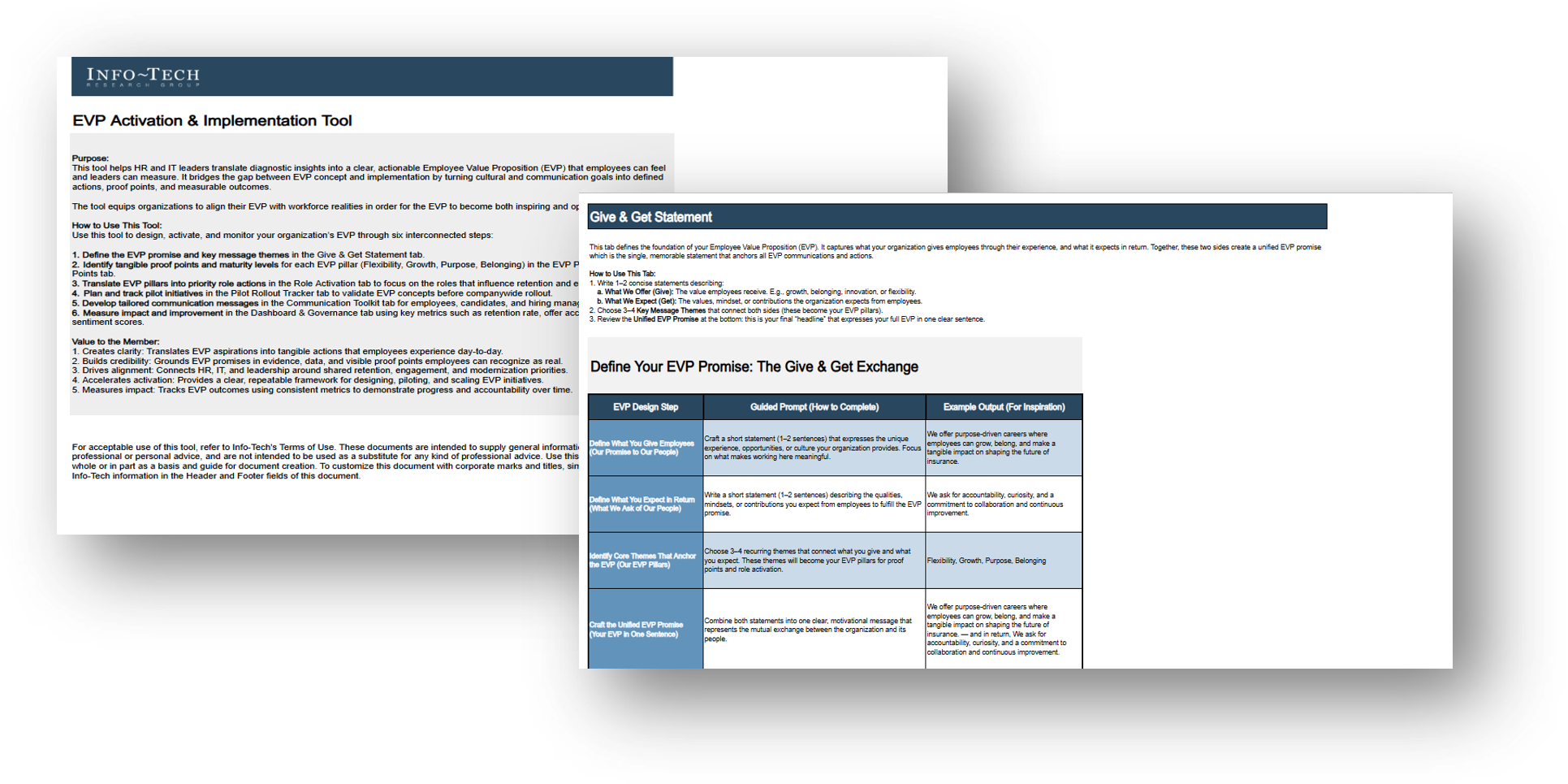
EVP Activation & Implementation Tool
Turns EVP insights into clear actions and messages that drive engagement and alignment.
Key deliverable
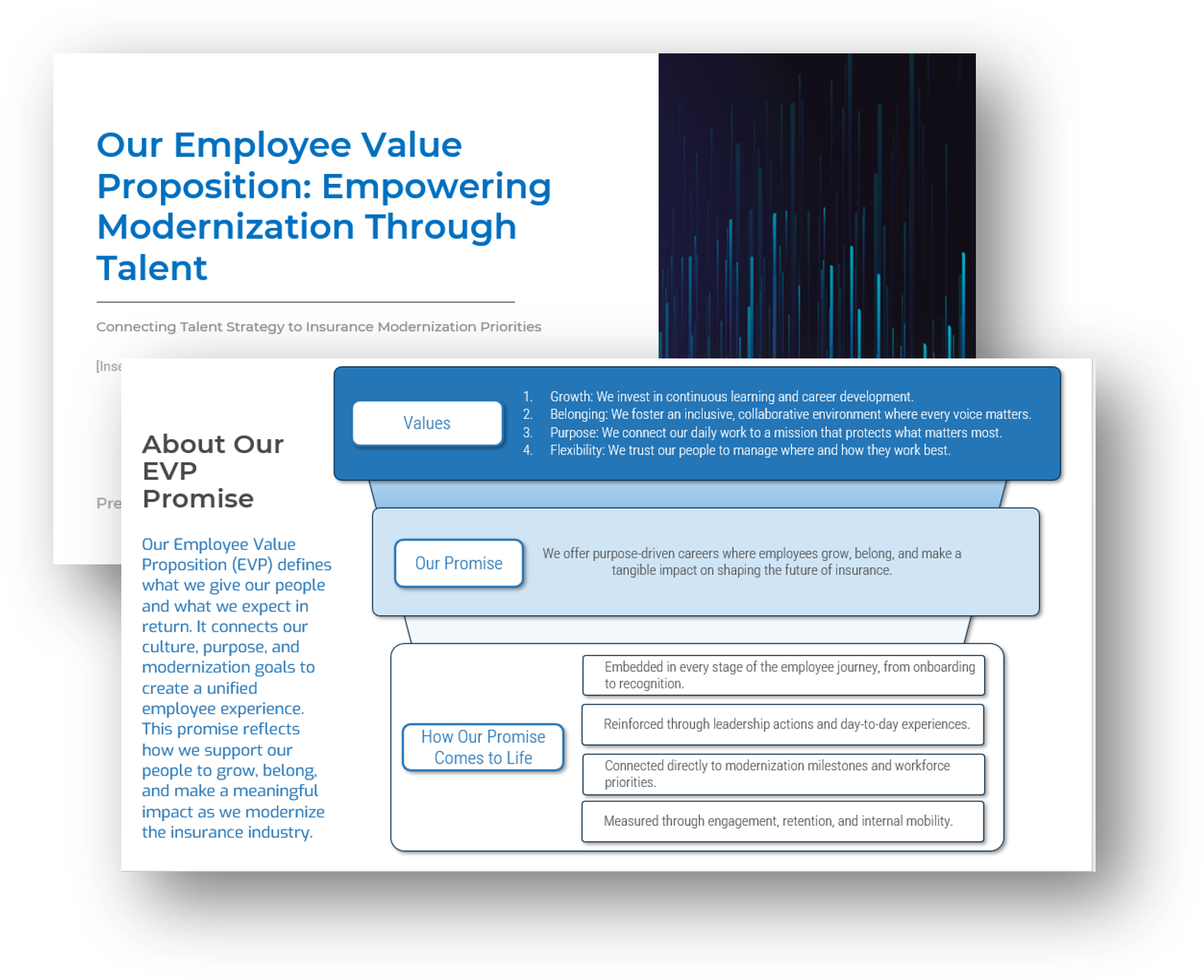
EVP Impact Report Template
Delivers an executive-level view of EVP outcomes, showcasing measurable workforce impact, engagement gains, and strategic ROI.
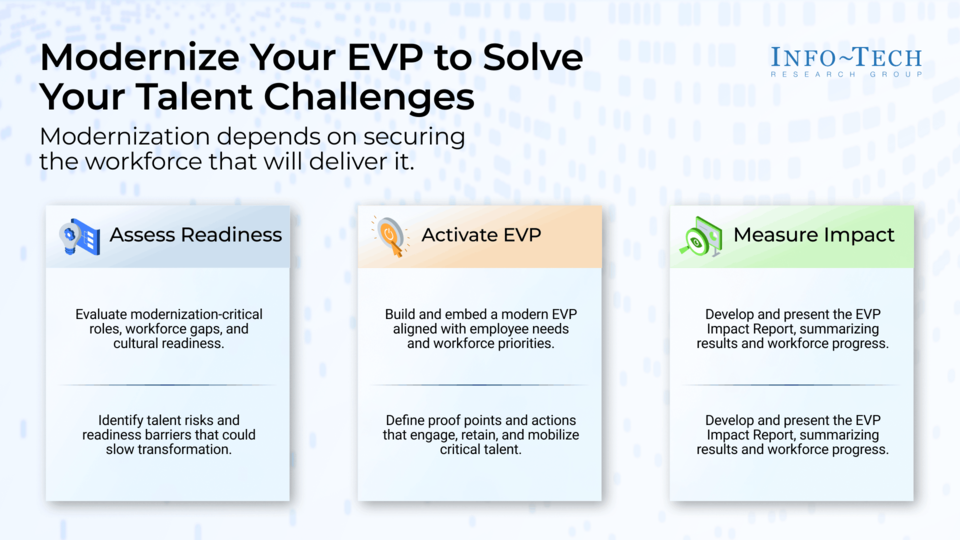
Info-Tech’s methodology to modernize your EVP to solve talent challenges in insurance
1. Assess Talent Readiness for Modernization Success |
2. Build and Embed a |
3. Develop and Present the EVP Impact Report |
|
|---|---|---|---|
Phase Steps |
1.1 Define modernization scope and critical roles |
2.1 Define your employer–employee value exchange |
3.1 Define report objectives and audience |
Deliverables |
|
|
|
Phase Outcomes |
|
|
|
Insight summary
Traditional workforce strategies must evolve to support modernization
Traditional recruitment and retention models were built for operational IT, not modernization. Today’s goals demand automation, integration, and data-driven capabilities that insurers cannot deliver without securing modernization-critical talent. Workforce strategies must change to align with the skills and employee expectations driving transformation.
EVP is redefining what is possible for tech careers in insurance
Modern technologists expect environments where they can innovate, grow technical depth, and contribute to meaningful outcomes. Insurance can offer a compelling career story grounded in community protection, mission-driven work, and cutting-edge modernization programs. When the EVP communicates this clearly, insurers can tap into new talent pools and shift perceptions of the industry.
Future talent models require access to both legacy and digital capabilities
Transformation demands new skills in cloud, data, and cybersecurity while still relying on expertise in core platforms. Insurers must preserve knowledge from experienced staff and accelerate development of digital roles. Structured rotations, mentoring, and learning pathways ensure both types of capabilities remain available to deliver change.
Work design must evolve to meet expectations of modern talent
Digital professionals prioritize flexibility, autonomy, and visibility into how their work drives outcomes. Insurers need work practices that enable hybrid collaboration, agile delivery, and cross-functional teaming. Reinforcing purpose and belonging helps employees stay engaged during transformation.
Your EVP must become a strategic enabler of modernization success
The talent experience now has a direct impact on transformation delivery. By evolving the EVP to attract and retain modernization-critical skills, insurers improve workforce resilience, reduce reliance on external vendors, and accelerate progress toward future-state operating models.
About Info-Tech
Info-Tech Research Group is the world’s fastest-growing information technology research and advisory company, proudly serving over 30,000 IT professionals.
We produce unbiased and highly relevant research to help CIOs and IT leaders make strategic, timely, and well-informed decisions. We partner closely with IT teams to provide everything they need, from actionable tools to analyst guidance, ensuring they deliver measurable results for their organizations.
What Is a Blueprint?
A blueprint is designed to be a roadmap, containing a methodology and the tools and templates you need to solve your IT problems.
Each blueprint can be accompanied by a Guided Implementation that provides you access to our world-class analysts to help you get through the project.
Need Extra Help?
Speak With An Analyst
Get the help you need in this 3-phase advisory process. You'll receive multiple touchpoints with our researchers, all included in your membership.
Guided Implementation 1: Assess Talent Readiness for Modernization Success
- Call 1: Review current workforce pressures, critical roles, and modernization goals.
- Call 2: Walk through the EVP Diagnostic Tool and interpret readiness findings.
Guided Implementation 2: Build and Embed a Modern Employee Value Proposition
- Call 1: Define your employer–employee value exchange and align proof points to EVP pillars.
- Call 2: Codevelop activation actions and communication approach using the EVP Activation & Implementation Tool.
Guided Implementation 3: Develop and Present the Employee Value Proposition Impact Report
- Call 1: Review progress metrics and synthesize findings into the EVP Impact Report template.
- Call 2: Finalize visualization, validate outcomes, and prepare for executive presentation.
- Call 3: Establish a quarterly cadence to track EVP metrics and refresh insights.
- Call 4: Identify next-phase opportunities for continuous improvement and workforce alignment.
Contributors
- Sandra Shemesh, Senior Manager, Talent Acquisition, Fengate Asset Management
- 1 anonymous company contributor
