
Leverage AI for Information Management
From complexity to clarity: AI-powered information management.
AI adds a powerful new layer to information management (IM), one that can dramatically accelerate how organizations create, access, and use information. But many IM practices are rooted in legacy approaches that prevent clarity as to where AI can meaningfully improve the usability, reliability, and quality of information. This blueprint helps IT leaders reframe their IM practices, demystify commercially available AI capabilities, and identify the initiatives that will deliver tangible impact.
AI has erased the traditional boundaries between structured data and unstructured information, radically disrupting the way organizations create, capture, and process knowledge, information, and insight. CIOs and data leaders must embrace this shift to build an integrated IM strategy that spans information disciplines, defends against AI’s risks, and unlocks the value creation opportunities presented by AI.
1. The dichotomy is dead.
The traditional separation between structured data and unstructured content no longer applies – AI consumes and processes both seamlessly. Treating them as distinct silos limits your ability to manage risk, deliver value, and enable future AI use cases. To stay competitive, organizations must adopt an integrated approach to IM across all formats.
2. Barriers are demolished.
AI has eliminated long-standing obstacles to information creation and capture, allowing almost any type of input to be captured and prepared for processing. Organizations must use emerging AI tools to leverage untapped sources of knowledge and improve information flow across stakeholder groups.
3. Recognize the new risks.
AI has greatly enhanced search and discoverability of information, but this overly available information also amplifies operational and reputational risk. Focus on proper classification and clear access boundaries to avoid exposing outdated, sensitive, or misaligned content in ways that compromise operations and trust.
Use this step-by-step blueprint to bring your information management into the AI era
Use this step-by-step blueprint to build an AI-enhanced IM practice that unlocks the full value of your information, featuring a practical workbook, presentation template, and other tools.
- Set the stage for AI-powered information by targeting key areas, defining your IM framework, and identifying distractions, problems, and strengths.
- Identify AI opportunities to resolve high-impact problems and elevate high-value strengths in IM.
- Define high-impact initiatives by building a business case that delivers a clear view of the benefits and value of AI investments into IM.
- Activate your AI-powered IM approach by building your roadmap and securing strategic approval for AI-powered IM.
Member Testimonials
After each Info-Tech experience, we ask our members to quantify the real-time savings, monetary impact, and project improvements our research helped them achieve. See our top member experiences for this blueprint and what our clients have to say.
9.0/10
Overall Impact
Client
Experience
Impact
$ Saved
Days Saved
Frontier Behavioral Health
Guided Implementation
9/10
N/A
N/A
The value is from the input and advice for our governance undertaking
INFO~TECH RESEARCH GROUP
Leverage AI to Improve Information Management
From complexity to clarity: AI-powered information management.
Analyst perspective
Trust your information, power your AI.
AI does not change the foundations of information management – it rapidly amplifies its effectiveness and magnifies its risks.
AI in information management is most usefully thought of as a “layer” that drives speed and precision and offers results in highly complex environments. The “AI layer” is continually improving, but it’s based on foundational AI competencies – the ability to digitize what we see, hear, say, and read; the ability to predict what comes next; the ability to organize, plan, and execute; and the ability to communicate. These foundational AI competencies are recompiled into increasingly advanced commercial offerings that are driving actual value and results at the functional level.
We developed this blueprint to help leaders navigate the changes AI has triggered in the information management space. Your responsibility is twofold:
- Let go of dichotomous and hierarchal views of information, where structured data and unstructured data are worlds unto themselves, and the hierarchy debate between “what is knowledge,” “what is an insight,” and “what is information” leads to chatter but no outcomes.
- Harness AI as a partner in radically improving information management practices – AI can help prepare your information for advanced, customer-facing AI use cases – by providing information you trust at scale.
This blueprint walks you through a process of defining a type-agnostic information management framework that enables you to prioritize your activities effectively; demystifies commercially available AI capabilities that significantly improve information management practices; and provides you with steps and tools to identify AI-enabled information management initiatives that are impactful, valuable, and tangible.

Nysa Zaran
Research Director, Data & Analytics
Info-Tech Research Group

Jinit Shah
Research Analyst
Info-Tech Research Group
EXECUTIVE BRIEF
Executive summary
Your Challenge
- The proliferation of AI has put increased pressure on IT departments to communicate and defend their organizations’ information management practices. Initial questions are: Can we find our information? Can we trust our information? And is our information secure? These questions underpin the larger questions: Are we ready to move forward with AI? What opportunities can we create with our information? And how do we make sure we are not left behind?
- AI is blurring the lines between structured data and unstructured content and breaking down long-standing barriers to knowledge creation. The shift is real and requires leaders to respond with management frameworks that span information disciplines (data, content, and knowledge) and rapidly uplift their practices both to bolster their defensive posture against AI risks and unlock value creation opportunities presented by exponentially advancing AI.
Common Obstacles
Navigating the Accelerating Pace of AI
The rapid advancement of AI steepens the learning curve for leaders, making it difficult to determine where to begin, what to prioritize, and how to identify the most valuable opportunities in their information management landscape.Overcoming Fragmentation and Misalignment
Disconnected management principles across data, content, and knowledge domains – along with inconsistent terminology – make it challenging to form a unified strategy for AI readiness, resulting in noise, misalignment, and missed opportunities for strategic progress.Demonstrating Tangible Value
Organizations struggle to measure and communicate the real benefits and ROI of improved information management, which hinders their ability to justify investment and sustain momentum for change.
Info-Tech’s Approach
Use AI to prepare for AI.
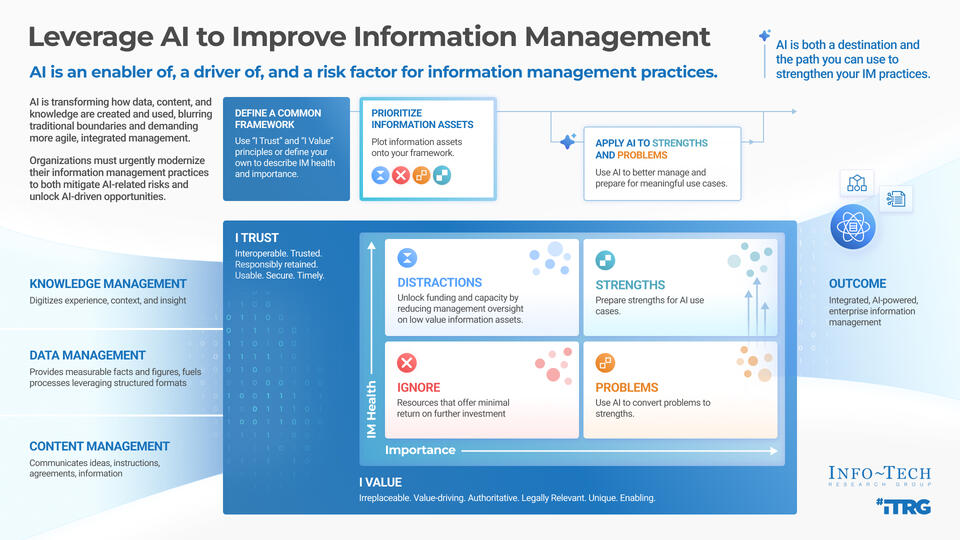
- Rapidly define your prioritization framework – what makes information important to your organization, and your critical dimensions of information management health. This becomes the foundation of your information management practice.
- Use your prioritization framework to uncover distractions, problems, and strengths. Use these insights to halt activities that do not benefit your organization and prioritize turning problems into strengths.
- Use AI as your supercharger – recognize the AI capabilities that rapidly improve information management practices, score the highest value initiatives to your organization, and use AI to turn your problems into strengths and your strengths into strategic fuel that propel your AI journey.
Info-Tech Insight
Use AI to prepare for AI. AI’s biggest impact is that it eradicates the traditional fault lines between data and content and radically disrupts the way we create, capture, and process knowledge, information, and insight. Use these capabilities to your advantage and apply them to your organization’s most important assets by creating a prioritization framework that is content and data agnostic. Additionally, select the AI capabilities that can move the needle on your information management practices, building the base your organization needs to take long-term, strategic advantage of one of its most important assets – its information.
Your challenge
This research is designed for information management leaders committed to using AI strategically to transform how information is managed, ensuring risk is minimized and value is maximized.
- As a leader in information management (IM), keeping pace with emerging trends and technologies can feel like chasing a moving target in a fog. The speed of change – driven by evolving AI capabilities, shifting business priorities, and the sheer complexity of data – is overwhelming. The pressure to anticipate, adapt, and guide others through uncertainty is real, especially when the stakes are high and the answers aren’t obvious.
- That’s why having a stable framework matters. A clear, principle-based approach for prioritizing within your information landscape – and for matching the right AI capabilities to the right problems – gives structure to navigating rapidly evolving landscapes. While the specific tools and technologies will continue to evolve, the framework remains your compass. It helps you focus on what’s most urgent, most impactful, and most aligned with your strategic goals. More importantly, it creates a repeatable way to evaluate new opportunities without reinventing your decision-making process every time. By leading with this discipline, you move beyond chasing trends and start shaping outcomes, guiding your team to adopt AI capabilities with intention.
90% of the world’s data has been generated in the past two years.
90%
(Source: Rivery.io, 2025)
Insight summary
The Dichotomy is Dead
The AI layer bridges what was once a fault line between structured data and unstructured content. This is a significant game changer because it immediately allows for cross-modality insights and automations – LLM, and the metadata and knowledge graphs that inform them, can simultaneously process disparate information types such as images, sounds, and structured data, hypothesize the relationship between them, and produce insights and new information. “Interoperable information” is no longer a stretch goal, it’s a capability that you can buy and refine to your context.
Barriers are Demolished
AI capabilities have demolished the barriers to information creation and capture. Nearly any type of input can be captured, extracted, annotated, categorized, parsed, and prepared for processing. Organizations must look at the information they are not capturing today and immediately put AI capabilities to work – the barriers (time, resources, access) are no longer relevant. Processes, procedures, approaches, records, methods, conversations – the market is flooded with tools to capture and process these. Extend your thinking to the customers and stakeholders your organization serves – what does your organization need them to capture to improve its services to them, and how can you leverage AI to facilitate this?
Recognize the New Risks
The AI layer has had significant impact on enhancing search and supporting the discoverability of information. This has led many to adopt information management frameworks that promote “sharable and accessible information.” But most organizations will find that overly-available “shareable and accessible information” is an operational and reputational risk. Process requirements, division of duties, confidentiality, and the protection of sensitive information will force organizations to lock down critical assets and be deliberate about what is shared and with whom. Focus your efforts on classifying information, clarifying the boundaries of what should be accessible and shareable to whom and under what conditions. This will allow your organization to leverage AI capabilities in search and discoverability on a deliberately architected foundation.
Systems, services, and processes are generating massive amounts of information
- 402.74 million terabytes — data generated daily worldwide, 2025
- 376.4 billion — emails sent and received each day, 2025
- 100 zettabytes — total cloud-stored data by 2025
- 720,000 hours — of video content uploaded to YouTube daily
- 500 million — tweets sent daily on X (formerly Twitter)
50% of world’s data is stored in the cloud by 2025. (Source: TechJury, 2024)
30% of organizational data is regarded as high-quality and trustworthy. (Source: gitNux, 2025)
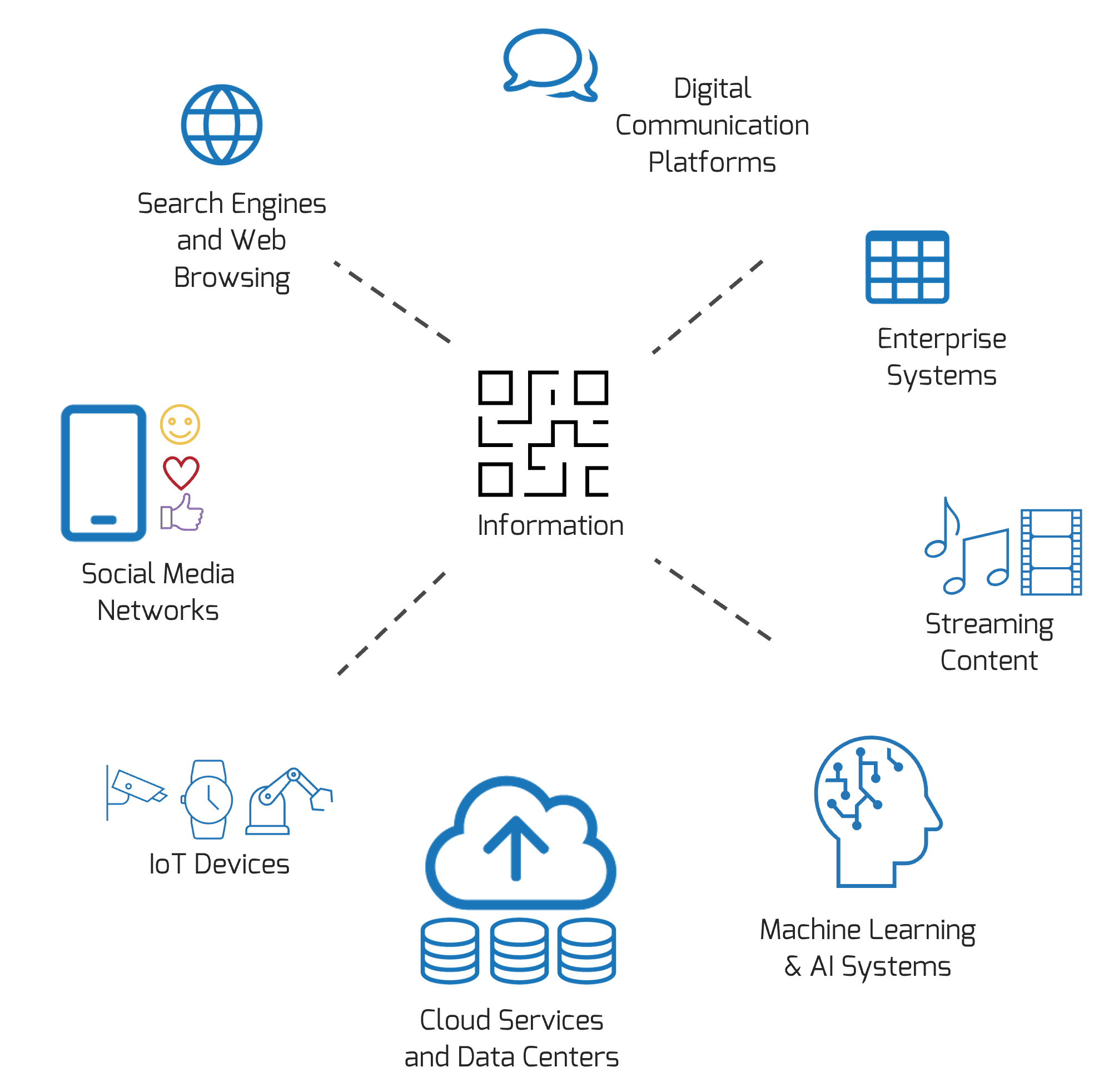
Knowledge workers lose nearly a third of their working hours just trying to find the information they need.
27%
(Source: RocketSoftware, 2025)
IT core priorities are leaning toward employee effectiveness and productivity.
60% of IT leaders cited “improving employee collaboration and productivity” as a core information management priority.
Integration, interoperability, and lack of automation are top obstacles to productivity.
- 19% TOP CHALLENGE: Information is siloed across applications, making it hard to search, access, and use.
- 24% TOP CHALLENGE: Applications lack integration with each other.
- 20% TOP CHALLENGE: Insufficient automation forces repetitive manual tasks.
- 19% TOP CHALLENGE: Collaboration across different applications is challenging. (Source: ''IT Turns its Attention to Employee Productivity,” OpenText, 2021)
Information management provides enterprise-wide strategy and governance across data, content, and knowledge
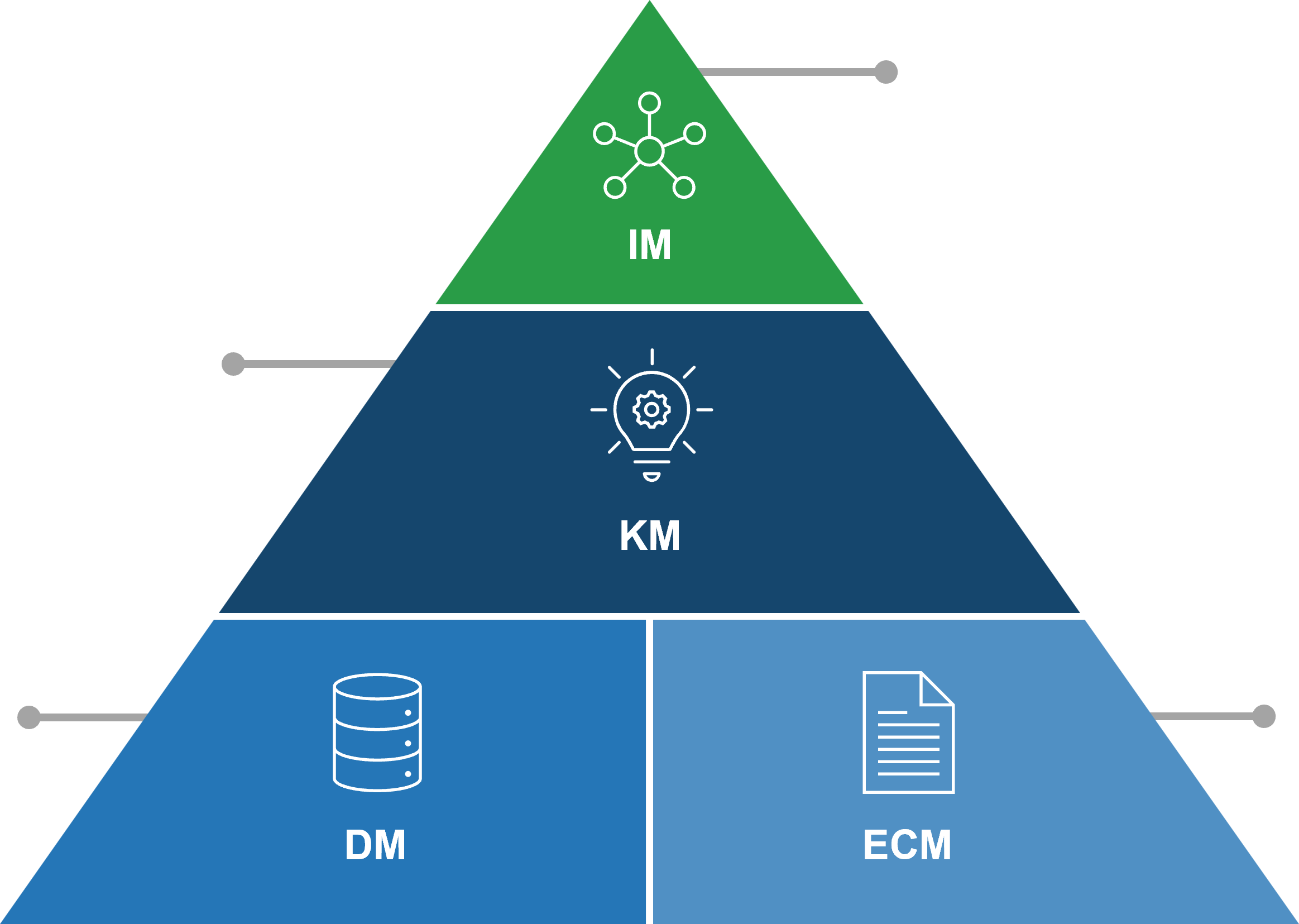
Information Management
IM provides enterprise-wide strategy and governance across data, content, and knowledge. It aligns all layers with business goals, designs unified architectures, and drives initiatives like enterprise search and informed decision-making.Knowledge Management
KM transforms information into actionable knowledge by capturing expertise and lessons learned. It enables sharing through collaboration and communities, building on inputs from DM and ECM to add context and foster a knowledge-rich environment.Data Management
DM focuses on organizing structured data like databases, spreadsheets, and quantitative records. It ensures data is accurate, well-defined, and accessible, forming the backbone for analytics and reporting.Enterprise Content Management
ECM manages unstructured content such as documents, emails, images, and web pages. It governs the lifecycle of content, ensuring consistency, compliance, and findability.
Data growth, AI, and compliance put information management in the spotlight.
- Explosion of Data:
Rapid growth in volume, variety, and velocity of information across organizations. - Digital Transformation:
Shift to cloud, remote work, and digital business models increases complexity and distribution of information. - AI & Analytics Demands:
Effective AI and automation require high-quality, well-managed information as a foundation. - Regulatory Pressure:
Stricter compliance requirements (GDPR, SOX, ISO, etc.) make precise information management essential. - Risk & Security Concerns:
Rising risks of data breaches, litigation, and reputational damage. - Competitive Advantage:
Organizations recognize information as a strategic asset for agility, resilience, and differentiation.
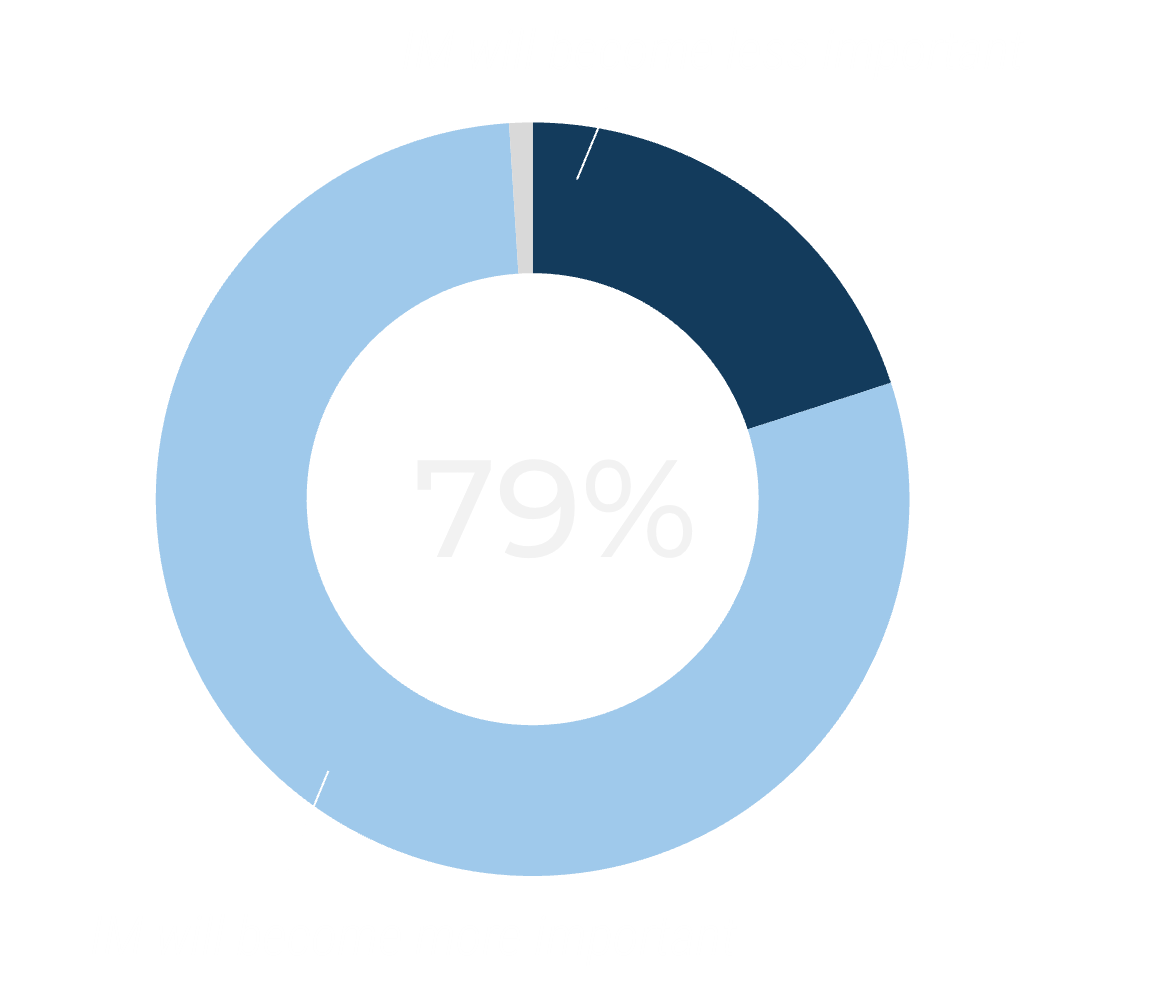
79% of leaders state that information management will become more important.
(Source: Association for Intelligent Information Management, 2023)
Integrate your information management framework to prioritize effectively across information types
Debate priorities, not hierarchies.
Integrated information management prioritizes overarching principles that guide decision-making and resource allocation, rather than rigidly distinguishing between content, knowledge, and data or debating their hierarchical relationships.
Focus on defining what makes information important, and what “well managed information” means to your organization and use that framework to prioritize your efforts and investments.
“The new world is all about Data AND Content, not Data OR Content.
We’ve operated in the past with a convenient dichotomy between data management and content management.
If this dichotomy ever made sense, it makes less and less as time goes on.” (Source: Acambah, 2025)
Apply AI’s base functions to reshape information management
Foundational AI Capabilities
LEARNING
Acquire knowledge from data or experience; improve performance over time using ML.- Automates data classification, tagging, and anomaly detection. Improves predictive analytics by learning from historical data.
IMPACT
PERCEPTION
Interpret sensory input like images, audio, and signals (e.g. computer vision, speech recognition).- Facilitates automated document scanning, image-based data extraction, and voice-driven data entry. Improves accuracy in capturing unstructured data from diverse sources.
IMPACT
REASONING/ PROBLEM SOLVING
Apply logic and algorithms to infer, conclude, and solve complex problems.- Enables intelligent query resolution and decision support systems. Helps enterprises optimize workflows and resource allocation by analyzing complex scenarios.
IMPACT
NATURAL LANGUAGE PROCESSING
Understand, interpret, and generate human language for text or speech tasks.- Transforms how employees interact with data – natural language queries replace complex SQL. Powers chatbots and virtual assistants for knowledge retrieval and customer support.
IMPACT
KNOWLEDGE REPRESENTATION
Encode facts, relationships, and context so AI can reason and answer questions.- Creates structured knowledge graphs from scattered enterprise data. Enhances semantic search and contextual recommendations, making information more discoverable.
IMPACT
PLANNING/DECISION-MAKING
Set goals, plan steps, and choose optimal actions based on predicted outcomes.- Supports dynamic data-driven strategies by simulating outcomes and recommending optimal actions. Critical for supply chain, risk management, and project planning.
IMPACT
GENERATIVE CAPABILITIES
Create new content such as text, images, or music using advanced generative AI models.- Automates and facilitates content creation – reports, summaries, and presentations – saving time and improving consistency. Enables personalized communication at scale.
IMPACT
Leverage AI to Improve Information Management
Enterprise AI
AI applied internally to improve how the organization operates and manages information. It focuses on efficiency, productivity, and decision-making.
- Intelligent Search & Retrieval — Quickly find relevant documents across silos.
- Data Classification & Governance — Automate tagging, compliance checks, and retention policies.
- Workflow Automation — Streamline repetitive tasks like approvals or data entry.
- Predictive Analytics for Operations — Forecast resource needs or detect anomalies in processes.
- Employee Productivity Tools — AI assistants for summarizing reports, drafting emails, or answering queries.
Example Use Cases:
GOAL
Boost workforce productivity and maintain well-managed, protected, and easily accessible information

Product AI
AI embedded into the products or services you deliver to customers, creating new features, smarter experiences, and competitive differentiation.
- Personalization Engines — Tailor recommendations for e-commerce or media platforms.
- Smart Features in SaaS Apps — Automated insights, predictive suggestions, or natural language interfaces.
- AI-Powered Analytics for Clients — Deliver dashboards that predict trends or optimize performance.
- Conversational Interfaces — Chatbots or virtual assistants integrated into customer-facing products.
- Fraud Detection or Risk Scoring — Embedded intelligence for financial or security products.
Example Use Cases:
GOAL
Enhance customer value, differentiate offerings, and create new revenue streams
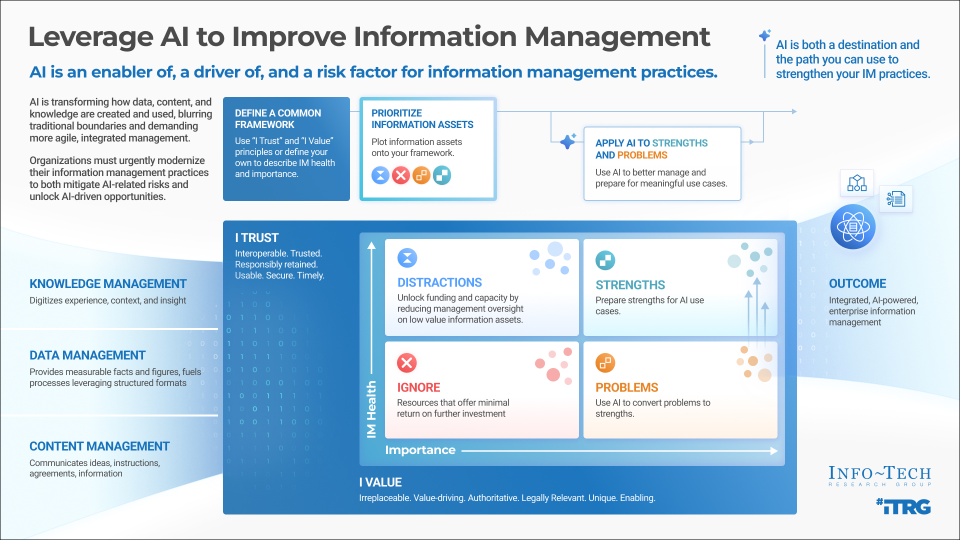
Info-Tech’s Methodology to Leverage AI to Improve Information Management
1. Set the Stage for AI-Powered Information |
2. Identify AI Opportunities in Information Management |
3. Define High-Impact Initiatives |
4. Activate Your AI-Powered IM Approach |
|
Phase Steps |
|
|
|
|
Phase Outcomes |
|
|
|
|
Blueprint deliverables
Key deliverable:
Leverage AI for Information Management C-Suite Presentation Template
A presentation template that enables easy customization and executive-facing content.
Each step of this blueprint is accompanied by supporting deliverables to help you accomplish your goals:
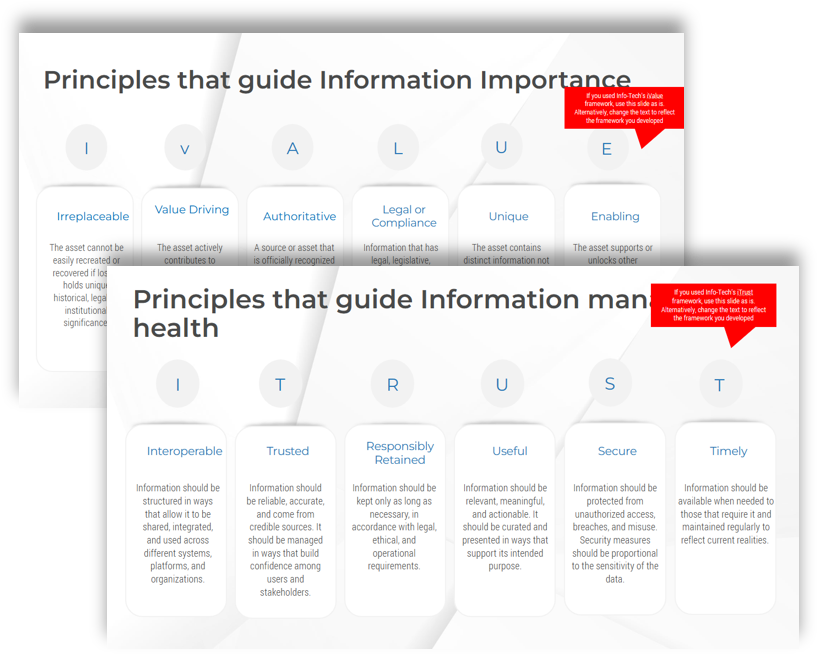
Information Management Principles
Leverage a library of principles to create an information management framework that is appropriate for your organization. (Part of the Leverage AI for Information Management Workbook.)
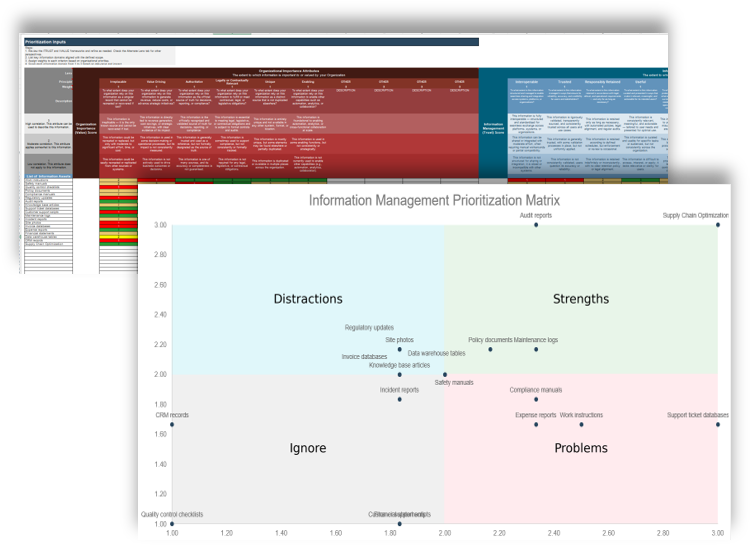
Prioritization Matrix
Prioritize information assets and define your next steps. (Part of the Leverage AI for Information Management Workbook.)
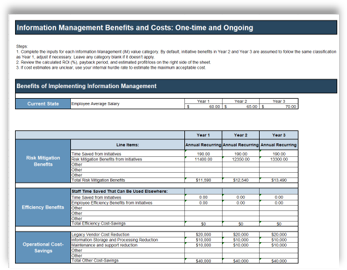
ROI and Business Case Tool
Leverage a library of AI capabilities and benefits to build a business case that is appropriate for your organization. (Part of the Leverage AI for Information Management Workbook.)
Measure the value of this blueprint
Leverage this blueprint to ensure your AI-powered information management approach delivers measurable business value and aligns with your organization’s strategic priorities.
Project outcome |
Value |
Metric |
| Time to Decision & Execution | Track how quickly teams move from identifying IM priorities to launching AI-powered initiatives. | Number of high-impact AI initiatives launched |
| Quality & Accessibility of Information Assets | Monitor the percentage of information assets meeting defined management standards before and after implementation. |
|
| Business Impact of AI Initiatives | Quantify the operational efficiencies, cost savings, or risk reductions delivered by AI-powered IM projects. | Percent reduction in manual processes |
| ROI & Value Realization | Use pre- and post-initiative ROI calculations to demonstrate financial and strategic benefits. | Financial ROI from AI-powered IM investments |
| Risk Mitigation | Measure reductions in compliance, security, and operational risks as a result of improved information management practices. | Number of risks mitigated, or compliance issues resolved |
Critical inputs required for leveraging AI to improve information management
To complete this blueprint, you will need to have the following items:
Organizational Priorities
Organizational priorities will drive the scope of your analysis and action plan.Information Domain Lists or Catalogues
Having ready-made lists of information domains or catalogues streamlines the prioritization process.
Info-Tech offers various levels of support to best suit your needs
DIY Toolkit |
Guided Implementation |
Workshop |
Executive & Technical Counseling |
Consulting |
| “Our team has already made this critical project a priority, and we have the time and capability, but some guidance along the way would be helpful.” | “Our team knows that we need to fix a process, but we need assistance to determine where to focus. Some check-ins along the way would help keep us on track.” | “We need to hit the ground running and get this project kicked off immediately. Our team has the ability to take this over once we get a framework and strategy in place.” | “Our team and processes are maturing; however, to expedite the journey we'll need a seasoned practitioner to coach and validate approaches, deliverables, and opportunities.” | “Our team does not have the time or the knowledge to take this project on. We need assistance through the entirety of this project.” |
Diagnostics and consistent frameworks are used throughout all five options. |
||||
Guided Implementation
A Guided Implementation (GI) is a series of calls with an Info-Tech analyst to help implement our best practices in your organization.
A typical GI is 8 to 12 calls over the course of 2 to 3 months.
What does a typical GI on this topic look like?
Phase 1 |
Phase 2 |
Phase 3 |
Phase 4 |
| Call #1: Scope requirements, objectives, and your specific challenges.
Call #2: Validate your information management framework and Identify key business areas. Call #3: Prioritize issues, strengths, and activities to stop. |
Call #4: Resolve high-impact IM problems with AI.
Call #5: Enhance high-value IM strengths with AI. |
Call #6: Build the business case for AI-powered IM investments.
Call #7: Select initiatives for AI investment. |
Call #8: Build the roadmap with timelines, value horizons, and KPIs.
Call #9: Secure strategic approval and prepare executive presentation. |
About Info-Tech
Info-Tech Research Group is the world’s fastest-growing information technology research and advisory company, proudly serving over 30,000 IT professionals.
We produce unbiased and highly relevant research to help CIOs and IT leaders make strategic, timely, and well-informed decisions. We partner closely with IT teams to provide everything they need, from actionable tools to analyst guidance, ensuring they deliver measurable results for their organizations.
What Is a Blueprint?
A blueprint is designed to be a roadmap, containing a methodology and the tools and templates you need to solve your IT problems.
Each blueprint can be accompanied by a Guided Implementation that provides you access to our world-class analysts to help you get through the project.
You get
Leverage AI to Improve Information Management – Phases 1-4
Leverage AI for Information Management C-Suite Presentation Template
Leverage AI for Information Management Excel Workbook
Need Extra Help?
Speak With An Analyst
Get the help you need in this 4-phase advisory process. You'll receive multiple touchpoints with our researchers, all included in your membership.
Guided Implementation 1: Set the Stage for AI-Powered Information
- Call 1: Scope requirements, objectives, and your specific challenges.
- Call 2: Validate your information management framework and Identify key business areas.
- Call 3: Prioritize issues, strengths, and activities to stop.
Guided Implementation 2: Improve and Enhance With AI
- Call 1: Resolve high-impact IM problems with AI.
- Call 2: Enhance high-value IM strengths with AI.
Guided Implementation 3: Define High-Impact Initiatives
- Call 1: Build the business case for AI-powered IM investments.
- Call 2: Select initiatives for AI investment.
Guided Implementation 4: Activate Your AI-Powered IM Approach
- Call 1: Build the roadmap with timelines, value horizons, and KPIs.
- Call 2: Secure strategic approval and prepare executive presentation.
Contributors
- Suresh Hebbar, Technical Architect, Trudell Medical Limited.
- Preeti Chopra, Knowledge Management Specialist – Corporate Affairs, STEMCELL Technologies
- Shannon Steffes, Site Operations Global Knowledge Management Specialist, Meta
- Michele Scrimger, Director Impact Lab, Impact Assessment Agency of Canada
- Steve Labelle, Head, Information and Data Governance, ATIP and Litigation
- Walter Di Lello, Implementation Manager, lastminute.com
- William McKnight, President, McKnight Consulting Group
 Move Away from File Shares and Organize Enterprise Information
 Develop an Enterprise Content Management Strategy and Roadmap
 Leverage AI for Information Management
