
Define Your Business Needs for an Oil and Gas ERP Transition
A guide to gathering and validating the key requirements and considerations for an ERP transformation.
ERP complexity emerges well before vendors are at the table, with many organizations navigating challenges such as:
- Operating in low-tolerance environments where downtime, disruption, or poor cutover planning can have significant operational and financial impacts.
- Facing complex modernization decisions, with unclear ROI projections and overlapping priorities between IT, finance, and operations.
- Needing a structured approach to requirements gathering that ensures every stakeholder group is aligned on functional, nonfunctional, and compliance needs.
- Seeking to de-risk ERP transformation by validating requirements early, improving visibility, and avoiding scope drift during implementation.
Our Advice
Critical Insight
- Match to your needs, not to your wants: Modernization efforts fail because they are not positioned and implemented in a way that suits stakeholder and process needs. Proper elicitation of key requirements and a robust validation process are far more essential to success than the ultimate choice of system.
- Don’t reinvent the wheel: ERP requirements should align with established industry best practices rather than legacy customizations or ad hoc integrations. Minimize bespoke modifications and favor modular, standards-based solutions to reduce long-term cost and complexity.
- Change happens when everyone is on board: ERP adoption succeeds when process owners actively champion new features and process changes within their domains. IT can enable and support, but true utilization depends on business leaders driving ownership and accountability for adoption.
Impact and Result
- Clear, validated ERP requirements aligned to oil and gas operational realities.
- Reduced scope ambiguity and fewer late-stage changes during configuration and build.
- Stronger stakeholder ownership and adoption of the future ERP solution.
Define Your Business Needs for an Oil and Gas ERP Transition
A guide to gathering and validating the key requirements and considerations for an ERP transformation.
Analyst perspective
Don't forget to show your work.
ERP transformations are large, political, and deeply consequential for every department of an organization. IT is accountable for making the new system work, but IT alone cannot define what "fit for purpose" means. That definition has to come from the business and the stakeholders being supported.
Many organizations fall into the trap of thinking they need to make their ERP "unique." But uniqueness is expensive to build, harder to support, and rarely necessary. Every major ERP platform has spent decades codifying the industry's best standardized process patterns. The more you deviate from those patterns, the more you will pay to keep those deviations alive.
The smarter, more responsible path is not to invent your way into the future, but to prove your way into it. Start with the basics, expand based on your needs as an oil and gas (O&G) organization, and validate diligently. When you demonstrate the evidence behind your priorities — i.e. when you can show your work — you reduce scope ambiguity, you elevate the quality of decision-making, and you generate the internal alignment required to avoid costly, late-stage change.
By taking this approach up-front, you maximize the probability that your ERP transformation will deliver what you expect.

Evan Garland
Senior Research Analyst, Industry Practice
Info-Tech Research Group
Executive summary
Your Challenge
Legacy ERP systems in oil and gas are costly to maintain, fragmented across business units, and poorly suited for integration with modern tools like AI and advanced analytics.
Determining the right modernization path is complex and time consuming, particularly in an industry where operational continuity is paramount.
Organizations need a clear, structured decision framework that aligns ERP modernization with both business goals and operational realities.
Common Obstacles
Deep customizations, manual workarounds, and entrenched data silos make even basic requirements gathering and process mapping a major challenge.
Organizational change management capabilities often determine modernization success more than the technology itself yet are frequently underdeveloped.
Extremely limited tolerance for downtime constrains rollout options, especially in production and logistics environments tied to critical operations.
Info-Tech's Approach
Guide organizations through a structured ERP requirements gathering methodology that balances functional, nonfunctional, and compliance needs.
Highlight your unique organizational ERP priorities. Align these priorities with industry best practices to focus investment on true differentiators and maximize success probability.
Facilitate stakeholder validation to confirm that internal priorities, pain points, and success criteria are clearly reflected in requirements documentation.
Info-Tech Insight
Modernization efforts fail because they are not positioned and implemented in a way that suits stakeholder and process needs. Proper elicitation of key requirements and a robust validation process are far more essential to success than the ultimate choice of system.
Your challenge
ERP complexity emerges well before vendors are at the table, with many organizations navigating challenges such as:
- Struggling with fragmented and heavily customized ERP systems that limit integration with modern analytics, automation, and AI tools.
- Operating in low-tolerance environments where downtime, disruption, or poor cutover planning can have significant operational and financial impacts.
- Facing complex modernization decisions, with unclear ROI projections and overlapping priorities between IT, finance, and operations.
- Needing a structured approach to requirements gathering that ensures every stakeholder group is aligned on functional, nonfunctional, and compliance needs.
- Seeking to de-risk ERP transformation by validating requirements early, improving visibility, and avoiding scope drift during implementation.
60% of companies that completed an ERP implementation cited effective stakeholder communication as the top skill required for success.
Source: NetSuite, 2024
Common obstacles
Pain points often stem from organizational behaviors, not technology flaws
- Deep customizations and manual workarounds make it difficult to benchmark against vendor best practices or leverage out-of-the-box capabilities.
- Entrenched data silos across operations, finance, and logistics create inconsistent views of performance and complicate integration with modern systems.
- Weak process ownership and limited change management maturity reduce adoption of new features, even when they improve efficiency on paper.
- Unclear requirements documentation and poor stakeholder validation lead to missed priorities and costly rework later in the project lifecycle.
Disruptions are costly and not uncommon
51% of companies experience disruptions when going live with a new ERP system.
Source: Rubin Brown, 2025
Among companies that faced delays with ERP project delivery, 40% cited project scope expansion as the leading cause.
Source: Jacopo Solutions, 2025
Info-Tech's approach
Structuring your approach to gathering and validating needs will de-risk your outcome
- Work through a structured ERP requirements gathering methodology that balances functional and nonfunctional needs. Evaluate your existing processes and functions to surface sources of need and critical processes for industry operations.
- Highlight your unique organizational ERP priorities. Layer in additional functionalities that support O&G industry operations over your core ERP modules. Combine all priorities together with industry best practices to focus investment on true differentiators and maximize the probability of success.
- Facilitate stakeholder validation to confirm that internal priorities, pain points, and operational must-haves are accounted for. Build confidence in your final requirement set through multiple rounds of requirements specification and validation with your key stakeholder groups.
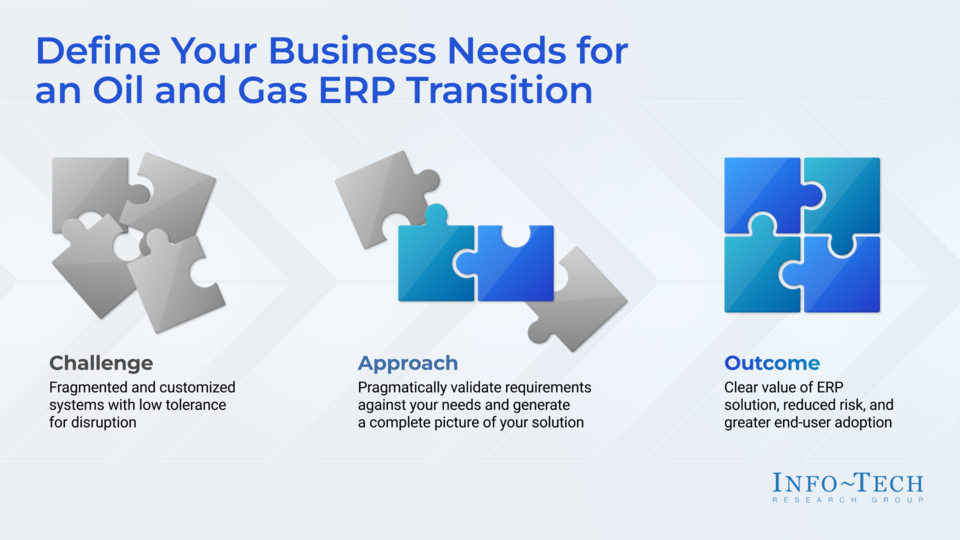
Define your business needs for an Oil and Gas ERP transition
Challenges
- Fragmented and customized systems in current operations
- Low tolerance for disruption; emphasis on cost and proving ROI
- Multiple layers of validation for stakeholder needs and business requirements
Modernization efforts fail because they are not positioned and implemented in a way that suits stakeholder and process needs. Proper elicitation of key requirements and a robust validation process are far more essential to success than the ultimate choice of system.
Approach: Pragmatically validate requirements against your needs and generate a complete picture of your solution.
- Define base requirement set
- Highlight key requirements
- Review and validate key requirements
- Adjust base requirements to fit purpose
ERP requirements should align with established industry best practices rather than legacy customizations or ad hoc integrations. Minimize bespoke modifications and favor modular, standards-based solutions to reduce long-term cost and complexity.
Outcomes
- Clear map of ERP solution value to business units
- Reduction of ERP transformation project risk
- Greater end-user adoption of features in new solution
ERP adoption succeeds when process owners actively champion new features and process changes within their domains. IT can enable and support, but true utilization depends on business leaders driving ownership and accountability for adoption.
ERP transformations are hard to make easy. But with the correct guidance, you can make them simpler.
Match to your needs, not to your wants
Modernization efforts fail because they are not positioned and implemented in a way that suits stakeholder and process needs. Proper elicitation of key requirements and a robust validation process are far more essential to success than the ultimate choice of system.
Don't reinvent the wheel
ERP requirements should align with established industry best practices rather than legacy customizations or ad hoc integrations. Minimize bespoke modifications and favor modular, standards-based solutions to reduce long-term cost and complexity.
Change happens when everyone is on board
ERP adoption succeeds when process owners actively champion new features and process changes within their domains. IT can enable and support, but true utilization depends on business leaders driving ownership and accountability for adoption.
Leverage Info-Tech's supporting tools to accelerate your process
Key deliverable: Oil and Gas ERP Requirements Gathering Tool
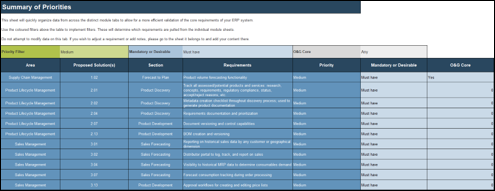
The Oil and Gas ERP Requirements Gathering Tool enables a structured collection of ERP requirements in alignment with the major functional and nonfunctional needs of your organization. Use it to define, highlight, and prioritize the key requirements for your ERP implementation and track validation of requirements with stakeholders.
Download the Oil and Gas ERP Requirements Gathering Tool
Info-Tech offers various levels of support to best suit your needs
| DIY Toolkit | Guided Implementation | Workshop | Executive & Technical Counseling | Consulting |
|---|---|---|---|---|
| "Our team has already made this critical project a priority, and we have the time and capability, but some guidance along the way would be helpful." | "Our team knows that we need to fix a process, but we need assistance to determine where to focus. Some check-ins along the way would help keep us on track." | "We need to hit the ground running and get this project kicked off immediately. Our team has the ability to take this over once we get a framework and strategy in place." | "Our team and processes are maturing; however, to expedite the journey we'll need a seasoned practitioner to coach and validate approaches, deliverables, and opportunities." | "Our team does not have the time or the knowledge to take this project on. We need assistance through the entirety of this project." |
Diagnostics and consistent frameworks are used throughout all five options.
Guided Implementation
What does a typical GI on this topic look like?
| Phase 1 | Phase 2 |
|---|---|
|
Call #1: Scope requirements, objectives, and your specific challenges. Call #2: Define requirements for core modules 1 and 2. Call #3: Define requirements for core modules 3 and 4. Call #4: Define requirements for core modules 5 and 6. Call #5: Identify integrations and unique industry modules. Call #6: Review desired functions from unique industry modules. |
Call #7: Review stakeholder feedback and edit requirement set. Call #8: Add prioritization to key requirements and finalize requirement set. |
A Guided Implementation (GI) is a series of calls with an Info-Tech analyst to help implement our best practices in your organization.
A typical GI is four to eight calls over the course of two to three months.
Workshop overview
Contact your account representative for more information.
workshops@infotech.com 1-888-670-8889
| Day 1 | Day 2 | |
|---|---|---|
| Activities | Establish Requirement Foundations | Strengthen Readiness Through Validation |
| 1.1 Define scope, business objectives, and transformation constraints 1.2 Establish baseline ERP requirement set (functional, nonfunctional, compliance) using Info-Tech templates. 1.3 Identify industry-specific modules and integrations (especially O&G specific). 1.4 Identify primary stakeholder groups and process owners for validation. |
2.1 Review stakeholder feedback on requirement set and address major gaps or disagreements. 2.2 Apply prioritization across requirement set (value vs. complexity/feasibility scoring). 2.3 Finalize prioritized requirement set and prepare for vendor communications/RFP. |
|
| Deliverables |
|
|
Measure the value of this blueprint
Save time and cost and solidify the benefits of your new ERP
Industry guidance for contingency on ERP transformation projects typically ranges from 5% to 15% of total program value. As a conservative illustration, if even 3% to 7% of total spend is consumed by late-stage change requests driven by unclear or unvalidated requirements, the avoidable rework exposure can easily reach hundreds of thousands to multiple millions of dollars.
The cost of rework (in both time and dollars) for ERP projects increases as progress is made. Use our methodology and tools to save time upfront and protect against expensive corrections down the line.
| Total ERP Program Value | 3% Avoidable rework Costs | 7% Avoidable Rework Costs | Range of Cost Saving |
|---|---|---|---|
| $8M | $240,000 | $560,000 | $320,000 |
| $15M | $450,000 | $1,050,000 | $600,000 |
| $30M | $900,000 | $2,100,000 | $1,200,000 |
Initiative Outcomes
IT Value Realization
- Reduced rework and change requests during configuration and build
- Less complex portfolio, achieved by minimizing custom code and avoiding ad hoc integrations
- Greater alignment to vendor best practices and future roadmap feasibility
Business Value Realization
- Faster, more accurate processes with less manual work and reconciliation
- Higher adoption and feature utilization due to process ownership and clarity
- Clearer ROI and value realization tracking tied to prioritized requirements
Info-Tech's methodology for defining your business needs for an oil and gas ERP transition
| 1. Establish Requirement Foundations | 2. Strengthen Readiness Through Validation | |
|---|---|---|
| Phase Steps |
|
|
| Phase Outcomes |
|
|
About Info-Tech
Info-Tech Research Group is the world’s fastest-growing information technology research and advisory company, proudly serving over 30,000 IT professionals.
We produce unbiased and highly relevant research to help CIOs and IT leaders make strategic, timely, and well-informed decisions. We partner closely with IT teams to provide everything they need, from actionable tools to analyst guidance, ensuring they deliver measurable results for their organizations.
What Is a Blueprint?
A blueprint is designed to be a roadmap, containing a methodology and the tools and templates you need to solve your IT problems.
Each blueprint can be accompanied by a Guided Implementation that provides you access to our world-class analysts to help you get through the project.
Need Extra Help?
Speak With An Analyst
Get the help you need in this 2-phase advisory process. You'll receive multiple touchpoints with our researchers, all included in your membership.
Guided Implementation 1: Establish Requirement Foundations
- Call 1: Scope requirements, objectives, and your specific challenges.
- Call 2: Define requirements for core modules 1 and 2.
- Call 3: Define requirements for core modules 3 and 4.
- Call 4: Define requirements for core modules 5 and 6.
- Call 5: Identify integrations and unique industry modules.
- Call 6: Review desired functions from unique industry modules.
Guided Implementation 2: Strengthen Readiness Through Validation
- Call 1: Review stakeholder feedback and edit requirement set.
- Call 2: Add prioritization to key requirements and finalize requirement set.