
Create Your Agentic AI Roadmap for Data Management
Turn use cases, fit gating, readiness, complexity checks, and scoring into a defensible plan.
Organizations are under pressure to move quickly on agentic AI, but most lack a reliable way to determine which opportunities are viable, operationally ready, and worth funding. Without a disciplined qualification process, teams risk investing in poorly scoped use cases and advancing initiatives before governance, data, and readiness conditions are in place. This blueprint helps CIOs, data leaders and governance stakeholders define, qualify, and then prioritize agentic AI use cases through a structured methodology that produces a defensible, execution-ready roadmap.
Before starting any agentic AI initiative, it is critical to define candidate use cases, validate them through agentic fit, readiness, and complexity gates, and prioritize qualified opportunities. Using a consistent scoring framework supports stronger roadmap decisions, governance alignment, and leadership confidence.
1. The most expensive use case is one that’s not well-defined.
Agentic AI investment is wasted when vague use cases are funded. Define your use cases using a consistent method to clearly scope and evaluate them against your business priorities.
2. Not every AI idea deserves to move forward.
Not every AI opportunity requires an agentic approach, and not every agentic use case is ready to move into delivery. Validate AI ideas using a three-gate model to qualify use cases based on each gate’s criteria.
3. A roadmap that surfaces risks gets executive support.
Leadership supports decisions they can defend and justify. Prioritize candidates based on benefits, efforts, and risks to turn use cases into fundable projects.
Use this step-by-step blueprint to qualify and operationalize your agentic AI opportunities
Our research offers a structured methodology along with practical tools, including a scoring kit and workbook, to help organizations qualify agentic AI opportunities before prioritizing them, resulting in a defensible, execution-ready roadmap.
- Define the candidate use cases by identifying priority data management domains, scoping candidate opportunities, and documenting each use case using a structured method.
- Apply the qualification gates to confirm whether the opportunity is truly agentic, operationally ready, and how complex it is to build.
- Prioritize qualified candidates and turn them into action by using a scoring approach to compare opportunities, dependencies, and delivery considerations.
- Translate scoring results into a sequenced, execution‑ready roadmap supported by clear rationale and governance alignment.
- Create execution-ready decision outputs using decision cards with ownership, KPIs and guardrails to support leadership review and funding decisions.
Member Testimonials
After each Info-Tech experience, we ask our members to quantify the real-time savings, monetary impact, and project improvements our research helped them achieve. See our top member experiences for this blueprint and what our clients have to say.
10.0/10
Overall Impact
$68,999
Average $ Saved
20
Average Days Saved
Client
Experience
Impact
$ Saved
Days Saved
Tyler Technologies, Inc.
Guided Implementation
10/10
$68,999
20
Best: Real options and paths for how to build a Knowledge layer on top of Data / Information. Worst: Vendor products are still immature and fragmen... Read More
Create Your Agentic AI Roadmap for Data Management
Turn use cases, fit gating, readiness, complexity checks, and scoring into a defensible plan.
Analyst perspective
Agents amplify decisions. Make yours count.
Agentic AI represents one of the most important emerging opportunities for data leaders, but the real barrier is not interest, it is practical decision-making. Most organizations already have plenty of ideas, pilots, and internal curiosity. The harder question is how to determine which opportunities are worth pursuing, which ones are ready to move forward, and which ones require stronger foundations before they can deliver value safely and responsibly.
From my perspective, the challenge comes down to three practical issues. Organizations need to separate true agentic AI opportunities from use cases better suited to rules-based automation, workflow improvement, or traditional AI. They also need a consistent way to assess and prioritize opportunities based on benefit, effort, risk, readiness, and complexity. Just as importantly, they need to recognize that agentic AI does not reduce the need for strong data management foundations. It increases the importance of trusted metadata, data quality, lineage, governance, security, ownership, escalation paths, and oversight.
This research is designed to help data leaders make those decisions in a structured and defensible way. The approach provides a practical scoring kit that can be applied to existing use case opportunities. It helps to define each use case clearly, assess whether it is truly agentic, determine whether the organization is ready to support it, and understand how complex it will be to deliver.
The process is intentionally disciplined. Before a use case is scored, first test whether it genuinely requires an agent. Then assess whether the required data, governance, controls, and operating conditions are ready enough to support responsible execution. Finally, evaluate complexity to better understand execution difficulty and confidence in the value estimate. Only after those gates are complete should scoring of the opportunity against benefit, effort, and risk be done.
The result is more than a ranked list of agentic AI ideas. It creates a practical management roadmap that shows what should move forward now, what should come next, what should wait, and what foundational work must be addressed first. Together, the prioritization list and roadmap help you move from agentic AI curiosity to confident action by showing where to invest, where to pause, and where stronger data management foundations are needed before agentic AI can scale responsibly.

Jason Edwards
Principal Research Director
Info-Tech Research Group
Executive summary
Your Challenge
Organizations are being pressured to deliver agentic AI outcomes in data management before they have a reliable way to decide where it will actually work.
- Agentic AI ideas arrive faster than teams can credibly evaluate them.
- Effort is spent ranking use cases that were never clearly defined or scoped.
- Readiness is overestimated; governance and control gaps surface mid-pilot.
- Leaders struggle to build a credible, fundable case for AI investment at scale.
The issue is not a lack of ambition, it is the absence of a disciplined, repeatable way to decide what to pursue and in what order.
Common Obstacles
These barriers make the challenge difficult to address for most organizations:
- No disciplined method to qualify opportunities before scoring them.
- True agentic use cases are not separated from deterministic automation.
- Data, governance, and readiness gaps are underestimated until pilots fail.
- Build complexity is underestimated, so timelines, costs, and risks don't match what the candidate actually demands.
Conventional approaches rank use cases on ambition and market momentum rather than on a structured, gated assessment.
Info-Tech's Approach
Info-Tech provides a structured method to define agentic AI candidates, qualify them through three gates, and score only those that survive. It includes:
- A clear way to define and scope candidate use cases from real operations.
- An agentic fit gate that separates true agentic work from automation.
- A readiness gate and a complexity gate that test foundations and calibrate scoring.
- A scoring kit that ranks benefit, effort, and risk into a sequenced roadmap.
The result is a governed, execution-ready roadmap that reduces avoidable pilot failure and raises the odds of measurable business impact.
Info-Tech Insight
Organizations that qualify agentic AI use cases through a disciplined sequence of gates, before scoring them, make faster and more defensible decisions than those relying on theory, vendor narratives, or isolated pilots, with a credible path from pilot to production.
Your challenge
This research is designed to help organizations that are facing these challenges:
- Agentic AI investment is accelerating, but most organizations lack a reliable, production-grounded way to decide which data management use cases to prioritize and how to justify those decisions to leadership.
- Teams cannot consistently distinguish true agentic opportunities from tasks that are better and more reliably handled by deterministic automation, leading to overengineered solutions and wasted investment.
- Governance, data quality, and readiness prerequisites are systematically underestimated; initiatives appear promising in pilots but stall or fail when conditions for production deployment are not in place.
- Leaders are pressured to present AI roadmaps based on market momentum rather than evidence, reducing the credibility of investment proposals and increasing the risk of low-ROI commitments.
Each of these challenges is structural, not a tooling gap. This blueprint addresses them with three qualification gates: Agentic Fit (is an agent genuinely required?), Readiness (are the data and governance foundations in place?), and Complexity (how hard is it to build, and how much can the value estimate be trusted?).
95% of enterprise Gen AI pilots deliver no measurable P&L impact.
MIT Project NANDA, 2025
11% of organizations are actively running agentic AI systems in production.
Deloitte, 2026
26% of chief data officers are confident their data can support new AI-enabled revenue streams.
"2025 CDO Study," IBM Institute for Business Value, 2025
64% of CEOs say fear of falling behind drives AI investment before they clearly understand the value..
"2025 CEO Study," IBM Institute for Business Value, 2025
Common obstacles
These barriers make this challenge difficult to address for many organizations.
Agent-washing makes valid comparison impossible
Vendors and internal teams routinely label automation, copilot UX, and RPA workflows as "agentic AI." This overstates capability, blurs the boundary between deterministic automation and true agentic systems, and makes it impossible to compare opportunities on an apples-to-apples basis.
No disciplined way to qualify opportunities
Teams evaluate agentic AI opportunities with no consistent method to confirm a use case genuinely needs an agent, to test whether the organization is ready to deliver it, or to weigh how complex it will be to build. Decisions are made on enthusiasm and demos rather than a repeatable, defensible assessment.
- AI tools purchased from specialized vendors succeed roughly twice as often as internal builds in part because internal teams lack a disciplined method to qualify and de-risk candidates before committing to a build.
Readiness is systematically overestimated
Governance, data quality, and infrastructure prerequisites are confidently asserted at the start of pilots, but readiness assessments are applied too late after design decisions are already made, not before. Initiatives appear promising in pilots, then stall when production conditions are not in place.
Theory-first frameworks don't transfer to outcomes
Most available frameworks start with abstract taxonomies or maturity models. Without a concrete, gated method that scores real candidates on benefit, effort, and risk, they cannot produce defensible prioritization decisions that hold up in leadership conversations.
Why conventional approaches fail
88% of organizations now use AI in at least one business function. But only 23% are scaling agentic AI specifically; the rest is general AI being relabeled.
"The State of AI 2025," McKinsey & Company, 2025
43% of data leaders admit data readiness is their biggest obstacle to AI initiatives.
Drexel University LeBow College of Business & Precisely, 2026
39% of organizations report any EBIT impact at the enterprise level – and most of those report less than 5%.
MIT Project NANDA, 2025
Insight summary
Overarching insight
Organizations that qualify agentic AI use cases through a disciplined sequence of gates before scoring them make faster and more defensible decisions than those relying on theory, vendor narratives, or isolated pilots and create a credible path from pilot to production.
Phase 1 insight
The fastest way to waste an agentic AI budget is to score use cases that were never clearly defined. Stating each candidate as a precise trigger, action, and outcome, scoped narrowly enough to assess, eliminates the most common failure mode (MIT Project NANDA, 2025).
Phase 2 insight
The order of the three gates matters. Confirming true agentic behavior first, then readiness, then complexity, means teams never design governance or estimate effort for use cases that do not actually require an agent.
Phase 3 insight
Scoring use cases only after all three gates have been applied produces more grounded decisions. When benefit, effort, and risk are scored against confirmed agentic fit, readiness, and complexity, ranked roadmaps survive leadership scrutiny.
Tactical insight
The most common reason agentic AI pilots fail to scale is not technical, it is that data and governance prerequisites were never verified. Applying the readiness gate before a use case is scored is a data team's highest-leverage action.
Tactical insight
A decision card is not documentation, it is the contract that makes a roadmap executable. Because the kit autopopulates gate results and scores, the team's effort goes to naming owners, guardrails, KPIs, and conditions.
Insight details
Prioritize what matters. Roadmap what's next. Scale agentic AI with confidence.
The bar for agentic AI investment is rising. Four insights separate tomorrow's leaders from the organizations still funding the wrong bets.
The competitive advantage in agentic AI has already shifted.
The competitive advantage has shifted from what agents can do to which ones organizations choose first. The MIT NANDA study found 95% of enterprise AI pilots delivered no measurable P&L impact (2025). That is not a technology failure – it is a selection failure. This blueprint replaces internal speculation with a structured, three-gate qualification method and disciplined scoring.
Mislabeling automation as agentic creates the wrong governance architecture.
Agent washing compounds the problem. Deloitte's 2026 research confirms that many so-called agentic initiatives are automation in disguise. Organizations that misclassify do not just waste budget, they build the wrong governance architecture, over-engineering autonomy and under-investing in controls. The agentic fit gate eliminates this at the earliest decision point.
Organizations do not skip readiness assessment; they do it in the wrong order.
The readiness problem is equally consequential. IBM's 2025 CDO Study reveals a 55-point gap between organizations reporting data strategy alignment (81%) and those confident their data can support AI-enabled revenue (26%). McKinsey confirms eight in ten organizations cite data limitations as the primary scaling blocker (2025). The damage is in the timing: gaps surface mid-deployment, after budget is committed. The readiness gate sits before scoring, assessing nine concrete dimensions so gaps surface first. A third gate, complexity, then calibrates how hard each candidate is to build and how much to trust its value estimate.
A ranked list gets a meeting. A defensible decision card gets a funded initiative.
Finally, how a prioritization output is formatted determines whether it gets funded. IBM finds 64% of CEOs admit fear of falling behind drives investment before value is understood ("2025 CEO Study," IBM Institute for Business Value, 2025). A ranked list answers which; it does not answer why or what it depends on. The one-page decision cards this blueprint produces consolidate each "now" candidate's gate results, scores, prerequisites, guardrails, KPIs, and decision signal into a single leadership-ready document, shifting the conversation from defending a number to authorizing a decision.
The organizations that will lead are not those with the most ambitious roadmaps, they are the ones that qualify candidates through disciplined gates, classify honestly, and walk into leadership conversations with decisions they can defend.

Info-Tech's approach
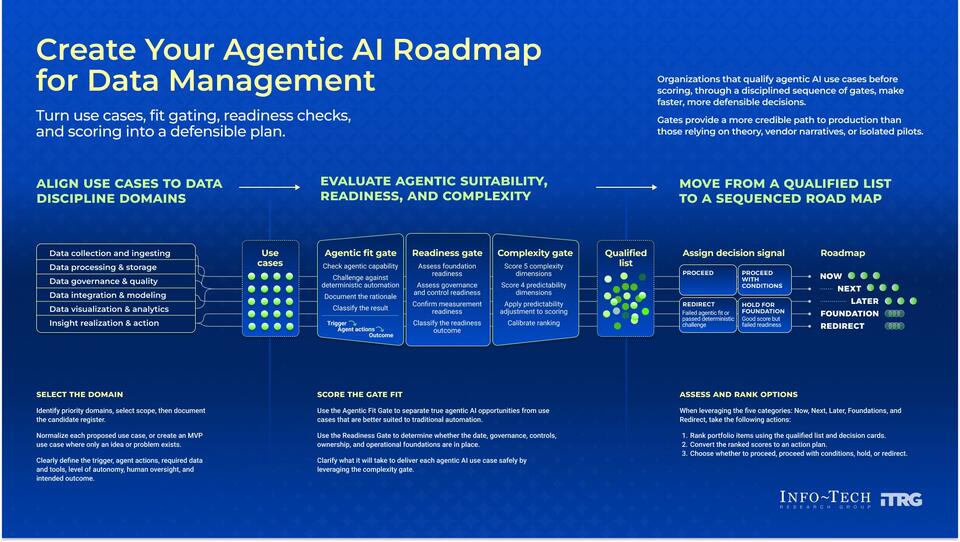
Qualify before you score: from candidate ideas to a defensible roadmap
Define Candidates Clearly
Define your own candidate use cases from real operations, stated as a precise trigger, agent actions, and outcome, scoped narrowly enough to assess, not borrowed from vendor claims or abstract theory.
Qualify Through Three Gates
Each candidate passes three gates in order: agentic fit confirms it genuinely needs an agent, readiness confirms the data and governance foundations are in place, and complexity calibrates how hard it is to build.
Score With Discipline
Only qualified candidates are scored on benefit, effort, and risk. A predictability adjustment, set by the complexity gate, discounts benefit where the value estimate rests on assumption rather than measurement.
Produce a Sequenced Roadmap
The scored candidates are sorted automatically into Now, Next, Later, Foundations, and Redirect, with a one-page decision card for every now candidate – a roadmap leadership can fund.
The Info-Tech difference:
- Qualify before you score. Three gates filter out non-agentic, unready, and speculative candidates first.
- Complexity-calibrated scoring. The score reflects build difficulty and how far the estimate can be trusted.
- Built-in governance, guardrails, and oversight live inside the readiness gate, not added later.
- Leadership-ready output. A repeatable kit producing an autosequenced roadmap and decision cards.
Info-Tech's methodology for Agentic AI in Data Management
| 1. Define the Candidate Use Cases | 2. Qualify the Candidate Use Cases | 3. Prioritize, Interpret, and Decide | |
|---|---|---|---|
| Phase Steps |
|
|
|
| Phase Outcomes | A structured candidate use case register with a clearly defined set of use cases, mapped to data management domains, that are ready to enter the qualification gates in Phase 2. | A qualified candidate list: Each use case confirmed as agentic, assessed for readiness, calibrated for complexity, and tagged with a Proceed, Proceed With Conditions, Hold for Foundations, or Redirect signal. | A prioritized use case roadmap with decision cards for the top candidates organized into Now, Next, Later, Foundations, and Redirect categories, with explicit guardrails, ownership, and success measures defined. |
About Info-Tech
Info-Tech Research Group is the world’s fastest-growing information technology research and advisory company, proudly serving over 30,000 IT professionals.
We produce unbiased and highly relevant research to help CIOs and IT leaders make strategic, timely, and well-informed decisions. We partner closely with IT teams to provide everything they need, from actionable tools to analyst guidance, ensuring they deliver measurable results for their organizations.
What Is a Blueprint?
A blueprint is designed to be a roadmap, containing a methodology and the tools and templates you need to solve your IT problems.
Each blueprint can be accompanied by a Guided Implementation that provides you access to our world-class analysts to help you get through the project.
Need Extra Help?
Speak With An Analyst
Get the help you need in this 3-phase advisory process. You'll receive multiple touchpoints with our researchers, all included in your membership.
Guided Implementation 1: Define the Candidate Use Case
- Call 1: Identify priority data management domains and frame the opportunity.
- Call 2: Select and scope candidates as trigger-actions-outcome statements.
- Call 3: Document the candidate register and confirm business owners.
Guided Implementation 2: Qualify the Candidate Use Cases
- Call 1: Run the agentic fit gate to confirm true agentic candidates.
- Call 2: Run the readiness gate and document foundation gaps.
- Call 3: Run the complexity gate to calibrate scoring and sequencing.
- Call 4: Score candidates on benefit, effort, and risk; review the results.
Guided Implementation 3: Prioritize and Turn Qualified Candidates Into Action
- Call 1: Build the prioritized roadmap and decision cards.
- Call 2: Secure leadership sign-off and prepare the executive presentation.
Contributors
- Jeremy Molnar, Allied Effects
- Charly Lin, Morpheo AI
- Duncan Palmer, Co-operators
- Marina Neyman, Hoffman La Roche
- Tim Eyres, Hoffman La Roche
 Build a Robust and Comprehensive Data Strategy
 Activate Data Governance
 Build a Data Architecture Roadmap
 Sprint Toward Data-Driven Culture Using DataOps
 Develop a Master Data Management Practice and Platform
 Build a Data Integration Strategy
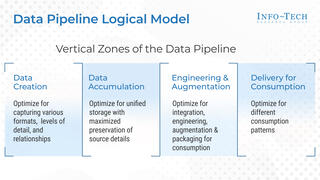 Build a Data Pipeline for Reporting and Analytics
 Break Open Your DAM With Intuitive Metadata
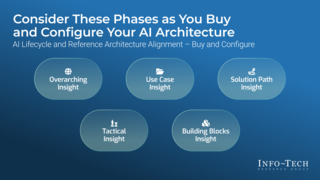 Define the Components of Your AI Architecture
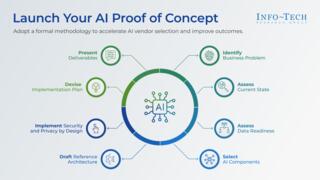 Launch Your AI Proof of Concept
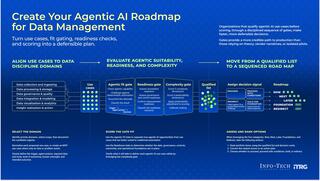 Create Your Agentic AI Roadmap for Data Management