Our systems detected an issue with your IP. If you think this is an error please submit your concerns via our contact form.
Build Resilience: Strengthening Construction Amid Policy Shifts
Stay ahead of tariffs and disruptions with proactive risk planning.
Construction leaders face rising costs, supply chain delays, and labor shortages driven by shifting trade policies. Act now or let economic pressure choose your next move.
Our Advice
Critical Insight
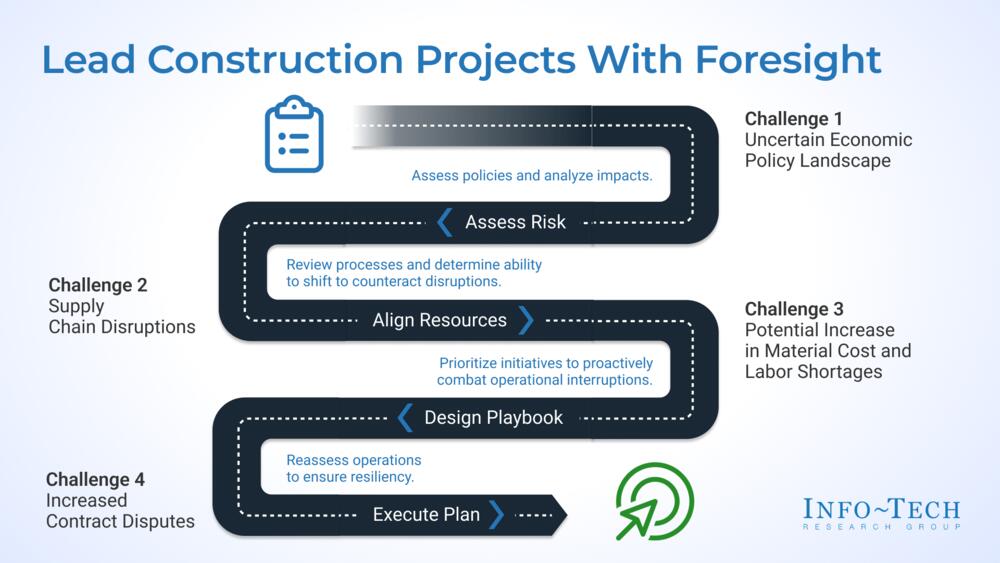
Lead construction projects with foresight. Shape outcomes early, build trust, and drive results. Take control before circumstances take over.
Impact and Result
- Comprehensive management and analysis of risks applicable to the specific situation.
- Analysis resources usage to align them with organizational goals.
- Critical response plan to maintain business continuity and ensure organizational resilience.
- Tools to execute efficiently to ensure stakeholder buy-in and success.
Research & Tools
1. Build Resilience: Strengthening Construction Amid Policy Shifts Storyboard – This research outlines a four-step framework for construction CIOs to lead through disruption.
Construction leaders face rising costs, supply chain delays, and labor shortages driven by shifting trade policies. Act now or let economic pressure choose your next move. Drawing from case studies and research, this research helps leaders take early action to build resilience and influence outcomes during hectic economic trade policy changes.
Build Resilience: Strengthening Construction Amid Policy Shifts
Stay ahead of tariffs and disruptions with proactive risk planning.
Align resources, reduce risk, and show results

The current uncertainty has many of us hesitant, delaying decisions and awaiting direction with no sense of control.
Leaders must respond to an uncertain economic policy landscape, persistent supply chain disruptions, rising material cost, potential labor shortages, and a growing wave of contract disputes that threaten budgets, timelines, and stakeholder trust.
This has caused widespread anxiety and locked us in a defensive posture!
This reaction is understandable, but waiting is not a strategy. Inaction carries significant risks.
Waiting for tariffs to impact your organization can leave you behind the curve.
In an industry where completion of projects is directly correlated to success, your organization needs to ensure you shape your outcome from these new tariffs.
No matter your role, being the one who brings solutions can position you as an anchor for stability.
Associate the challenges with new statistics to understand the disruptions to construction operations
5.5%Increase in construction project costs |
6-9 monthsTimeline for full impact of price hikes |
40%Percentage of mechanical equipment for |
6%-8%Projected increase to |
20%-30%Percentage of construction workforce |
US$200 billionEstimated US GDP loss from tariffs, |
We have a four-step approach to achieving resilience in times of policy and budget uncertainty
Info-Tech is a leader in developing IT best practices for construction organizations.
Use our methodologies, tools, deliverables, and a vast offering of analyst guidance, services, and workshops to succeed.
Step 1: Assess the Risk Impact on Your Organization
- Build an up-to-date and integrated risk register.
- Analyze the impact of each risk.
- Build a risk event action plan.
Step 2: Determine the Resources Needed to Succeed
- Perform an IT staffing assessment.
- Assess and benchmark your IT spend.
- Review your agreements with critical vendors.
Step 3: Build a Critical Response Plan
- Revisit your workforce plan.
- Build an IT knowledge transfer plan.
- Develop your IT cost optimization roadmap.
Step 4: Execute With Confidence
- Draft employee communication.
- Execute on your succession plans.
- Execute on your business continuity plans.
- Renegotiate your vendor agreements.
This content is exclusive to members.
Sign up to continue reading the full blueprint, or sign in if you already have an account.
Our systems detected an issue with your IP. If you think this is an error please submit your concerns via our contact form.