
Assess and Prioritize Agentic AI Use Cases in Gaming & Hospitality
Empowering the human-centric experience through agentic AI.
- Persistent labor shortages, high turnover, and difficulty attracting younger talent are making it harder to deliver consistent service and high-quality guest experiences.
- Guest expectations for seamless, personalized experiences are rising, but disconnected systems prevent organizations from delivering a true omnichannel experience.
- Rising and volatile costs, combined with economic pressure, are compressing margins and forcing trade-offs between cost control and service quality.
Our Advice
Critical Insight
Agentic AI enables properties to operate as coordinated systems that sense guest context and orchestrate autonomous actions across channels in real time, shifting staff away from operational tasks and toward delivering more meaningful, human hospitality.
Impact and Result
When CIOs align teams to define practical AI use cases, they reduce risk and avoid stalled adoption. Info‑Tech helps by aligning teams around practical Agentic AI use cases by:
- Establishing where agentic AI belongs in Hospitality.
- Aligning IT and business around defensible use cases.
- Prioritizing governed, value‑driven agentic AI investments.
Assess and Prioritize Agentic AI Use Cases in Gaming & Hospitality
Empowering the human-centric experience through agentic AI.
Analyst perspective
Maximize human hospitality through agentic AI.
The hospitality industry is at a turning point. Operational challenges and mounting economic pressures are eroding competitive advantage, while rising guest expectations demand more seamless, personalized experiences. As organizations continue to move through the wave of generative AI, the next shift is on the horizon: agentic AI.
Agentic AI has the potential to transform hospitality by enabling properties to operate as coordinated, context-aware systems. From optimizing internal workflows to orchestrating real-time, personalized guest interactions, it represents a shift beyond task automation toward enterprise-wide coordination. However, many organizations are struggling to adopt agentic AI and enable its potential through practical, scalable, high-value use cases.
Succes depends on clearly defining where agentic AI creates value, aligning use cases to business capabilities and guest experience priorities, and taking a structured approach to prioritizations and deployment. By appropriately selecting use cases, agentic AI can allow organizations to shift staff away from routine operational work and toward delivering more meaningful, human centered-hospitality.

August Hummelbrunner
Research Analyst, Gaming, Sports & Hospitality
Info-Tech Research Group
Executive summary
Your Challenge
Persistent labor shortages, high turnover, and difficulty attracting younger talent are making it harder to deliver consistent service and high-quality guest experiences.
Guest expectations for seamless, personalized experiences are rising, but disconnected systems prevent organizations from delivering a true omnichannel experience.
Rising and volatile costs, combined with economic pressure, are compressing margins and forcing trade-offs between cost control and service quality.
Common Obstacles
Organizational resistance driven by concerns over loss of control, workforce impact, and brand risk slows adoption and alignment across stakeholders.
Fragmented systems, siloed departments, and uneven organizational readiness constrain cross-enterprise execution, slowing adoption and increasing risk.
Uncertainty around where autonomous decision-making is appropriate in a high-touch, experience-driven industry limits the ability to confidently identify and prioritize agentic AI use cases.
Info-Tech's Approach
When CIOs align teams to define practical AI use cases, they reduce risk and avoid stalled adoption. Info-Tech helps by aligning teams around practical agentic AI use cases by:
- Establishing where agentic AI belongs in Hospitality.
- Aligning IT and business around defensible use cases.
- Prioritizing governed, value-driven agentic AI investments.
Info-Tech Insight
Agentic AI enables properties to operate as coordinated systems that sense guest context and orchestrate autonomous actions across channels in real time, shifting staff away from operational tasks and toward delivering more meaningful, human hospitality.
The operating model is being squeezed by industry and economic pressures
With growing pressures, the hospitality industry is at a pivotal moment to adopt agentic AI to remain competitive, as the following challenges make it increasingly difficult to sustain performance and growth:
- Persistent labor shortages, high turnover, and difficulty attracting younger talent are making it harder to deliver consistent service and high-quality guest experiences.
- Guest expectations for seamless, personalized experiences are rising, but disconnected systems prevent organizations from delivering a true omnichannel experience.
- Rising and volatile costs, combined with economic pressure, are compressing margins and forcing trade-offs between cost control and service quality.
Agentic AI should serve as a core operational layer to alleviate cost and staffing pressures, reducing the need to choose between guest experience and margin performance.
Across the hospitality industry, rising operating costs remain the largest challenge, with the AHLA reporting the following as the top financial pressures:
Rising cost of goods and supplies (71%)
Rising labor costs (65%)
Fluctuating demand and occupancy (59%)
Increasing utility and energy costs (50%)
Workforce shortages (42%)
These pressures highlight significant operational challenges that require a technological shift.
Source: AHLA, 2026
Agentic AI adoption remains slow due to organizational and structural barriers
Hospitality organizations lag behind other industries in AI adoption, with the following obstacles acting as key barriers:
Stakeholder Resistance
Organizational resistance driven by concerns over loss of control, workforce impact, and brand risk slows adoption and alignment across stakeholders.
Operational Fragmentation
Fragmented systems, siloed departments, and uneven organizational readiness constrain cross-enterprise execution, slowing adoption and increasing risk.
Autonomy Uncertainty
Uncertainty about where autonomous decision-making is appropriate in a high-touch, experience-driven industry limits the ability to confidently identify and prioritize agentic AI use cases.
Agentic AI is gaining momentum, but it has yet to be fully realized
55% of hospitality organizations believe that AI will revolutionize the industry, reflecting confidence in a key operational shift through the AI technologies.
Source: MARA, NA
As reported by McKinsey, over the past three years, AI contributed to more than 6% annual revenue growth and more than 6% annual cost savings, with impacts continuing to grow.
Source: McKinsey, 2025
Agentic AI can have a tremendous impact on transforming the hospitality industry
Enhancing Employee Productivity
73% of organizations cite enhancing employee productivity as a key driver of agentic AI adoption. As staffing challenges persist, productivity gains enable organizations to do more with the same workforce while improving service quality.
Improving Operational Resilience
76% of organizations cite improving operational resilience as a key driver of agentic AI adoption, as it enables continuous monitoring, rapid disruption detection, and autonomous response, maintaining service quality and continuity under pressure.
Enhancing Customer Experience
97% of organizations cite enhancing customer experience as the top driver of agentic AI adoption. As expectations for convenience and personalization rise, organizations must deliver consistent, high-quality experiences at scale to strengthen loyalty and revenue.
Source: PwC, 2025
Assess and Prioritize Agentic AI Use Cases Gaming & Hospitality
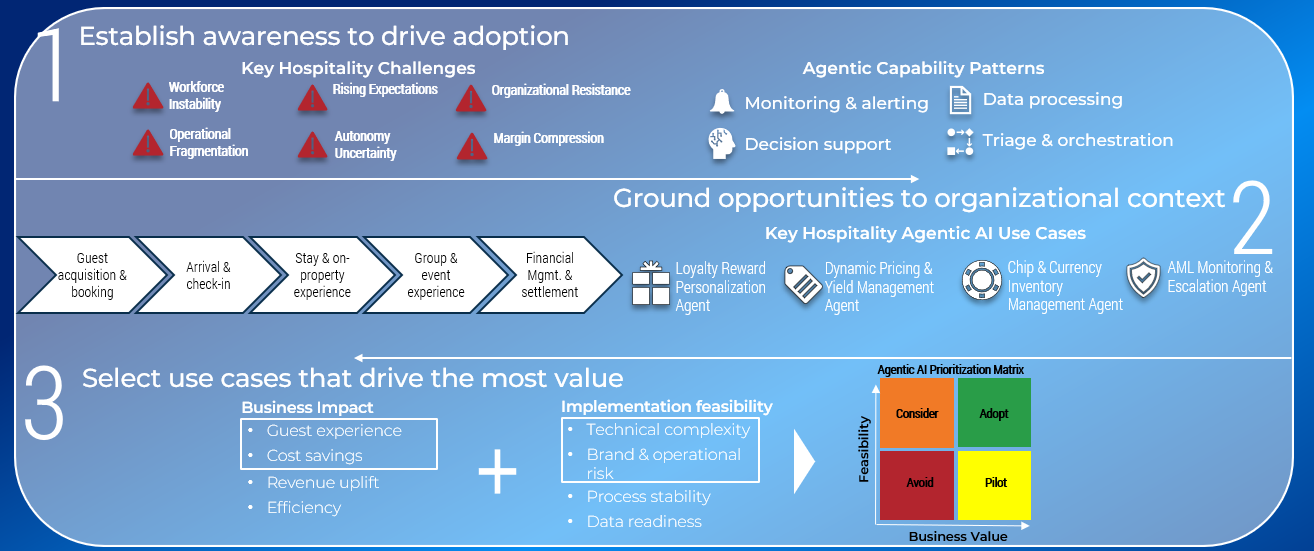
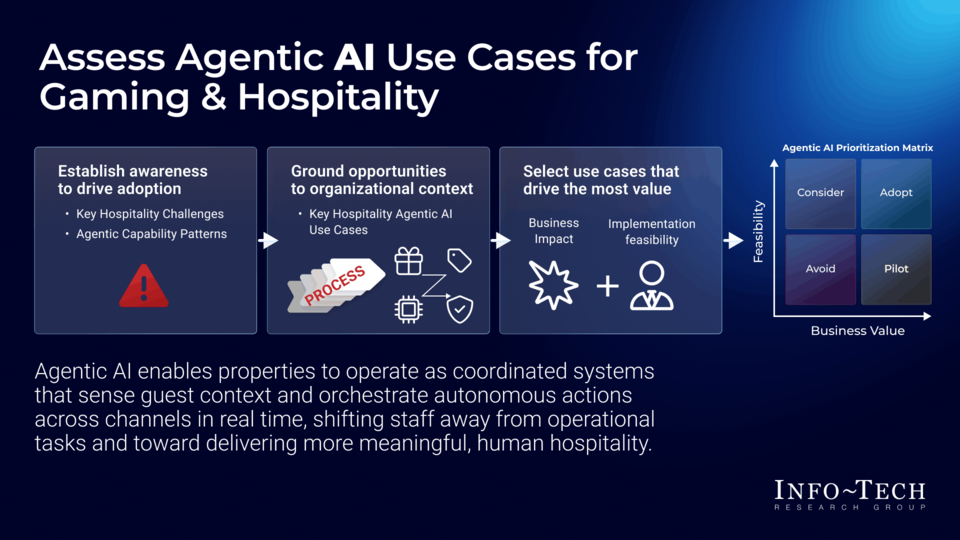
Agentic AI enables properties to operate as coordinated systems that sense guest context and orchestrate autonomous actions across channels in real time, shifting staff away from operational tasks and toward delivering more meaningful, human hospitality.
Info-Tech's methodology for Assess and Prioritize Agentic AI in Gaming & Hospitality
| 1. Establish Alignment | 2. Frame Opportunities | 3. Score & Validate | |
|---|---|---|---|
| Phase Steps | 1.1 Align on agentic AI capabilities 1.2 Explore agentic AI |
2.1 Map AI capability to business context 2.2 Assess agentic AI use cases |
3.1 Score use cases for prioritization 3.2 Review and validate prioritized use cases |
| Phase Outcomes | A shared understanding of agentic AI concepts, capability patterns, and how they connect to business context. | A structured set of agentic AI use cases aligned to business capabilities and value drivers. | A prioritized and validated use case portfolio with a clear understanding of the highest-value opportunities to pursue. |
Insight summary
Agentic AI enables better human hospitality
Agentic AI enables properties to operate as coordinated systems that sense guest context and orchestrate autonomous actions across channels in real time, shifting staff away from operational tasks and toward delivering more meaningful, human hospitality.
Understanding leads to buy-in
Establishing a shared understanding of how agentic AI works and applies to organizational capabilities and workflows strengthens buy-in across leadership and frontline staff, reducing fear and reinforcing employee empowerment.
Reality avoids low-value
In a siloed hospitality and gaming environment, capability mapping keeps agentic AI focused on real pain points, preventing teams from chasing innovative but low-value use cases that fail to enhance the guest experience.
Small wins create change
Trust emerges through deliberate sequencing. Start with low-risk, measurable agents in back-of-house or operational workflows to build confidence. Use early wins to fund complex use cases and avoid use cases that threaten brand perception.
Prioritize for fast, measurable wins
Value is realized when insight leads to action. Prioritize closed-loop agents that accelerate time to value while minimizing risk and cross-functional friction.
Prevent wasted effort with assessment
Prevent wasted effort and funds by validating each use case against organizational readiness before approval.
Research deliverable
Each step of this research is accompanied by supporting deliverables to help you accomplish your goals:
Agentic AI Use Case Tool for Gaming & Hospitality
Provides the structure to identify and list agentic AI use cases, score each one across business value and feasibility, and build a prioritized portfolio, enabling teams to confidently select the highest-impact opportunities ready to move into the Build Your Agentic AI Prototype phase.
About Info-Tech
Info-Tech Research Group is the world’s fastest-growing information technology research and advisory company, proudly serving over 30,000 IT professionals.
We produce unbiased and highly relevant research to help CIOs and IT leaders make strategic, timely, and well-informed decisions. We partner closely with IT teams to provide everything they need, from actionable tools to analyst guidance, ensuring they deliver measurable results for their organizations.
What Is a Blueprint?
A blueprint is designed to be a roadmap, containing a methodology and the tools and templates you need to solve your IT problems.
Each blueprint can be accompanied by a Guided Implementation that provides you access to our world-class analysts to help you get through the project.
Need Extra Help?
Speak With An Analyst
Get the help you need in this 4-phase advisory process. You'll receive multiple touchpoints with our researchers, all included in your membership.
Guided Implementation 1: Scope Requirements
- Call 1: Scope requirements, objectives, and your specific challenges.
Guided Implementation 2: Establish Alignment
- Call 1: Align on fundamental agentic AI concepts.
- Call 2: Explore agentic AI in practice.
Guided Implementation 3: Frame Opportunities
- Call 1: Anchor AI capability to business context.
- Call 2: Develop agentic AI use cases.
Guided Implementation 4: Score and Validate
- Call 1: Score use cases for prioritization.
- Call 2: Review use case portfolio.
Contributors
Mark Rosa, CIO, Mohegan Gaming
Aubert Nungisa, Director of IT, Curling Canada
Denise Walker, CIO, Starwood Hotels
