
Adapt to Uncertainty With a Technology-First Action Plan for Nonprofits
Cost cutting in times of crisis works; doubling down on innovation works even better.
Economic volatility, policy upheaval, and escalating digital threats are fundamentally reshaping how nonprofits secure funding, maintain donor trust, and deliver on their missions – just as budgets shrink and the need for the services nonprofits provide continues to rise. These are no longer temporary shocks, but long-term structural challenges requiring deep organizational adaptation. Our step-by-step blueprint empowers nonprofit technology leaders to build a mission-driven Technology-First Action Plan that transforms today’s challenges into tomorrow's capacity.
In the face of these headwinds, technology should be regarded not as a back-office function or line item, but a stabilizing force. By streamlining operations, safeguarding stakeholder data, modernizing service delivery, and enabling transparency, IT can anchor organizational resilience. Nonprofit leaders and decision-makers must reframe technology as a core strategic asset essential to weathering today’s crises while delivering long-term impact.
1. Cut costs to free up resources for innovation.
Though innovation plays a key role in helping nonprofits extract maximum value from limited funding, it is often the first to see its budget slashed amid budget shocks. Nonprofit leaders must cut unnecessary costs and redirect that spending to the people, resources, and budgetary capacity their innovation efforts will need to overcome today’s turmoil.
2. Meet the moment. Take the lead.
As much as today’s uncertainty is a strain on IT resources, it can also be an opportunity. By demonstrating that technology can be used not only to solve problems but also to enable better decision-making, nonprofit technology decision-makers can get the most out of limited resources, as well as showcase their ability to lead.
3. Build an adaptive IT team.
With technology advancing at an exponential rate, you will never permanently close the skills gap. Focus instead on building sustainable learning and development practices to enable your staff to retain knowledge and develop in-demand skills as they are needed.
Use this step-by-step blueprint to realign nonprofit sector IT into a posture of resilience
Our research offers guidance and templates to make a clear assessment of IT’s strengths and vulnerabilities, and where they can be leveraged. Use our Technology-First Action Plan framework to empower IT to lead their organization through the challenges facing the nonprofit sector.
- Assess uncertainties and opportunities by leveraging this moment to explore where the organization is most vulnerable and where it is most poised to further lean into technology risks.
- Review IT Spend & Staffing tools and services to find costs that can be either cut or channelled toward innovation opportunities.
- Build your Technology-First Action Plan by identifying and prioritizing initiatives that will drive the organization forward and consolidate those initiatives into a 12-month plan.
- Prepare to execute by defining the organizational value of your plan and building an adjustable communications strategy to bring stakeholders on board.
Adapt to Uncertainty With a Technology-First Action Plan for Nonprofits
Cost cutting in times of crisis works; doubling down on innovation works even better.
Analyst perspective
In times of sustained uncertainty, mission resilience depends on adaptability, innovation, and strategic use of technology.
The nonprofit sector is operating through a period of sustained economic, geopolitical, and policy volatility. Trade tensions, declining aid budgets, rising costs, shifting regulations, and growing demand for services are converging to test organizational resilience. These pressures are increasingly structural, reshaping how nonprofits secure funding, allocate limited resources, and deliver on their missions.
Technology is becoming a critical source of adaptability. It enables nonprofits to streamline operations, protect stakeholder data, respond to changing service needs, strengthen transparency, and make limited resources go further. Organizations that treat technology as a strategic capability, rather than simply an overhead cost, will be better positioned to navigate disruption while sustaining mission impact.
Build a mission-driven technology action plan that strengthens resilience today while creating capacity for what comes next.

Vidhi Trivedi
Research Analyst
Info-Tech Research Group
Please note: This research was developed with the assistance of generative AI. For information about how, please see in the Appendix.
Executive summary
Your challenge
In 2026, nonprofits are navigating sustained global volatility as funding contraction, trade disruption, rising operating costs, regulatory complexity, and digital threats converge. These pressures are forcing organizations to meet growing community needs with less predictable resources, making resilience, adaptability, and technology-enabled efficiency increasingly critical.
Funding Contraction & Resource Pressure
Funding conditions for many nonprofits operating globally have materially tightened. Official development assistance fell by a record 23.3% in 2025 and is projected to decline another 6.9% in 2026, bringing aid to its lowest level since 2014. Humanitarian assistance and funding for government and civil society are projected to fall by roughly 40% between 2024 and 2026 (OECD, 2026).
For nonprofits that rely on public, institutional, or international funding, these funding pressures are translating into program cuts, staffing constraints, and reduced capacity to meet rising needs. In July 2026, Reuters reported that nearly 90% of surveyed women-led organizations were struggling to meet growing demand and 40% were at risk of closure following donor funding cuts (Reuters, 2026).
Trade, Cost & Demand Pressure
Persistent trade-policy volatility is adding to an already constrained operating environment. Since the first wave of US tariffs, trade policy has continued to evolve through legal challenges, replacement tariff authorities, negotiated arrangements, exemptions, and renewed actions across major trading relationships. In July 2026, the US introduced new Section 301 tariffs covering 60 economies, reinforcing that trade uncertainty remains an active rather than resolved risk (USTR, 2026).
For nonprofits, the impact is primarily indirect but material. Higher or less predictable costs for technology, equipment, program supplies, transportation, and other operating inputs can coincide with tighter funding and rising service demand. Globally, 61% of charities identify financial sustainability as a top challenge, 39% cite increased competition for funding, 28% report rising costs, and 67% report increased demand for services (World Giving Report, Charity Insights 2026).
Digital, Cyber & AI Risk
Greater digital reliance is expanding both opportunity and exposure. Nonprofits increasingly depend on digital platforms, cloud services, data, and AI to fundraise, manage programs, communicate with stakeholders, and operate efficiently.
At the same time, limited technology capacity can amplify risk. Rapid adoption without sufficient cybersecurity, data governance, skills, and AI oversight can expose organizations to operational disruption, privacy failures, and loss of stakeholder trust.
Executive summary
Common obstacles
For nonprofit leaders and technology decision-makers, sustained trade, funding, and operating volatility is creating structural barriers to mission delivery. The challenge is no longer simply responding to individual disruptions but building the capacity to adapt as tariff policy, funding conditions, supply chains, regulation, community demand, and technology risks continue to shift.
Shortened Planning Horizons
Since the first wave of US tariffs, trade policy has continued to shift through court rulings, new authorities, exemptions, negotiated arrangements, and renewed tariff actions. In February 2026, the US Supreme Court struck down broad IEEPA-based tariffs, but new measures followed under other authorities, including Section 301 tariffs covering 60 trading partners (Reuters, 2026; USTR, 2026).
For nonprofits, the impact is largely indirect but significant. Changing trade conditions can raise or destabilize costs for technology, program supplies, transportation, and other operating inputs. At the same time, 61% of charities globally cite financial sustainability as a top challenge and 67% report increased demand for services (Charities Aid Foundation, 2026).
Without stronger scenario planning and timely data, nonprofits risk staying in a reactive cycle of budget shifts, delayed investments, and short-term decisions.
Digital Capacity & Governance Gaps
Nonprofits are increasingly relying on cloud platforms, automation, digital fundraising, data tools, and AI to extend limited capacity. Trade volatility adds another layer of risk where technology hardware, devices, and vendor ecosystems depend on globally sourced inputs. USTR’s 2026 Section 301 action applied new tariffs across 60 trading partners while retaining exemptions for selected products (USTR, 2026).
For nonprofit IT leaders, this can translate into less predictable hardware costs, vendor pricing, renewals, implementation timelines, and total cost of ownership. With 61% of charities citing financial sustainability as a major challenge and 28% reporting rising costs, absorbing unexpected technology spend becomes harder (Charities Aid Foundation, 2026).
Without stronger governance, sourcing discipline, and vendor oversight, short-term cost pressure can create longer-term operational and cyber risk.
Severe Resource & Capacity Constraints
Nonprofits are facing a compounded resource squeeze: demand is rising while funding and operating capacity are becoming less predictable. OECD reports that official development assistance fell 23.3% in 2025 and is projected to decline another 6.9% in 2026, with vulnerable countries and civil-society sectors among the most exposed (OECD, 2026).
Globally, 61% of charities identify financial sustainability as a top challenge, 39% cite increased competition for funding, 28% report rising costs, and 67% report increased demand for services (Charities Aid Foundation, 2026).
This leaves nonprofits with less flexibility to invest in cybersecurity, automation, data modernization, and digital service delivery precisely when those capabilities are most needed.
Executive summary
Resolution
Explore the entire suite of research that supports these pillars by visiting our research center IT's Moment: A Technology-First Solution for Uncertain Times.
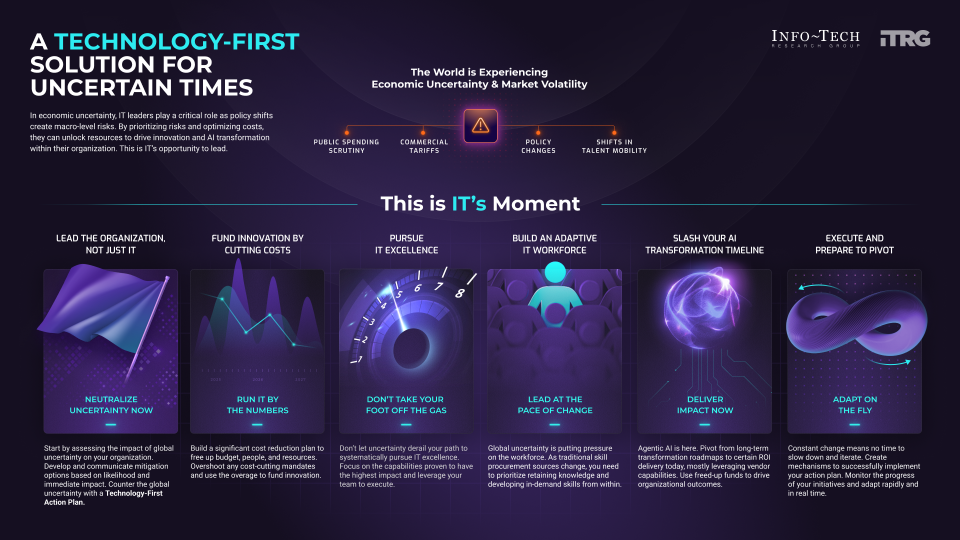
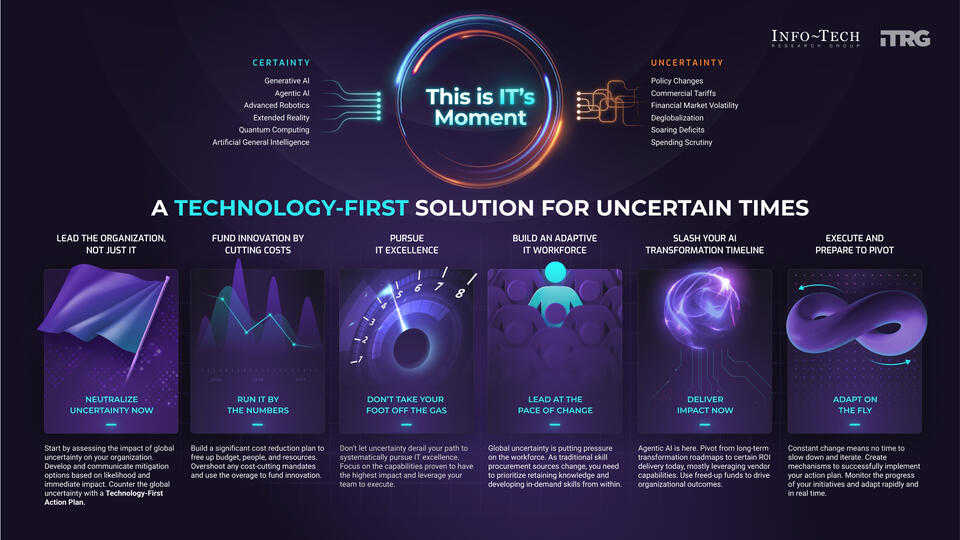
Lead the Organization, Not Just IT
Neutralize Uncertainty Now
Fund Innovation by Cutting Costs
Run IT by the Numbers
Pursue IT Excellence
Don't Take Your Foot off the Gas
Build an Adaptive IT Workforce
Lead at the Pace of Change
Slash Your AI Transformation Timeline
Deliver Impact Now
Execute and Prepare to Pivot
Adapt on the Fly
Info-Tech's Approach
Phase 1 – Assess Uncertainties & Opportunities
Phase 2 – Review Budget, Staffing & Contracts
Phase 3 – Build Your Technology-First Action Plan
Phase 4 – Get Ready to Execute!
1 Lead the Organization, Not Just IT
Neutralize Uncertainty Now
- Defuse Uncertainty Drivers: Understand organizational impact.
- Lean Into the Curve: Apply Exponential IT.
- Pick Your First Bets: Deliver use cases now.
- Claim Your New Mandate: Technology-first or go out of business.
- Get the Word Out: Tell the entire organization now.
Start by assessing the impact of global uncertainty on your organization. Develop and communicate mitigation options based on likelihood and immediate impact. Counter the global uncertainty with a technology-first action plan.
2 Fund Innovation by Cutting Costs
Run IT by the Numbers
- Don't Bet the Farm: Set the innovation budget.
- Find Real Dollars Quickly: Cut costs now.
- Demonstrate Technology Impact: Benchmark spend and shift.
- Shorten the Cycles: Build a flexible budget (finally).
- Sharpen the Pencil: Renegotiate vendor contracts.
Build a significant cost reduction plan to free up budget, people, and resources. Overshoot any cost-cutting mandates and use the overage to fund innovation.
Only 20% of CFOs are happy with the impact tech investments make on their business (Rimini Street, 2024).
3 Pursue IT Excellence
Don't Take Your Foot off the Gas
- Get the Baseline: Understand your maturity.
- Focus on What Really Matters: Improve your critical capabilities.
- You Can't Do IT Alone: Guide your team.
- Enable Everyone: Provide tools and training.
- Aim High Selectively: Leapfrog for impact.
Don't let uncertainty derail your path to systematically pursue IT excellence. Focus on the capabilities proven to have the highest impact and leverage your team to execute.
85% of core processes are ineffective on average across all IT organizations (Info-Tech IT Management & Governance Diagnostic, 2024).
4 Build an Adaptive IT Workforce
Lead at the Pace of Change
- Knowledge Is Power: Stop the drain.
- Drive Adaptability: Be it and teach it.
- Lead the Pack: Autonomize aggressively.
- Fill Your Gaps: Build critical skills.
- Win the Race for Talent: Money isn't everything.
Global uncertainty is putting pressure on the workforce. As traditional skill procurement sources change, you need to prioritize retaining knowledge and developing in-demand skills from within.
IT positions that are going unfilled are costing organizations in the United States an average of $187 billion in lost revenue each year (CompTIA, 2024).
5 Slash Your AI Transformation Timeline
Deliver Impact Now
- Just Do It: Deliver AI now.
- Stop Saying No: Democratize AI.
- Spend, Spend, Spend: Overfund innovation.
- Have ONE Strategy: AI Strategy = IT Strategy = Enterprise Strategy
- If in Doubt, Buy Over Build: Select the right vendors.
Agentic AI is here. Pivot from long-term transformation roadmaps to certain ROI delivery today, mostly leveraging vendor capabilities. Use freed-up funds to drive organizational outcomes.
CEOs believe that the researching and implementing AI is the top IT priority (Foundry, 2025).
6 Execute and Prepare to Pivot
Adapt on the Fly
- Aim for Impact: Say yes to promising pilots.
- Measure What's Real and Fund What Works: Fund based on outcomes.
- Let Things Go. Kill failing projects quickly.
- Shatter the Org Chart: Match talent to impact.
- It's Not Bragging If It's True: Share wins and failures.
Constant change means no time to slow down. Create mechanisms to successfully implement your action plan. Monitor the progress of your initiatives and adapt rapidly and in real time.
Nonprofits that prioritize technology now are positioned to lead the sector in resilience, efficiency, and impact
Operational Challenges & Technology Gaps
According to Sage's 2025 Nonprofit Technology Impact Report:
- Forty-one percent of respondents report lack of process automation and organizational inefficiency as their top internal challenge, and 35% cite time-consuming manual reporting. Real-time dashboards remain elusive for 34%.
Digital Maturity Drives Outcomes
According to Blackbaud's The Status of Fundraising in the AI Era:
- Organizations with higher levels of technology integration are significantly more likely to meet or exceed fundraising goals.
- Seventy-two percent of respondents met or surpassed their targets over the last 12 months.
- Yet only 14% have a formal AI policy, and most report inconsistent adoption across donor, program, and internal systems.
Cost & Demand Pressures Necessitate Tech Adoption
According to research by Pierre Audoin Consulting (Unit4, 2025):
- Seventy-nine percent of nonprofits expect rising demand for services while facing escalating costs.
- Nearly half identified legacy systems as the top barrier to digital transformation.
- The average nonprofit takes one to two weeks to launch fundraising campaigns or activate programs – due to siloed systems and poor data integration.
Cost cutting in times of crisis works.
Doubling down on innovation fuels long-term mission impact.
Innovation outpaces austerity
While other organizations may respond to budget cuts by scaling back operations, nonprofit leaders should show how digital innovation can drive more value through optimized resource efficiency. From digitized service delivery to AI-enhanced donor outreach, innovation helps amplify limited resources and accelerate impact.
Starve waste, feed a revolution
Cut inefficiencies now so you can preserve the budget for innovation when it matters most. Investing in tools that automate reporting, streamline program workflows, or improve donor tracking gives your team capacity to serve and not just survive.
Technology powers better impact decisions
This is the moment to show that technology is not overhead, but a strategic partner. Use IT to unlock insights into community needs, grant performance, and donor engagement. Demonstrate how digital tools inform smarter, faster decisions across the organization.
Always be learning
The exponential rate of technology development and adoption means nonprofit organizations will never close the skill gap again, especially for IT. Focus on establishing sustainable learning and development practices that allow staff to upskill and apply those skills quickly.
Change is constant; struggle is optional
Change is inevitable, but it doesn't have to be hard. Establish adaptive practices in your change plan to ensure that it remains on track and continuously moves in the right direction.
Info-Tech's methodology for building a Technology-First Action Plan
| 1. Assess Uncertainties & Opportunities | 2. Review Budget, Staffing & Contracts | 3. Build Your Technology-First Action Plan | 4. Get Ready to Execute | |
|---|---|---|---|---|
| Key Activities |
|
|
|
|
| Phase Outcomes | Understand the risks that vulnerabilities are creating for your organization and the technology-enabled opportunities that need to be seized. | Review your IT budget to determine where there are opportunities to cut costs relentlessly. Funnel these cost savings toward innovative opportunities. | Prioritize initiatives that will drive the organization forward in times of uncertainty. Establish a 12-month roadmap showing when each initiative can be achieved. | Succeed at the action plan with a clear change and communication approach to enable adaptability in the moment when new vulnerabilities inevitably emerge. |
Each phase of this blueprint is accompanied by phases of the supporting deliverable to help you accomplish your goals:
Uncertainties & Opportunities Assessment
Identify how macro-uncertainties are generating new risks for your organization and opportunities to leverage technology more effectively.
IT Spend & Staffing Benchmarking
Assess the current IT spend across systems, contracts, projects, and the workforce to identify cost optimization opportunities.
Technology-First Action Plan Roadmap
Identify key initiatives that IT will pursue and deliver against over the next 12 months to reduce the impacts of uncertainties.
Communication & Execution
Define and prepare to communicate how the Technology-First Action Plan will deliver organizational value.
Key deliverable:
Technology-First Action Plan
Build a Technology-First Action Plan that demonstrates how IT can lead the organization in responding to ongoing uncertainties.
Blueprint benefits
| IT Benefits | Organizational Benefits |
|---|---|
|
|
Measure the value of this blueprint
The objective of this blueprint is to improve not just IT's value, but the organization's value.
ORGANIZATIONAL VALUE
Mission Acceleration
- Year-over-year (YoY) constituent growth
- Expansion of digital or remote service offerings
- New programs launched or piloted faster
Cost Optimization
- Administrative cost ratio or overhead ratio
- Grant and fund utilization rate
- Procurement savings vs. baseline
- Program cost per beneficiary
Operational Efficiency
- Staff time saved through automation
- Downtime reduction for service-critical systems
- Ratio of administrative cost to direct program delivery
Constituent Satisfaction
- Service satisfaction scores
- Constituent or beneficiary/donor feedback ratings
- Net Promoter Score (NPS)
- Donor retention and growth
- Constituent engagement continuity
- Mission Acceleration: Expand the reach and pace of impact by using technology to launch new programs, scale services, and respond faster to community needs.
- Cost Optimization: Maximize the value of every dollar by improving how resources are allocated, minimizing inefficiencies, and strengthening funder confidence.
- Operational Efficiency: Improve internal capacity and agility by streamlining workflows, reducing manual effort, and ensuring critical systems support mission delivery.
- Constituent Satisfaction: Strengthen trust and engagement with beneficiaries, donors, and partners through responsive, transparent, and data-informed service experiences.
Research Note:
Beyond Automation, Beyond Borders: Cultivating Your Talent in a New Global Reality

Fred Chagnon
Principal Research Director
Info-Tech Research Group
While the discourse around artificial intelligence, particularly generative AI, often emphasizes workforce displacement, a strategy fixated on replacing human workers with AI is shortsighted. True value creation in the AI era demands a strategic investment in people – employees and partners – to augment, manage, and innovate with these technologies.
This imperative is critically amplified by emerging de-globalization trends that are reshaping global talent pipelines and increasing the need for organizational self-sufficiency. Sustainable success, innovation, and resilience will therefore hinge on an organization's commitment to cultivating in-house talent, focusing on skills for AI, cybersecurity, and adaptive leadership to effectively navigate a future defined by human–AI cocreation.
"The evidence suggests that, rather than seeking to replace people with AI, organizations that prioritize employee development alongside their AI investments will be better positioned to innovate, navigate ethical complexities, build customer trust, and ultimately unlock the full, transformative potential of AI and other exponential technologies.
In an era where both technological disruption and geopolitical fragmentation demand greater organizational resilience, focusing on developing our people internally becomes the linchpin of any successful AI strategy and, indeed, overall business strategy."
Info-Tech offers various levels of support to best suit your needs
| DIY Toolkit | Guided Implementation | Workshop | Executive & Technical Counseling | Consulting |
|---|---|---|---|---|
| "Our team has already made this critical project a priority, and we have the time and capability, but some guidance along the way would be helpful." | "Our team knows that we need to fix a process, but we need assistance to determine where to focus. Some check-ins along the way would help keep us on track." | "We need to hit the ground running and get this project kicked off immediately. Our team has the ability to take this over once we get a framework and strategy in place." | "Our team and processes are maturing; however, to expedite the journey we'll need a seasoned practitioner to coach and validate approaches, deliverables, and opportunities." | "Our team does not have the time or the knowledge to take this project on. We need assistance through the entirety of this project." |
Diagnostics and consistent frameworks are used throughout all five options.
About Info-Tech
Info-Tech Research Group is the world’s fastest-growing information technology research and advisory company, proudly serving over 30,000 IT professionals.
We produce unbiased and highly relevant research to help CIOs and IT leaders make strategic, timely, and well-informed decisions. We partner closely with IT teams to provide everything they need, from actionable tools to analyst guidance, ensuring they deliver measurable results for their organizations.
What Is a Blueprint?
A blueprint is designed to be a roadmap, containing a methodology and the tools and templates you need to solve your IT problems.
Each blueprint can be accompanied by a Guided Implementation that provides you access to our world-class analysts to help you get through the project.
Need Extra Help?
Speak With An Analyst
Get the help you need in this 4-phase advisory process. You'll receive multiple touchpoints with our researchers, all included in your membership.
Guided Implementation 1: Assess uncertainties and opportunities
- Call 1: Understand the specific macro-uncertainties impacting your organization and why the Technology-First Action Plan can help.
- Call 2: Identify risks and opportunities for the organization.
- Call 3: Assess which risks are most likely to impact the organization.
Guided Implementation 2: Review budget, staffing, and contracts
- Call 1: Conduct and review the results of the IT Spend & Staffing Benchmark.
- Call 2: Identify opportunities to reduce costs across systems, contracts, projects, and workforce.
Guided Implementation 3: Build your Technology-First Action Plan
- Call 1: Brainstorm possible risk-response actions.
- Call 2: Prioritize the actions into an initiative roadmap.
Guided Implementation 4: Get ready to execute
- Call 1: Define the elements of each initiative that will ensure its success.
- Call 2: Identify how the Technology-First Action Plan will drive organizational value and build a plan to communicate.
Contributors
- Luigi Di Sessa, Director of Information Technology, Vancouver Foundation
- Cody Thomas, IT Director, Thompson Child & Family Focus
- William Skelly, Vice President of Information Technology, USO
