
Visualize the Higher Education Industry of the Future
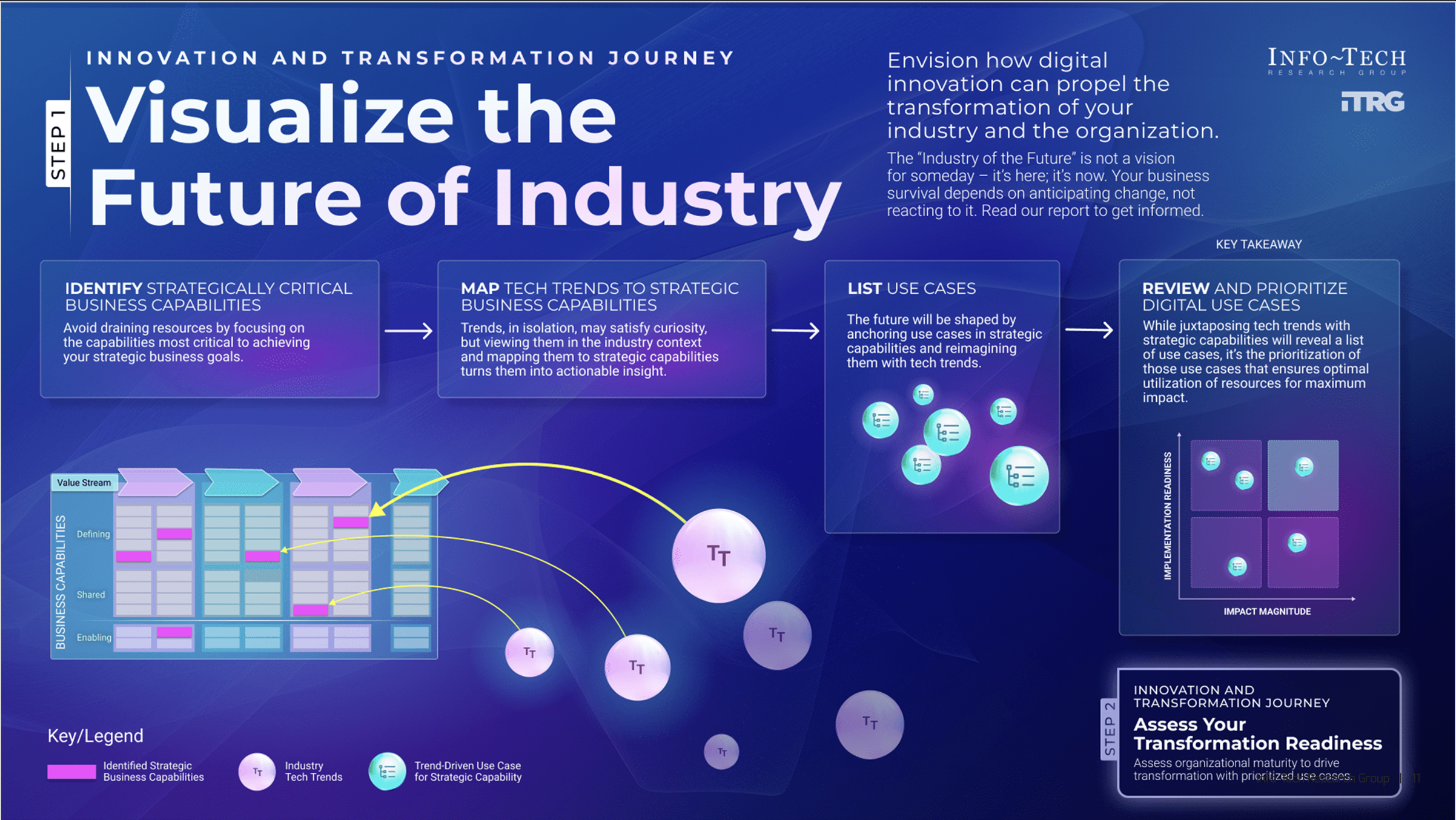
Envision how digital can propel the transformation of your industry and your institution.
The future is already here, unfolding in real time. Organizations can no longer afford to simply react – survival depends on anticipating what’s next. For IT leaders, the mandate is clear: proactively align emerging technologies with strategic capabilities to build a foundation for transformation – before the market demands it.
Our Advice
Critical Insight
Envision how digital innovation can propel the transformation of higher education and your institution. The "Industry of the Future" is not a vision for someday – it's here; it's now. Your business survival depends on anticipating change, not reacting to it. Read our report to get informed.
Impact and Result
This report aims to assist CxOs with a transformation mandate to evangelize the role of technology in the future of the organization and the higher education industry.
Develop Your Higher Education Industry of the Future Report
Envision how digital can propel the transformation of your industry and your institution.
EXECUTIVE BRIEF
Analyst perspective
Adapting today to educate tomorrow

Mark Maby
Principal Research Director,
Industry Practice
Info-Tech Research Group
In the past, universities could rely on stable enrollment patterns, predictable funding streams, and a centuries-old model of teaching and research. That era is ending. Today, demographic shifts, escalating costs, and evolving learner expectations are reshaping the academic landscape. At the same time, technologies such as AI, adaptive learning platforms, and immersive digital environments are redefining what it means to teach, learn, and credential knowledge.
These changes are not hypothetical – they are happening now. Institutions that fail to adapt will not vanish overnight, but they risk becoming irrelevant to the learners, employers, and societies they serve. The challenge is not simply to digitize existing practices but to reimagine the value proposition of higher education in a world where knowledge is abundant, skills are dynamic, and lifelong learning is essential.
The “University of the Future” is not a distant concept; it is emerging in real time. To thrive, academic leaders must anticipate trends that will shape pedagogy, research, and student engagement. More importantly, they must align these trends with institutional strengths and mission, creating strategies that enable innovation before external pressures demand it. The question is no longer whether higher education will change – it is how quickly and how boldly institutions will lead that change.
Why higher education can’t wait
While some industries have led the digital transformation, highly governed sectors, like education, have been at the lagging end of it. Now, rapid changes in other industries will not let higher education be a spectator anymore.
Competition redefined:
- Global disruptions in research collaboration
- Rising operational and technology costs
- Increasing demands for environmental, social, and governance (ESG) accountability
Evolving systemic pressures:
- AI-driven digital disruption reshaping learning and administration
- Shifting expectations from students, faculty, and employers.
- Heightened regulatory and accreditation requirements
Disruption signals are everywhere:
- Demand for instant, unified data from faculty and administration.
- Learners seek portable credentials and flexible, hybrid experiences.
- Cyber threats and regulations drive unified security and governance.
- AI automation fuels expectations for intelligent, self-service workflows.
- Generative AI disrupts traditional teaching and assessment models.
Digital transformation can significantly impact strategic KPIs for higher education.
KPIs expected to increase over three years include:
1.8x
Satisfaction improvement in student engagement
1.7x
Increased utilization in existing education services
1.7x
Increased uptake in new education services
1.4x
Improvement in profit margins
1.4x
Higher rate of teaching innovation
Source: "Digital Transformation of Higher Education Institutions in Asia Will Lead to Significant Improvement in Student Engagement Levels,” Microsoft Asia News Center, 2018
Education’s technological evolution forward
Even within institutions, there are pockets of innovation.
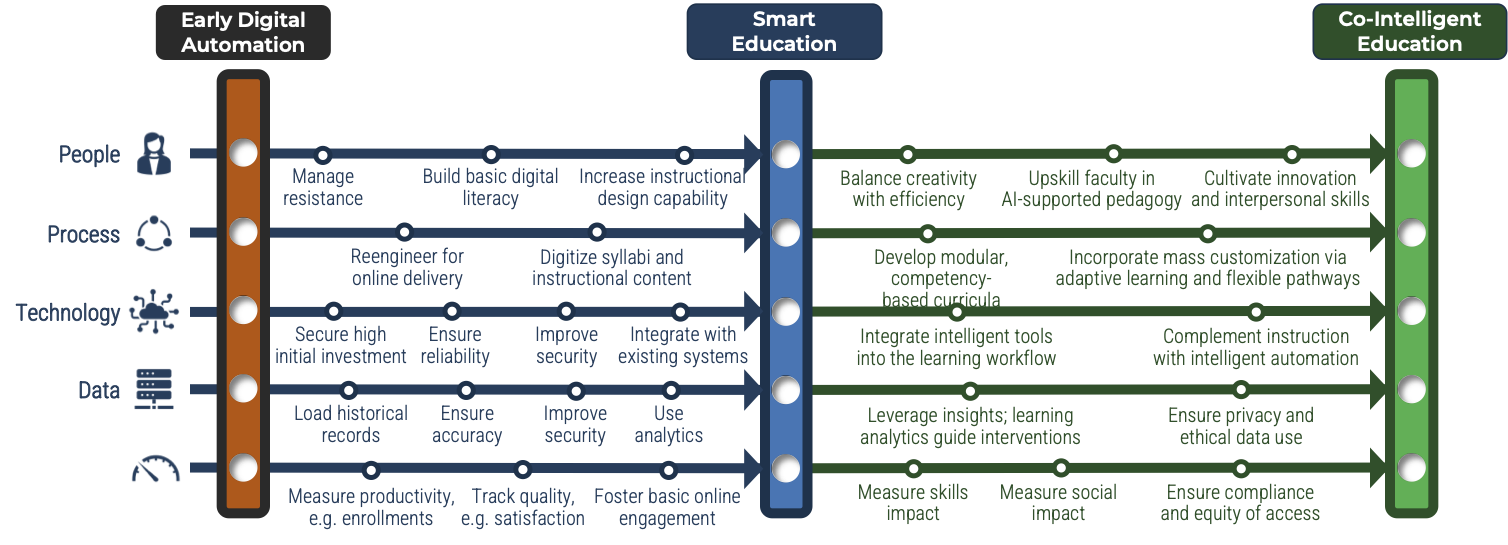
Yet, progress on institutional transformation is fragmented and inconsistent
Islands of innovation without enterprise-wide orchestration
Despite years of digitalization efforts across organizations, the progress on the digital journey has been patchy and uneven.
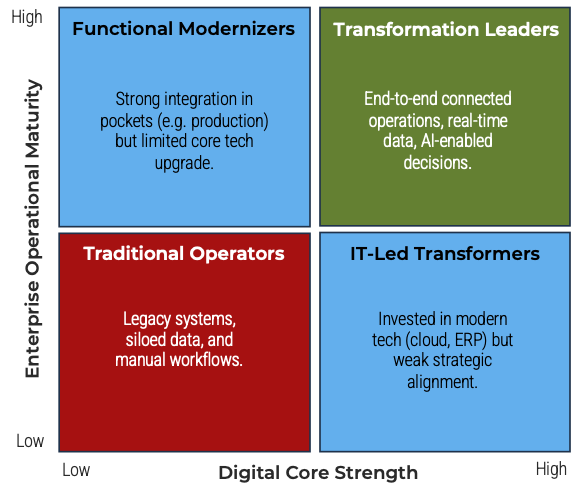
At one end, some operate as globally integrated entities equipped with cloud, edge/IoT, AI, Gen AI, etc., while on the other end, many still rely on manual logs, spreadsheets, and legacy systems.
Maturity varies substantially across regions, functions, and institutional units. In most organizations, investments may be driven by IT but lack end-to-end transformation.
Reflect:
How would you rate your organization on operational maturity and digital core strength?
Institutional leaders shall envision the future not as a possibility but as an inevitability
Industry landscape that may emerge in three to five years
Traditional boundaries between online, hybrid, and in-person learning dissolve as institutions compete for lifelong learners.
Outcome-based funding becomes central to student success and institutional strategy.
Data-driven, adaptive campuses use real-time analytics to optimize student support, resource allocation, and sustainability.
AI-powered platforms transform advising, assessment, and research, enabling scalable, individualized experiences.
Faculty and staff collaborate with digital colleagues, reshaping roles and workflows.
The emerging future will be fundamentally driven by connected ecosystems, intelligent automation, and learner-centered experiences.
Too much is at stake
The next decade will not reward incrementalism in higher education.
Institutions that embrace the future will unlock exponential gains, while those clinging to legacy models may find themselves disintermediated or obsolete.
Exponential Rewards:
Winners will reshape the education landscape.
Value Creation at Scale
Digital-first universities will grow two to four times faster than their peers by monetizing data and insights and expanding into new revenue streams such as microcredentials.
Cost and Efficiency Curve Reset
Early adopters of AI and automation will achieve step-function transformation in productivity – not 5%, but 25% to 50% faster curriculum development cycles, near-zero administrative downtime, and radically leaner operations.
Strategic Control
Institutions leading ecosystem orchestration by shaping partnerships with employers and edtech platforms will set new academic and industry standards.
Existential Risks:
Laggards will play catchup until irrelevancy.
Margin Erosion and Commoditization
Institutions that fail to evolve will be trapped in a race to the bottom of commoditized degrees, margin erosion, and high student attrition.
Digital Disintermediation
Platform-based learning may leapfrog traditional institutions by offering education-as-a-service and predictive learning pathways.
Talent Flight
The best digital-native talent won’t wait. Organizations failing to evolve will struggle to attract the future workforce.
This is a fork-in-the-road moment for higher education. Winners will reimagine the industry architecture, rewire how value is created and captured, and emerge as next-generation market-makers. Laggards? They risk suffering closures and forced mergers.
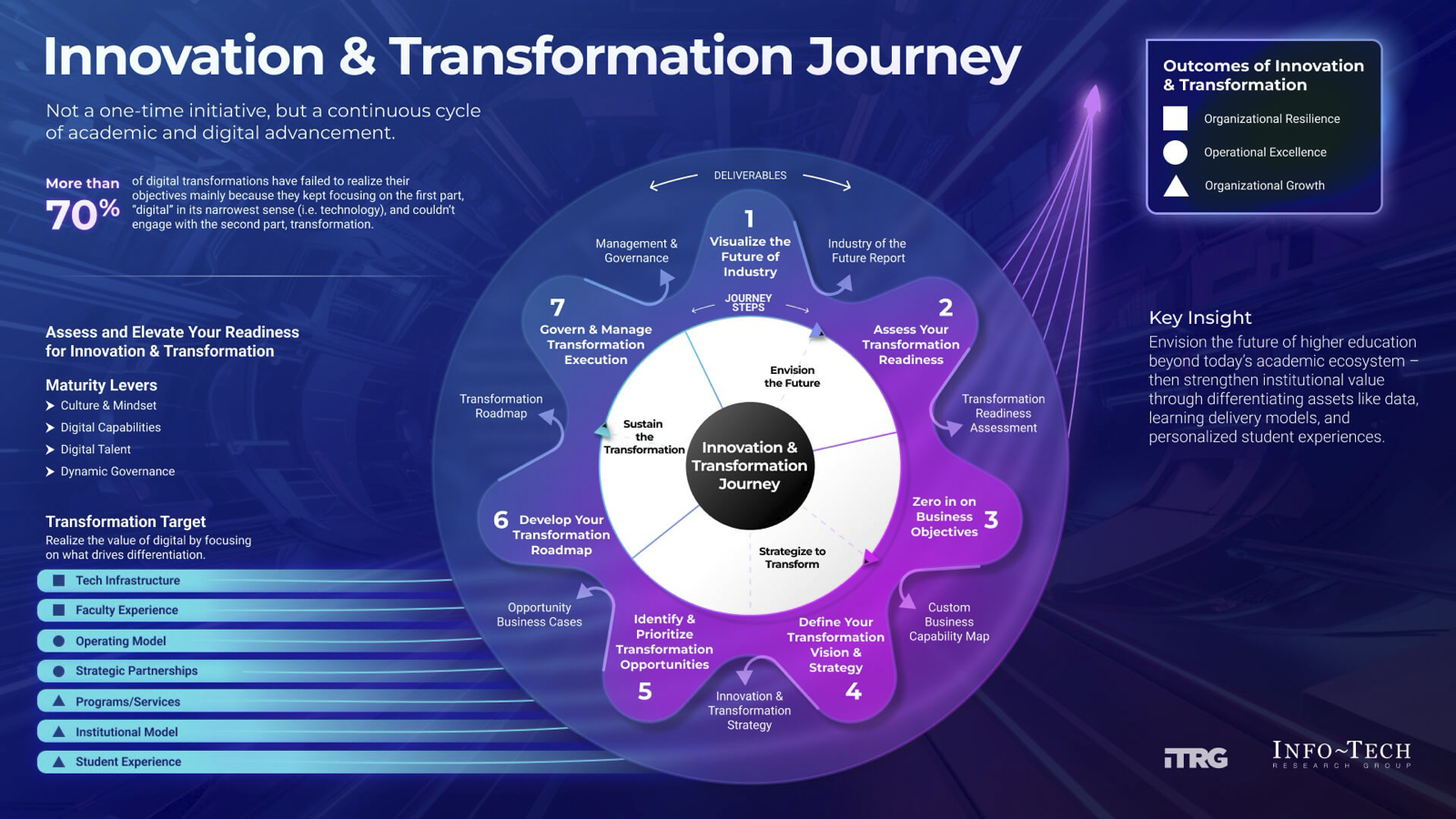
This report is a guide for bold leadership not just to adapt but to shape the future of the industry
It is:
- Vision-driven but anchored in real-world shifts.
- Built by CIOs for executive leadership – CEOs and boards – to reinvigorate the discussion on digital innovation and transformation.
- Customizable for organization-specific capabilities and context.
It contains:
- Industry Capabilities Overview
- Technology Trends Shaping Your Industry
- Digital Opportunities/Prioritized Use Cases in Your Industry
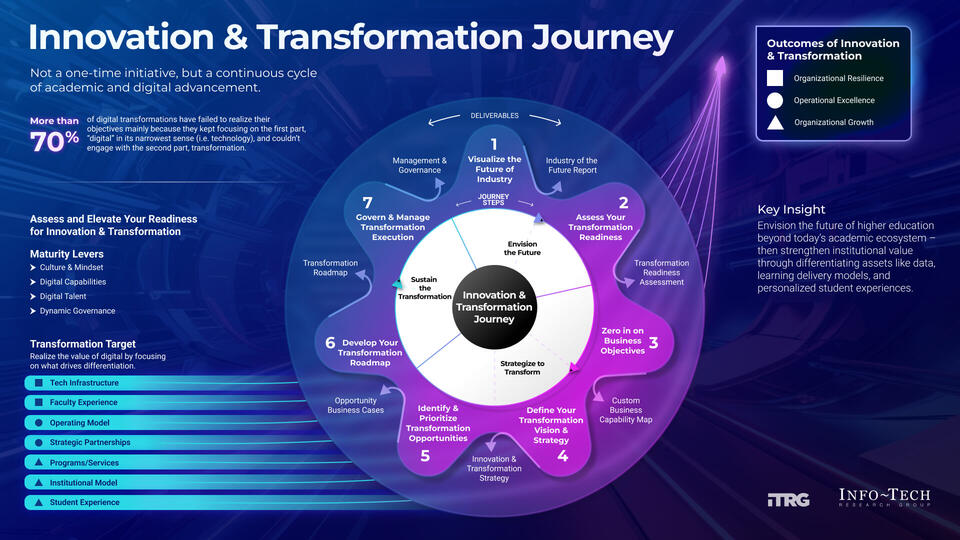
- Next Steps on Your Innovation & Transformation Journey
This report aims to assist CxOs with a transformation mandate to evangelize the role of technology in the future of the organization and the industry.
Blueprint deliverable
At the end of this project, you will have created an executive presentation that is customized for your industry as well as for your organization.
Industry of the Future Report
Use your industry-specific template to customize an executive presentation for your own organization.
Develop the Higher Education Industry of the Future Report Workbook
Use your industry-specific workbook to complete the activities in this storyboard and customize the report in the context of your industry, subindustry, and organization.
Phase 1
Avoid draining resources by focusing on the capabilities most critical to achieving your strategic institutional goals.
Identify Strategic Institutional Capabilities
Phase 1
1.1 Understand your strategic institutional goals
1.2 Identify top strategic institutional capabilities
This phase will walk you through the following activities:
- Review your strategic institutional goals.
- Identify strategically critical institutional capabilities.
This phase involves the following participants:
- Chief Digital Officer or Chief Innovation Officer and/or CIO/CTO/Head of Technology
Step 1.1
Understand your strategic institutional goals
Activities
1.1.1 Review your strategic institutional goals
Identify Strategic Institutional Capabilities: Step 1.1
This phase involves the following participants:
- Chief Digital Officer or Chief Innovation Officer and/or CIO/CTO/Head of Technology
Outcomes of this step
- Clear understanding of your organization’s strategic institutional goals
About Info-Tech
Info-Tech Research Group is the world’s fastest-growing information technology research and advisory company, proudly serving over 30,000 IT professionals.
We produce unbiased and highly relevant research to help CIOs and IT leaders make strategic, timely, and well-informed decisions. We partner closely with IT teams to provide everything they need, from actionable tools to analyst guidance, ensuring they deliver measurable results for their organizations.
What Is a Blueprint?
A blueprint is designed to be a roadmap, containing a methodology and the tools and templates you need to solve your IT problems.
Each blueprint can be accompanied by a Guided Implementation that provides you access to our world-class analysts to help you get through the project.
Talk to an Analyst
Our analyst calls are focused on helping our members use the research we produce, and our experts will guide you to successful project completion.
Book an Analyst Call on This Topic
You can start as early as tomorrow morning. Our analysts will explain the process during your first call.
Get Advice From a Subject Matter Expert
Each call will focus on explaining the material and helping you to plan your project, interpret and analyze the results of each project step, and set the direction for your next project step.
Unlock Sample Research