
Transform Your Transportation Operations With High-Value AI Use Cases
Build an intelligent transportation ecosystem.
- Leaders understand the potential for AI initiatives but hesitate to commit, uncertain if it will deliver a meaningful advantage.
- Transportation companies produce mass amounts of data from every vehicle, route, and delivery, yet it goes unused, leading to inefficient operations.
- Executives face an exciting yet crowded AI landscape, making it challenging to distinguish valuable solutions from the hype.
Our Advice
Critical Insight
Transportation modernization will not be driven by isolated AI pilots but by a strategic, capability-driven approach that aligns AI investments with measurable business outcomes. Unlock efficiency, resilience, and innovation across the entire supply chain, to build an intelligent, interconnected ecosystem.
Impact and Result
Info-Tech’s human-centric, value-based approach is a guide for selecting and prioritizing AI use cases:
- Leverage a transportation-specific business reference architecture to identify business capability and value-driver-aligned AI use cases.
- Ensure AI is treated as an opportunity rather than an experiment. Create a standardized strategy with clear success metrics.
- Select and prioritize AI use cases to balance quick wins and long-term strategic investments while understanding the execution implications.
Transform Your Transportation Operations With High-Value AI Use Cases
Build the intelligent transportation ecosystem.
Analyst Perspective
Build the Intelligent Transportation Ecosystem
The goods transportation and logistics industry is undergoing rapid transformation as customer expectations rise for faster, more sustainable, and more transparent services. At the same time, ongoing disruption, cost pressures, and operational complexity are forcing organizations to reassess how resilient and efficient their operations truly are. To remain competitive, transportation leaders must modernize core processes and better leverage the growing volume of operational data generated across fleets, routes, and customer interactions.
Artificial intelligence has emerged as a compelling enabler in this shift. As AI capabilities mature, they offer transportation companies new ways to address long-standing operational challenges, from network optimization and asset utilization to risk management and customer experience. However, while interest in AI is high, many organizations struggle to determine where to begin, which use cases matter most, and how to scale initiatives beyond isolated pilots.
This report provides a practical and structured starting point through an AI use-case library that maps opportunities to key organizational value drivers. By offering a clear framework to identify priorities, align investments to business outcomes, and focus on measurable impact, it helps transportation leaders move from experimentation to execution. When applied effectively, AI becomes more than a technology investment; it serves as a strategic enabler that strengthens resilience, improves operational performance, and drives sustainable value creation across the enterprise.

Michael Adams
Senior Research Analyst
Info-Tech Research Group
Executive summary
Your Challenge
- Leaders understand the potential for AI initiatives but hesitate to commit, uncertain if it will deliver a meaningful advantage.
- Transportation companies produce mass amounts of data from every vehicle, route, and delivery, yet it goes unused, leading to inefficient operations.
- Executives face an exciting yet crowded AI landscape, making it challenging to find valuable solutions within the hype.
Common Obstacles
- Business stakeholders need to cut through the hype surrounding AI to ensure their investments can drive business value for the firm. The key barriers to success include:
- Cultural resistance slows progress as there is misalignment between initiatives and business goals.
- Pilots are disconnected without standardization or clear outcomes, leaving investments trapped in the proof-of-concept stage.
- Lack of talent, their workforce, and legacy systems limit transportation companies' ability to take on new technological advancements.
Solution
- Info-Tech's human-centric, value-based approach is a guide for selecting and prioritizing AI use cases:
- Leverage a transportation-specific business reference architecture to identify business capability and value-driver-aligned AI use cases.
- Ensure AI is treated as an opportunity rather than an experiment. Create a standardized strategy with clear success metrics.
- Select and prioritize AI use cases to balance quick wins and long-term strategic investments while understanding the execution implications.
Info-Tech Insight:
Transportation modernization will not be driven by isolated AI pilots but by a strategic, capability-driven approach that aligns AI investments with measurable business outcomes. Unlock efficiency, resilience, and innovation across the entire supply chain to build an intelligent, interconnected ecosystem.
Your challenge
- Transportation leaders have found that AI has become essential to remaining competitive in an increasingly difficult competitive landscape. Seventy-one percent of leaders have fully funded transformation initiatives for their supply chains, yet 35% say building a business case for the technology is a challenge (Logility, 2025). There is pressure to adapt, yet unclear business cases and fragmented pilot results causes hesitation. Leaders need a clear path to where AI will drive value to them, to ensure there will be measurable results.
- With the abundance of data created throughout a supply chain, transportation companies have an opportunity to harness it and make data-driven decisions to improve their business processes. Yet, 84% of transportation and logistics executives believe their industry lags behind others in adopting AI (Trucking Info, 2025). Companies must position themselves to leverage the enormous amount of data through AI and advanced analytics solutions.
- The AI landscape is filled vendors that have overlapping abilities and inconsistent claims. The rise in competitors leaves executives in a challenging spot, trying to identify reliable partners and sustainable technologies that fit their organizational needs. This leads to slow decision-making due to skepticism, which delays innovative efforts.
Common obstacles
- Cultural resistance is slowing progress as there is misalignment between initiatives and business goals. Employees are reluctant to trust new algorithms that offer recommendations without transparent reasoning and are concerned about job security. On the other hand, IT leaders pursue new technologies on pure ambition rather than measurable business results, creating a disconnect between the new initiatives and value realization.
- Pilots are disconnected without standardization, or clear outcomes, leaving investments trapped in the proof-of-concept stage. Pilots are often launched in silos, using different data sources, making it challenging to scale or replicate results. This leads to inefficiencies as disconnected efforts deplete budgets and cause lack of buy-in for new AI efforts.
- The lack of talent, the current workforce, and legacy systems limit transportation companies' ability to take on new technological advancements. The promise of AI runs into a persistent shortage of skilled professionals who can ensure success with this transition. Fifty-two percent of transportation leaders say that legacy solutions act as an obstacle to supply chain performance (Logility, 2025). These tools limit growth and widen the gap between innovation goals and actual execution, as organizations are unprepared to make these transformational changes.
Recommended approach
Proceed with confidence.
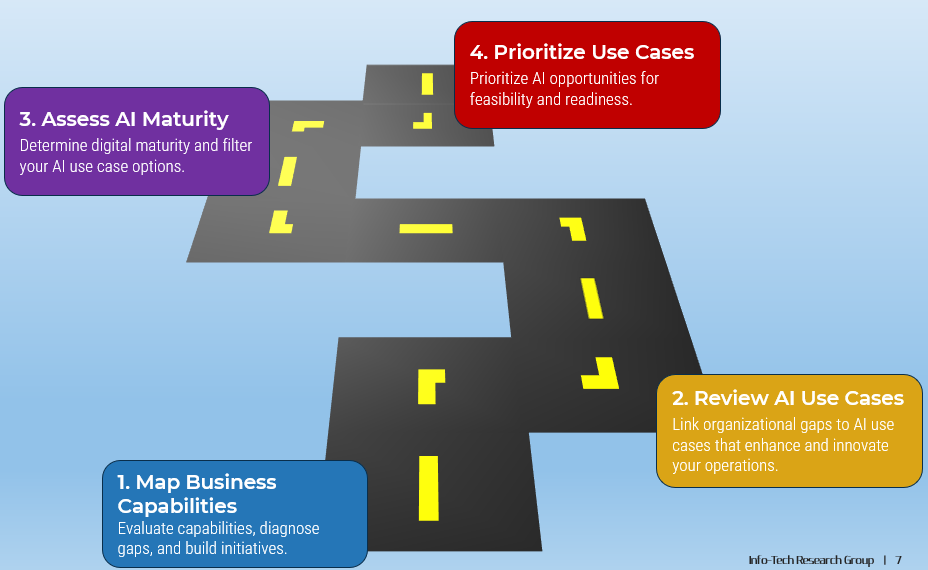
- Leverage a transportation-specific business reference architecture to identify business capability and value-driver-aligned AI use cases. Every initiative should be mapped to a core business capability to ensure measurable value. This ensures AI investments support the business instead of having redundant pilots.
- Ensure AI is treated as an opportunity rather than an experiment. Create a standardized strategy with clear success metrics. AI should be embedded into workflows rather than confined to siloed pilots. When standardized, AI can deliver results that can be scaled and improved upon to ensure long-term success.
- Select and prioritize AI use cases to balance quick wins and long-term strategic investments while understanding the execution implications. Balancing quick wins and long-term investments can support immediate operational improvement and lead to a larger evolution for the business.
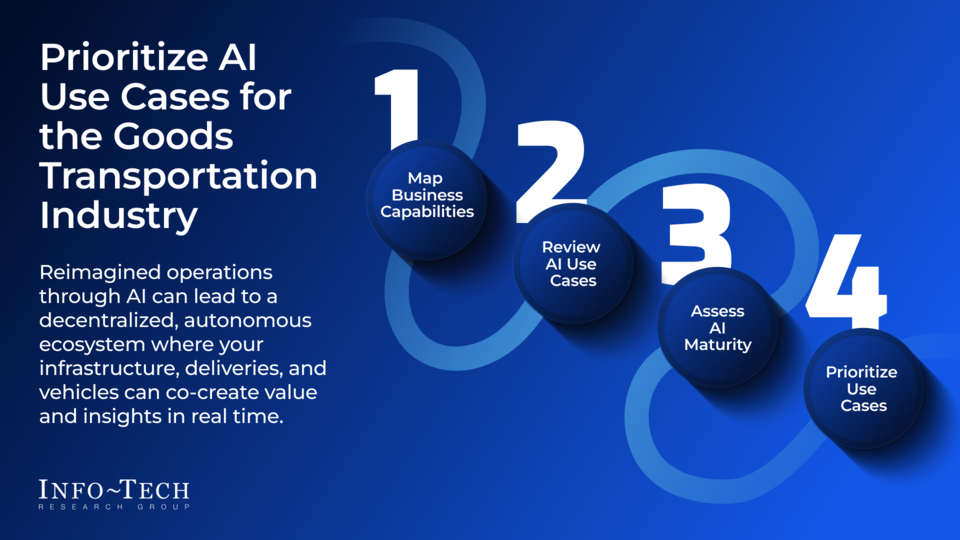
Prioritize AI Use Cases for the Goods Transportation Industry
Problem:
Transportation companies compete on efficiency in their operations, and in an increasingly digital age, AI solutions help power improvements. With an abundance of solutions available, companies must find the most suitable solutions to assist their organization.
Challenges:
- Volatile demand and network disruptions
- Workforce shortages
- Rising customer expectations
Solution:
Modernize your operations by using a strategic, capability-driven approach that will align your AI investments with measurable business outcomes.
Benefits:
- Discover and address operational inefficiencies.
- Aligned business drivers, success metrics, and capability consideration for AI adoption.
- Prioritized AI use cases by strategic fit, feasibility, and readiness.
Reimagined operations through AI can lead to a decentralized, autonomous ecosystem where your infrastructure, deliveries, and vehicles can co-create value and insights in real time.
Measure the value of this blueprint
Leverage this blueprint's approach to ensure your AI use cases align with and support your key business drivers and speed time to value.
Business Drivers |
Context |
Operational Efficiency |
Lower operational costs and boost performance by streamlining processes. |
Business Growth |
Expand market reach through new services, stronger capabilities, and scalable infrastructure. |
Customer Experience |
Provide reliable, transparent, and responsive transport services to elevate customer satisfaction. |
Employee Experience |
Enhance productivity and safety through better tools and workflows. |
Risk and Resilience |
Strengthen the ability to anticipate disruptions, meet compliance needs, and sustain operations. |
ESG |
Improve sustainability efforts and operate ethically. |
With Info-Tech Resources |
Without Info-Tech Resources |
|||
Project Steps |
Time |
Average Cost (USD) |
Time |
Rationale |
Capability and Strategy Mapping |
0.5-1 day |
$7,500 - $10,000 |
3-5 days |
Creation of a reference architecture and facilitation |
Use Case Generation |
0.5-1 day |
$5,000 - $7,500 |
2-3 days |
Consultant facilitation |
Organizational Readiness Assessment |
1-2 days |
$5,000 - $7,500 |
3-4 days |
Assessment development and facilitation |
Use Case Prioritization |
1 day |
$5,000 - $7,500 |
2-3 days |
Scoring matrix and facilitation |
Effort |
3-5 days |
$22,500 - $32,500 |
10-15 days |
|
Info-Tech offers various levels of support to best suit your needs
DIY Toolkit
"Our team has already made this critical project a priority, and we have the time and capability, but some guidance along the way would be helpful."
Guided Implementation
"Our team knows that we need to fix a process, but we need assistance to determine where to focus. Some check-ins along the way would help keep us on track."
Workshop
"We need to hit the ground running and get this project kicked off immediately. Our team has the ability to take this over once we get a framework and strategy in place."
Consulting
"Our team does not have the time or the knowledge to take this project on. We need assistance through the entirety of this project."
Diagnostics and consistent frameworks are used throughout all four options.
Guided Implementation
What does a typical GI on this topic look like?
A Guided Implementation (GI) is a series of calls with an Info-Tech analyst to help implement our best practices in your organization.
A typical GI is between 10 to 12 calls over the course of 2 to 3 months.
About Info-Tech
Info-Tech Research Group is the world’s fastest-growing information technology research and advisory company, proudly serving over 30,000 IT professionals.
We produce unbiased and highly relevant research to help CIOs and IT leaders make strategic, timely, and well-informed decisions. We partner closely with IT teams to provide everything they need, from actionable tools to analyst guidance, ensuring they deliver measurable results for their organizations.
What Is a Blueprint?
A blueprint is designed to be a roadmap, containing a methodology and the tools and templates you need to solve your IT problems.
Each blueprint can be accompanied by a Guided Implementation that provides you access to our world-class analysts to help you get through the project.
Need Extra Help?
Speak With An Analyst
Get the help you need in this 4-phase advisory process. You'll receive multiple touchpoints with our researchers, all included in your membership.
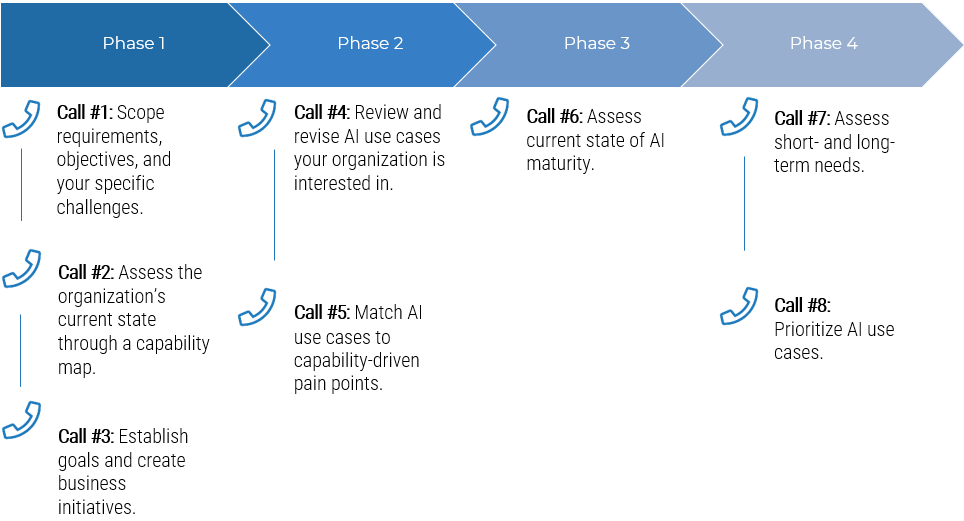
Guided Implementation 1: Prioritize AI Use Cases
- Call 1: Assess short- and long-term needs.
- Call 2: Prioritize AI use cases.
Guided Implementation 2: Translate Needs Into Use Cases
- Call 1: Review and revise AI use cases your organization is interested in.
- Call 2: Match AI use cases to capability-driven pain points.
Guided Implementation 3: Assess Current AI Maturity
- Call 1: Assess current state of AI maturity.
Guided Implementation 4: Identify and Frame Challenges
- Call 1: Scope requirements, objectives, and your specific challenges.
- Call 2: Assess the organization’s current state through a capability map.
- Call 3: Establish goals and create business initiatives.
Contributors
- Steve Schmidt, Managing Partner, Info-Tech
- Duraid Ibrahim, Executive Counselor, Info-Tech
- Joe Meier, Executive Counselor, Info-Tech
- Donnafay MacDonald, Research Director, Info-Tech
- Mike Kelley, VP of IT, Groendyke Transportation
- Daniel Millbank, CTO, Xpress Global Systems
