
Modernize Your Loyalty Program Through a Digital Strategy
Find your place in the digital economy.
- Align loyalty with business goals like growth, retention, and personalization.
- Integrate loyalty across POS, e-commerce, CRM, and marketing systems.
- Prove ROI and value across the organization.
- Ensure data security in personalized programs.
Our Advice
Critical Insight
Most loyalty programs fail not because of weak rewards, but because they don’t align with the emotional and behavioral drivers of their highest-value customers.
Impact and Result
- Analyze loyalty strategy value drivers and enable a more targeted and effective loyalty program.
- Uncover, organize, and prioritize digital loyalty opportunities that drive strategic impact.
- Translate insights into a prioritized, outcome-driven loyalty modernization roadmap.
Modernize Your Loyalty Program Through a Digital Strategy
Find your place in the digital economy.
Analyst perspective
Driving tomorrow’s success through technology.

A successful loyalty program transformation requires more than tactical upgrades; it demands structured, cross-functional alignment between IT and the business. CIOs must guide modernization through a deliberate process, not just to implement technology but to clarify purpose, actions, and decisions that can unlock enterprise-wide value.
Without a structured approach, loyalty initiatives risk becoming fragmented, duplicative, or disconnected from customer outcomes. CIOs sit at the critical junction of data, systems, and customer touchpoints, giving them a unique vantage point to integrate what the business wants with what the technology enables.
By leading with strategic intent, CIOs can help the organization move from chasing isolated features to building loyalty ecosystems that are measurable, scalable, and aligned to business objectives. Structure brings focus. Focus unlocks traction. And traction leads to transformation that sticks.
Donnafay MacDonald
Research Director, Industry Research
Info-Tech Research Group
Executive summary
Your Challenge
A clear understanding of business goals is a critical component for successfully modernizing a loyalty program. CIOs often struggle to:
- Align loyalty with business goals like growth, retention, and personalization.
- Integrate loyalty across POS, e-commerce, CRM, and marketing systems.
- Prove ROI and value across the organization.
- Ensure data security in personalized programs.
Common Obstacles
CIOs encounter obstacles when addressing challenges such as:
- Without defined business objectives, IT struggles to align loyalty tech with business goals.
- Evolving data privacy regulations complicate scalable personalization.
- Siloed data and lack of clear data ownership.
- Legacy systems can’t support real-time data or hyper-personalization.
Info-Tech’s Approach
Formulate an effective plan that allows your organization to build a loyalty program that aligns business and IT goals:
- Analyze loyalty strategy value drivers and enable a more targeted and effective loyalty program.
- Uncover, organize, and prioritize digital loyalty opportunities that drive strategic impact.
- Translate insights into a prioritized, outcome-driven loyalty modernization roadmap.
Power up the impact of your loyalty
To maximize the strategic value of loyalty programs, organizations should move beyond basic fixes and instead align initiatives with business goals, leverage technology, and focus on measurable outcomes. Treat loyalty as a growth engine that is integrated across departments, to drive engagement and long-term value.
Your challenge
CIOs often struggle to align loyalty technology investments with measurable business value.
CIOs often find it difficult to align loyalty initiatives with enterprise strategy while navigating fragmented systems and rising customer expectations.
There are four specific challenges to address:
- Lack of Alignment: Unclear business goals and disjointed objectives make it difficult to define what success looks like for loyalty, growth, retention, and personalization.
- Fragmented ROI: The impacts of loyalty programs are hard to isolate and measure across departments. Lacking a defined starting point, it’s hard to quantify how loyalty programs drive customer value or conversion rates.
- Integration Complexity: Advanced loyalty programs rely on centralized data to deliver seamless, data-driven engagement. Legacy infrastructure often lacks the agility or interoperability to support real-time data integration.
- Balance Personalization With Privacy: Loyalty programs must protect customer data while delivering tailored experiences, ensuring compliance, and securing data across systems.
Data Challenges
21%
of organizations lack centralized data to scale advanced tech effectively, such as AI.
Source: Microsoft and IDC, 2024
Common obstacles
These barriers make this challenge difficult to address for many organizations:
- Data ownership is fragmented across departments, and integrating systems requires coordination, standardization, and investment, often delayed by unclear accountability and the lack of unified governance.
- Budget constraints, technical debt, and fear of disruption to operations make modernization a long-term, high-risk initiative and limit the CIO’s ability modernize legacy architecture.
- Loyalty goals often sit outside IT’s domain, and without clear KPIs from Marketing or the business, CIOs struggle to build a tech roadmap that aligns with business priorities.
- Loyalty programs depend on sensitive customer data and CIOs must ensure compliance with evolving regulations (e.g. GDPR, CPRA) and implement secure, auditable data governance.
Balancing AI-driven engagement with data privacy demands
83%
of organizations expect AI to have a moderate to high impact on customer engagement.
Source: Microsoft and IDC, 2024
41%
of organizations worldwide view data security as the leading concern when adopting AI.
Source: Microsoft and IDC, 2024
Shift your loyalty focus to stay competitive
Behavioral and strategic drivers reshaping loyalty
- Research reveals that loyalty programs continue to struggle with engagement, as only 49% of enrolled US consumers actively participate. In addition to low active participation, 33% of global consumers say they’ll abandon a brand if offers and promotions feel irrelevant, raising the stakes for retailers to deliver relevant experiences (Capital One Shopping Research, 2025).
- Traditional loyalty is being reshaped by Gen Z and Millennials, with 58% favoring brands that align with their social and political values (Capital One Shopping Research, 2025), and over 70% prioritizing experience-driven rewards over traditional points and perks (“Gen Z Seeks Travel Loyalty Programs,” Forbes, 2025).
- Generational differences are not the only drivers: affluent consumers are also putting increased demand on retailers for elevated, personalized recognition across every interaction, putting pressure on brands to evolve loyalty into a dynamic, end-to-end experience (The Bond, 2025).
- Globally, hundreds of billions in unredeemed loyalty points reveal a massive gap in perceived value, underscoring the need for more relevant, engaging reward models ("How Retailers Are Using AI,” Forbes, 2025).
Average loyalty program sign-up & usage

On average, US adults are enrolled in 19 loyalty programs but actively use less than half.
Source: Capital One Shopping Research, 2025
Redefine loyalty to fuel growth and retention
Brand Recommendation
79%
Customers recommend brands that offer exceptional loyalty experiences.
Sustain Brand Loyalty
85%
Customers stay with brands who have effective loyalty programs.
Maximize Spending
74%
Customers boost their spending to qualify for program benefits.
Source: The Bond, 2025
Info-Tech Insight
Differentiation in loyalty requires more than points; it requires privilege. While AI garners buzz, its role in loyalty remains nascent, where most programs still rely on undifferentiated, transactional models. True loyalty stems from emotional connection, driven by personalized access to exclusive content, products, and experiences – not points.
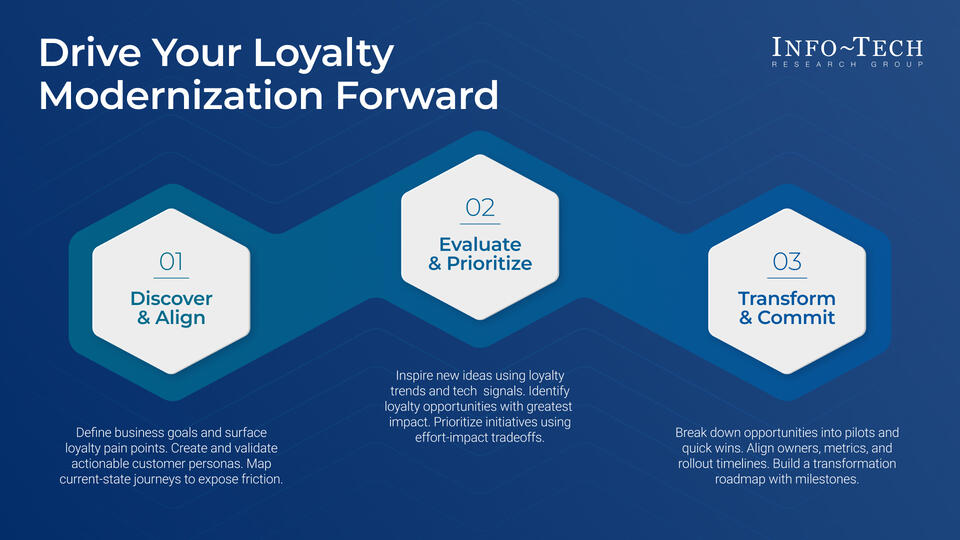
Drive your loyalty modernization forward
Info-Tech Insight
When CIOs and business leaders co-own the journey, technology stops being a cost center and starts delivering outcomes that matter. A step-by-step framework ensures both sides act in sync, unlocking smarter investments, faster wins, and lasting impact.
-
Discover & Align
Define business goals and surface loyalty pain points.
Create and validate actionable customer personas.
Map current-state journeys to expose friction. -
Evaluate & Prioritize
Inspire new ideas using loyalty trends and tech signals.
Identify loyalty opportunities with greatest impact.
Prioritize initiatives using effort-impact trade-offs. -
Transform & Commit
Break down opportunities into pilots and quick wins.
Align owners, metrics, and rollout timelines.
Build a transformation roadmap with milestones.

Info-Tech’s methodology for Modernize Your Loyalty Program Through a Digital Strategy
1. Discover and Align |
2. Evaluate and Prioritize |
3. Transform and Commit |
|
Phase Steps |
Goal: Map loyalty pain points to digital opportunities. 1.1 Review business context 1.2 Create persona journey map |
Goal: Prioritize opportunities and assess internal readiness. 2.1 Define value streams and stages 2.2 Explore the digital horizon 2.3 Identify and rank opportunities |
Goal: Transform stakeholder journeys. 3.1 Break opportunities into initiatives 3.2 Align across departments 3.3 Define your loyalty roadmap |
Phase Outcomes |
|
|
|
Insight summary
Align loyalty with emotion
Most loyalty programs fail not because of weak rewards, but because they don’t align with the emotional and behavioral drivers of their highest-value customers.
Map to modernize
You can’t modernize what you haven’t mapped. Aligning stakeholders, surfacing loyalty pain points, and defining customer personas are foundational to transformation. Without clarity on friction and needs, initiatives risk misfiring or replicating what’s already broken.
Prioritize for feasibility
Prioritization brings focus and credibility. Once pain points are visible, CIOs must assess capability gaps and business readiness to execute. Early filtering of ideas builds momentum, ensures feasibility, and avoids spreading resources too thin.
Execute with clarity
Execution is where loyalty wins or fails. Successful pilots require cross-functional alignment, clear metrics, and realistic rollout planning. CIOs must define outcomes early and ensure ownership doesn't get lost at handoff.
Uncover loyalty gaps
Journey maps should expose both customer pain and system complexity. Too often, current-state mapping stops at the frontend. CIOs must surface backend limitations, like data silos or campaign lag, that dilute loyalty value.
Back wins with ROI
Quick wins need real business backing. Not every pilot deserves launch. CIOs should champion initiatives with clear ROI, cross-team support, and measurable progress within 90 days.
About Info-Tech
Info-Tech Research Group is the world’s fastest-growing information technology research and advisory company, proudly serving over 30,000 IT professionals.
We produce unbiased and highly relevant research to help CIOs and IT leaders make strategic, timely, and well-informed decisions. We partner closely with IT teams to provide everything they need, from actionable tools to analyst guidance, ensuring they deliver measurable results for their organizations.
What Is a Blueprint?
A blueprint is designed to be a roadmap, containing a methodology and the tools and templates you need to solve your IT problems.
Each blueprint can be accompanied by a Guided Implementation that provides you access to our world-class analysts to help you get through the project.
Need Extra Help?
Speak With An Analyst
Get the help you need in this 5-phase advisory process. You'll receive multiple touchpoints with our researchers, all included in your membership.
Guided Implementation 1:
- Call 1: Scope requirements, objectives, and your specific challenges.
Guided Implementation 2:
- Call 1: Review business context.
- Call 2: Create persona journey map.
Guided Implementation 3:
- Call 1: Define value streams and stages.
- Call 2: Explore the digital horizon.
Guided Implementation 4:
- Call 1: Identify and rank opportunities.
- Call 2: Break opportunities into initiatives and align across departments.
Guided Implementation 5:
- Call 1: Define your loyalty roadmap.
- Call 2: Summarize results and plan next steps.
Contributors
- Craig Broussard, Senior Executive Counselor, Info-Tech Research Group
- Elizabeth Silva Smulski, Senior Research Analyst, Info-Tech Research Group
- Terra Higginson, Principal Research Director, Info-Tech Research Group
- Brian Jackson, Principal Research Director, Info-Tech Research Group
- Manish Jain, Principal Research Director, Info-Tech Research Group
- 4 external anonymous contributors
