
Power Your Success With a Winning Point-of-Sale System
Simplify your search.
- Ditch legacy POS for cloud-native, flexible, and scalable systems.
- Replace fragile integrations with a future-ready, unified framework.
- Move from batch to real-time data for faster, smarter decisions.
- Simplify and standardize system configurations to reduce complexity and ease support and upgrades.
Our Advice
Critical Insight
- Outdated POS systems hold back businesses and IT from delivering engaging retail experiences everywhere.
- To compete in a digital-first world, retailers must turn the store into a connected, data-driven experience – where what can’t be done online is done exceptionally well in person.
Impact and Result
- Take a structured, interactive approach to explore POS innovation.
- Assess business needs and define clear objectives and requirements.
- Set criteria, shortlist vendors, score options, and choose confidently.
- Partner with Info-Tech to modernize your POS: Explore innovation, clarify objectives, set criteria, shortlist vendors, and confidently choose the right system.
Power Your Success With a Winning Point-of-Sale System
Simplify your search.
Analyst Perspective
Maximize your growth.
Selecting a modern point-of-sale (POS) system is a complex, high-stakes decision that impacts nearly every part of a retail business, from customer experience and inventory visibility to operational agility. Retailers often face fragmented requirements, vendor overload, and unclear priorities, which can delay decisions or lead to suboptimal outcomes.
The key to success lies in aligning business goals with technology capabilities. This starts by identifying critical use cases, setting clear success metrics, and creating a structured vendor evaluation process grounded in actual business needs.
Retailers who adopt a feature-based, traceable approach avoid request for proposal (RFP) fatigue, reduce bias, and move confidently from selection to negotiation with clarity and purpose. The right framework can help you cut through the noise, focus your team, and accelerate decisions. It can help you apply a structured approach, ensuring that you engage the business, prioritize what matters most, and ultimately select a vendor that fits both your strategy and your architecture.

Donnafay MacDonald
Research Director, Industry Research
Info-Tech Research Group
Executive Summary
Your Challenge
The POS ecosystem is outdated and missing capabilities that support modern retail. CIOs struggle to:
- Ditch legacy POS for cloud-native, flexible, and scalable systems.
- Replace fragile integrations with a future-ready, unified framework.
- Move from batch to real-time data for faster, smarter decisions.
- Simplify and standardize system configurations to reduce complexity and ease support and upgrades.
Common Obstacles
IT is constrained in its ability to support the demands of modern retail. For example:
- Slow feature delivery limits supports for mobile POS, self-checkout, and new payment options.
- Batch processing creates lags between actions and insights.
- Fragmentation creates silos and incompatibility.
- Outdated controls increase payment card industry (PCI) and privacy gaps.
- Legacy systems sap resources and stall innovation.
Info-Tech's Approach
Info-Tech's approach to improvement includes:
- Taking a structured, interactive approach to explore POS innovation.
- Assessing business needs and defining clear objectives and requirements.
- Setting criteria, shortlisting vendors, scoring options, and choosing confidently.
Partner with Info-Tech to modernize your POS – to explore innovation, clarify your objectives, set criteria, shortlist vendors, and confidently choose the right system.
Info-Tech Insight
Outdated POS systems hold back business and IT from delivering engaging retail experiences everywhere. To compete in a digital-first world, retailers must turn the store into a connected, data-driven experience, where what can't be done online is done exceptionally well in person.
Your Challenge
Outdated POS systems are holding back retail IT with complex integrations, siloed data, and cumbersome customizations that block agility and scalability.
The challenge for CIOs lies not just in fitting new technology into existing architecture, but also in reimagining what else can be modernized to amplify business outcomes.
There are three specific challenges to address:
- Limited Visibility –The evolving marketplace makes it challenging to maintain a complete picture of vendors. This, in turn, makes it difficult to navigate available solutions.
- Competing Priorities – Business priorities prevent the creation of actionable requirements for flexibility, scalability, and enhanced customer experiences.
- Integration Complexities – Integration roadblocks complicate efforts to connect new POS systems to the existing architecture and enable real-time data flow.
Prioritize retail transformation by equipping store teams with the tools to seamlessly manage, upsell, and personalize every sales opportunity.
Common Obstacles
Cut through retail system complexity to enable modernization.
Disjointed systems limit in-store innovation.
Legacy POS platforms were not built for the fast rollout of modern features, such as mobile checkout or new payment methods. Adding new capabilities calls for complicated, time-consuming custom development and testing. With outdated architectures and constrained flexibility, even minor updates require significant effort and raise the possibility of system disruptions.
Lack of real-time data hinders personalization.
Traditional POS systems rely on batch processing, creating delays between customer transactions and actionable insights. These delays undermine the ability to respond quickly to customer needs and market changes. Moving to real-time data flow demands not only technology upgrades but also a rethink of enterprise architecture – a complex and resource-intensive transformation.
Integration challenges slow innovation across channels.
After years of layering new tools onto old systems, retailers end up with fragmented platforms and inconsistent controls that create data silos and expose the business to security and compliance risks. Untangling these complexities requires a unified effort to consolidate systems and modernize security – all while keeping critical operations running.
A modern POS system can connect and power your core business systems
A POS system combines software and hardware to manage retail transactions across in-store, online, and kiosk channels, supporting the full purchase cycle and encompassing all the activities involved in a sale.
Modern POS systems are highly sophisticated and often integrate seamlessly with a retailer's core business capabilities, including finance management, marketing, customer relationship management, supply chain management, and reporting and analytics.
Understanding what a modern POS system can offer – and the problems it can solve
when implemented effectively – has never been more critical for retailer competitiveness. To empower retailers, a modern POS system can:
- Enable seamless transactions across all sales channels.
- Connect seamlessly with core business systems.
- Track and manage inventory in real time.
- Generate valuable data for enhanced reporting and analytics.
- Unlock customer insights to drive personalization and loyalty.
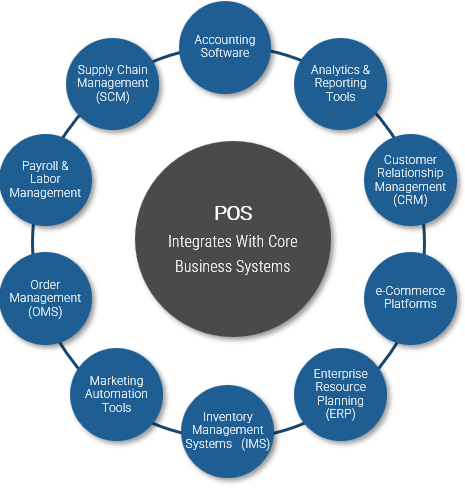
Boost digital transformation and business performance with the right POS system
The right POS system … |
This enables the business to … |
|---|---|
Allows a business to accept diverse payment types, including contactless payments, mobile wallets, and BNPL (buy now pay later). |
Expand customer payment options, support omnichannel retail, and enhance customer satisfaction. |
Integrates with CRM, loyalty, and marketing platforms. |
Personalize customer experiences, drive repeat business, and strengthen customer relationships. |
Connects with inventory and supply chain systems in real time. |
Improve inventory accuracy, reduce stockouts/overstock, and enhance operational efficiency. |
Supports cloud-based architecture and remote updates. |
Achieve scalability, faster deployment times, and consistent performance across all locations. |
Provides analytics on sales, customer behavior, and staff performance. |
Power data-driven decisions in product placement, staffing, and promotions. |
Offers self-service kiosks and mobile checkout capabilities. |
Reduce wait times, lower labor costs, and improve in-store customer flow. |
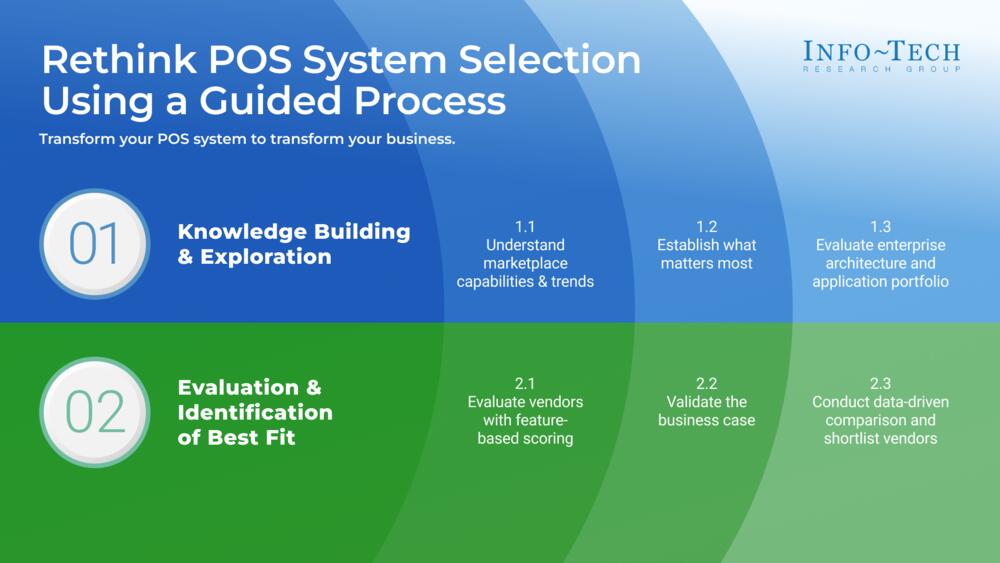
Rethink POS system selection using a guided process
By modernizing their POS systems, retailers gain powerful new capabilities that can drive operational transformation and empower them to deliver outstanding customer experiences.
Transform your POS system to transform your business.
01. Knowledge Building and Exploration
Begin by evaluating the current POS landscape. Then explore emerging technologies and vendor offerings, and confirm alignment with strategic objectives to build a compelling case for transformation.
- 1.1 Understand marketplace capabilities and trends.
- 1.2 Establish what matters most.
- 1.3 Evaluate enterprise architecture and application portfolio.
Evaluation and Identification of Best Fit
Follow by establishing a clear definition of success to guide your evaluation of solutions, and conclude by identifying the vendors that are most capable of delivering impactful value.
- 2.1 Evaluate vendors with feature-based scoring.
- 2.2 Validate the business case.
- 2.3 Conduct data-driven comparison and shortlist vendors.
Fast-track your software selection, guided by principles of the RASF framework
Rather than wasting valuable time sitting through repetitive demos or sifting through outdated requirements, focus your energy on what truly matters – identifying key business issues and aligning on what drives the most value. Streamlining the discovery process accelerates decision-making and ensures that your efforts are targeted, strategic, and impactful.
This guide will work through activities in the education and discovery phase and then the evaluation phase of the Rapid Application Selection Framework (RASF). Upon completion of this guide, you will be prepared to begin the selection phase, followed by the negotiation and configuration phase, to begin your digital transformation.

Download TheRapid Application Selection Framework to learn more.
Info-Tech's New POS Software Vendor Selection Methodology
Phase Steps |
Education & Discovery |
Evaluation |
|---|---|---|
1.1 Understand marketplace capabilities and trends. |
2.1 Evaluate vendors with feature-based scoring. |
|
Phase Outcomes |
|
|
Deliverables |
|
|
Deliverables
Each step of this guide is accompanied by supporting deliverables to help you accomplish your goals:
The Ultimate POS Vendor Selection Tool
This vendor selection tool streamlines the process of evaluating and choosing the right POS system by matching business needs with vendor capabilities. It eliminates guesswork through guided criteria, comparison tools, and structured decision support for faster, more confident outcomes.
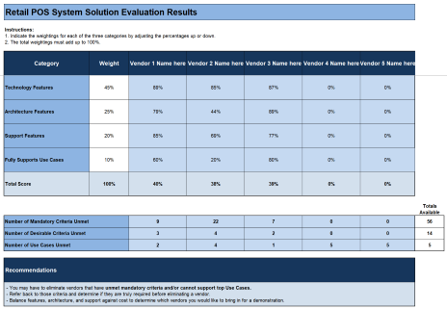
Kick-start your RFP and vendor decision-making process with confidence. This framework provides the structure and focus needed to cut through complexity and align stakeholders quickly. Use it to accelerate progress, reduce rework, and make smarter, faster decisions.
Measure the benefits of laying the groundwork for POS system transformation
A clear roadmap for POS transformation will have a measurable impact on organizational resilience.
Project Outcome |
Metric |
|---|---|
Aligned IT-business focus |
White-elephant initiatives are eliminated. |
Validated requirements and use cases |
When making decisions, there is confidence that solutions address real business problems. |
Cross-functional buy-in |
Departments are actively engaged. |
Vetted business value |
Initiatives are prioritized based on business value. |
Assessed feasibility |
Initiatives can move from ideas to becoming actionable. |
Get more from your POS selection process
Reduce risk of implementation failure.
- Early validation of vendor fit and system capabilities helps to avoid costly surprises during rollout and adoption.
Accelerate decision-making and alignment.
- Business-led input streamlines evaluation, builds consensus faster, and avoids delays from miscommunication or indecision.
Improve vendor comparability and fairness.
- Feature-based scoring enables objective, side-by-side assessments that reduce bias and elevate fit-for-purpose vendors.
Deliver higher business value and ROI.
- Solutions chosen based on real business needs drive better outcomes, increase efficiency, and avoid underused features.
Shorten time to value (TTV).
- With clearer priorities and faster selection, implementation begins sooner, translating to faster operational impact.
Info-Tech offers various levels of support to best suit your needs
DIY Toolkit
"Our team has already made this critical project a priority, and we have the time and capability, but some guidance along the way would be helpful."
Guided Implementation
"Our team knows that we need to fix a process, but we need assistance to determine where to focus. Some check-ins along the way would help keep us on track."
Workshop
"We need to hit the ground running and get this project kicked off immediately. Our team has the ability to take this over once we get a framework and strategy in place."
Executive & Technical Counseling
"Our team and processes are maturing; however, to expedite the journey we'll need a seasoned practitioner to coach and validate approaches, deliverables, and opportunities."
Consulting
"Our team does not have the time or the knowledge to take this project on. We need assistance through the entirety of this project."
Diagnostics and consistent frameworks are used throughout all five options.
Guided Implementation
What does a typical GI on this topic look like?
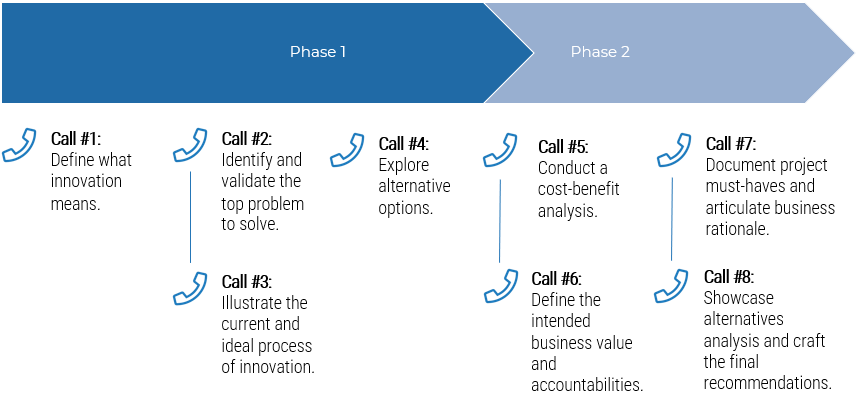
A Guided Implementation (GI) is a series of calls with an Info-Tech analyst to help implement our best practices in your organization.
A typical GI is 8 to 12 calls over the course of 4 to 6 months.
Workshop Overview
Contact your account representative for more information.
workshops@infotech.com 1-888-670-8889
Day 1 | Day 2 | |
|---|---|---|
Activities | Knowledge Building and Exploration | Evaluation and Identification of Best Fit |
1.1 Understand marketplace capabilities and trends. | 2.1 Evaluate vendors with feature-based scoring. | |
Outcomes |
|
|
Deliverables |
|
|
Insight Summary
Modernize to compete.
Retailers who want to stay competitive must modernize. Integrated POS platforms enable real-time engagement and agility, while legacy systems drag down responsiveness and limit growth.
Align market trends with business needs.
Having a deep understanding of POS market trends and aligning these trends with internal business needs enables smarter decisions, better vendor alignment, and stronger long-term return on investment (ROI).
Use measurable criteria to choose better vendors.
Using clear, measurable criteria drives objective decision-making, reduces risk, and increases the odds of selecting a high-performing vendor.
Prioritize integration for seamless operations.
Focusing on integration capabilities ensures that a POS system supports seamless data flow across ERP, CRM, and inventory – a critical foundation for operational success.
Define success early to guide selection.
Defining success criteria and building use cases early aligns teams on priorities and ensures that vendor selection is driven by real business needs and measurable outcomes.
Evaluate POS trends and assess current systems
Knowledge Building and Exploration
Phase 1 |
Phase 2 |
|---|---|
1.1 Understand marketplace capabilities and trends. 1.2 Establish what matters most. 1.3 Evaluate enterprise architecture and application portfolio. |
2.1 Evaluate vendors with feature-based scoring. 2.2 Validate the business case. 2.3 Conduct data-driven comparison and shortlist vendors. |
Power Your Success With a Winning Point-of-Sale System
This phase will walk you through the following activities:
- Gain insight into current POS capabilities and trends while refining business requirements for a new system.
- Assess whether existing architecture or applications can meet any of the business needs.
This phase involves the following participants:
- IT Project Lead
- Business Project Lead
- Business subject matter experts (SMEs) from Store Associates, Operations, Finance, and Marketing
- Project Sponsor
1.1 Understand marketplace capabilities and trends
1-2 hours
- Leverage SoftwareReviews and third-party vendor data where possible.
- Standardize terminology and clarify the meanings of key terms to ensure clear communication with vendors.
- In Tab 3, Features to Score, review the features that are relevant for supporting the valid requirements.
Input |
Output |
|---|---|
|
|
Materials |
Participants |
|
|
Explore essential POS capabilities and key integrations
Align POS selection with your growth strategy.
Most modern POS systems include standard features, such as inventory management, labor management, and reporting and analytics, and are designed to integrate seamlessly with your core business systems.
While some POS platforms offer extended capabilities out of the box, many critical functions, such as accounting, payroll, loyalty programs, and e-commerce, are often delivered through third-party integrations. When not included in the platform, these should be considered essential components of your broader POS ecosystem.
To the right is a list of core capabilities that all retailers should aim to include when implementing a new POS system, regardless of industry or sector. By leveraging a composable POS ecosystem – where components and features can be flexibly added, removed, or integrated – you can maximize scalability and adapt quickly as your business evolves.
Info-Tech Insight
The right POS system is one that integrates flexibly, scales easily, and supports your evolving business needs through a composable ecosystem.
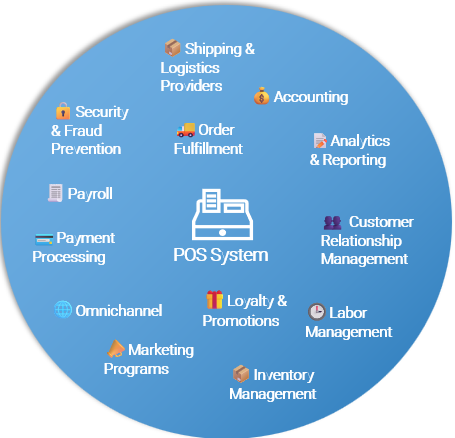
Icon Source: ChatGPT
About Info-Tech
Info-Tech Research Group is the world’s fastest-growing information technology research and advisory company, proudly serving over 30,000 IT professionals.
We produce unbiased and highly relevant research to help CIOs and IT leaders make strategic, timely, and well-informed decisions. We partner closely with IT teams to provide everything they need, from actionable tools to analyst guidance, ensuring they deliver measurable results for their organizations.
What Is a Blueprint?
A blueprint is designed to be a roadmap, containing a methodology and the tools and templates you need to solve your IT problems.
Each blueprint can be accompanied by a Guided Implementation that provides you access to our world-class analysts to help you get through the project.
Need Extra Help?
Speak With An Analyst
Get the help you need in this 2-phase advisory process. You'll receive multiple touchpoints with our researchers, all included in your membership.
Guided Implementation 1: Evaluate POS Trends and Assess Current Systems
- Call 1: Define what innovation means.
- Call 2: Identify and validate the top problem to sovle.
- Call 3: Illustrate the current and ideal process of innovation.
- Call 4: Explore alternative options.
Guided Implementation 2: Shortlist Vendors Based on Business-Aligned Criteria
- Call 1: Conduct a cost-benefit analysis.
- Call 2: Define the intended business value and accountabilities.
- Call 3: Document project must-haves and articulate business rationale.
- Call 4: Showcase alternatives analysis and craft the final recommendations.
Contributors
- 3 Anonymous Contributors
