
Extend Enterprise Architecture to Operational Technology for Utilities
From strategy to grid: A practical walkthrough of EA for AMI.
- IT and OT are unique and have conflicting design priorities.
- Innovation roadmaps are disjointed. OT assets have a longer lifecycle than IT assets, causing siloed approaches to planning.
- Regulations are evolving and utilities are subjected to more scrutiny in terms of data, privacy, and security – areas where OT traditionally is less mature.
Our Advice
Critical Insight
The future of enterprise architecture for utilities will be hybrid and must evolve to model, govern, and guide both IT and OT environments. To survive and remain competitive, utilities must have visibility into their IT/OT architecture to meet the demands for technology innovation, regulatory compliance, customer experience, and operational efficiency.
Impact and Result
- EA supports the planning across all layers, leading to lower operating costs, improved security, and streamlined data.
- Integrate planning and investments to enable agility in your organization and quickly meet complex business demands.
Extend Enterprise Architecture to Operational Technology for Utilities
From strategy to grid: A practical walkthrough of EA for AMI.
Analyst perspective
Unify business and operational priorities through enterprise architecture.

The utility of the future cannot be realized without bridging the gap between enterprise architecture (EA) and operational technology (OT). Utilities face increasing complexity through regulatory pressures, cybersecurity mandates, customer expectations for reliability, and the rapid deployment of digital initiatives such as advanced metering infrastructure (AMI), distributed energy resource (DER) integration, and smart grid automation. While EA is well-established on the IT side, OT remains underrepresented, leaving a critical gap in governance, lifecycle planning, and cross-domain decision-making.
Extending EA into OT provides the structured foundation utilities need to manage this complexity. By systematically applying architecture practices across business, data, application, and technology layers, utilities gain a holistic view of their operational and digital ecosystems. This alignment ensures interoperability, reduces duplication, and enables resilience in hybrid digital-physical environments.
By following the methodology outlined in this blueprint, utilities can avoid piecemeal integration efforts, establish EA as the bridge between IT and OT, unlock enterprise-wide benefits ranging from data-driven decision-making to regulatory resilience, and position themselves to thrive as a digitally enabled organization of the future.
Bevin Chau
Research Director
Utilities, Industry Practice
Info-Tech Research Group
Executive summary
Your Challenge
- Conflicting design priorities and uniqueness: Architecturally, IT and OT have different design priorities (e.g. business agility, scalability, cost efficiency vs. reliability, real-time control).
- Disjointed innovation roadmaps: IT assets’ lifecycles are measured in years, while OT assets’ lifecycles span decades, causing siloed approaches to planning and meeting business objectives.
- Navigating evolving regulations: Utilities are subject to increased regulatory scrutiny in data, security, and privacy – areas where OT traditionally is less mature than IT.
Common Obstacles
- Resource and skill gaps: Few professionals are well versed in both EA principles and OT systems. Upskilling internally is a long, drawn-out process, and the external resource pool is limited.
- Unplanned and accidental architecture: Over time, organizations have developed an IT/OT architecture covering specific needs without considering interoperability.
- Technology incompatibility: Aging OT infrastructure and proprietary third-party technology inhibit effort to integrate with modern platforms without costly upgrades.
Info-Tech’s Approach
Enterprise architectures take time to develop – determine how OT can gradually adopt EA best practices for effective integration:
- Establish OT’s processes: You can’t extend OT without understanding what OT does and how it contributes to the business.
- Address the EA gaps in OT: Evaluate how well EA currently supports each OT process and where improvements can be made.
- Apply EA through AMI: Explore practical application of EA in OT by using AMI as an example and guide.
Info-Tech Insight
The future of enterprise architecture for utilities will be hybrid and must evolve to model, govern, and guide both IT and OT environments. To survive and remain competitive, utilities must have visibility into their IT/OT architecture to meet the demands for technology innovation, regulatory compliance, customer experience, and operational efficiency.
Extending EA into OT is crucial in building the utility of the future
Research has shown utility organizations with mature EA practices including IT and OT see many benefits.
Utilities with mature EA reported:
36%
Higher success rate for digital transformation initiatives
28%
Lower technology total cost of ownership
IT/OT initiatives supported by EA frameworks resulted in:
37%
Faster IT/OT convergence initiatives timelines
42%
Lower IT/OT system integration costs
Source: Capstera 2025
Drivers for extending EA into OT
Align to Strategic Business Goals: EA practices for IT and OT enable integrated planning aligned to organizational objectives.
Integrate Technology Stack: Organic growth of EA focused on singular and specific needs has expanded technical debt and shadow IT and OT.
Reduce Cost: EA supports cost reduction activities such as rationalizing the application portfolio and streamlining data pipelines, standards, and policies.
Meet External and Internal Demands at Pace: Regulators, customers, and boards are demanding more and demanding it quicker. EA enables cohesive planning.
Secure Field and Edge Devices: Cyber standards minimize the vulnerability as a result of growing edge devices (e.g. meters, DERs).
Info-Tech Insight
Extend EA practices into OT to unlock low-cost, low-effort initiatives yielding tremendous benefits for your organization, such as portfolio rationalization, decreasing the total cost of ownership, and improving operational efficiencies and decision-making.
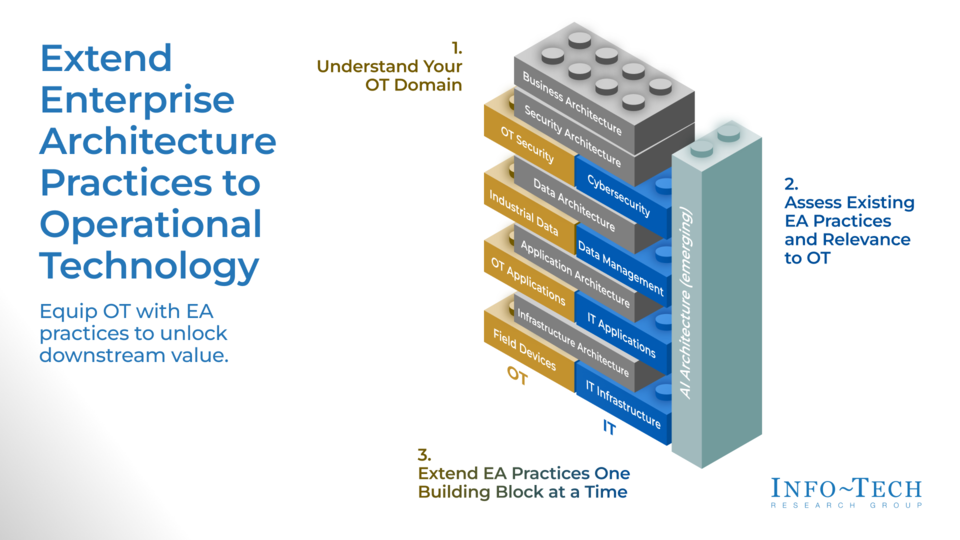
Extend Enterprise Architecture Practices to OT
Equip OT with EA practices to unlock downstream value
Common Obstacles
OT Perceives EA Practices as Roadblocks
OT leaders and engineers value control and autonomy and view EA as another bureaucratic hurdle.
Disjointed Priorities, Views, and Culture
Utilities have indicated the greatest challenge in bridging IT/OT is not technology but cultures and managing change.
Your Challenge
EA Is Developed and Managed by IT
Conventional EA practices are initiated by IT with little involvement from OT, reducing OT applicability.
Divestment of Resources to Meet Business Goals
Fragmented planning leads to siloed approaches to projects and initiatives and diluted return on investments.
Impact
Unlock Downstream Value
EA supports planning across all layers, leading to lower operating costs, improved security, and streamlined data.
Adapt to Business Demands Quicker
Integrate planning and investments to enable agility in your organization and quickly meet complex business demands.
Building the utility of the future demands a unified, enterprise-wide effort, and EA provides the blueprint to orchestrate it. As OT becomes as sophisticated as IT with edge platforms and the emergence of AI, extending EA into OT unlocks operational intelligence and accelerates innovation across your enterprise.
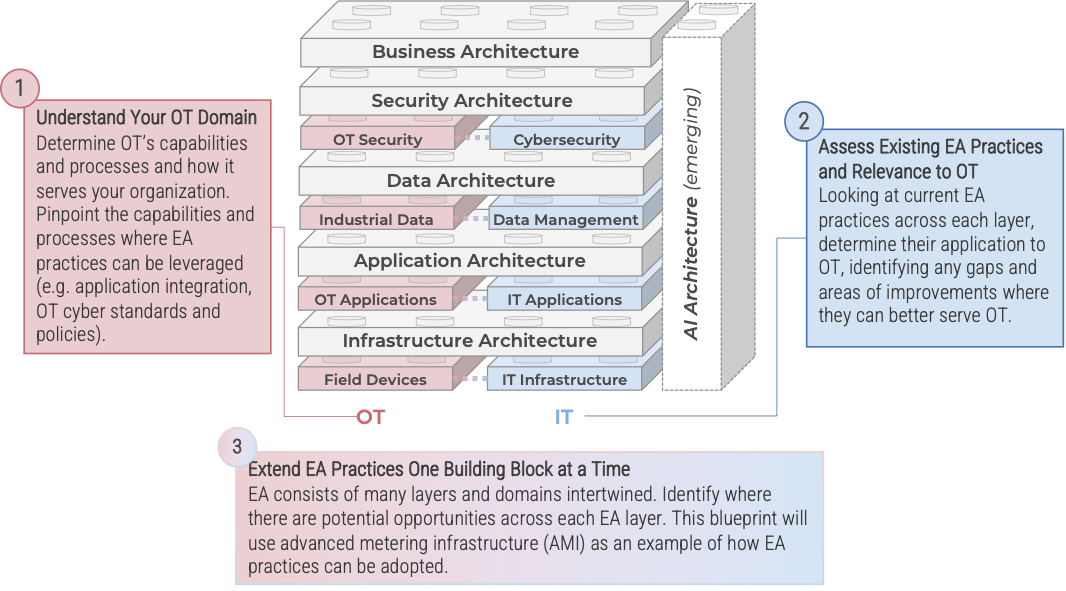
Info-Tech’s approach
Evaluate, assess, and apply
Phase 1: Evaluate OT Capabilities & Context |
Phase 2: Assess EA Practices’ Applicability to OT |
Phase 3: Walkthrough of EA Practices for AMI |
|
Objective |
Identify your organization’s OT capabilities and determine where EA practices currently apply or could apply. Ensure OT capabilities are aligned to business objectives. | Evaluate the applicability of EA practices across each domain, considering each OT capability as a practical example. Determine the current and target state. | Turn theory into practice by showing how EA improves planning, governance, and integration of a capability. This blueprint will be using AMI as an example. |
Activities |
|
|
|
Outcomes |
Capability mapping depicting the organization’s OT functions, creating common knowledge on where OT plays within the organization to ensure assessment is business-aligned. | Baseline architecture views (process, data, application, technology) covering priority OT domains. This provides a transparent map of weaknesses and risk and enables prioritization of investments and efforts. | Example walkthrough of EA practices adopted for AMI, serving as a template that can be replicated across other OT capabilities. |
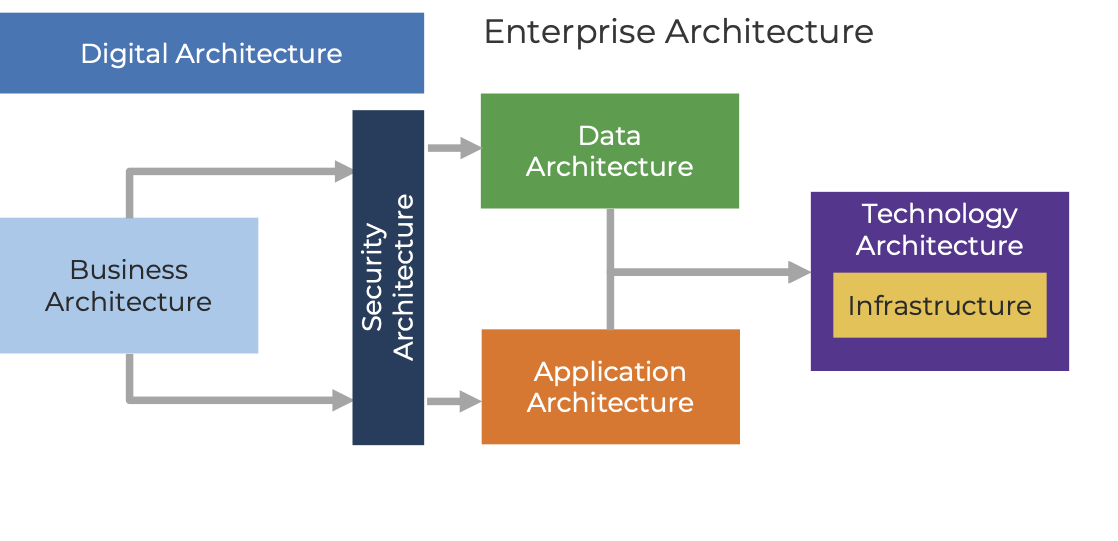
EA spans all the domains of architecture
Business architecture is the cornerstone that sets the foundation for all other architectural domains: security, data, application, and technology.
“An enterprise architecture practice is both difficult and costly to set up. It is normally built around a process of peer review and involves the time and talent of the strategic technical leadership of an enterprise.”
– The Open Group, 2018
What each EA domain layer means for OT
Each domain of enterprise architecture provides a distinct purpose and objective for OT outlined below:
EA Domain |
Purpose for OT |
Business |
|
Security |
|
Data |
|
Application |
|
Infrastructure |
|
AI (emerging) |
|
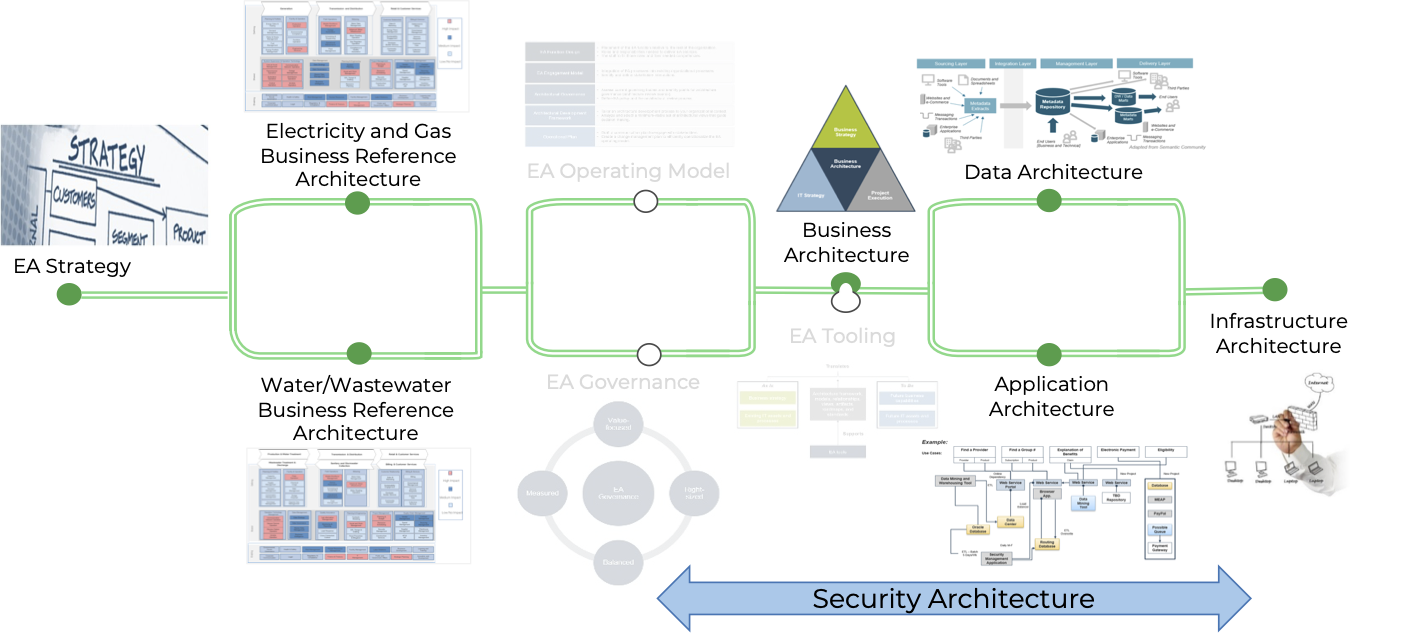
Focus of this blueprint in your EA journey
The involvement of OT resides in several key steps within the broader EA journey. This blueprint examines the steps where EA practices is most likely to organically extend into OT highlighted below.
Insight map
A utility of the future needs EA to capture all dimensions of technology
Utilities are facing complex pressures from regulators, customers, government, and their own boards. Addressing these challenges will become more difficult if OT and other organizational domains are not integrated into your enterprise architecture.
Spotlight your organization’s OT capabilities
Although IT and OT have their own uniqueness, hidden in plain sight are commonalities serving as opportunities for shared EA practices. Showcase how OT supports your organization to better understand where EA can help.
Prioritize areas yielding the greatest returns
Many opportunities and initiatives can be identified by assessing the gaps. Prioritize these opportunities to align with your organizational goals – for example, streamlining data, securing field devices, or reducing operating costs.
Architectures are not built overnight – start small and scale
EAs are dynamic, and your approach should be too. Avoid a “big bang” solution and instead focus on a specific area (e.g. AMI, security standards, or app consolidation). The many-to-many relationships will organically construct your EA.
Blueprint deliverables
Each step of this blueprint is accompanied by supporting deliverables to help you accomplish your goals:
Utility OT Capability Baseline
(included in this deck)
Leverage Info-Tech’s business reference architecture to identify OT capabilities aligned to your overall EA/business strategy.
EA for OT Maturity Assessment and Gap Analysis
Evaluate how well EA currently supports OT capabilities, identifying where gaps are to strengthen or develop EA practices.
AMI Use Case Walkthrough
(included in this deck)
Review a step-by-step demonstration of how EA supports planning, governance, integration, and lifecycle management for AMI deployment.
Key deliverable
Prioritization and Roadmap Tool for OT EA Practices
The OT view of the business reference architecture and the gap analysis will inform your organization of the priority OT capabilities and EA practices needed. The roadmap will guide both OT and EA teams to further extend EA practices into OT.
Blueprint benefits
IT Benefits
- Standardize and integrate applications with a single reference model, reducing integration complexity (e.g. AMI data flowing into CIS, OMS).
- Reduce technical debt by reducing custom solutions across each EA layer.
- Improve security and risk posture by mapping OT systems into cyber controls (ISO 27001/NIST/IEC 62443).
- Greater collaboration and resource planning by understanding common infrastructure and data needs.
Business Benefits
- Improve strategic alignment. OT capabilities are tied to business outcomes such as regulatory compliance, operational efficiency, and customer service.
- Accelerate digital transformation and IT/OT initiatives. With EA as a foundation, IT/OT convergence initiatives have 37% quicker timelines due to more efficient planning and allocation of resources (Electric Power Research Institute, as cited in Capstera, 2025).
- Lower operating cost through rationalizing applications and streamlining data and infrastructure.
Info-Tech Insight
EA is a tool for your organization to proactively plan and plant the seeds for downstream value. The impact may not be apparent at first, but long-term benefits, like having the agility to deploy new technologies or achieving operational efficiencies via standardization, will be traced back to having foundational planning processes.
Measure the value of this blueprint
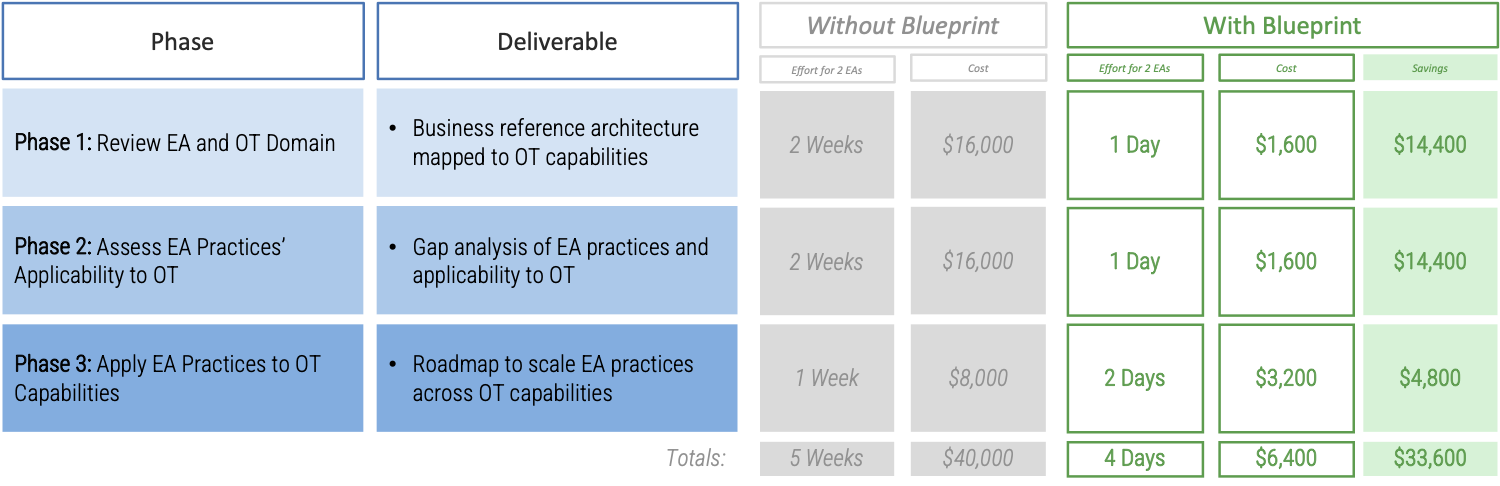
This blueprint serves as a catalyst for your organization to broaden EA into OT.
The average hourly rate of an enterprise architect in the United States is around US$100 (Coursera, 2025). This blueprint and its accelerators are meant to direct focus on the priority areas where EA will derive the greatest value for OT and could save your EA team around US$33,000 worth of effort.
Case Study: Lead with business architecture: Salt River Project’s approach to expanding EA to OT
Organization
Salt River Project, Arizona, USA
Industry:
Electricity and Water Utility
Sources:
1898 & Co., 2022
Challenge
Salt River Project (SRP), a water and electricity utility company, saw a need to digitally transform due to aging grid infrastructure, rapid growth in demand, and increasing integration of renewable energy sources/distributed energy resources. Traditionally, SRP’s OT team operated with minimal EA oversight and operated separately from IT teams, leading to siloed planning and lack of a unified IT/OT strategy. Given the growing call to innovate, SRP saw a need to align OT initiatives to broader corporate objectives to efficiently manage their transformation journey and ensuring all business units work toward a shared future-state architecture.
Solution
To start, SRP focused on its business architecture by establishing a formal OT strategy and governance program alongside with the IT organization, essentially bringing EA practices into the OT environment by:
- Defining a unified OT strategy and roadmap for digital transformation aligned with enterprise and IT goals.
- Standing up an IT/OT governance structure, ensuring stakeholders from both sides have regular cadences.
- Defining an EA capability specifically to support OT delivery in coordination with IT.
- Creating common tools and templates, joint architecture review boards, and an integrated planning process.
- Beginning to standardize OT infrastructure services (networks and compute at plants/substations).
Impact
- Cross-silo collaboration improved significantly as the new governance structure ensured OT and IT teams engage in joint planning and speak a common architectural language.
- SRP avoided duplicate efforts and accelerated the timeline to grid modernization.
- SRP continued expanding EA practices into OT, such as a standardized secure OT network configuration.
“As OT and IT technologies converge and increase in complexity, additional coordination and collaboration will be fundamental for fully integrated, reliable and secure solutions that promote resource efficacy.”
– 1898 & Co., 2022
Case Study: Enterprise architecture enables successful rollout of smart meter and other digital technology
Organization
CLP Group
Industry:
Energy, Infrastructure Utility
Sources:
Avolutions
Challenge
CLP’s organizational goal is to “put the customer first and offer personalized, accessible services using digital technology.” Its existing architecture posed challenges, with fragmented back-end systems, siloed processes, and limited visibility of customer and operational data. CLP sought a structured way to align digital transformation, OT operations, and customer-focused services with enterprise strategy.
Solution
CLP created a plug-and-play method built upon “digital building blocks,” which included business capability models, reusable components, and standardized integration patterns, shared protocols, and security frameworks. This enabled teams across the organization to achieve their objectives based on their unique requirements.
CLP leveraged the ABACUS EA platform to connect business architecture with application and technology layers, ensuring traceability from business outcomes to OT systems.
The digital building blocks allowed the successful rollout of a smart meter project that involved building an architecture roadmap of technology components and data streams to enable customer demand response.
Impact
Operational Benefits: Over 60% of CLP architecture will be updated over the next five years, with a system where domain architects collaborate with digital teams. Documents and diagrams are consolidated into a uniform approach, and key information points, capabilities, and solution requirements are captured.
Customer Benefits: Customers have near real-time usage data and enabled demand response programs; e.g. cutting 300,000 kWh in four hours during a peak demand campaign.
Strategic Benefits:
- Improved ability to integrate renewables with standardized components
- EA acting as a bridge that enables digital/OT transformation and supports plug-and-play reuse
“CLP are creating digital building blocks which set the organization up for growth, one reusable component at a time.”
– Chenen Chiang, Head of Enterprise Architecture & Digital Transformation
Info-Tech offers various levels of support to best suit your needs
DIY Toolkit
"Our team has already made this critical project a priority, and we have the time and capability, but some guidance along the way would be helpful."
Guided Implementation
"Our team knows that we need to fix a process, but we need assistance to determine where to focus. Some check-ins along the way would help keep us on track."
Workshop
"We need to hit the ground running and get this project kicked off immediately. Our team has the ability to take this over once we get a framework and strategy in place."
Executive & Technical Counseling
"Our team and processes are maturing; however, to expedite the journey we'll need a seasoned practitioner to coach and validate approaches, deliverables, and opportunities."
Consulting
"Our team does not have the time or the knowledge to take this project on. We need assistance through the entirety of this project."
Diagnostics and consistent frameworks are used throughout all five options.
Guided Implementation
What does a typical GI on this topic look like?
Phase 1: Evaluate OT Capabilities and Organizational Context
|
Phase 2: Assess EA Practices’ Applicability to OT
|
Phase 3: Walkthrough of EA Practices for AMI
|
A Guided Implementation (GI) is a series of calls with an Info-Tech analyst to help implement our best practices in your organization.
A typical GI is 4 to 7 calls over the course of 6 months.
Workshop overview
Contact your account representative for more information.
workshops@infotech.com 1-888-670-8889
Day 1 | Day 2 | Day 3 | Day 4 | |
Activities | Explore Contextual Elements of EA and OT1.1 Identify EA and OT stakeholders. 1.2 Review organizational strategy, including business needs and strategic direction. 1.3 Interview EA and OT stakeholders to identify business and technology needs, pain points, and gaps. | Assess Current and Target State of EA for OT2.1 Complete OT mapping of business reference architecture. 2.2 Assess current state and future state of EA practices within OT. 2.3 Conduct gap analysis to identify gaps in EA practices to OT capabilities. | Implement EA Practices for OT3.1 Walk through EA practice applicability for AMI. 3.2 Conduct tabletop exercise extending EA practices to priority OT capabilities. 3.3 Create roadmap of OT capabilities to apply EA practices. | Establish EA-OT Governance to scale & sustain4.1 Define EA governance to include OT in EA processes. 4.2 Define effectiveness and success measures. |
Deliverables |
|
|
|
|
About Info-Tech
Info-Tech Research Group is the world’s fastest-growing information technology research and advisory company, proudly serving over 30,000 IT professionals.
We produce unbiased and highly relevant research to help CIOs and IT leaders make strategic, timely, and well-informed decisions. We partner closely with IT teams to provide everything they need, from actionable tools to analyst guidance, ensuring they deliver measurable results for their organizations.
What Is a Blueprint?
A blueprint is designed to be a roadmap, containing a methodology and the tools and templates you need to solve your IT problems.
Each blueprint can be accompanied by a Guided Implementation that provides you access to our world-class analysts to help you get through the project.
Need Extra Help?
Speak With An Analyst
Get the help you need in this 3-phase advisory process. You'll receive multiple touchpoints with our researchers, all included in your membership.
Guided Implementation 1: Evaluate OT capabilities and organizational context
- Call 1: Explore existing role of EA and OT in your organization.
- Call 2: Augment the business reference architecture to align with organizational strategy.
- Call 3: Highlight OT capabilities in the business reference architecture.
Guided Implementation 2: Assess EA practices’ applicability to OT
- Call 1: Assess the current and target state of EA practices for OT. Determine the gaps where EA practices need to be developed or improved.
- Call 2: Prioritize OT capabilities and EA practices for extension.
Guided Implementation 3: Walkthrough of EA practices for AMI
- Call 1: Walk through leveraging EA for AMI rollout.
- Call 2: Replicate applying EA practices to other OT capabilities.
Contributors
- Jeff Breci, Director, Information Security, Metropolitan Utilities District
- Jonathan Jakub, Manager, Enterprise Solutions, Lincoln Electric System
- Nate Bird, Manager, Communications Infrastructure, Lincoln Electric System
