
Construct With Confidence Using the Right Construction Management System
Narrow your CMS search and align your tools to your needs.
- Construction companies struggle to leave behind their legacy systems and upgrade to more flexible, scalable construction management systems.
- Companies often have fragmented software solutions and require a unified network of solutions to help align the organization and achieve business goals.
- The evolving marketplace makes it challenging to complete a picture of vendors, making it difficult to navigate available solutions.
Our Advice
Critical Insight
In a fragmented environment like construction projects, coordination is everything. A CMS acts as the operational center, aligning dispersed teams, merging workflows, and turning multi-location complexities into controlled execution.
Impact and Result
This buyers guide is intended to assist organizations in:
- Analyzing the CMS market evolutions to identify key innovations.
- Evaluating the business’s current state to understand organizational objectives and align goals with the new CMS.
- Creating criteria, shortlisting vendors, scoring options, and choosing your next solution confidently.
Construct With Confidence Using the Right Construction Management System
Narrow your CMS search and align your tools with your needs.
Analyst Perspective
The right CMS does not just manage projects but also aligns people, processes, and profits.
Construction management systems (CMS) are critical platforms that enable construction companies to streamline project execution while improving cost control. In an industry where project complexity is rising, margins are thin, and rework is expensive, the right CMS is a strategic imperative. It acts as a hub, connecting field to office, syncing data, and ensuring strategic decisions are made to keep timelines tight and budgets intact. Modern construction companies operate in a landscape shaped by labor shortages, supply chain volatility, and increasingly complex owner demands. Fragmented point solutions and paper-based workflows are no longer sustainable. A CMS can help unify siloed systems, enabling greater transparency, real-time field reporting, and proactive risk management. Yet not all CMS platforms are created equally. Vendors vary in their ability to support diverse contractor types and multi-entity operations. Choosing the wrong platform leads to misaligned workflows, costly change orders, and technology debt that stalls innovation. This buyer’s guide helps construction leaders cut through the noise. Rather than just checking boxes, this will provide a structured approach to evaluating CMS solutions, aligning to your operating model and data needs. With the right system in place, construction companies can unlock operational clarity, empower field teams, and build the foundation for long-term success.

Michael Adams
Research Analyst, Construction Industry
Info-Tech Research Group
Executive Summary
Your Challenge | Common Obstacles | Info-Tech’s Approach |
|---|---|---|
Construction companies struggle to leave behind their legacy systems and upgrade to more flexible, scalable construction management systems. Companies often have fragmented software solutions and require a unified network of solutions to help align the organization and achieve business goals. The evolving marketplace makes it challenging to complete a summary of vendors, making it difficult to navigate available solutions. | Companies lack robust change management strategies to initiate change and ensure the successful integration of new technologies. The fragmentation of solutions has led to data silos and incompatibility, creating difficulty in integrating and transferring necessary data. Stakeholder relations are hindering the alignment of IT with broader business goals. Different departments operate with competing priorities, making it difficult for IT leaders to gain buy-in for enterprise-wide initiatives. | This buyer’s guide is intended to assist organizations with:
|
Info-Tech Insight
In construction, projects do not fail from poor intent but rather from poor coordination. The right CMS acts as your project control tower, connecting field and office in real time to manage scope, schedule, and cost with precision. A CMS tailored to your workflows helps empower teams to execute projects with confidence and keep them on track and within budget.
Unlock how a CMS impacts your organization
A construction management system is a software solution that streamlines tasks and connects workflows across the project lifecycle. A well-designed CMS extends beyond project tracking: it unifies operations, integrates functions, and enhances day-to-day efficiency across teams (CMiC, “What Is Construction Management Software”, 2024).
Construction firms often maintain legacy tools under the belief that if their technology isn’t broken, it doesn’t need replacing. But when leaders experience the impact of modern project management and collaboration capabilities, it becomes clear: outdated workflows are holding them back from delivering true operational performance (CMiC, “Why You Should Be Using Construction Project Management Software”, 2024).
Some companies deploy multiple CMS platforms across projects to address varying client requirements, subcontractor preferences, or regional needs. Properly connecting the field to the office is a unique challenge for each project, and for ease of use, companies may utilize several platforms to address the complexities of projects via team communication to meet deadlines (LinkedIn, 2022).
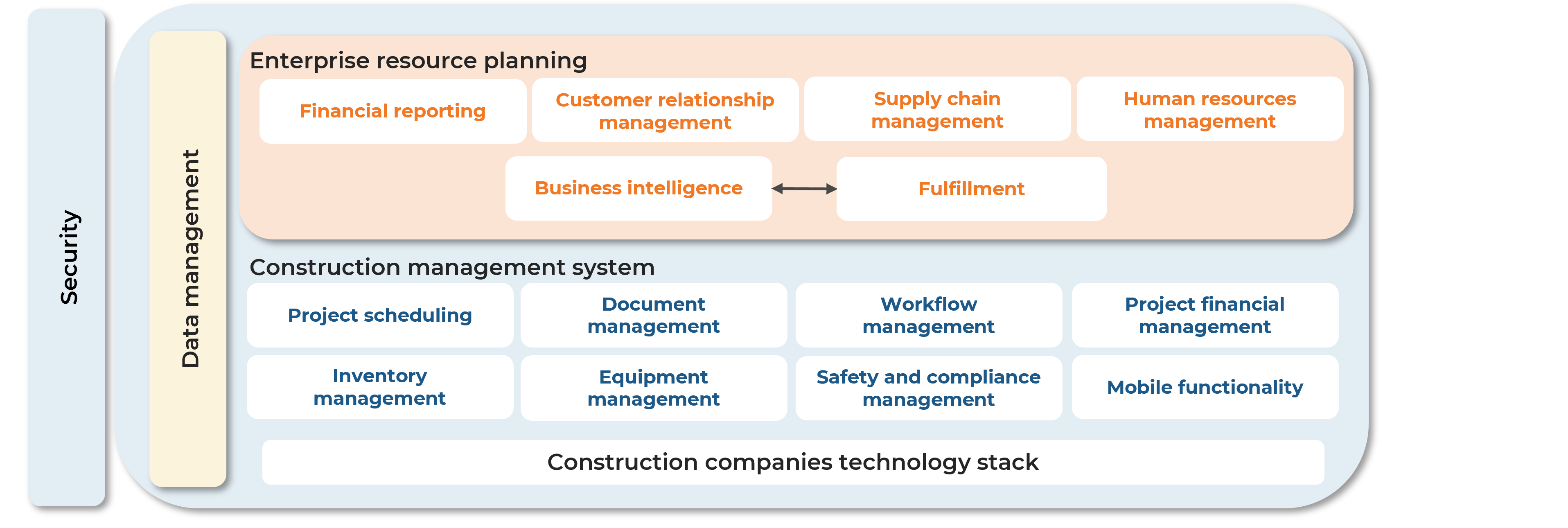
Info-Tech Insight
In a fragmented environment like construction projects, coordination is everything. A CMS acts as the operational center, aligning dispersed teams, merging workflows, and turning multi-location complexities into controlled execution.
Analyze the difference between an ERP and a CMS
An ERP system is an essential tool for any business.
- ERP systems centralize data from core operational processes into a single system, streamlining operations through integration.
- They are tailored to handle the complex, resource-intensive tasks unique to the construction industry.
- ERPs are used primarily for company-wide business operations, including finance teams, executives, HR, procurement, and project managers.
A CMS is tailored for specific project-level execution capabilities.
- Project managers and field staff use these systems regularly to aid project progression.
- They report the information back to corporate systems to ensure project visibility and check that projects are remaining on track and on budget.
ERP systems have evolved to host some project-specific capabilities from CMS, and some companies are finding these the most suitable solution. However, through integration, CMS remain prominent within the industry, enabling them to manage projects and report back to the appropriate stakeholders.
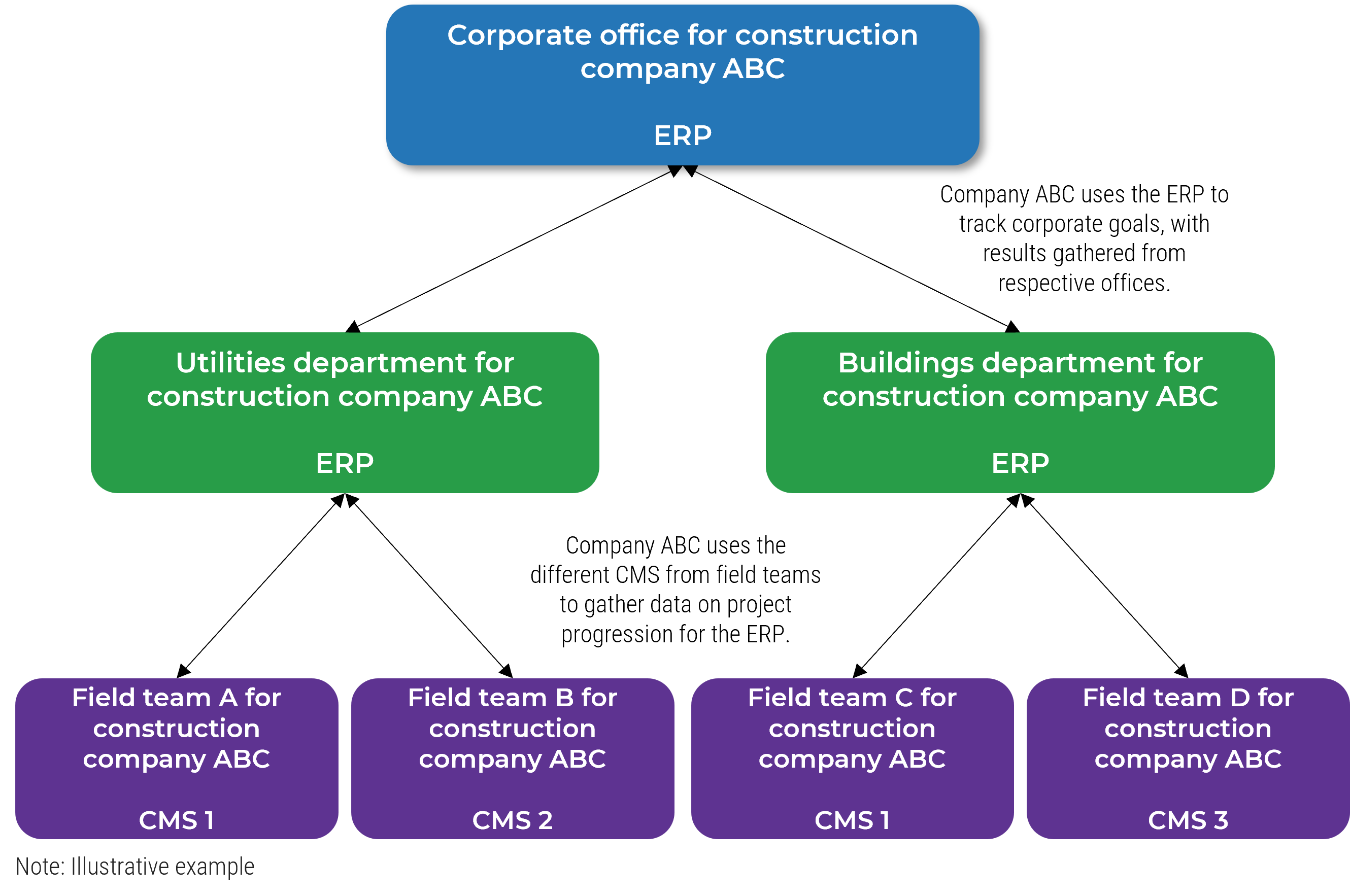
Integrate ERP and CMS for project success
Classic Fire and Life Safety reduces financial risk with Procore.
INDUSTRY: Construction
SOURCE: Procore, 2024
Challenge | Solution | Results |
|---|---|---|
Classic Fire and Life Safety is a speciality contractor with a unique footprint. The company takes on all types of construction projects, from 5-million-square-foot industrial complexes to residential buildings. Managing resources across such a breadth of projects has always been a challenge, especially given their rapid growth. About two years ago, they adopted an ERP system with a built-in project management module. The idea was that the ERP would streamline functions like budgeting and payroll, while the module would help everyone get on the same page regarding construction projects. “The ERP was strong, but we quickly realized the project module was not what we were looking for to handle project oversight.” They began a search for a new CMS that could bring all the company’s locations, talent, and people together on one platform while integrating with the ERP. | Classic Fire and Life Safety decided to purchase Procore, as they knew it would easily integrate with their ERP and was built with purpose for construction companies. They kept the ERP they already had, while Procore would serve as the comprehensive project management hub. Even with a dozen locations and hundreds of people across Canada and the US, Classic found that Procore gave its people 360-degree visibility, reducing the risk factor on large, remote projects. Through the integration, Classic achieved a seamless data flow between the ERP and the CMS. Key project information only needed to be entered once and was automatically synchronized across systems. The bi-directional sync eliminated the double entry of data, giving flexibility to how information was entered and shared. | With the solutions working in tandem, Classic Fire and Life Safety realized significant improvements to project control and business performance. Key outcomes of using both an ERP and a CMS included:
|
Construct with confidence using the right construction management system
Each construction project requires input from various stakeholders. As project complexity continues to increase, companies must have sound systems in place to manage each project throughout the lifecycle, from planning to closeout.
Construction industry challenges:
- Legacy systems
- Talent shortages
- Fragmented processes
- Rising complexity
CMS evolutions:
- Cloud-based solutions
- Advanced technology utilization
- Enhanced integration capabilities
1. Identify key market trends.
1.1 Define unique challenges within the industry that are applicable to your organization.
1.2 Analyze how the CMS market has evolved over time.
1.3 Identify intended gains from a modern CMS.
2. Define business requirements.
2.1 Determine the organization’s capability map and goals.
2.2 Evaluate current information and data assessment of the organization.
2.3 Evaluate current level of support from CMS.
2.4 Identify key features needed from a modern CMS.
3. Assess solutions.
3.1 Evaluate and score CMS vendors.
- Technical Features
- Architecture
- Support
- Evaluation
Blueprint deliverables
Each step of this blueprint is accompanied by supporting deliverables to help you accomplish your goals:
CMS Scoping Activity Workbook
Assess key challenges your company faces and how a new CMS will combat them.
Construction Capability Map Workbook
Identify your company’s capability map and understand the current information assessment and level of CMS support.
Key deliverable:
CMS Evaluation and Scoring Tool
Evaluate selected vendors to narrow your search and find the vendor most suitable for your company.
Info-Tech offers various levels of support to best suit your needs
| DIY Toolkit | Guided Implementation | Workshop | Executive & Technical Counseling | Consulting |
|---|---|---|---|---|
| "Our team has already made this critical project a priority, and we have the time and capability, but some guidance along the way would be helpful." | "Our team knows that we need to fix a process, but we need assistance to determine where to focus. Some check-ins along the way would help keep us on track." | "We need to hit the ground running and get this project kicked off immediately. Our team has the ability to take this over once we get a framework and strategy in place." | "Our team and processes are maturing; however, to expedite the journey we'll need a seasoned practitioner to coach and validate approaches, deliverables, and opportunities." | "Our team does not have the time or the knowledge to take this project on. We need assistance through the entirety of this project." |
Diagnostics and consistent frameworks are used throughout all five options.
Guided Implementation
What does a typical GI on this topic look like?
| Phase 1 | Phase 2 | Phase 3 |
|---|---|---|
Call #1: Scope objectives of new CMS and challenges being faced. Call #2: Understand the market. | Call #3: Identify business goals and align objectives. Call #4: Identify current and target-state information assessment. Call #5: Identify relationship between current state and expected gains. Call #6: Identify key features that mend the gaps. | Call #7: Determine evaluation criteria. Call #8: Score and evaluate solutions. Call #9: Identify next steps. |
A Guided Implementation (GI) is a series of calls with an Info-Tech analyst to help implement our best practices in your organization.
A typical GI is 6-8 calls over the course of 4 to 6 months.
Workshop overview
Contact your account representative for more information.
workshops@infotech.com 1-888-670-8889
| Day 1 | Day 2 | Day 3 | |
|---|---|---|---|
Activities | Explore the problem space. 1.1 Define unique challenges within the industry that are applicable to your organization. 1.2 Analyze how the CMS market has evolved over time. 1.3 Identify intended gains from a modern CMS. | Evaluate the current business state. 2.1 Determine the organization’s capability map and goals. 2.2 Evaluate current information and data assessment of the organization. 2.3 Evaluate current level of support from CMS. 2.4 Identify key features needed from a modern CMS. | Assess vendors. 3.1 Evaluate and score CMS vendors. |
Deliverable |
|
|
|
Outcomes |
|
|
|
Phase 1
Identify key market trends
| Phase 1 | Phase 2 | Phase 3 |
|---|---|---|
1.1 Define unique challenges within the industry. 1.2 Analyze the CMS market evolution. 1.3 Identify intended gains from a modern CMS. | 2.1 Develop capability maps and organizational goals. 2.2 Evaluate current information and data assessment of the organization. 2.3 Evaluate current level of support from CMS. 2.4 Identify key features needed from a modern CMS | 3.1 Evaluate and score CMS vendors. |
This phase will produce the following deliverables:
- CMS Scoping Activity Workbook
- Prioritized list of trends and relevance
This phase involves the following participants:
- CIO
- COO
- Project managers
Grasp the challenges for the construction industry
TALENT IS A BOTTLENECK
The construction industry is facing an aging workforce and a shortage of labor entering the field. It is challenging to upskill the workers, resulting in inefficiency and inconsistent production. Projects are taking longer to complete, and companies need to find ways to improve their processes.
LEGACY SYSTEMS
Construction firms still operate on outdated systems, or even use spreadsheets and manual processes. These tools were not built for today’s pace, do not support remote access, and make real-time visibility impossible. In order to innovate and progress in this competitive industry, companies must focus on digital innovation.
COMPLEXITY IS CRUSHING MARGINS
Project complexity has exploded within the industry from tighter timelines, changing regulations, increasing customer demands, and the need for lower costs. Without tight control on their operations, companies can lose out on margins to control risk before it erodes profitability.
FRAGMENTED PROCESSES
Every project requires a unique grouping of stakeholders to complete the project in full. With disjointed systems across teams, data gets lost throughout the process and slows decisions, increasing risks while draining resources. As workflows become connected, companies can operate like a single team as opposed to isolated departments.
Activity 1.1 Identify most relevant industry challenges
1 hour
Use the activity workbook to log your progress with this activity.
- Gather key stakeholders from relevant departments.
- Break out into department groups and discuss the key industry challenges. Facilitate open discussion, understanding each department’s challenges.
- Analyze the problem space across departments and how challenges affect the organization.
- Compile results from breakout groups and facilitate a discussion to define whether the challenges are due to people, processes, or technology.
Prompt questions:
- How is rising project complexity affecting your department?
- Is this something that could be addressed with current systems?
- Is this an organizational process challenge or a software system challenge?
- How is your talent adapting to new technology practices?
- How would new tech bolster the organization?
- What is the underlying reason for resistance to change?
Download the CMS Scoping Activity Workbook
| Input | Output |
|---|---|
|
|
| Materials | Participants |
|
|
Embrace the future of construction management systems
As technology continues to evolve, so do systems like CMS. Discover the top trends driving innovation and reshaping how firms operate.
| 1 | The acceleration of digitization for the industry: Increased stakeholder pressure for data transparency and integration are accelerating digital adoption. Systems like CMS are supporting these efforts.
|
|---|---|
| 2 | The shift to cloud-based solutions: As project complexity continues to grow, cloud-based solutions centralizing project data and enabling real-time insights are becoming imperative to stay competitive and deliver high-quality projects on time and within budget.
|
| 3 | The ability to integrate with other systems: With the multiple inputs in construction projects, not all systems can serve the needs of the entire team. Integrating the appropriate technologies helps companies connect teams, improve data quality, and lower the risk of error throughout the project lifecycle.
|
| 4 | The demand for advanced technology capabilities: To properly scale and succeed in the highly competitive construction industry, productivity and accuracy are key differentiators for businesses. This is transforming CMS platforms from static project trackers to intelligent control hubs that power smarter, faster, and more connected construction environments.
|
Activity 1.2 Analyze the CMS market evolution
1 hour
- Gather key stakeholders from relevant departments.
- Break out into groups and discuss, based on the evolution of the CMS market, where your current solution may be falling behind the industry standard, considering how the CMS supports your overall business strategy.
- Compile results from breakout groups and facilitate a discussion as to why a more modern CMS may be suitable. Consider the following scenarios:
- The current CMS is outdated and cannot support modern project delivery.
- The CMS fails to support data strategy and analytical needs.
- The current vendor no longer aligns with our strategy.
- We cannot scale with the current CMS.
- Use the activity workbook to log your progress with this activity
Download the CMS Scoping Activity Workbook
| Input | Output |
|---|---|
|
|
| Materials | Output |
|
|
Identify intended gains from a modern CMS
COMMUNICATION AND COLLABORATION
Using a CMS helps break down silos between teams, centralizing project-related communication, enabling real-time collaboration, and creating alignment across stakeholders.
REDUCTION OF REWORK
In the construction industry, rework is costly, damages client trust, and delays projects. Real-time visibility through a CMS helps reduce risk, ensure accuracy, and enable proactive issue resolution.
DATA CLARITY
A CMS centralizes data, creating consistent and accurate real-time project information in one place. This allows teams to make faster, data-driven decisions to operate with confidence across every phase of construction.
SCALABILITY
A CMS streamlines core processes and embeds standardized workflows across teams, making it easier for companies to grow without adding unnecessary overhead, so performance scales alongside the business.
Activity 1.3 Identify intended gains from a modern CMS
1 hour
- Gather key stakeholders from relevant departments.
- Now that you have justification for why a new CMS may be needed, use the same groups and identify how you want the new system to impact the organization. Taking perspectives from different departments, understand what impact looks like for each group of stakeholders.
- Compile results from breakout groups and prioritize the intended gains from a modern CMS to the organization. Rank each gain based on urgency and strategic fit using the associated legend:
1: Minimal impact – negligible effect
2: Low impact – noticeable but minor
3: Moderate impact – disrupts some processes
4: High impact – affects multiple departments
5: Critical impact – major threat or opportunity
- Use the activity workbook to log your progress with this activity.
Download the CMS Scoping Activity Workbook
| Input | Output |
|---|---|
|
|
| Materials | Output |
|
|
Enhancing workflow efficiency and communication with a new CMS
How DCL Design Build Group streamlined operations and enhanced transparency with Contractor Foreman.
INDUSTRY: Construction
SOURCE: Contractor Foreman, 2025
Challenge | Solution | Results |
|---|---|---|
DCL Design Build Group is an established Canadian construction company with 50+ years of experience in construction. The company has built a solid reputation as a seasoned builder, developer, and investor across various sectors. DCL faced several operational inefficiencies that were impacting their project delivery and client satisfaction. The company struggled with fundamental project management challenges that are common in construction. They faced challenges with manual scheduling, document version control, inefficient communication, etc. These issues were compounded by repetitive estimating processes and fragmented document management systems. They set clear objectives for a new technology solution to centralize data, enhance project transparency, and improve task coordination between office and field teams. They listed out their requirements and looked for a solution that would address their multiple pain points simultaneously while improving overall efficiency and client satisfaction. | After a comprehensive analysis of options, they selected Contractor Foreman as their CMS. The solution centralized their data, gave the user-friendly approach they were looking for, and integrated features that could address their specific challenges. They received a comprehensive platform that included project scheduling, document management, client communication, and estimating tools in one system. The solution was particularly attractive because of its mobile accessibility and client access features, which would enhance transparency and communication throughout projects. They had support throughout implementation and training to streamline the process and get the company off and running to improve their operational processes. | The implementation of Contractor Foreman significantly improved DCL’s operations by enhancing workflow efficiency and streamlining communication both internally and with clients. Key features like project scheduling, document management, client access, and estimating became integral tools that optimized daily coordination across teams. They noticed several measurable improvements:
DCL found the solution that aligned with their objectives, addressing core challenges while enhancing their service delivery. |
Phase 2
Define business requirements
| Phase 1 | Phase 2 | Phase 3 |
|---|---|---|
1.1 Define unique challenges within the industry. 1.2 Analyze the CMS market evolution. 1.3 Identify intended gains from a modern CMS. | 2.1 Develop capability maps and organizational goals. 2.2 Evaluate current information and data assessment of the organization. 2.3 Evaluate current level of support from CMS. 2.4 Identify key features needed from a modern CMS | 3.1 Evaluate and score CMS vendors. |
This phase will produce the following deliverables:
- Business capability map
- Current state information assessment
- Current state CMS support assessment
- Key features list
This phase involves the following participants:
- CIO
- COO
- Supply chain directors
- Dispatch and logistics coordinators
- Other key stakeholders as appropriate
About Info-Tech
Info-Tech Research Group is the world’s fastest-growing information technology research and advisory company, proudly serving over 30,000 IT professionals.
We produce unbiased and highly relevant research to help CIOs and IT leaders make strategic, timely, and well-informed decisions. We partner closely with IT teams to provide everything they need, from actionable tools to analyst guidance, ensuring they deliver measurable results for their organizations.
What Is a Blueprint?
A blueprint is designed to be a roadmap, containing a methodology and the tools and templates you need to solve your IT problems.
Each blueprint can be accompanied by a Guided Implementation that provides you access to our world-class analysts to help you get through the project.
Need Extra Help?
Speak With An Analyst
Get the help you need in this 3-phase advisory process. You'll receive multiple touchpoints with our researchers, all included in your membership.
Guided Implementation 1: Identify key market trends
- Call 1: Scope objectives of new CMS and challenges being faced.
- Call 2: Understand the market.
- Call 3: Identify business goals and align objectives.
Guided Implementation 2: Define business requirements
- Call 1: Identify current and target-state information assessment.
- Call 2: Identify relationship between current state and expected gains.
- Call 3: Identify key features that mend the gaps.
Guided Implementation 3: Identify Assessment Criteria and Assess Solutions
- Call 1: Determine evaluation criteria.
- Call 2: Score and evaluate solutions.
- Call 3: Identify next steps.
Contributors
- Tim Butts, CIO, Findorff
- Farhana Ahmad, Senior Marketing Manager, CMiC
- Steve Schmidt, Managing Partner, Info-Tech Research Group
- Donn Griffin, Executive Counselor, Info-Tech Research Group
- Hank Leingang, Executive Counselor, Info-Tech Research Group