
Assess and Prioritize Agentic AI Use Cases in Retail
Powered by AI, guided by people.
- With no clear path forward amid agentic AI hype, it’s hard to identify which retail use cases deliver real, measurable value.
- Limited internal AI skills and experience with autonomous systems slow adoption and create risk uncertainty.
- There is pressure to prove ROI on AI investments while managing cost, compliance, and operational disruption.
- Disconnected point solutions and legacy systems block the data foundation agentic AI requires.
- It’s difficult to link AI initiatives to specific business outcomes and prioritized capabilities.
Our Advice
Critical Insight
Agentic AI doesn't create retail transformation on its own; it emerges from aligning autonomous decision-making to the capabilities that matter most. Retailers unlock agentic AI by first innovating in ready-made domains, where workflows, logic, and ownership are already in place.
Impact and Result
- Establish where agentic AI belongs in retail.
- Align IT and business around defensible use cases.
- Prioritize governed, value‑driven agentic AI investments.
Assess and Prioritize Agentic AI Use Cases in Retail
Powered by AI, guided by people.
Analyst perspective
Agentic AI is Retail's next big shift.
Agentic AI is rapidly becoming a source of competitive differentiation in retail. Autonomous systems that can reason, plan, and execute, rather than simply analyze, are moving from experimentation into core enterprise operations.
Unlike traditional automation, Agentic AI enables coordinated decision-making across merchandising, supply chain, pricing, and customer experience. Retailers that invest early are setting new performance standards that will define the next decade.
In this research, we analyze agentic AI use cases across retail, highlight organizations realizing tangible value, and deliver actionable tools to help leaders assess readiness, identify high-impact opportunities, and deliver a prioritized list of agentic AI use cases based on business value and feasibility.
This research is the precursor to your agentic AI journey. The use cases, readiness insights, and prioritization outputs gathered here are designed to set the stage for Info-Tech Research Group’s Design Your Agentic AI Prototype workshop, where retail leaders translate their highest-impact opportunity into a structured, production-ready agent design.

Donnafay MacDonald
Research Director, Retail Industry
Info-Tech Research Group
Executive summary
Your Challenge |
Common Obstacles |
Info-Tech’s Approach |
|---|---|---|
CIOs face challenges that limit their ability to scale agentic AI and deliver enterprise value. The challenges limiting CIO effectiveness include:
Foundational gaps prevent agentic AI from delivering enterprise value. |
The obstacles preventing CIOs from sustaining momentum and gaining enterprise trust include:
Removing organizational barriers enables scalable, trusted agentic AI. |
When CIOs align teams to define practical AI use cases, they reduce risk and avoid stalled adoption. Info‑Tech helps by aligning teams around practical agentic AI use cases by:
|
Info-Tech Insight
Agentic AI delivers enterprise value only when CIOs replace isolated pilots with shared, cross‑functional use case prioritization. Alignment turns experimentation into governed investment decisions and enables scale across the retail value chain.
Your challenge
Foundational gaps prevent most retailers from scaling agentic AI to deliver enterprise value:
- Your competitors are betting on AI agents as a competitive advantage and, without production-ready infrastructure, you risk being left behind.
- Disconnected data silos limit AI's potential. This is constraining your ability to deploy autonomous agents that operate across inventory, pricing, and customer experience.
- Current pilots can’t provide the ROI clarity executives demand, slowing down the investment needed to compete in an AI-first retail landscape.
- Speed to value is the new competitive battlefield, and foundational gaps are costing you months or years of advantage.
Retailers agree: AI is essential
75% of retailers say AI agents are essential to compete.1
63% of retailers say they are either piloting AI or have already adopted it.2
Sources: 1Salesforce, 2025
2Lenovo, 2026
Common obstacles
These barriers make this challenge difficult to address for many organizations:
- AI accountability is fragmented, and when agents underperform, no clear owner exists, eroding the executive trust required to scale.
- Limited internal capability creates delivery bottlenecks, forcing a choice between slow execution that misses market windows or risky deployments that jeopardize compliance.
- Security, compliance, and trust concerns stall production. Even successful pilots become shelfware while competitors deploy and iterate.
- Organizational misalignment compounds the cost of delay. As teams navigate internal friction, the 75% of retailers who view AI agents as essential are building advantages.
Most Retailers Will Not Be Ready for Agentic AI in the Next 12 Months
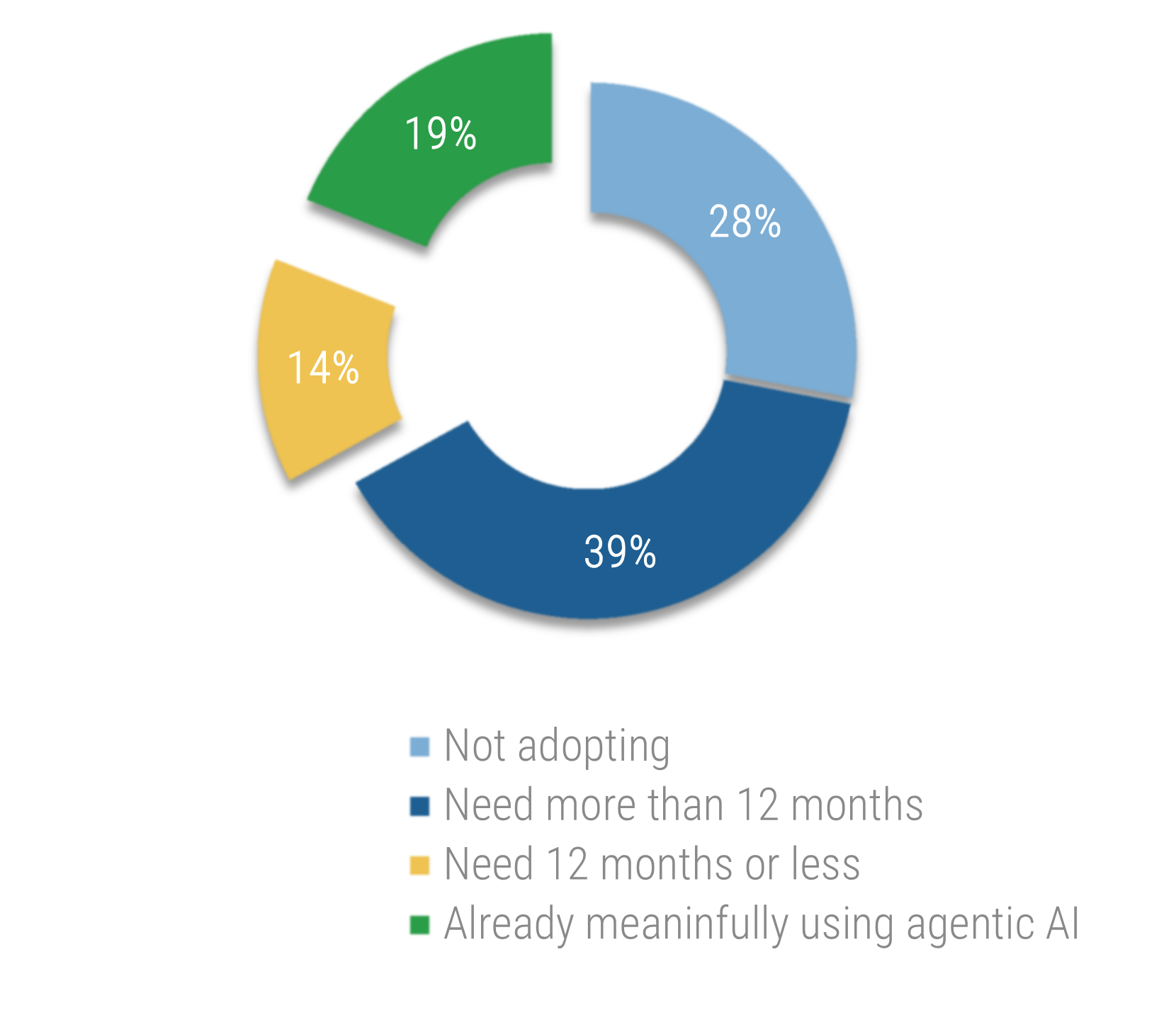
Source: Lenovo, "CIO Playbook 2026 The Race for Enterprise AI", Lenovo, 2026
How AI is transforming retail
Retailer survey respondents said they are focusing their AI efforts to:
42% Improve Customer Experience
42% Enhance Decision-Making
39% Automate Business Processes
39% Increase Data Quality
Source: KPMG, 2025
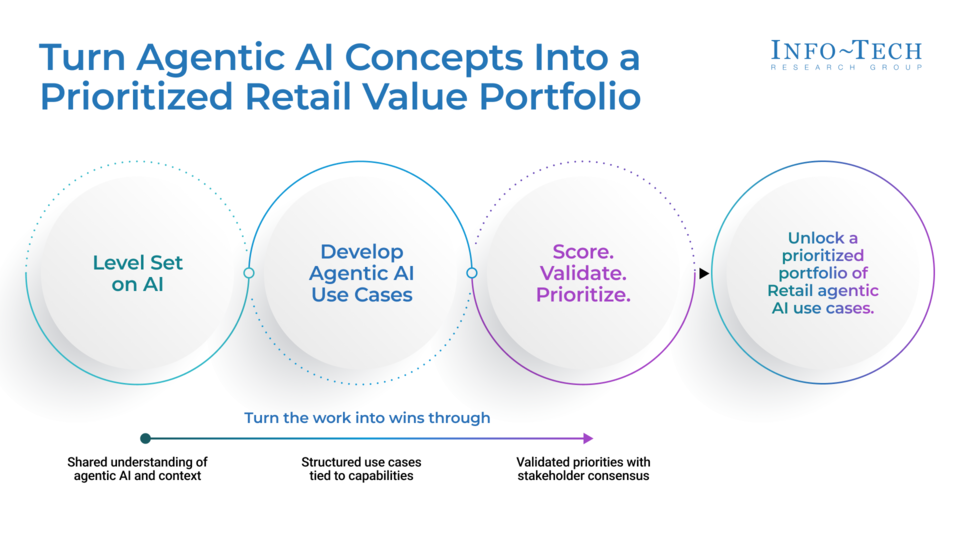
Turn agentic AI concepts into a prioritized retail value portfolio
KEY INSIGHT
Retailers unlock agentic AI by first innovating in ready-made domains, where workflows, logic, and ownership are already in place.
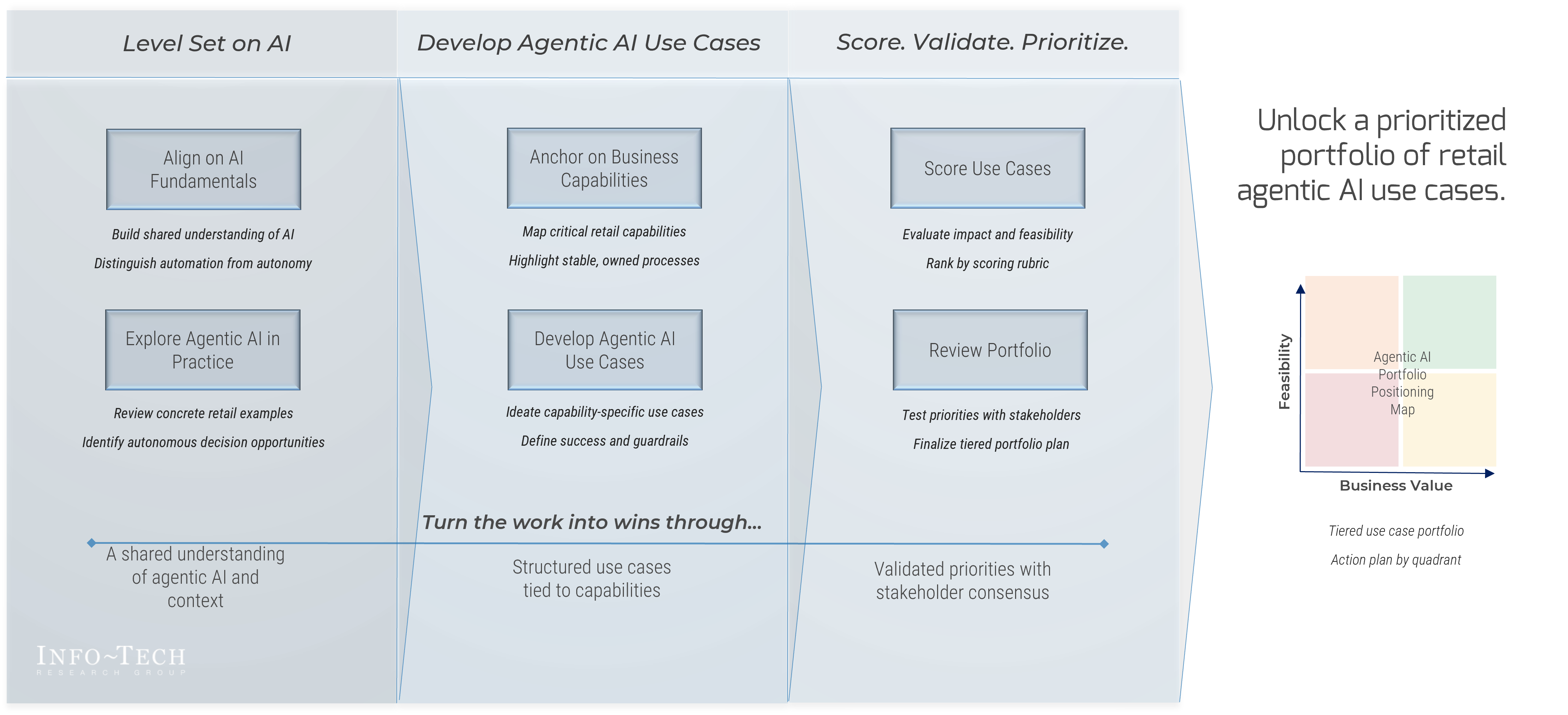
Info-Tech’s methodology for assessing and prioritizing agentic AI use cases in Retail
1. Ground & Explore |
2. Frame Opportunities |
3. Score & Validate |
|
|---|---|---|---|
Phase Steps |
1.1 Establish agentic AI capability patterns. |
2.1 Anchor AI capability to business context. |
3.1 Score use cases for prioritization |
Phase Outcomes |
A shared understanding of agentic AI concepts and capability patterns and how they connect to the business context |
A structured set of business-aligned agentic AI use cases, anchored to clear capabilities, domains, and value areas |
A prioritized and validated use case portfolio with consensus on the highest-value opportunities to pursue. |
Insight summary
Agentic AI Success Depends on Strategic Sequencing
Strategic discipline beats technical sophistication: Map use cases, assign ownership, and sequence risk – otherwise agents stall in pilots and never scale.
Match Roles to Value
Context drives the right agent design. A framework that classifies AI agents by the role they play helps CIOs balance value, risk, and organizational readiness across the enterprise, turning fragmented pilot ideas into a strategic, sequenced deployment roadmap.
Reality Tests Big Ideas
The best idea you can't execute is worthless. CIOs must score every agent on business impact, risk exposure, and feasibility to separate viable use cases from wishful thinking.
Win Small to Win Big
Trust emerges through deliberate sequencing. Start with low-risk, measurable agents to build confidence. Use early wins to fund complex agents and avoid use cases that threaten enterprise credibility.
Prioritize Use Cases for Fast Wins
Prioritize AI use cases that focus on agents operating within closed-loop workflows, where value can be proven quickly, risk is low, and cross-functional friction is minimal.
Gate Use Cases With Readiness
Prevent wasted effort by validating each use case against readiness criteria before it earns a place in the portfolio.
Research deliverable
Each step of this research is accompanied by supporting deliverables to help you accomplish your goals:
Agentic AI Use Case Tool for Retail
Provides the structure to identify and list agentic AI use cases, score each one across business value and feasibility, and build a prioritized portfolio, enabling teams to confidently select the highest-impact opportunities ready to move into the Build Your Agentic AI Prototype phase.
About Info-Tech
Info-Tech Research Group is the world’s fastest-growing information technology research and advisory company, proudly serving over 30,000 IT professionals.
We produce unbiased and highly relevant research to help CIOs and IT leaders make strategic, timely, and well-informed decisions. We partner closely with IT teams to provide everything they need, from actionable tools to analyst guidance, ensuring they deliver measurable results for their organizations.
What Is a Blueprint?
A blueprint is designed to be a roadmap, containing a methodology and the tools and templates you need to solve your IT problems.
Each blueprint can be accompanied by a Guided Implementation that provides you access to our world-class analysts to help you get through the project.
Need Extra Help?
Speak With An Analyst
Get the help you need in this 3-phase advisory process. You'll receive multiple touchpoints with our researchers, all included in your membership.
Guided Implementation 1: Ground & Explore
- Call 1: Scope requirements, objectives, and your specific challenges.
- Call 2: Align on fundamental agentic AI concepts.
- Call 3: Explore agentic AI in practice.
Guided Implementation 2: Frame Opportunities
- Call 1: Anchor AI capability to business context.
- Call 2: Develop agentic AI use cases.
Guided Implementation 3: Score & Validate
- Call 1: Score use cases for prioritization.
- Call 2: Review use case portfolio.
Contributors
- Three anonymous contributors
