
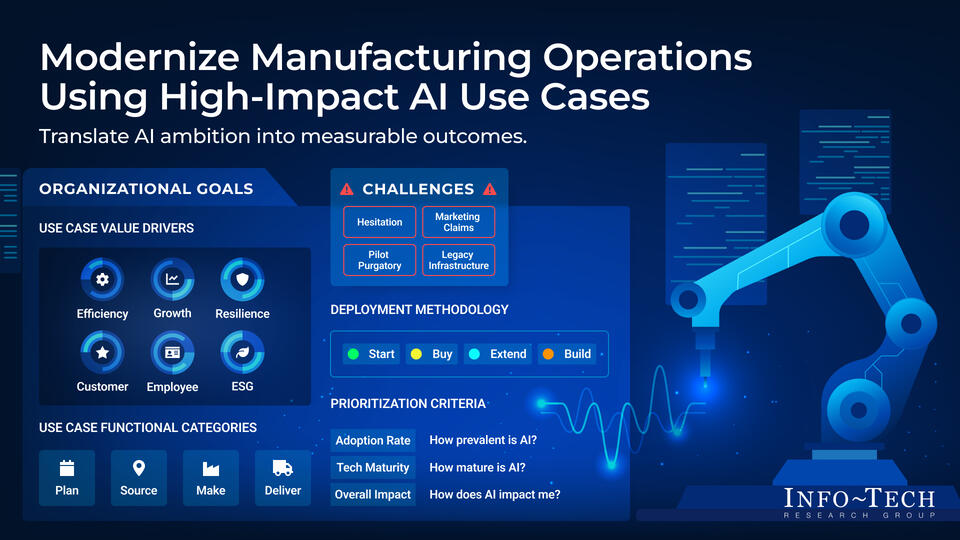
Modernize Manufacturing Operations Using High-Impact AI Use Cases
Translate AI ambition into measurable outcomes.
- Executives oscillate between urgency to act and hesitation to commit; paralyzed by uncertainty about where AI will deliver meaningful advantage first.
- Organizations recognize potential but lack a practical framework to move from ideas and pilots to enterprise-scale AI roadmaps.
- Leaders face a crowded vendor landscape with overlapping promises, making it difficult to distinguish real value from marketing noise.
- Most manufacturers still lack real-time intelligence across their operations and consistently underutilize data captured from machines, systems, and sensors.
Our Advice
Critical Insight
Align AI with core value drivers, integrate it into real-time operations, and govern it responsibly to outpace the competition.
Impact and Result
- Anchor AI investment in business capability and value driver alignment. Start from what the business needs to be better at, not what the technology can do.
- Treat AI as an operational capability, not a lab experiment. Standardize strategy with clear success metrics, integration criteria, and scale-up pathways.
- Institutionalize responsible and resilient AI governance. Ensure AI decisions remain auditable, explainable, and compliant.
- Prioritize use cases that combine quick wins with strategic foundations. Invest in use cases that generate immediate operational results and build capabilities for future scaling.
Member Testimonials
After each Info-Tech experience, we ask our members to quantify the real-time savings, monetary impact, and project improvements our research helped them achieve. See our top member experiences for this blueprint and what our clients have to say.
10.0/10
Overall Impact
10
Average Days Saved
Client
Experience
Impact
$ Saved
Days Saved
CELL THERAPY CATAPULT LIMITED
Guided Implementation
10/10
N/A
10
Expediency of short-notice to set up call for an engagement that met my tight deadline Clear and knowledgeable information and artefacts that direc... Read More
Modernize Manufacturing Operations Using High-Impact AI Use Cases
Translate AI ambition into measurable outcomes.
Analyst perspective
Translate AI ambition into measurable outcomes
After years of automation and lean optimization, many factories have reached the limits of incremental improvement. AI now promises a step-change: the ability to see, decide, and act across production networks with speed and precision previously unimaginable. Yet the path from promise to performance is far from straightforward.
Despite soaring investment, most manufacturers still struggle to translate AI pilots into enterprise-scale gains. The reasons are familiar: fragmented data architectures, siloed decision-making, and an abundance of experimentation without clear business alignment. The result is a widening gap between technological capability and operational impact. CIOs are now being asked not only to implement AI, but to prove its value, determining where it genuinely drives efficiency, resilience, and innovation, and where it merely adds complexity.
The next phase of AI in manufacturing will be defined by focus and execution. Predictive maintenance, computer-vision-based quality control, and intelligent forecasting have already demonstrated measurable returns. The frontier now lies in integrating these proven tools with emerging ones; such as generative copilots for planning, multimodal analytics for process optimization, and agentic AI for autonomous operations. When combined under a coherent data and governance model, these systems can anticipate disruptions, adapt production schedules in real time, and continuously improve throughput and quality.
What separates the leaders from the laggards is not access to technology, but the discipline to deploy it where it matters most. Many manufacturers are already transforming AI from an innovation experiment into a core operational capability: a self-learning, adaptive intelligence embedded in every process, every machine, and every decision. AI is no longer a research initiative; it is the new operating system of industrial performance.

Shreyas Shukla
Principal Research Director, Industry
Info-Tech Research Group
Executive summary
Your Challenge
Executives oscillate between urgency to act and hesitation to commit, paralyzed by uncertainty about where AI will deliver meaningful advantage first.
Organizations recognize potential but lack a practical framework to move from ideas and pilots to enterprise-scale AI roadmaps.
Leaders face a crowded vendor landscape with overlapping promises, making it difficult to distinguish real value from marketing noise.
Most manufacturers still lack real-time intelligence across their operations and consistently underuse data captured from machines, systems, and sensors.
Common Obstacles
Cultural resistance slows progress. Operations teams distrust "black box" models, while IT struggles to align pilots with business goals.
Disconnected experiments are deployed without standard data pipelines, governance frameworks, or clear ROI targets, leaving AI investments trapped at the proof-of-concept stage.
Operating environments continue to be disrupted. Manufacturers continue to struggle with shifting trade policies, supply chain sanctions, and vendor risk concerns, which increase uncertainty.
Talent shortage and legacy systems continue to limit organizations' ability to pivot quickly.
Info-Tech's Approach
Anchor AI investment in business capability and value driver alignment. Start from what the business needs to be better at, not what the technology can do.
Treat AI as an operational capability, not a lab experiment. Standardize strategy with clear success metrics, integration criteria, and scale-up pathways.
Institutionalize responsible and resilient AI governance. Ensure AI decisions remain auditable, explainable, and compliant.
Prioritize use cases that combine quick wins with strategic foundations. Invest in use cases that generate immediate operational results and build capabilities for future scaling.
Info-Tech Insight
Align AI with core value drivers, integrate it into real-time operations, and govern it responsibly to outpace the competition.
Your Challenge
Executives oscillate between urgency to act and hesitation to commit.
Manufacturing executives understand that AI has become essential to competitiveness but remain caught between strategic ambition and execution paralysis. On one hand, boardroom pressure and industry benchmarks demand visible AI progress; on the other, unclear business cases and fragmented pilot results breed caution. This tension leads to reactive, fragmented decisions. Without clarity on where AI drives tangible advantage first, leaders hesitate to scale, fearing missteps that could waste capital or disrupt stable operations.
Organizations recognize potential but lack a practical framework to move from ideas and pilots to enterprise-scale AI roadmaps.
Across the sector, manufacturers have no shortage of ideas or proofs of concept demonstrating AI's promise, but few succeed in institutionalizing them. The gap lies in the absence of a repeatable framework that connects business priorities, technical enablers, and measurable outcomes. Too often, AI initiatives remain confined to innovation teams or data labs, disconnected from the daily realities of production, logistics, or supply chain operations. As a result, pilots prove feasibility but fail to achieve scalability, governance, or integration.
Leaders face a crowded vendor landscape with overlapping promises, making it difficult to distinguish real value from marketing noise.
AI for manufacturing has become a saturated market filled with vendors touting overlapping capabilities and inconsistent claims. From predictive analytics to autonomous production suites, the proliferation of platforms leaves decision-makers struggling to identify credible partners and sustainable technologies. This confusion results in slow decision-making, vendor fatigue, and a growing skepticism that undermines genuine innovation.
Most manufacturers still lack real-time intelligence across their operations and consistently underuse data.
Despite years of investment, many plants remain data-rich but insight-poor. Critical information remains siloed, delayed, or poorly contextualized. The result is a persistent reliance on manual reporting and backward-looking KPIs that hinder proactive decision-making.
Manufacturers risk being outpaced by those who can adapt faster and operate smarter by deploying AI.
Common Obstacles
Cultural resistance slows progress.
AI adoption in manufacturing often collides with deep-rooted cultural and organizational barriers. On the shop floor, operations leaders are reluctant to trust opaque algorithms that offer recommendations without transparent reasoning. Meanwhile, IT departments pursue technology pilots driven by architecture or data ambitions rather than tangible business outcomes, creating a disconnect between innovation and value realization.
Disconnected experiments are deployed.
The majority of AI initiatives in manufacturing remain stuck in the perpetual pilot phase due to weak foundations. Projects are launched in silos, each with different data sources, tools, and success metrics, making it impossible to replicate or scale results. What begins as innovation quickly becomes inefficiency, as disconnected efforts drain budgets and erode confidence in AI's long-term value.
Operating environments continue to be disrupted.
Geopolitical volatility and fluctuating trade regulations have become defining forces in global manufacturing. Export controls, regional sanctions, and trade realignments constantly reshape supplier ecosystems and cost structures, undermining the stability required for long-term AI investment. These disruptions not only strain procurement and logistics but also affect the continuity of AI partnerships, data flows, and cloud deployments.
Talent shortages and legacy systems continue to limit organizations' ability to pivot quickly.
The promise of AI collides with a persistent shortage of skilled professionals who can translate data science into industrial performance. Most manufacturers still depend on legacy systems that resist integration with modern analytics or automation tools. The result is a widening gap between aspiration and execution, where technological ambition far outpaces organizational readiness.
Manufacturers cannot scale AI until they confront the human, structural, and systemic inertia that keeps innovation fragmented, trust low, and readiness lagging behind ambition.
Info-Tech's Approach
Anchor AI investment in business capability and value driver alignment.
Every AI initiative should be mapped to a core business capability and directly linked to a measurable value. This ensures AI becomes a means to enhance organizational strength, not a collection of disconnected projects so that leaders can prioritize where AI will create tangible, repeatable impact instead of scattering resources across opportunistic or redundant pilots.
Treat AI as an operational capability, not a lab experiment.
Pilots should no longer exist in isolation; they must feed into a common model library, data foundation, and deployment process. AI becomes part of "how we operate," embedded into workflows, dashboards, and decision cycles rather than confined to innovation centers. When standardized in this way, AI consistently delivers results that can be scaled, audited, and improved.
Institutionalize responsible and resilient AI governance.
Institutional governance ensures that models are explainable, data is traceable, and outcomes comply with both internal controls and external regulations. Manufacturers should create clear ownership for model lifecycle management, and governance should also extend to resilience planning, addressing geopolitical and supply chain risks that could disrupt cloud services or data partnerships.
Prioritize use cases that combine quick wins with strategic foundations.
Quick wins, such as predictive maintenance, defect detection, or spend analytics, build confidence and generate measurable ROI, while foundational investments create the infrastructure for long-term differentiation. Each chosen use case should serve dual purposes: immediate operational improvement and contribution to a broader capability evolution. This dual-focus approach prevents innovation fatigue, aligns stakeholders around shared results, and establishes the continuous momentum necessary for AI to evolve from incremental efficiency to enterprise transformation.
AI will not transform manufacturing through experimentation; it will transform it when every investment strengthens a core business capability, delivers measurable impact, and endures under governance and scale.
Info-Tech's methodology for adopting AI for manufacturing workflows
| 1. Discover Objectives | 2. Frame Priorities | 3. Explore & Evaluate | 4. Plan Next Steps | |
| Phase Steps |
|
|
|
|
| Phase Outcomes | Gain a holistic view of how value is created across your organization. Understand how your organization creates value across the Plan, Source, Make, and Deliver functions. Uncover where performance, data, or process gaps limit business outcomes, and obtain a fact-based starting point for targeting high-impact AI opportunities. |
Identify and align on the dominant value driver that will anchor subsequent discussions. Build stakeholder consensus on the single most influential driver to ensure future AI exploration remains focused, relevant, and tied to organizational strategy. |
Invest in use cases that are both feasible and strategically meaningful. Assess use-case fit based on adoption rate, technology maturity, and impact. Filter out low-value or speculative ideas to ensure all shortlisted use cases are grounded in your industry context and practical to pursue. |
Ensure that your AI roadmap delivers measurable value and early wins. Validated high-potential use cases and identify requisite enablers. Create a focused and actionable AI roadmap, ready for detailed evaluation and phased implementation. |
Manufacturers are grappling with uncertainties once again...
| Top focus areas | |
|---|---|
| Business | IT |
| Reshoring | Unified Data |
| Cost Containment | Cybersecurity |
| Talent | Vendor Lock-in Avoidance |
"71% of US CEOs plan to alter their supply chains in the next 3-5 years..."
Source: The Conference Board, 2025.
And challenges related to AI adoption have them worried...
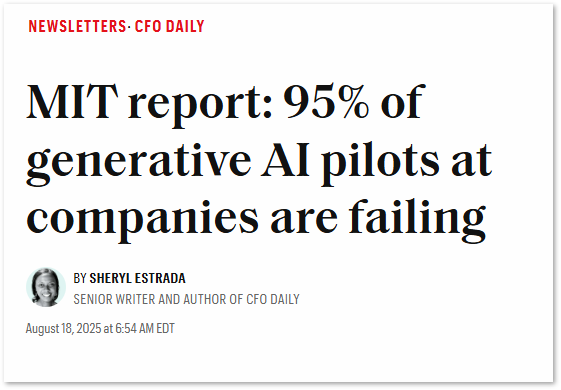
Source: "MIT report...", Fortune Magazine, 2025
Tools like ChatGPT and Copilot are widely adopted.
"ChatGPT sees renewed attention... references to ChatGPT rose 81% QoQ to 3% of calls...."
Source: "What CEOs talked about...", IoT Analytics, 2025
Enterprise-grade systems, both custom and vendor-made, are being quietly rejected.
"...while 60% of organizations evaluate [such AI systems], only 20% reached pilot stage and just 5% made it into production."
Source: "Crossing the AI Divide...", Stratevolve, n.d.
This failure is due to brittle workflows, lack of contextual learning, and misalignment with day-to-day operations.
"...fundamental issues around leadership resistance, workforce readiness, security concerns, and cultural factors will prevent many businesses from ever implementing AI solutions effectively. "
Source: "7 Reasons Why...", Pure IT, n.d.
The real story isn't that AI is failing.
It's that bad pilots are failing.
However, AI use continues to climb...
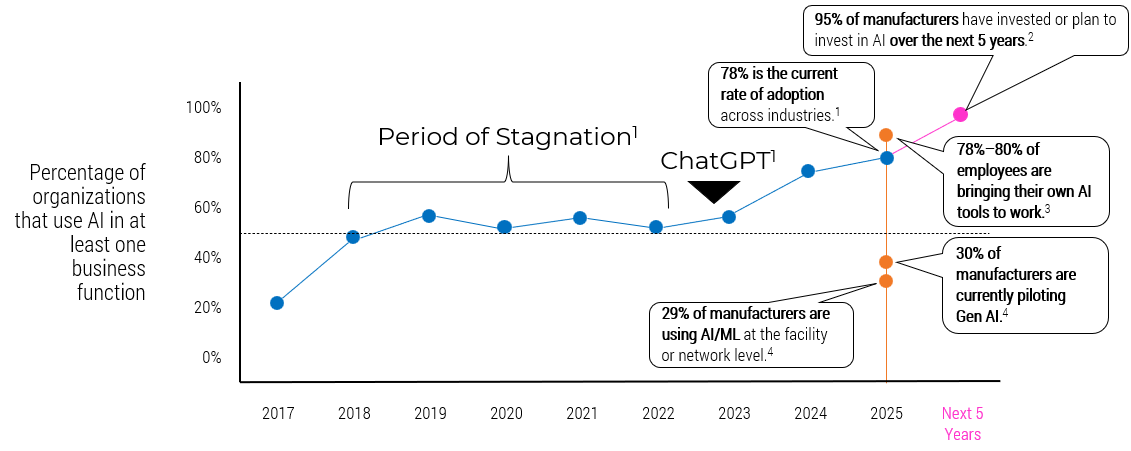
While the manufacturing industry is still establishing AI foundations for smart operations...
Source(s):
1 - "The State of AI...", McKinsey & Co., 2025
2 - "10th Annual State of...", Rockwell Automation, 2025
3 - "AI at Work Is Here...", Microsoft, 2024
4 - "2025 Smart manufacturing...", Deloitte, 2025
5 - "Industrial AI market...", IOT Analytics, 2025
About Info-Tech
Info-Tech Research Group is the world’s fastest-growing information technology research and advisory company, proudly serving over 30,000 IT professionals.
We produce unbiased and highly relevant research to help CIOs and IT leaders make strategic, timely, and well-informed decisions. We partner closely with IT teams to provide everything they need, from actionable tools to analyst guidance, ensuring they deliver measurable results for their organizations.
What Is a Blueprint?
A blueprint is designed to be a roadmap, containing a methodology and the tools and templates you need to solve your IT problems.
Each blueprint can be accompanied by a Guided Implementation that provides you access to our world-class analysts to help you get through the project.
Need Extra Help?
Speak With An Analyst
Get the help you need in this 4-phase advisory process. You'll receive multiple touchpoints with our researchers, all included in your membership.
Guided Implementation 1: Gain a holistic view of how value is created across your organization
- Call 1: Understand Info-Tech’s value drivers for use cases.
- Call 2: Discuss and assign weights to value drivers based on current & desired objectives.
Guided Implementation 2: Align on the dominant value driver
- Call 1: Identify your top organizational goals.
- Call 2: Map goals to value drivers and identify dominant value driver for AI investment.
Guided Implementation 3: Identify strategically meaningful use cases
- Call 1: Understand use case dimensions and prioritize dimensions that match your goals.
Guided Implementation 4: Ensure that your AI roadmap delivers measurable value
- Call 1: Review relevant use cases across functional verticals.
- Call 2: Discuss next steps.
Contributors
- Eswara P – Solutions Architect, Global Systems Implementation Firm
- Nick M – Lead Product Owner, Global MES Software Vendor
- Kshitij G – AI Business Solution Lead, Global Software Firm
- Katie Erickson – Marketing Director, Boutique SI
- Christiana Tse – Independent Expert, Market Research Firm
- Ram N – Chief Digital Officer, Canadian Manufacturing Solutions Company
- Naga Sravani S – AI Product Manager, Global Food Manufacturer
- Kishore Kumar S – Solutions Architect, Global Auto OEM
- 4 Anonymous contributors
