
Build a Public Sector Shared Services Organization
A five-phase roadmap to improve service quality, reduce duplication, and modernize public sector operations.
- Despite repeated calls for government reform, many agencies continue to operate siloed back-office operations, leading to inefficiencies, inconsistent service quality, fragmented data systems, and budget overruns.
- The lack of integrated services and governance standards hampers both operational effectiveness and strategic agility.
Our Advice
Critical Insight
- Agencies fail to realize shared services benefits without clearly defined governance, service scope, stakeholder alignment, and performance metrics.
- Our phased approach breaks complexity into manageable steps, helping agencies build trust, establish accountability, and align shared services with strategic goals.
Impact and Result
Agencies using this blueprint will:
- Reduce administrative duplication and cost
- Improve service consistency and quality
- Increase digital maturity and scalability
- Build a performance-driven shared services organization aligned with public accountability
Build a Public Sector Shared Services Organization
A five-phase roadmap to improve service quality, reduce duplication, and modernize public sector operations.
Analyst Perspective
Shared services transform government through integration and efficiency
Public sector agencies face growing pressure to modernize services, reduce costs, and meet rising constituent expectations. Traditional siloed structures — marked by duplicated functions and fragmented systems — are no longer sustainable. In this context, shared services organizations offer more than efficiency gains; they serve as platforms for government transformation.
By centralizing common functions such as IT, human resources (HR), and procurement, shared services reduce duplication, improve service quality, and foster cross-agency collaboration. This guide introduces a four pillar framework that provides a structured approach for building a high-performing shared services organization (SSO). The four pillars — people, process, technology, and governance — must work in tandem from the outset to ensure sustainable impact.
Public shared services organizations, unlike their private counterparts, must operate within a complex environment of statutory mandates, union agreements, budget cycles, and federated governance. This guide addresses these realities directly, offering readiness assessments, implementation templates, governance models, and staffing benchmarks that are tailored to government.
Success requires more than structural change. It requires cultural alignment, process harmonization, platform enablement, and shared accountability. Whether an agency is initiating its shared services journey or optimizing an existing model, this guide functions as both a strategic compass and an operational playbook.
Ultimately, a shared services approach represents a chance to reimagine government service delivery as integrated, efficient, and constituent-focused. The tools and frameworks provided here will help public sector leaders navigate complexity, secure buy-in, and build a future-ready shared services organization.
Neal Rosenblatt
Principal Research Director, Industry Practice
Info-Tech Research Group
Build a Public Sector Shared Services Organization
A five-phase roadmap to improve service quality, reduce duplication, and modernize public sector operations.
EXECUTIVE BRIEF
Executive Summary
Your Challenge
Public sector agencies face structural and cultural challenges that complicate their shift to shared services.
- Fragmented Operations: Despite repeated reform efforts, many agencies maintain siloed operations.
- Change Resistance: Cultural and institutional resistance undermines transformation efforts.
- Cross-Jurisdictional Complexity: Governments operate in multi-layered environments with diverse needs.
These challenges highlight the need for deliberate planning and stakeholder alignment to succeed.
Common Obstacles
Significant barriers remain and must be addressed before shared services can deliver their full value.
- Governance Deficiencies: Ineffective governance derails many shared services initiatives.
- Capability Gaps: Not all organizations are prepared to transition to shared services, especially those without business reference architecture maturity.
- Funding and Cost Models: Budgeting and financial management structures can be misaligned.
Overcoming these obstacles requires proactive coordination, resource planning, and risk mitigation strategies.
Info-Tech’s Approach
A structured and phased approach, centered on people, processes, technology, and governance, is key to implementing effective shared services.
- Assess: Assess readiness and rationale.
- Design: Design the operating model.
- Build: Build the platform.
- Scale: Pilot and scale.
- Optimize: Institutionalize and optimize.
This approach ensures that shared services are built not only for efficiency, but also for adaptability, collaboration, and long-term value.
Info-Tech Insight
Shared services are not merely a tool for cost containment — they are a platform for transformation. When implemented with a thoughtful balance of governance, stakeholder inclusion, and technical modernization, a public sector shared services organization can shift government operations from fragmented service providers to high-performing centers of excellence.
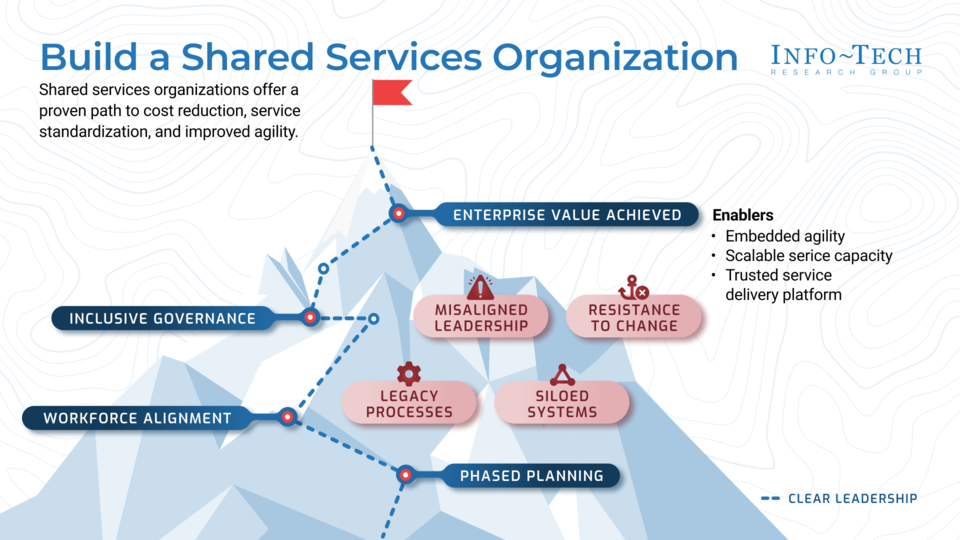
From Barriers to Breakthroughs
Overcome strategic barriers and accelerate enablers to build a shared services organization.
Shared services organizations offer a proven path to:- Cost reduction
- Service standardization
- Improved agility
But getting there requires more than structural change. It demands:
- Clear leadership
- Phased planning
- Inclusive governance
- Workforce alignment
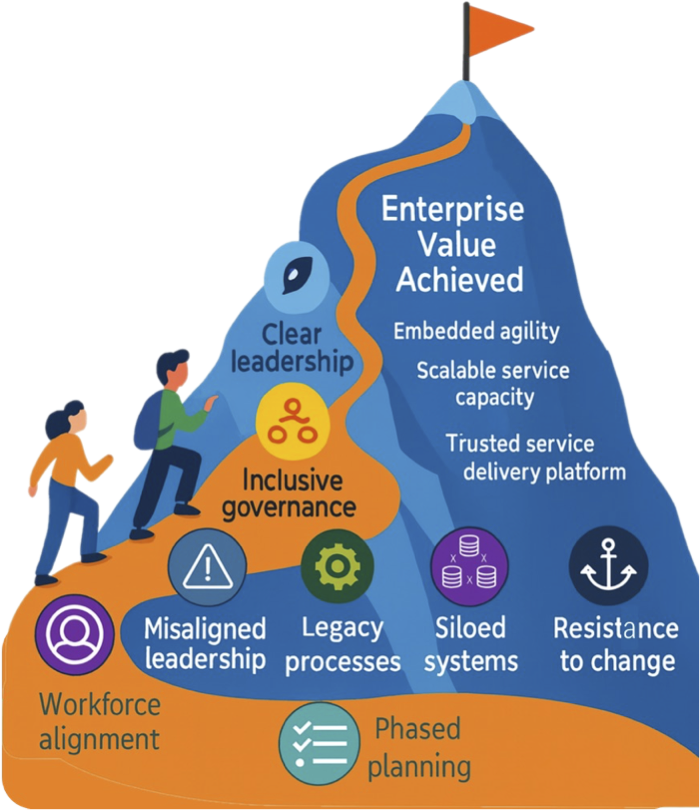
This guide offers a practical roadmap for CIOs, CTOs, CDOs, CISOs, chief enterprise architects, and directors of shared services, HR, IT, and finance.
You’ll learn to:
- Overcome structural challenges.
- Remove institutional obstacles.
- Implement integrated shared services.
You’ll do this through the lens of the four pillars – people, process, technology, and governance.
Your Challenge
Overcome structural complexity, cultural resistance, and jurisdictional fragmentation.
- Fragmented operations lead to inefficiency. Many government agencies continue to operate independently, often replicating the same administrative and IT functions in parallel. This results in duplicated services, fragmented data systems, and inconsistent performance metrics. Without integration, these inefficiencies accumulate into higher costs and diminished service quality.
- Cultural resistance slows transformation. Even when the benefits of shared services are clear, resistance from within agencies can halt progress. Employees and leaders may fear the loss of autonomy, control over their resources, or even their roles. This resistance can manifest as reluctance to share data, delays in participation, or withdrawal from cross-agency initiatives altogether.
- Cross-jurisdictional complexity complicates alignment. The shared services model must accommodate vastly different operational, legal, and policy environments across jurisdictions. A model that works at the federal level may be ill-suited for municipal operations, while state agencies must often straddle the demands of both. Aligning stakeholders and processes across these tiers is a delicate balancing act.
Common Obstacles
Systemic barriers undermine shared services momentum.
- Weak governance undermines accountability. Without a clearly defined governance model, shared services initiatives can become mired in confusion. Roles and responsibilities may be ambiguous, leading to poor decision-making and service misalignment. The lack of standardized service levels and performance metrics further limits transparency and erodes trust among stakeholders.
- Uneven capability maturity inhibits scalability. Agencies vary widely in terms of digital maturity, technical infrastructure, and process discipline. This disparity makes it difficult to adopt a one-size-fits-all shared service model. Some departments may lack the foundational capabilities, such as reliable data systems or trained personnel, required to participate effectively.
- Financial uncertainty and cost allocation can create conflicts: Cost-sharing mechanisms are often a flashpoint in shared services planning. Agencies may resist funding shared services without guarantees of proportional benefit. Start-up costs, unclear return on investment (ROI) timelines, and the absence of equitable chargeback models contribute to skepticism and inaction, especially among resource-constrained agencies.
Info-Tech’s Approach
Build a purpose-driven, scalable shared services model.
Info-Tech’s approach equips IT leaders with a practical, phased roadmap aligned to four pillars — people, process, technology, and governance — to simplify complexity. This approach offers a repeatable model for sustainable shared services across all levels of government.
- Assess: Gauge readiness, infrastructure, and stakeholder support to inform a data-driven go/no-go decision.
- Design: Establish scope, governance, and standardized processes to create a clear, actionable operating model.
- Build: Launch core platforms, onboard staff, and initiate services to operationalize the shared services framework.
- Scale: Expand participation and services, enhancing performance through automation and analytics.
- Optimize: Institutionalize improvements, align with digital goals, and evolve the shared services organization into a driver of public value.
Download Info-Tech’s Shared Services Workbook & Planning Guide.
From Silos to Service: Build a shared services platform for government transformation
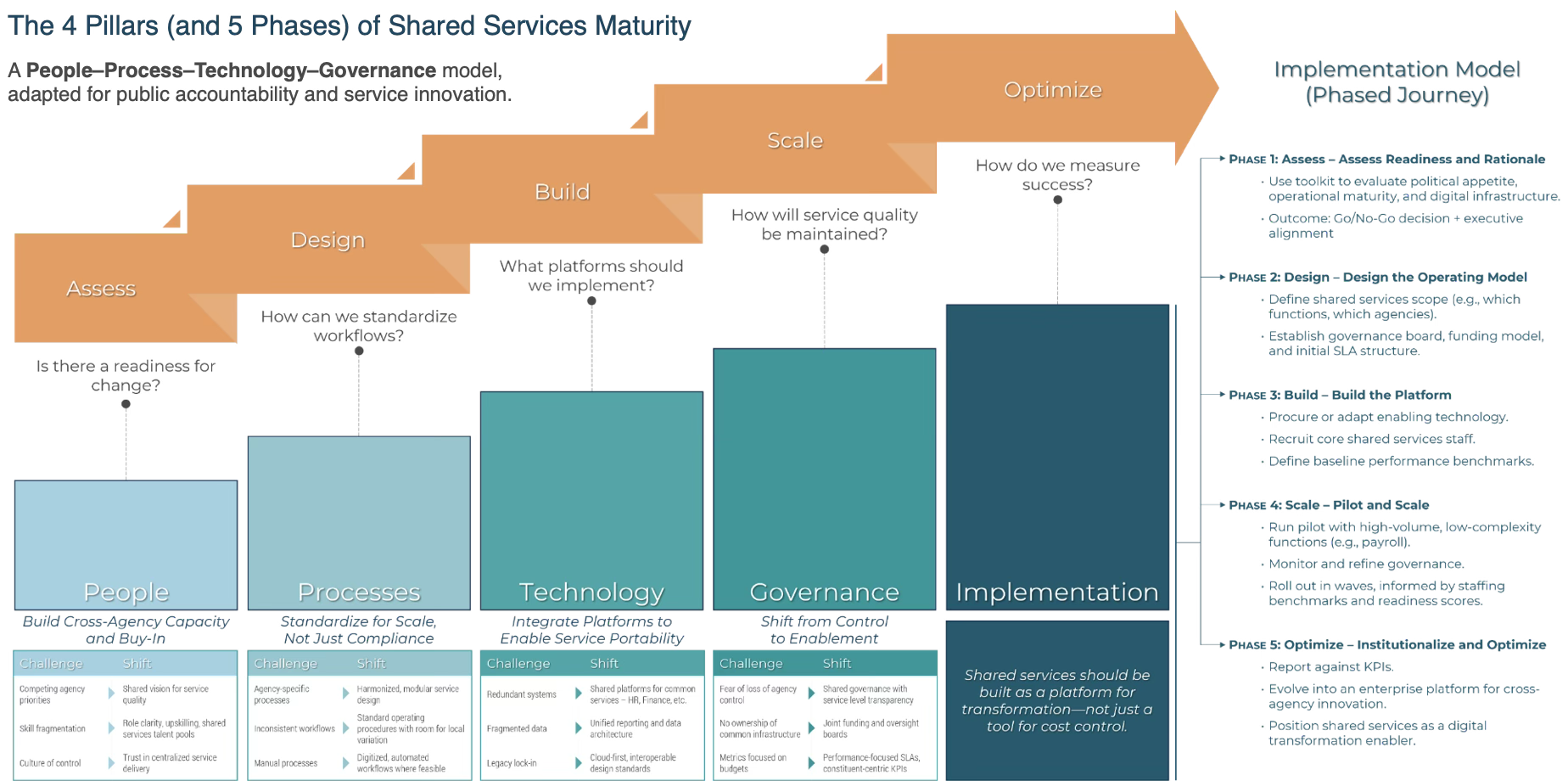
Unifying Framework: The Four Pillars of Public Sector Shared Services Maturity
These pillars frame what must fundamentally change across government for shared services to work, not just as a cost efficiency measure but as an engine for transformation.
Pillar | Strategic Focus | Shift Required |
People | Build cross-agency capacity and buy-in. | From competing priorities ➝ to a shared vision From fragmented skills ➝ to shared talent pools From control culture ➝ to trust in delivery |
Process | Standardize for scale, not just compliance. | From custom-built workflows ➝ to modular service design From inconsistency ➝ to standard operating procedures (SOPs) with flexibility From manual ➝ to digital, automated processes |
Technology | Enable service portability through integrated platforms. | From redundant systems ➝ to shared platforms From fragmented data ➝ to unified architecture From legacy lock-in ➝ to cloud-first interoperability |
Goverance | Shift from control to enablement. | From agency fear ➝ to shared governance and transparency From no ownership ➝ to joint funding and oversight From budget metrics ➝ to outcome KPIs |
Implementation Model: The Five Phases of Building a Public Sector Shared Services Organization
Each phase intersects with the four pillars, suggesting a matrixed transformation approach that is simultaneously vertical (pillar deepening) and horizontal (phase progression).
Phase 1 | Focus Area | Key Activities | Outcomes |
Assess | Readiness and Rationale | Use tools to assess culture for change, digital maturity, ops capacity, and stakeholder alignment. | Go/no-go decision and executive alignment |
Design | Operating Model and Governance | Define functional scope, select agencies, set up governance board, and develop funding model and service level agreements (SLAs). | Shared services blueprint with governance and accountability structures |
Build | Platform and Team | Procure/adapt core platforms (e.g. HRMS, ERP), staff shared services, and establish baselines. | Minimum viable shared services operating model |
Scale | Piloting and Expansion | Pilot high-volume/low-complexity services (e.g. payroll), refine model, and expand services using benchmarks. | Cross-agency rollout with confidence and learning built into the scaling effort |
Optimize | Institutionalization and Innovation | Report key performance indicators (KPIs), embed continuous improvement and strategic workforce planning, and align with digital transformation goals. | Mature enterprise-wide shared services organization, driving value and innovation |
Info-Tech’s Roadmap for Building a Public Sector Shared Services Organization
Phase Steps | 1. Assess1.1 Assess shared services readiness. 1.2 Complete shared services heat map assessment. 1.3 Complete business reference architecture diagnostic. | 2. Design2.1 Define shared services functional scope. 2.2 Identify and engage participating agencies. 2.3 Establish shared services governance structure. 2.4 Develop funding and cost allocation model. 2.5 Draft SLAs and service performance agreements. | 3. Build3.1 Select and procure shared services platforms. 3.2 Define and assemble shared services team. 3.3 Configure and launch enabling tools. 3.4 Establish service management workflows. 3.5 Set operational baselines and success metrics. | 4. Scale4.1 Launch pilot for shared services. 4.2 Monitor service performance and user feedback. 4.3 Refine operating model and service workflows. 4.4 Expand to additional services and agencies. 4.5 Institutionalize reporting, reviews, and benchmark comparisons. | 5. Optimize5.1 Operationalize KPI reporting and strategic dashboards. 5.2 Embed continuous improvement into governance. 5.3 Institutionalize strategic workforce planning. 5.4 Align shared services to digital transformation goals. 5.5 Sustain value realization and innovation pipeline. |
Phase Outcomes | Go/no-go decision grounded in data, leadership alignment, and capability analysis | Fully articulated operating model with clear roles, services, and performance expectations | Operational shared services organization with the essential tools, personnel, and service workflows in place | Proven model scaled across agencies, with increasing efficiency, trust, and service value | Mature, integrated shared services organization delivering continuous public value |
Blueprint Deliverables
Each step of this blueprint is supported by Info-Tech’s Shared Services Workbook & Planning Guide to help you accomplish your goals.
Shared Services Workbook & Planning Guide
The Shared Services Workbook & Planning Guide is designed for IT decision-makers, across all levels of government, who are exploring, launching, or optimizing a shared services organization. This guide serves as both a strategic compass and a tactical playbook. It offers tools, insights, benchmarks, and real-world examples needed to build and sustain an effective public sector shared services model and maintain service excellence for public sector stakeholders.
Insight Summary
Overarching Insight
Shared services are not merely a tool for cost containment — they are a platform for transformation. When implemented with a thoughtful balance of governance, stakeholder inclusion, and technical modernization, public sector shared services organizations can shift government operations from fragmented service providers to high-performing centers of excellence.
Phase 1 Insight
Diagnostic tools are essential to surface readiness gaps, capability maturity, and agency alignment before moving forward.
Phase 2 Insight
Designing the operating model upfront — including governance, scope, and SLAs — sets the foundation for scalable and trusted services.
Phase 3 Insight
A shared services organization becomes real when platforms, staff, and workflows are deployed in alignment with defined SLAs and KPIs.
Phase 4 Insight
Pilots validate the model. Measured outcomes and iterative refinement accelerate agency participation and trust.
Phase 5 Insight
Optimization is not the end — it’s the beginning of sustained value and innovation.
Tactical Insight
Without structured governance, shared services risk fragmentation instead of consolidation.
Tactical Insight
Use heat maps and readiness tools to prioritize functions that offer the quickest wins and cross-agency momentum.
Blueprint Benefits
Empower IT leaders to modernize infrastructure and governance while helping government organizations improve service quality, reduce costs, and scale innovation.
IT Benefits
- Standardized IT Service Delivery: Drives consistency and reduces duplication across agencies
- Improved Cybersecurity Posture: Leverages centralized governance and zero trust architecture
- Interoperable Platforms: Enables data sharing and integration across departments
- Data-Driven Operations: Enables real-time decisions using built-in analytics and performance dashboards
- Future-Ready IT Architecture: Incorporates cloud-native, scalable, and modular platforms
- Governance Tools for IT Leaders: Includes decision matrices, templates, and phased roadmaps
Business Benefits
- Operational Efficiency Gains: Consolidates redundant services and streamlines operations
- Cost Savings and ROI: Achieves economies of scale and better resource allocation
- Enhanced Service Quality: Improves responsiveness, reliability, and transparency
- Improved Accountability: Enforces SLAs, KPIs, and performance tracking for better oversight
- Support for Digital Government Goals: Aligns with modernization mandates and constituent demands
- Workforce Flexibility: Enhances public sector agility with shared talent pools and new career pathways
How can you measure the value of following Info-Tech’s approach?
Info-Tech’s Shared Services Workbook & Planning Guide helps IT leaders shift from fragmented, high-cost operations to a scalable, resilient, and performance-driven shared services model.
Value is measured across four key performance dimensions, each aligned to tangible metrics:
Performance Area | Key Metrics | How to Measure Success |
| Cost Efficiency |
| Compare pre/post implementation budgets, use function-based staffing benchmarks, and track overhead cost trends. |
| Service Performance |
| Implement SLAs and dashboards, and review monthly performance scorecards. |
| Operational Scalability |
| Track service catalog growth, platform usage analytics, and agency adoption rates. |
| Digital Maturity and Innovation |
| Audit technology portfolio, track automation impact, and monitor user feedback loops. |
This blueprint provides IT leaders with a measurable framework for proving the ROI of shared services transformation, aligned to outcomes that matter in the public sector: fiscal accountability, quality service delivery, and sustainable modernization.
Establish baseline metrics
Baseline metrics will be improved through:
- Consolidation of redundant systems and platforms.
- Implementation of standardized service catalogs and SOPs.
- Adoption of function-based staffing benchmarks.
- Automation of high-volume, low-complexity workflows.
- Deployment of real-time analytics and performance dashboards.
- Migration to cloud-native, interoperable infrastructure.
- Alignment of services with clearly defined SLAs and KPIs.
- Establishment of cross-agency governance structures.
- Centralized procurement and shared IT service delivery.
- Continuous improvement cycles driven by data and user feedback.
These baseline metrics serve as a foundation for performance tracking and executive reporting and are typical for many public sector organizations. They can be customized for your agency’s context during readiness assessment and roadmap planning. When paired with quarterly dashboards and maturity reviews, they help IT leaders show value, identify gaps, and prioritize service enhancements.
Metric | Current | Goal | Performance Area |
| IT service delivery cost per user | $1,200/year | $900/year | Cost efficiency |
| Help desk FTEs per 1,000 end users | 1.8 | 1.0 | Cost efficiency |
| Duplicate systems across agencies | 12 per major function | < 3 per major function | Cost efficiency |
| Average SLA compliance rate | 75% | ≥ 90% | Service performance |
| Average ticket resolution time (Tier 1) | 48 hours | 24 hours | Service performance |
| Percent of services using standardized SOPs | 30% | 85% | Operational scalability |
| Percent of agencies migrated to shared services | 25% | 80% | Operational scalability |
| Percent of workflows automated | 10% | 50% | Digital maturity and innovation |
| Percent of services with real-time dashboards | 20% | 90% | Digital maturity and innovation |
| Function-based staffing alignment (FTE/volume) | No benchmarks used | Benchmarked and aligned in 100% of domains | Cross-cutting (all pillars) |
For illustrative purposes only; not an exhaustive list
INDUSTRY SUCCESS STORY: Federal Government
Efficiency in action: A case study on implementing shared services for IT infrastructure and operations
MEMBER
CIO, CTO, CFO
INDUSTRY
Federal Government
INFO-TECH SOLUTIONS
Infrastructure and Operations Shared Services
Challenge
- Key government agencies struggled with fragmented IT environments, leading to inefficiencies, redundancies, and missed cost-saving opportunities.
- Historically, IT infrastructure and operations were managed in silos, making it difficult to transition toward a collaborative, shared-services model.
Solution
- To address this, the IT leadership team joined Info-Tech’s four-day workshop focused on the essential phases of infrastructure and operations shared services.
- The workshop equipped the IT leaders with the frameworks, strategies, and tools needed to align shared goals, improve efficiency, and establish a unified IT risk framework.
Results
- Operational Alignment: The IT leaders built shared goals, standardized templates, initiative templates, and high-level capability maps.
- Risk and Efficiency Gains: They established IT risk frameworks and conducted inventory assessments to eliminate redundancies.
- Sustainable Strategy: They developed a strategic roadmap to drive long-term collaboration and optimize shared services across agencies, with a clear understanding of roles, capabilities, and goals.
- From Silos to Synergy: An operationally resilient, future-ready IT environment was unlocked by shifting from fragmentation to collaboration.
Info-Tech offers various levels of support to best suit your needs
DIY Toolkit
“Our team has already made this critical project a priority, and we have the time and capability, but some guidance along the way would be helpful.”
Guided Implementation
“Our team knows that we need to fix a process, but we need assistance to determine where to focus. Some check-ins along the way would help keep us on track.”
Workshop
“We need to hit the ground running and get this project kicked off immediately. Our team has the ability to take this over once we get a framework and strategy in place.”
Executive & Technical Counseling
“Our team and processes are maturing; however, to expedite the journey we’ll need a seasoned practitioner to coach and validate approaches, deliverables, and opportunities.”
Consulting
“Our team does not have the time or the knowledge to take this project on. We need assistance through the entirety of this project.”
Diagnostics and consistent frameworks are used throughout all five options.
Guided Implementation
What does a typical GI on this topic look like?
Phase 1
| Phase 2
| Phase 3
| Phase 4
| Phase 5
|
A Guided Implementation (GI) is a series of calls with an Info-Tech analyst to help implement our best practices in your organization.
A typical GI is 8 to 12 calls over the course of 4 to 6 months.
About Info-Tech
Info-Tech Research Group is the world’s fastest-growing information technology research and advisory company, proudly serving over 30,000 IT professionals.
We produce unbiased and highly relevant research to help CIOs and IT leaders make strategic, timely, and well-informed decisions. We partner closely with IT teams to provide everything they need, from actionable tools to analyst guidance, ensuring they deliver measurable results for their organizations.
What Is a Blueprint?
A blueprint is designed to be a roadmap, containing a methodology and the tools and templates you need to solve your IT problems.
Each blueprint can be accompanied by a Guided Implementation that provides you access to our world-class analysts to help you get through the project.
Need Extra Help?
Speak With An Analyst
Get the help you need in this 5-phase advisory process. You'll receive multiple touchpoints with our researchers, all included in your membership.
Guided Implementation 1: Assess Shared Services Organizational Readiness and Rationale
- Call 1: Define goals, readiness, and challenges.
- Call 2: Assess diagnostic scores and heat map priorities.
Guided Implementation 2: Build the Operating Model and Governance Foundation
- Call 1: Finalize scope, agencies, and governance setup.
- Call 2: Develop SLAs, KPIs, and funding logic.
Guided Implementation 3: Build the Platform
- Call 1: Evaluate platforms and staffing structure.
- Call 2: Align tools, workflows, and pre-launch KPIs.
Guided Implementation 4: Pilot and Scale
- Call 1: Finalize pilot scope and feedback tools.
- Call 2: Interpret pilot data and update workflows.
Guided Implementation 5: Institutionalize and Innovate
- Call 1: Launch dashboards and CI practices.
- Call 2: Track value and plan strategic alignment.
