
AI Customer Experience Tools: Buyers Guide and Market Trends
Utilizing AI in customer experience will improve customer service.
Investing in AI customer experience (CX) solutions isn’t an option anymore, it’s a requirement. Organizations are increasingly using AI to transform every interaction into a personalized experience that builds loyalty and accelerates growth. This buyers guide makes the complex AI CX market easier to navigate by helping you pinpoint high-value use cases, align solutions to organizational needs, and streamline vendor evaluations with practical templates and tools.
The rapid growth of AI-driven CX solutions has flooded the market with tools promising better customer engagement, personalization, and support. But overlapping features and unclear use cases often cause organizations to overinvest in the wrong tools or underinvest in the essentials. This can result in fragmented strategies, added complexity, and limited ROI.
1. Governance is an essential guard rail.
Governance is non-negotiable. AI for CX demands clean, current data – and enterprise-grade governance. Build the foundation with strong data practices and support it with acceptable use policies that address compliance, privacy, and risk.
2. Employee training can’t be an afterthought.
AI adoption is a cultural shift. Employees often resist new systems out of fear of job loss, heavier workloads, or unfamiliar workflows. Without meaningful upskilling and change management, adoption slows and organizations miss out on the full value of their AI investments.
3. Human connection remains a key differentiator.
As AI reshapes customer interactions, the real advantage lies in tools that enhance – not replace – the human touch. Customers want to feel recognized, not processed. The challenge is choosing solutions that balance automation with empathy, ensuring experiences remain authentic and intentional.
Use this step-by-step guide to make better vendor decisions, faster.
This buyers guide equips you to make faster, more informed decisions that drive measurable gains in efficiency, personalization, and customer satisfaction. Learn from real-world case studies and explore the strengths and weaknesses of 10 leading vendors through practical SWOT analyses. Then accelerate selection with our Rapid Application Selection Framework to ensure you choose the right solution with confidence.
Use our two-phase approach, along with templates and tools, to:
- Define the AI CX vendor landscape, explore important trends, and understand which tools are a good fit for your organization.
- Evaluate AI CX software and define your solution requirements.
Member Testimonials
After each Info-Tech experience, we ask our members to quantify the real-time savings, monetary impact, and project improvements our research helped them achieve. See our top member experiences for this blueprint and what our clients have to say.
9.0/10
Overall Impact
$137,999
Average $ Saved
20
Average Days Saved
Client
Experience
Impact
$ Saved
Days Saved
Lincoln Technical Institute, Inc.
Guided Implementation
9/10
$137K
20
AI Customer Experience Tools
Buyers Guide and Market Trends
Analyst perspective
Using AI in customer experience will improve customer service
Artificial intelligence has fundamentally changed how organizations interact with their customers. Today, AI is being used to turn each individual interaction into a highly personalized experience to drive customer loyalty and business growth. By leveraging other CX tools, including sentiment and feedback analysis, businesses can address customer needs and provide improved support to drive customer satisfaction and loyalty.
Although there are many AI CX solutions available, adopting a solution requires more than just implementing the technology. Organizations must align their AI initiatives with business goals, while ensuring that their employees are equipped with the necessary skills and resources to adapt to AI-driven processes if they are to benefit from the competitive advantages AI offers.
This guide streamlines the evaluation for AI CX software by helping organizations identify key use cases, align solutions to business needs, and assess vendor fit. It enables faster and more informed buying decisions that lead measurable improvements in efficiency, personalization, and customer satisfaction.

Dana Cho-Wong
Research Specialist, Research – AI
Info-Tech Research Group
Executive Summary
Your Challenge
- Adopting AI to enhance CX presents several challenges. Integrating AI technologies requires aligning initiatives with business goals, securing cross-functional buy-in, and maintaining a focus on employee training. Organizations must also address concerns about data privacy and ensure that AI solutions enhance human connections to improve customer experience and retain customer confidence.
- Any tools that are adopted need to fulfil the use cases your organization wants addressed and integrate with existing systems and processes. Additionally, these tools must be capable of meeting your organization’s long-term vision and AI strategies.
Common Obstacles
- The rapid expansion of AI-driven CX solutions has introduced a wide variety of tools claiming to improve customer engagement, personalization, and support. Many of these solutions focus on marketing, sales, or service, but their overlapping capabilities often obscure which specific use cases they are best suited for. This makes it challenging for organizations to map available tools to the CX priorities that will deliver the greatest value.
- While many AI tools offer a wide array of functions, the complexity of the AI CX market and use cases often leads to misaligned investments by overcommitting to tools or underinvesting in core capabilities. This can result in fragmented strategies, added complexity, and limited ROI.
Info-Tech’s Approach
This buyers guide will help you:
- Understand what an AI CX tool is for and the problems they can solve for organizations.
- Understand key trends and differentiating features in the CX marketplace.
- Evaluate AI CX tools based on your business requirements, and leverage use cases to ensure that tools meet both business and technical requirements.
Info-Tech Insight
All businesses will rely on AI to transform the customer experience to meet the consumer expectations for personalized, seamless, and consistent interactions, making the adoption of AI an absolute necessity for future-proofing operations and staying ahead of the competition.
Many of the difficulties in adopting AI CX solutions lies with the organization’s data
- Making full use of an AI solution requires organizations to examine customers’ data, history, and preferences in real-time. While more customers expect a seamless and consistent customer experience across all touchpoints, legacy systems and inconsistent data can cause AI CX tools to generate irrelevant responses and cause negative customer experiences.
- As AI adoption demands strict data quality, privacy, and security measures, meeting these requirements can be challenging. Additionally, evolving regulations and data transparency policies can hinder AI integration into current systems.
71% of CX leaders say they need AI embedded into their tool suite (Zendesk, 2025).
Organizations must emphasize AI training to enable the adoption of a data-driven culture
Training gaps and cultural resistance continue to limit the CX impact of AI investments.
- Outdated systems often store data in fragmented and incompatible formats, posing a significant obstacle for AI algorithms to access, analyze, and leverage data for customer experience solutions. To overcome this, modernizing infrastructure with real-time data pipelines, cloud migrations, and robust APIs is essential.
- Organizations often underestimate the investment needed for training when adopting AI, as employees require upskilling to work effectively with new AI tools. Additionally, there is a shortage of AI-educated professionals who understand both legacy and modern systems, making it challenging to integrate AI with existing infrastructure and legacy platforms.
- AI adoption necessitates a cultural shift toward data-driven decision-making and automation, which can be difficult to implement. Employees are often resistant to this change due to fears of job displacement, increased workloads, or unfamiliar workflows, resulting in slower adoption.
Only 14% of leaders say that they have the right talent to meet their AI goals (Flexential, 2025).
Info-Tech’s approach
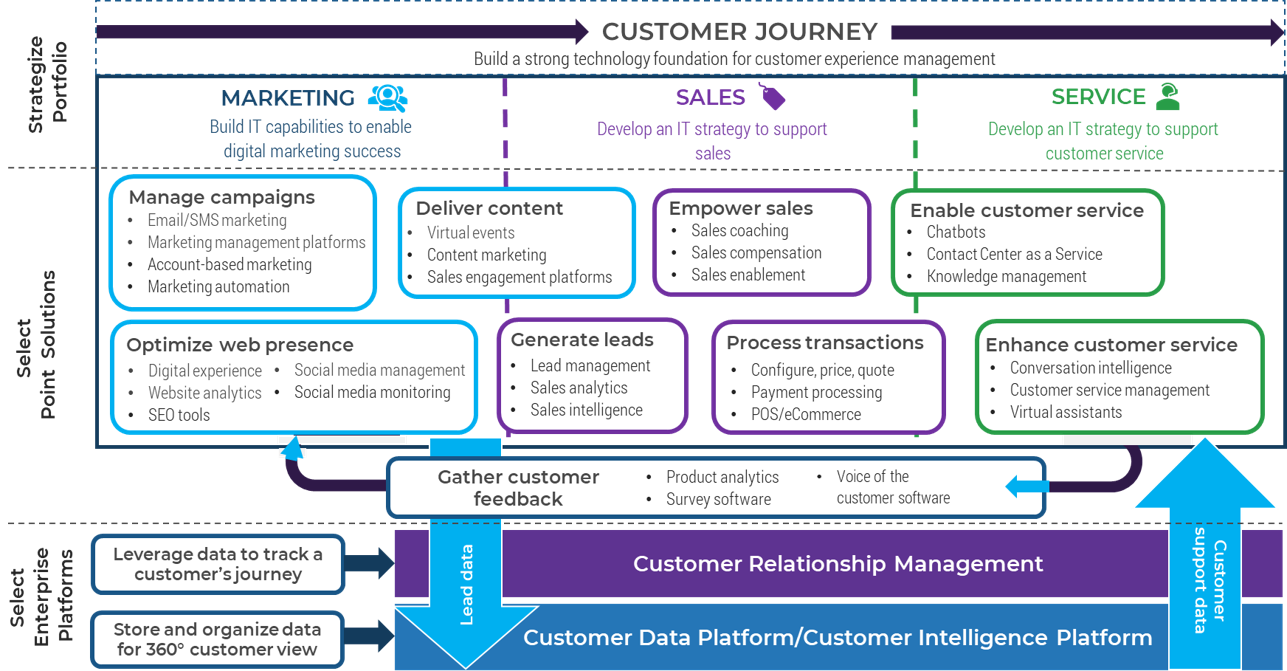
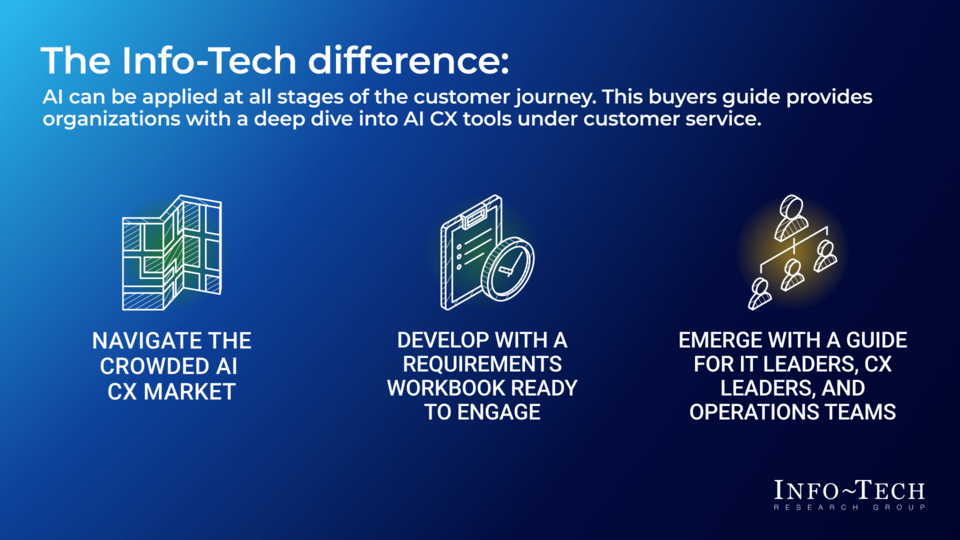
AI can be applied at all stages of the customer journey. To focus, this buyers guide provides organizations a deep dive into AI CX tools under customer service.
The Info-Tech difference:
- This buyer’s guide will help you navigate the crowded AI CX market, understand key trends, explore common use cases, and identify the features that truly differentiate solutions.
- You will emerge with a requirements workbook ready to engage with leading vendors to find the best fit for your organization’s knowledge goals, technical requirements, and user needs.
- The guide is designed for IT leaders, CX leaders, operations teams looking to enhance their customer support technology stack.
Info-Tech’s methodology for selecting the right AI CX solution
1. Contextualize the Vendor Landscape | 2. Select the Right AI Vendor | |
Phase Steps |
|
|
Phase Outcomes |
|
|
Info-Tech Insight
In a hurry? Save time by leveraging a lean RFP. A Lean RFP is just that – a very lean or light RFP that includes the constructs of an RFI while keeping the competitive advantages of negotiating an RFP.
Insight summary
Overarching insight
As AI transforms the CX landscape, the real competitive advantage is choosing tools that make every customer feel acknowledged, not processed. The standout players in this space orchestrate trust, emotion, and memory at scale. In an era where AI can mimic the human touch of personalization, success comes from blending machine intelligence with organic human-context so customer experiences feel intentional and not manufactured.
Phase 1 Insight
While AI can be applied to numerous business processes, organizations that prioritize customer experience often see strong returns. Companies that invest in AI CX solutions report significant improvements in customer retention, satisfaction, and revenue. In addition to streamlining interactions, AI enables predictive analytics that anticipate customer behavior, optimize lead scoring, and surface emerging trends, which allows businesses to tailor their outreach and services to their customers’ future needs with greater precision.
Phase 1 Insight
As businesses increasingly recognize the critical role of AI in CX, the adoption of AI CX tools, particularly the ones that focus on improving customer service, are set to dramatically increase across all industries. These tools, which are becoming indispensable for creating personalized customer experiences, will allow businesses to future proof their operations, adapt to market changes, and maintain their competitive position.
Phase 2 Insight
Organizations that adopt AI because of its novelty factor often neglect to properly align the solution with their specific use cases, making it difficult to establish clear metrics for success. This guide offers a structured approach to clarify key outcomes, helping organizations fully capitalize on their AI CX investments and enhance the services delivered to their clients.
Tactical insight
Relevant, accessible, and updated data is an absolute necessity for AI in CX. Ensuring that the proper resources are allocated to data governance and integration allows organizations to effectively use AI models to deliver more accurate, contextual insights that will enhance the customer experience.
Tactical insight
Governance, risk, and compliance (GRC) concerns must always be present when using AI to improve customer experience. Organizations should establish transparent acceptable use policies (AUPs) that define how AI tools manage customer data, ensure regulatory compliance, and embed ethical safeguards, especially in public- or constituent-facing environments.
Buyers guide deliverables
Key deliverable:
Requirements Workbook
This workbook will help you clearly define what your organization needs from an AI customer experience solution based on real use cases, not just features. It streamlines vendor conversations and improves evaluation consistency.
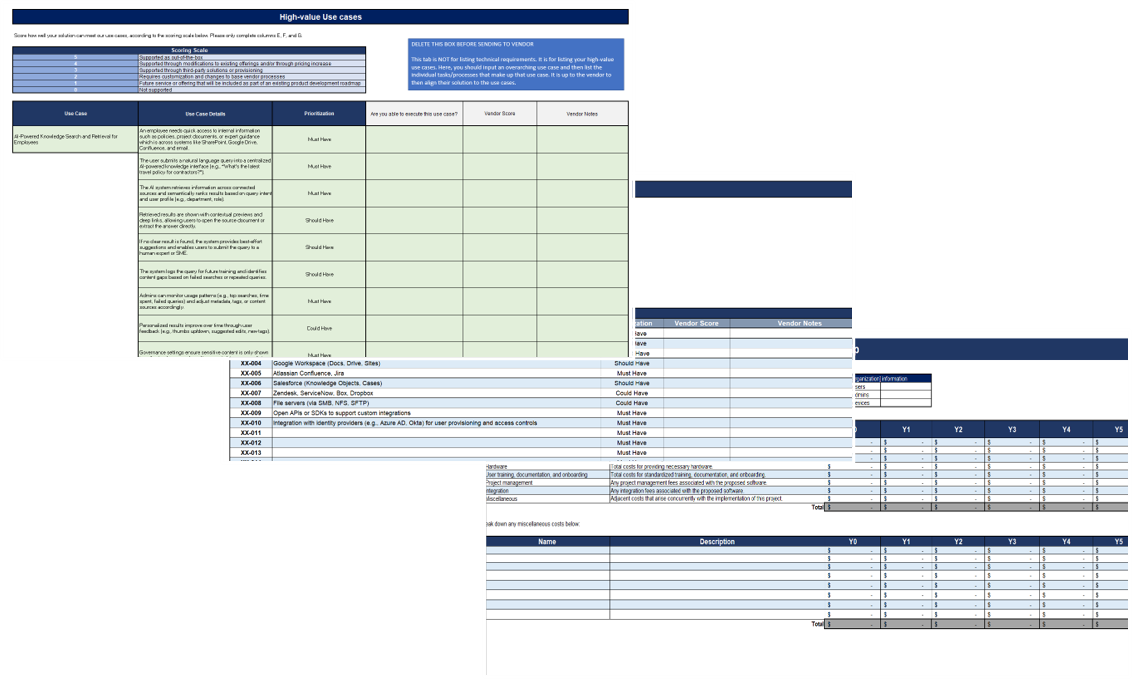
Each step of this blueprint is accompanied by supporting deliverables to help you accomplish your goals:
Demo Script
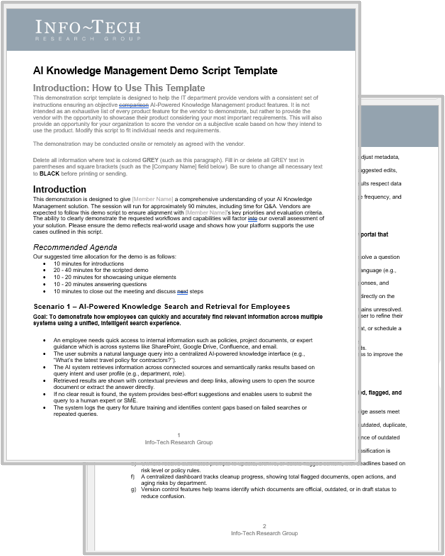
This demo script will ensure vendors demonstrate the CX capabilities that matter most to your organization, aligned to your top use cases. It keeps demos focused, comparable, and relevant so you can evaluate CX solutions based on how well they meet real-world needs, not just polished presentations.
This buyers guide simplifies informed AI CX software decisions for IT and business
IT Benefits
- Improved Decision-Making: Helps IT teams make more informed decisions about adopting AI tools and technologies for CX.
- Simplified Solution Selection: Simplifies the process of choosing a solution by converting business requirements into well-organized technical specifications.
- IT Alignment: Identifies integration points and compliance requirements to support alignment with IT architecture.
- Future-Proofing: Help IT future-proof the organization through the selection of a scalable and adaptable IT solution.
Business Benefits
- Optimized Investments: Aligns AI investments with business goals to maximize returns.
- Simplified Decision-Making: Provides a clear framework for evaluating solutions and vendors, streamlining the decision-making process.
- Business Relevance: Grounds evaluations in real-world use cases and challenges to ensure practical applicability.
- Cross-Functional Alignment: Enhances alignment among business stakeholders, CX managers, and IT teams.
- Improved Competitive Advantage: Leverages AI strategies to enhance customer experience and gain a competitive edge.
Measure the value of this research
Are the success factors below relevant to your organization?
Success Factor | Potential Metric(s) | Example Target |
Deliver expected business outcomes |
|
|
Develop confidence in the early stages of the AI journey |
|
|
Assure yourself your approach is the right one |
|
|
Develop detailed qualification criteria |
|
|
Minimize unanticipated costs |
|
|
Deliver AI solutions on time |
|
|
Executive brief case study

INDUSTRY: Electronics | SOURCE: NiCE
Sony Electronics uses NiCE to enhance CX by refining customer support and self-service options.
Challenge
Sony Electronics, a global leader in consumer and professional electronics, experienced difficulties in managing their customer interactions. Customers frequently struggled to reach the appropriate division in both pre- and post-sales services. The delays led to heightened customer dissatisfaction and increased operational costs as live agents often dealt with incorrectly routed calls. Additionally, by using spreadsheets to manually compile customer feedback, it made it difficult to track interactions, understand customer feedback, and identify where the customer experience could be improved.
Solution
Sony partnered with NiCE to enhance contact center experience with CXone, which enables the integration of calls, chat, and SMS into a unified experience. CXone’s tools were also used to improve Sony’s response rates. To improve the digital experience, Sony used NiCE’s Enlighten XO to analyze 60,000 customer interactions, identifying 40% of inquiries suitable for automation. These insights allowed Sony to use NiCE’s Enlighten Autopilot to become more efficient at handling customer queries while routing the others to appropriate agents.
Results
Sony's adoption of NiCE's solutions led to significant improvements with their customer experience. Sony has now been able to contain a minimum of 15.9% of its contacts within Autopilot and its self-serve options, which has improved routing and efficiency. Through leveraging NiCE’s solutions, Sony’s response rates and workflows have increased significantly, and overall customer satisfaction and overall omnichannel customer experience has been enhanced. With its continued partnership with NiCE, Sony plans to further improve the customer experience and explore better self-service solutions.
Executive brief case study

INDUSTRY: Healthcare | SOURCE: HubSpot
Santagostino uses HubSpot to consolidate communication channels and improve CX.
Challenge
Santagostino, a healthcare company specializing in telemedicine services, previously encountered difficulties with fragmented communication channels and an inefficient marketing automation platform. To address the silo-based communication channels, the company aimed to enhance its services by adopting a more structured and unified approach to improve the overall customer experience.
Solution
HubSpot offers comprehensive solutions to enhance the customer experience by consolidating multiple communication channels into a unified, omnichannel approach. Their tools can be used for lead generation, paid marketing campaigns driven by detailed data analysis, and customer retention activities.
HubSpot’s platform also ensures GDPR compliance and robust data management, providing scalability and adaptability to meet evolving business needs.
Results
By leveraging HubSpot’s platform, Santagostino transitioned from a multichannel system to an omnichannel approach, integrating online and offline interactions to create a seamless and personalized journey for patients. Adopting HubSpot also enabled Santagostino to significantly expand its customer base, leading to increased bookings and improved engagement.
Info-Tech offers various levels of support to best suit your needs
DIY Toolkit | Guided Implementation | Workshop | Executive & Technical Counseling | Consulting |
| “Our team has already made this critical project a priority, and we have the time and capability, but some guidance along the way would be helpful.” | “Our team knows that we need to fix a process, but we need assistance to determine where to focus. Some check-ins along the way would help keep us on track.” | “We need to hit the ground running and get this project kicked off immediately. Our team has the ability to take this over once we get a framework and strategy in place.” | “Our team and proceses are maturing; however, to expedite the journey we'll need a seasoned practitioner to coach and validate approaches, deliverables, and opportunities.” | “Our team does not have the time or the knowledge to take this project on. We need assistance through the entirety of this project.” |
Diagnostics and consistent frameworks are used throughout all five options. | ||||
Guided Implementation
A Guided Implementation (GI) is a series of calls with an Info-Tech analyst to help implement our best practices in your organization.
The AI software selection process should be broken into segments:
- Vendor shortlisting with this buyer’s guide
- Procuring via the Rapid Application Selection Framework
- Leveraging Info-Tech’s Contract Review Services
What does a typical GI on this topic look like?
Phase 1 | Phase 2 |
| Call #1: Discover what AI tools are right for your organization. Understand what software is and discover the “art of the possible.” Call #2: Identify right-sized vendors and build the business case to select an AI off-the-shelf SaaS provider. | Call #3: Define your key requirements. Call #4: Build procurement items, such as a requirements workbook and demo script. Call #5: Evaluate vendors and perform final due diligence. |
About Info-Tech
Info-Tech Research Group is the world’s fastest-growing information technology research and advisory company, proudly serving over 30,000 IT professionals.
We produce unbiased and highly relevant research to help CIOs and IT leaders make strategic, timely, and well-informed decisions. We partner closely with IT teams to provide everything they need, from actionable tools to analyst guidance, ensuring they deliver measurable results for their organizations.
What Is a Blueprint?
A blueprint is designed to be a roadmap, containing a methodology and the tools and templates you need to solve your IT problems.
Each blueprint can be accompanied by a Guided Implementation that provides you access to our world-class analysts to help you get through the project.
Need Extra Help?
Speak With An Analyst
Get the help you need in this 2-phase advisory process. You'll receive multiple touchpoints with our researchers, all included in your membership.
Guided Implementation 1: Contextualizing the AI CX Market
- Call 1: Discover what AI tools are right for your organization. Understand what software is and discover the “art of the possible.”
- Call 2: Identify right-sized vendors and build the business case to select an AI off-the-shelf SaaS provider.
Guided Implementation 2: Select the Right AI CX Vendor
- Call 1: Define your key requirements.
- Call 2: Build procurement items, such as a requirements workbook and demo script.
- Call 3: Evaluate vendors and perform final due diligence.
Contributors
- Thomas Randall, Research Lead, Info-Tech Research Group
- Yaz Palanichamy, Senior Advisory Analyst, Info-Tech Research Group
- Ryan Brunet, Principal Research Director, Info-Tech Research Group
- Hriday Gulrajani, Senior Research Analyst, Info-Tech Research Group
