
Build a Strategy for Big Data Platforms
Big Data; let's talk about the elephant in the room.
- The immaturity of the big data market means that organizations lack examples and best practices to follow, and they are often left trailblazing their own paths.
- Experienced and knowledgeable big data professionals are limited and without creative resourcing; IT might struggle to fill big data positions.
- The term NoSQL has become a catch-all phrase for big data technologies; however, the technologies falling under the umbrella of NoSQL are disparate and often misunderstood. Organizations are at risk of adopting incorrect technologies if they don’t take the time to learn the jargon.
Our Advice
Critical Insight
- NoSQL plays a key role in the emergence of the big data market, but it has not made relational databases outdated. Successful big data strategies can be conducted using SQL, NoSQL, or a combination of the two.
- Assign a Data Architect to oversee your initiative. Hire or dedicate someone who has the ability to develop both a short-term and long-term vision and that has hands-on experience with data management, mining and modeling. You will still need someone (like a database administrator) who understands the database, the schemas, and the structure.
- Understand your data before you attempt to use it. Take a master data management approach to ensure there are rules and standards for managing your enterprise’s data, and take extra caution when integrating external sources.
Impact and Result
- Assess whether SQL, NoSQL, or a combination of both technologies will provide you with the appropriate capabilities to achieve your business objectives and gain value from your data.
- Form a Big Data Team to bring together IT and the business in order to leave a successful initiative.
- Conduct ongoing training with your personnel to ensure up-to-date skills and end-user understanding.
- Frequently scan the big data market space to identify new technologies and opportunities to help optimize your big data strategy.

About Info-Tech
Info-Tech Research Group is the world’s fastest-growing information technology research and advisory company, proudly serving over 30,000 IT professionals.
We produce unbiased and highly relevant research to help CIOs and IT leaders make strategic, timely, and well-informed decisions. We partner closely with IT teams to provide everything they need, from actionable tools to analyst guidance, ensuring they deliver measurable results for their organizations.
What Is a Blueprint?
A blueprint is designed to be a roadmap, containing a methodology and the tools and templates you need to solve your IT problems.
Each blueprint can be accompanied by a Guided Implementation that provides you access to our world-class analysts to help you get through the project.
 Determine When You Should Use Synthetic Data
 Build a Data Warehouse
 Leverage Big Data by Starting Small
 Architect Your Big Data Environment
 Beyond Survival
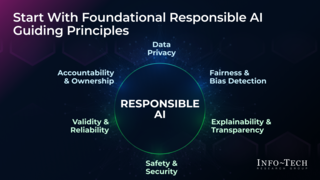 Prepare for AI Regulation
 Building Info-Tech’s Chatbot
 An Operational Framework for Rolling Out AI
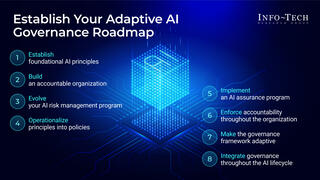 Establish Your Adaptive AI Governance Program: From Principles to Practice