Our systems detected an issue with your IP. If you think this is an error please submit your concerns via our contact form.
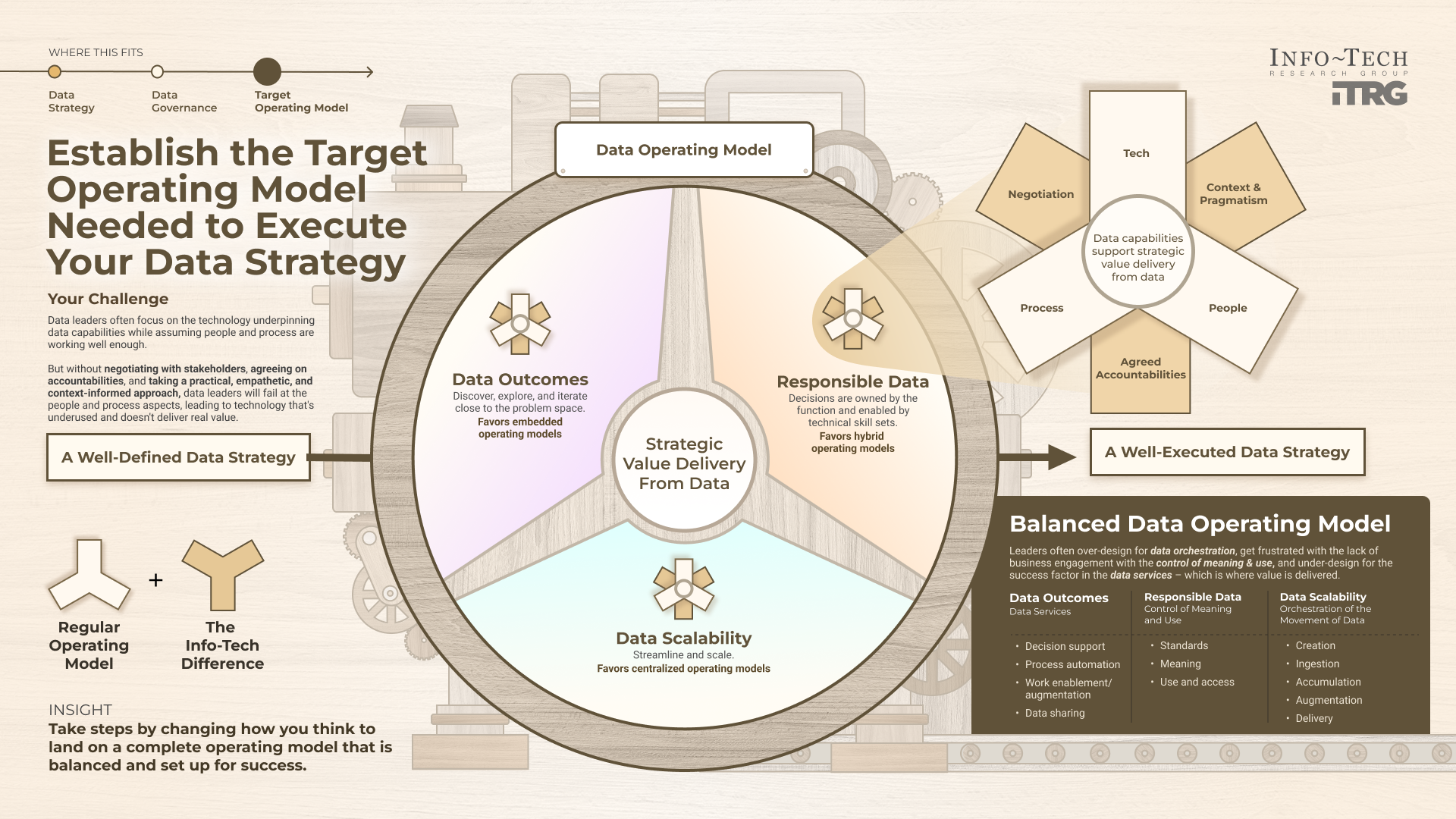
Establish the Target Operating Model Needed to Execute Your Data Strategy
Engineer a data management model that is co-owned, co-designed, and strategically aligned.
In the age of AI, a tailored data strategy is essential – but without the right operating model, even the best strategy will stall. Because data is owned and used by the entire organization, Data leaders must understand and engage with their organization’s internal dynamics and key stakeholders to ensure their operating model and data management capabilities are unique to their needs and effective. Our comprehensive framework will support that relational approach to enable an effective, value-driven data strategy.
Your data, the systems that support it, and the way it drives outcomes each require tailored approaches from different stakeholders – not one-size-fits-all frameworks that inevitably miss the mark. Data leaders must co-design a target operating model in partnership with those stakeholders – one that aligns decisions with those who own the outcomes, secures executive funding, and can stay agile in the face of constant change.
1. Check yourself.
Though IT leaders can feel like they are plugged into their organizations, in practice they often over rely on passive communication and siloed execution. Check in on your partners and stakeholders to ensure everyone is working together on the right things.
2. Don’t lose sight of context.
Many IT leaders fall back on leveraging generic frameworks that emphasize data management capability maturity, but without relating your target operating model to desired organizational outcomes, momentum can stall and what you build may not be what you need. Be sure to actively work to understand the context around your target operating model.
3. Simplify, simplify.
The process of developing your target operating model is just as critical as the model itself. Ensure your communication with stakeholders and partners is as simple as possible to ensure your operating model has the sustainable and agile foundations it needs to drive desired outcomes.
Use this step-by-step blueprint to engage with stakeholders to build a fit-for-purpose target operating model
Our research provides the templates, workbooks, and guides to navigate the dynamics of data operating model design. Follow this step-by-step framework to unite stakeholders in co-creating a target operating model that drives a data strategy unique to your organization.
- Deconstruct and assess capabilities vs. outcomes to visualize a target operating model, link its data management capabilities to strategic outcomes, and identify gaps to close.
- Draft your roadmap and plan your engagement strategy to define your service imperatives and scope of accountabilities and build an actionable roadmap to achieve them.
- Design the operating model with your strategy’s co-owners to ensure the model, key operational shifts, and RAID log are stakeholder-aligned.
- Communicate and secure endorsement for next steps to ensure executive buy-in for your target operating model and key operational shifts.




Research & Tools
1. Establish the Target Operating Model Needed to Execute Your Data Strategy Deck – A comprehensive framework that will plot out your approach to building a fit-for-purpose operating model.
Use this relationship-based blueprint to build an operating model that will deliver a unique, value-driven data strategy.
- Understand the challenges, obstacles, and recommended approaches to establishing your target data operating model.
- Encounter actionable insights to inform your approach to building your model.
- Benefit from multi-stage guidance on negotiating with stakeholders to co-design the right model for your organization.
2. Critical Data Management Capabilities Assessment – A methodical tool to assess your current and target data capability levels.
Use this tool to pinpoint the gaps between your current and target state.
- Conduct a line-by-line review of your data management capabilities and needs.
- Deliver a detailed analysis of your capability gaps.
- Obtain detailed, scored reports to identify and prioritize action areas.
3. Data Operating Model and Program Roadmap C-Suite Presentation Template – A customizable slide deck to document and articulate your plan.
Use this executive-facing presentation template to secure buy-in with a clear, outcome-linked narrative.
- Clearly express every step of your target operating model and data program plan.
- Relate your plan to your organization’s ultimate data strategy and outline its value delivery.
- Outline key asks and next steps to keep the process moving.
4. Target Operating Model Conversation Guide – A customizable guide to tailor your communications with each co-owner of your target operating model.
Use this conversation guide to navigate high-stakes stakeholder negotiations with clarity and confidence.
- Choose from one of three context-specific conversation templates.
- Prioritize and build an agenda for each conversation.
- Include customizable visuals for individual stakeholders.
5. Target Operating Model Workbook – A comprehensive tool to define your organization’s optimal data operating model.
Use this workbook to capture all decisions, accountabilities, and shifts in a visual, actionable format.
- Define the relationship between critical data management capabilities and your strategic data initiatives.
- Plan conversations with key stakeholders based on their relationship to your strategic objectives.
- Generate a summarized, visual representation of the shifts required to realize your operating model.
Member Testimonials
After each Info-Tech experience, we ask our members to quantify the real-time savings, monetary impact, and project improvements our research helped them achieve. See our top member experiences for this blueprint and what our clients have to say.
9.8/10
Overall Impact
$17,024
Average $ Saved
30
Average Days Saved

Info-Tech Academy
Data Management
At the end of this course, you will be able to design a data management practice that will allow your organization to use data as a strategic enabler.
- Number of Course Modules:
- 4
- Estimated Completion Time:
- 1 hour 20 minutes
Learning Outcome
At the end of this course, you will be able to design a data management practice that will allow your organization to use data as a strategic enabler.
Learning Objectives
- Align data management plans with business requirements and strategic plans.
- Create a collaborative plan that unites IT and the business in managing the organization’s data assets.
- Design a data management program that scales and evolves over time.
- Develop a data strategy and incorporate data capabilities into broader plans
All of our Info-Tech Academy courses have closed captioning available. To turn this function on, click on the C.C. in the bottom right corner of the video screen and click "English" on the options that pop-up.
An active membership is required to access Info-Tech Academy.
Establish the Target Operating Model Needed to Execute Your Data Strategy
Engineer a model that is co-owned, codesigned, and strategically aligned.
Analyst perspective
Be relevant, not mature.

|

|
|
Nysa Evagelinos |
Stephen Willis |
Leaders make three big mistakes when designing data operating models:
They design a model without a strategy. Designing an operating model without a strategy is like designing an engine before you know what it's supposed to power. Sure – it'll feel like you are doing something, but when you bring it to the business and ask them to use it, the first question they will ask is "what's this for?"
Our methodology roots your operating model design directly within your organization's strategy – ensuring you are designing the right model to get the right results.
They get the balance wrong. There are three critical dimensions to data operating models – capabilities that ensure data can be trusted, capabilities that ensure that data is available, and capabilities that ensure data drives tangible value. Leaders and organizations focus on one area to the detriment of the others and end up limping.
Our methodology focuses your thinking and ensures that you are balancing these critical areas of investment into data.
They design in a silo and don't negotiate. Data isn't managed by the data team. It is produced, used, managed, and exploited by every team in your organization. All teams have accountabilities over data. Data operating model design is about figuring out where accountabilities should sit to best deliver your organization's strategy. You cannot decide and dictate this on your own from the comfort of your office and expect others to comply. You must negotiate, directly.
Our methodology arms you with the relationship-forward approach that will lead you to design a data operating model that will get funded, drive value, and be resilient in the face of change.
Executive summary
Your Challenge
Data leaders must define an operating model that:
- Clearly outlines the flow of operations and how different functional areas will work together to meet the strategic goals defined in the data strategy.
- Defines which data capabilities are a priority for meeting strategic goals and the extent to which they must be developed.
- Actively services key stakeholders in meeting their strategic goals while balancing delivery of tactical workloads.
The model must be one that enables strategic outcomes, has sustained stakeholder buy-in, and receives the funding it requires, while maintaining flexibility to adapt to business change.
Common Obstacles
Leaders turn to frameworks that do not serve them
- In attempting to drive capability excellence, leaders turn to common maturity frameworks to assess their performance relative to "industry best practice." These frameworks lack organizational relevance, overrepresent management tasks to the detriment of value delivery, and leave leaders with a list of things to do with little to no strategic justification.
Leaders under-design core operational spaces
- In facing the complexity of the data space, leaders design for technology, often believing that scale and technical design excellence are the primary enablers of value.
Collaboration is challenging when negotiation points are unclear
- Teams often jump from strategy to execution, neglecting the negotiation on accountabilities and ways of working. This results in misalignment, lack of ownership, and ultimately, failed initiatives.
Info-Tech's Approach
Don't struggle to define and visualize the data operating model:
- Conduct focused negotiation discussions with co-owners of your organization's strategy, and align on the right choices for your context.
- Set the stage for data service implementation plans – what will be built, how it will be sustained, and the cross-organizational accountabilities that will shepherd continuous improvement over time.
- Understand the principles that drive success in different data capabilities, and the implications this has for your operating model design.
- Build a model informed by constant, real-world dynamics, developed through collaborative choices, and sustained through shared views of accountabilities and common goals.
Info-Tech Insight
Establishing the right target operating model (TOM) requires you to focus less on selecting the perfect operating model. What matters most is ensuring you're balancing three core success dynamics through direct, intentional collaboration with your organization's leaders. Many leaders believe they've mastered the balance between competing levers, but often they haven't. They tend to over-engineer data orchestration, become disheartened by limited business engagement with the meaning and use of data, and under-design collaboration in the data services – the only layer that delivers tangible value. Understand the dynamics your operating model needs to solve for and the conversations you need to have to align on a choice of operating model that has the foundations it needs to be funded, be sustained, be agile, and drive value.
Your challenge
This research is designed for data leaders who want to understand how to think through the dynamics that matter – not just the steps to follow.
- "Operating Model" is often dismissed as a consulting buzzword. Leaders leapfrog the process of assessing and (re)designing it, skipping from strategy to execution – but they hit a wall when their way of working (i.e. their operating model) gets in the way of execution efforts.
- Existing guidance on operating models describe "what is it" (variations of people, process, technology), archetypes (variations of "hybrid," "embedded," "centralized") and "the things you need to do" (plan, train, shift), but they don't help you think through the problems you need to solve for with data – why data causes these problems and the role your operating models plays in exacerbating or resolving for these challenges.
- The pace of change within the data space is overwhelming. Trending capabilities shift and become obsolete, making catching up seem nearly impossible. You need a stable and flexible mental framework to help you assess your problems and options that is grounded in stable realities around who is best skilled to make certain types of decisions, what problems technology can solve and what problems it cannot solve, and what core dynamics you must solve for over time to continue your path to success.
The biggest challenge CDOs face is how to drive value from data, and the biggest design challenge they face is meaningful organizational engagement. But many data leaders try and design their operating model in their office with the door closed. You can't fix an engagement problem unless you engage.
94% of business leaders believe they should be getting even more value from their data
Source: Salesforce State of Data and Analytics, 2023
Common obstacles
These barriers make this challenge difficult to address for many organizations:
- The pressure for rapid delivery often leaves little room for thoughtful reflection or strategic alignment.
- A constant influx of directives from vendors and consulting firms sets an external pace that can overwhelm internal priorities.
- Concepts like maturity models and capability frameworks can lead teams into complexity without clarity.
- There is often an over-reliance on executive sponsorship, which can stall progress if not paired with distributed ownership.
- Problems are frequently misdiagnosed as literacy issues when the root causes lie elsewhere.
- Teams may lack confidence in translating data capabilities into business-relevant language, making it harder to gain traction with stakeholders.
The pace of transformation within the data space is challenging even the most seasoned leaders
39% of leaders struggle to keep pace with rapidly evolving tools and tech.
Source: Enterprise Strategy Group, 2023
42% struggle with optimize spend to drive end results.
Source: Enterprise Strategy Group, 2023
Insight summary
|
Check yourself |
Leaders often feel they're partnering with the business, but in practice, they may be relying on passive communication and siloed execution of operating model decisions – speaking "at" rather than negotiating "with." This is partly because it's unclear what should be negotiated – what are the terms of the partnership? |
|---|---|
|
Obsessively aim to understand context |
Faced with this ambiguity, many leaders default to leveraging generic frameworks that emphasize capability maturity. They find that these capability maturity models offer a vision of progress but no context, and do not help them make the prioritization decisions they need to make. Some may invest in capability maturation, but devoid of specific organizational outcomes, funding and momentum dry out, and progress appears nonexistent to the business. Some diagnose this as a "data literacy" problem at the business level, but we argue it's a critical gap in data leader translation of how capabilities drive value at the line of business/functional service area and the core choices that lead to success. |
|
Simplify your thought model, your words, and your asks |
The process of developing a target operating model – through active dialogue, negotiation, and alignment – is just as critical as the model itself. Data leaders who recognize this also understand that success comes from solving for three essential dynamics, not hundreds of disconnected choices. A strong operating model balances these dynamics in a way that reflects the organization's culture, goals, and structure. These dynamics are universal – whether you're enabling self-serve reporting or deploying advanced AI solutions. These are the dynamics we will help you understand – we will help you deconstruct the conversations you need to have to align on a confident choice of operating model that has the foundations it needs to be funded, be sustained, be agile, and drive outcomes. |
The data value trinity
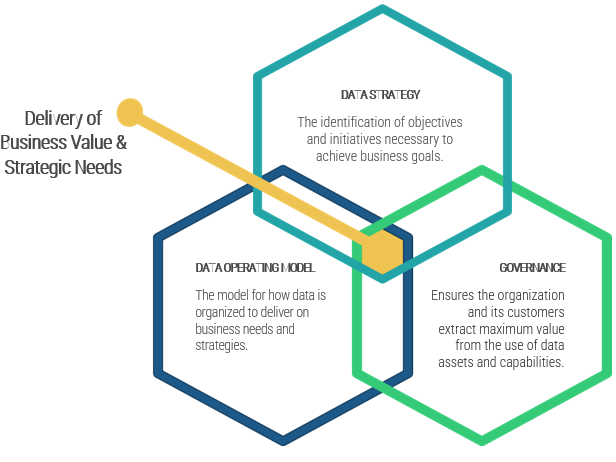
All three elements of the data value trinity work in harmony to delivery business value and achieve strategic needs. As one changes, the others need to change as well.
How do these three elements relate?
- Data strategy tells you what you need to achieve to be successful.
- Data operating model aligns resources, processes, measures, stakeholders, value streams, and decision rights to enable the delivery of your strategy and priorities. This is done by strategically structuring data capabilities in a way that enables the organization's vision and considers the context in which the model will operate.
- Governance is the confirmation of goals and strategy, which ensures the alignment of data initiatives and business strategy and is the mechanism by which you continuously prioritize work to ensure that what is delivered is in line with the strategy.
Too often strategy, operating models, and governance are considered separate practices – strategies are defined without clarity on how to support them. A significant change to your strategy necessitates a change to your operating model, which in turn necessitates a change to your governance and organizational structure.
Target Operating Model 101
If the strategy is "what," the operating model is "how."
- A data operating model is a visual representation of the way your organization will function using a clear and coherent blueprint. This visualization demonstrates how capabilities are organized and aligned to deliver on the business mission, strategic objectives, and technological objectives. It represents a series of decisions around ownership of people, process, technology, and ultimately, outcomes.
- Additionally, it should clearly describe the flow of work so that key stakeholders can understand where teams are accountable for data inputs and outputs. Investing time in the front end to get the operating model right is critical. This will give you a framework to rationalize future organizational changes, allowing you to be more iterative and your model to change as the business changes.
Operating models translate data ambition into execution.
- Access to data
- Time to insights
- Quality and Accuracy
- Agility and Responsiveness
- Compliance
Adapted From: Enterprise Strategy Group, 2023.
Target Operating Model Archetypes 101
Leverage common archetypes to express patterns of ownership.
Centralized
Capabilities are owned and operated by leadership within data. The data organization takes full responsibility of the functional areas and maintains control over the outcomes.
Hybrid
Capabilities are owned and operated by a variety of leadership roles throughout the organization. This can shift from data team ownership to other organization leadership. The decision of ownership is typically to enable speed of response or mitigate risks.
Embedded
Capabilities are owned and operated by leadership outside Data. Another area of the organization has taken authoritative power over the outcome of this functional area in order to respond quickly.
This content is exclusive to members.
Sign up to continue reading the full blueprint, or sign in if you already have an account.
Our systems detected an issue with your IP. If you think this is an error please submit your concerns via our contact form.