Our systems detected an issue with your IP. If you think this is an error please submit your concerns via our contact form.
Build Competitive Intelligence for Market Success
Competitive intelligence (CI) leaders can best deliver CI-influenced sales wins by arming sellers with up-to-date battlecards, product alignment, and a budget that supports success.
- Rapid technological advancements: Keeping up with the swift pace of tech innovation and emerging tools, frameworks, and methodologies.
- Diverse and fragmented competition: Monitoring numerous competitors, from startups to giants, including indirect players and potential entrants.
- Complex buying cycles: Understanding the multifaceted B2B sales cycle, competitor positioning, and post-sale customer relationship management.
- Data overload and quality: Managing vast data sources, ensuring relevancy, and maintaining data credibility amidst potential misinformation.
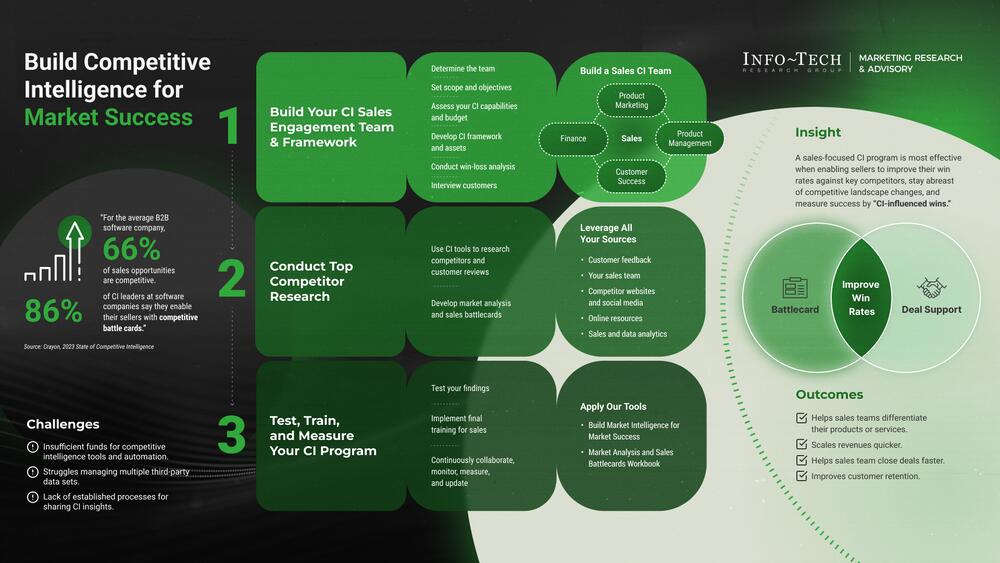
Our Advice
Critical Insight
- A sales-focused competitive intelligence program is most effective when enabling sellers to improve their win rates against key competitors, stay abreast of changes in the competitive landscape, and be measured by CI-influenced wins.
- A well-designed competitive intelligence program can help sales teams amplify your product and company capability strengths and overcome your weaknesses during sales interactions, making them more effective at winning deals over key competitors.
- To remove barriers in competitive intelligence, one must address the main challenge of inadequate executive support by educating stakeholders on CI benefits, ensuring resource acquisition, making reliable data source investments, fostering a collaborative culture, and maintaining ethical and legal compliance.
Impact and Result
This SoftwareReviews blueprint provides product management or a competitive intelligence team with guidance, tools, sample training agendas, and training output while measuring CI influence in competitive sales situations.
Sales CI is:
- Gathering and analyzing information about competitors, such as their products, pricing, marketing strategies, sales tactics, strengths, and weaknesses.
- Using insights gained from CI to inform sales strategy and tactics against key competitors. Outcomes include developing more effective messaging and positioning, identifying pricing and packaging opportunities, and handling competitive threats.
- Providing sales teams with intelligence on customer needs, preferences, and pain points relative to key competitors to help them tailor their competitive positioning to win more business.
- Creating a deep understanding of the competitive landscape to inform sales about new competitors as they emerge.
- Conducted ethically and within legal and regulatory boundaries.
Research & Tools
1. Build Competitive Intelligence for Market Success Storyboard – Research that shows how using product management can significantly increase win rates and measure the success of CI team funding from management.
By following the step-by-step process, you can learn how to compare the ranking of your product, brand, or company against top competitors using industry benchmarks and best practices.
2. Market Analysis and Battlecards Workbook – A detailed template to guide you in building a CI team to research and provide sales assets to help sales win in a competitive market.
This fully customizable, prebuilt PowerPoint presentation template documents the market analysis results and produces the sales battlecards.
3. Build Competitive Intelligence for Market Success Workbook – A tool to help you research and prioritize competitors and build CD sales data for output into battlecards.
This 12-tab Excel workbook will determine your competitors' strengths and weaknesses as they relate to your sales CI strategy and positioning. Develop competitive criteria, models, and data to help evaluate your desired sales opportunities to correctly position your company and products in your battlecards. The workbook includes budget, win/loss analysis, win/loss ROI, and customer interview questions as well as tracking and external reviews, market share, SWOT, and websites for research.
Member Testimonials
After each Info-Tech experience, we ask our members to quantify the real-time savings, monetary impact, and project improvements our research helped them achieve. See our top member experiences for this blueprint and what our clients have to say.
10.0/10
Overall Impact
$13,799
Average $ Saved
10
Average Days Saved
Build Competitive Intelligence for Market Success
Leverage strategic battlecards, product alignment, and resources.
Analyst perspective
Build Competitive Intelligence for Market Success
Standing out is a challenge. Constant venture funding and rapid development among start-ups and established companies mean offerings and features change constantly, making differentiation even harder.
With a dedicated CI team, sales teams can stay ahead of competitors. The cost is steep, often leading to lost deals and reduced revenue. But there's a straightforward solution: investing in a market- and sales-focused CI function.
By providing the right resources for competitive intelligence, companies can empower sales teams to make informed moves. CI teams that collaborate closely with sales, product management, and marketing can create effective tools like battlecards, gather relevant data, and design targeted seller support strategies — all to help boost win rates against key competitors.
Of course, there are challenges: keeping up with a changing competitive landscape, finding the right insights quickly, and building strong communications and support strategies. But when done right, the ROI is significant. Companies can turn competitive insights into a real advantage with a focused CI effort, improving win rates and driving growth.

Joanne Morin Correia
Principal Research Director, Marketing
Info-Tech Research Group
What is competitive intelligence?
Competitive Intelligence is:
- Gathering and analyzing information about competitors, such as their products, pricing, marketing strategies, sales tactics, strengths, and weaknesses.
- Using insights gained from CI to inform competitive sales strategy and tactics. Outcomes include developing more effective messaging and positioning, identifying pricing and packaging opportunities, and handling competitive threats.
- Providing sales teams with intelligence on customer needs, preferences, and pain points relative to key competitors to help them tailor their competitive positioning to win more business.
- Creating a deep understanding of the competitive landscape to inform sales about new and emerging competitors as they emerge.
- Conducting these practices ethically and within legal and regulatory boundaries.
Competitive Intelligence is not:
- The sole responsibility of sales teams. While sales teams are the primary users of CI for Sales, the process should be driven primarily by a dedicated CI function typically found within and highly collaborative with product marketing.
- About stealing trade secrets or engaging in unethical or illegal activities to gain an advantage over competitors.
- About providing tools for predicting sales outcomes or forecasting with certainty.
- A one-time activity. CI for Sales is an ongoing process that requires continuous data gathering and analysis to remain effective.
Info-Tech Insight
A well-designed competitive intelligence program can help sales teams amplify their products and company strengths and overcome their weaknesses during sales interactions, making them more effective at winning deals.
Executive Summary
| Pain Points | Obstacles | Info-Tech's Approach |
|
Limited CI resources, outdated data, and poor processes hinder informed decision-making, causing missed opportunities and lost revenues.
|
The inability to compete effectively results in stagnant sales growth, missed market and sales opportunities, challenges in attracting talent, partners, or future investors, and depreciation of company and brand value.
|
By ensuring that the CI function is resourced correctly and aligned with sales' strategic priorities, you can provide valuable insights into how to win against your competitors' products and services.
|
Info-Tech Insight
A sales-focused competitive intelligence program is most effective when enabling sellers to improve their win rates against key competitors, stay abreast of changes in the competitive landscape, and be measured by CI-influenced wins.
How does competitive intelligence help sales?
While CI can enable success within many important corporate functions, applications of CI that directly impact revenue are considered the most important.
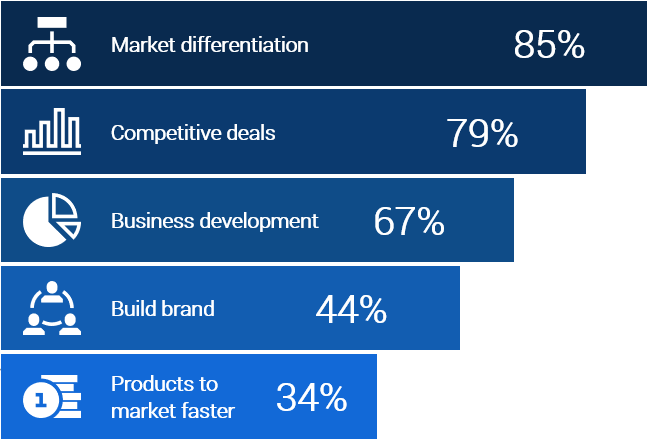
Source: Crayon, 2022
CI for sales:
- Equips sales teams with valuable knowledge about key competitors.
- Keeps sales up to date about the ever-changing competitive landscape.
- Identifies specific areas of competitive advantage, parity, and gaps.
- Empowers sellers to emphasize areas of competitive advantage and address objections related to gaps.
- Guides on how to tailor competitive pricing and solution packaging/bundling.
Leveraging competitive information allows sales professionals to improve win rates over key competitors.
Obstacles to successful CI implementations
Lack of executive support: Gaining buy-in and support from executives and key stakeholders is crucial for the success of a CI for sales program. If CI lacks value or relevance, it can be harder to secure the necessary resources, budget, and organizational alignment.
Limited resources and budget: Implementing a robust CI program requires dedicated resources, including personnel, technology, and research capabilities. Constraints can hinder the ability to gather comprehensive intelligence and support ongoing analysis and reporting.
Data quality and availability: CI relies on accurate, up-to-date information. It can be challenging to obtain reliable data from various sources and ensure its quality. Access to relevant market data, competitor information, and customer insights is required to generate actionable intelligence.
Resistance to change and cultural barriers: Implementing a CI for a sales program often requires a cultural shift within the organization. Some employees may resist change to adopt new processes and tools. Overcoming resistance, fostering collaboration, and promoting a CI-focused mindset throughout the sales team can be challenging.
Data privacy and ethical considerations: CI must adhere to ethical guidelines and comply with data privacy regulations. Balancing the need for competitive insights with ethical considerations and legal constraints can present challenges. Organizations must ensure their CI practices are conducted ethically and within legal boundaries.
Info-Tech Insight
To remove barriers in competitive intelligence, one must address the main challenge of inadequate executive support by educating stakeholders on CI benefits, ensuring resource acquisition, making reliable data source investments, fostering a collaborative culture, and maintaining ethical and legal compliance.
Problems of weak competitive intelligence
Misunderstanding
Difficulty in understanding the market:
Without comprehensive knowledge of competitors' products, pricing, and marketing tactics, CI leaders may struggle to understand the market's competitive landscape, making it challenging to develop effective positioning over key competitors and properly help the sales team improve win rates.
Inefficient resources
Allocation of marketing resources:
Without prioritizing which competitors and markets to focus on, CI leaders will be unable to size budget and resource needs to move the needle on improving win rates across all product markets and geographies.
Limited opportunities
Missed opportunities:
CI leaders with weak competitive intelligence will be surprised when new entrants or new products from existing competitors take deals away from sellers. This can lead to competitors gaining market share, resulting in lower revenue and profits for the company.
No differentiation
Inability to differentiate the company's products:
A lack of tight alignment between the CI function and product marketing and management can lead to generic marketing messages and a product and company that are undefined in the marketplace.
You can't afford to not invest in your CI team and resources
- A lack of a complete and commonsense CI program, team, and strategy is a considerable business risk to your company's success.
- CI research funding and resources are critical to have in place before the product is created or launched. If not, your ability to sell in the market is hampered.
- Sales representatives will make up information for clients; this considerably threatens your reputation and causes missed revenue opportunities.
- The market is changing fast, and without a modern CI program, there will be wasted dollars in other business areas to prop up weak CI and customer insights.
"Seventy-one percent of companies maintaining battlecards say these assets have helped them improve their win rate."
Source: Crayon, 2022
Build CI research to improve sales win rates
Our approach calls for the proper selection of competitors and research best practices to increase sales in a competitive win situation.
CI team plan and budget
Identify what CI resources are required to be put in place for a CI team to drive more wins in competitive selling situations
Win/loss analysis
Track win/loss rates against competitors to understand where there is a need for better CI sales enablement
SWOT analysis
Assess the strengths, weaknesses, opportunities, and threats in your organization's internal and external environments
Competitive company and product analysis
Compare competitors' strategy prices, contract types, and product attributes
Customer reviews
Organize customer reviews and competitive insights into sales battlecards
Diverse backgrounds and skills create stronger teams
The key is looking for a few core traits:
- Relentless researchers – Every member of your team needs to be curious and prepared to dig deep into the backlinks to find the information they crave.
- Conscious communicators – Competitive intelligence is a long game; your team must be okay with holding back information until they have the whole story. It would be best to have methodical people who won't jump to conclusions based on one bit of intel.
- Effective synthesis – Building a functional competitive intelligence system requires skilled writers who can synthesize vast amounts of data into concise and impactful memos. Without synthesizing research into meaningful insights, all the collected data becomes futile.
- Multidepartment experts – These experts should be proficient in comprehending the unique information that matters to each department and align with their core competencies, goals, and needs.
This content is exclusive to members.
Sign up to continue reading the full blueprint, or sign in if you already have an account.
Our systems detected an issue with your IP. If you think this is an error please submit your concerns via our contact form.