
Manage the Application Lifecycle
From birth to death, stay by your application's side.
- Applications exist in one of four lifecycle stages; to effectively operate each application, you must know to which stage it belongs.
- Each lifecycle stage presents unique challenges and unique questions that must be answered; to efficiently operate each application, you must know which question to answer.
- Failing to appropriately recognize the lifecycle stage for each application means the organization will ask the wrong questions to drive application functionality, and you will be unable to provide the right answers.
Our Advice
Critical Insight
- Organizations that predominantly purchase or rent solutions are more likely to deliver projects on time and on budget than those that create custom solutions.
- For more satisfied end users, and fewer changes over time, when making a significant change is necessary, opt for making changes to the application rather than the business process.
- Maximize stability and end-user satisfaction by applying at least half of the vendor imposed patches and version upgrades, and by making only the critical changes requested by the business.
- Retire an application if the business function no longer exists, the platform can no longer be supported by the existing infrastructure, or if vendor support is no longer available.
Impact and Result
- Reduce costs by determining your application’s position in the lifecycle, and then identifying which applications to invest in, when to invest in them, and when it is time to retire an application.
- Organizations that actively manage their applications lifecycle will save time and resources by getting out of the tweak, test and repeat cycle faster.
- Know which changes to the systems need to be made, and when to avoid making any changes at all. Avoiding unnecessary changes keeps applications more stable, resulting in greater satisfaction for both you and the business.

About Info-Tech
Info-Tech Research Group is the world’s fastest-growing information technology research and advisory company, proudly serving over 30,000 IT professionals.
We produce unbiased and highly relevant research to help CIOs and IT leaders make strategic, timely, and well-informed decisions. We partner closely with IT teams to provide everything they need, from actionable tools to analyst guidance, ensuring they deliver measurable results for their organizations.
What Is a Blueprint?
A blueprint is designed to be a roadmap, containing a methodology and the tools and templates you need to solve your IT problems.
Each blueprint can be accompanied by a Guided Implementation that provides you access to our world-class analysts to help you get through the project.
Contributors
- Independence First
- Pillar Administration
- Nutmeg Networks
- Freight Handlers Inc.
- Action on Hearing Loss
- County of Oxford
- Goodfellow Bros Inc.
- ETSA Utilities
- Wettenhalls Group
- Carodea Secretarial Trust
 Applications Priorities 2025
 Rationalize Your Application Portfolio
 Extend Agile Practices Beyond IT
 Integrate Portfolios to Create Exceptional Customer Value
 Automate Your Software Delivery Lifecycle
 Build Your BizDevOps Playbook
 Modernize Your Applications
 Embrace Business-Managed Applications
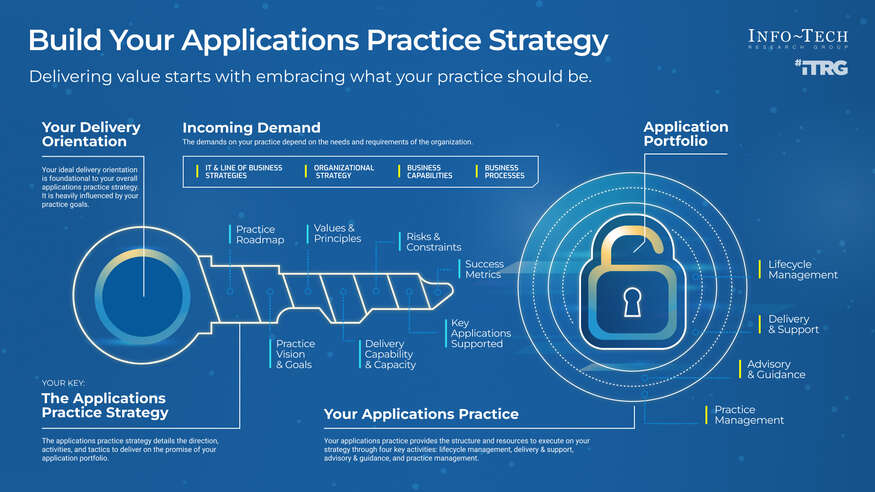 Build Your Applications Practice Strategy
 Review Your Application Strategy
 Assess the Value Drivers Within Your Solutions
 2020 Applications Priorities Report
 Applications Priorities 2022
 Make the Case for Product Delivery
 Satisfy Digital End Users With Low- and No-Code
 Select a Sourcing Partner for Your Development Team
 Applications Priorities 2023
 Make the Case for Enterprise Business Analysis
 Decide if You Are Ready for SAFe
 Adopt Generative AI in Solution Delivery
 Applications Priorities 2024
 Build Your Exponential IT Product Practice
 Insights Into Software Selection 2025
 Stay Relevant in the Era of AI-Powered Search
 Transform IT, Transform Everything
 Building Info-Tech’s Chatbot
 Assessing the AI Ecosystem
 Building the Road to Governing Digital Intelligence
 Bring AI Out of the Shadows
 The AI Vendor Landscape in IT
 An Operational Framework for Rolling Out AI
 Applications Priorities 2026
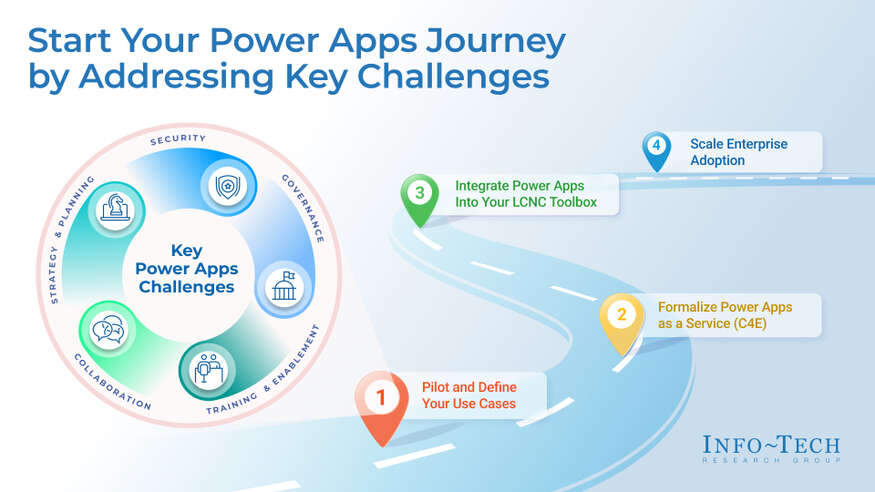 Develop a Plan to Overcome Your Microsoft Power Apps Challenges